Introduction to Bitcoin Nodes
Bitcoin is called “money without trust,” but in reality most people still end up trusting someone else—wallet providers, exchanges, or random servers—to tell them what’s going on with their own money.
A Bitcoin node changes that completely.
It’s not something flashy, and it won’t make you rich. It’s just your own copy of the Bitcoin network running on your machine, checking every rule for yourself, without asking anyone for permission or confirmation.
At that point, Bitcoin stops being something you use through others… and starts becoming something you verify and control directly.
It is a tool for verifying truth independently.
“Is this correct?”
and start confirming it yourself.
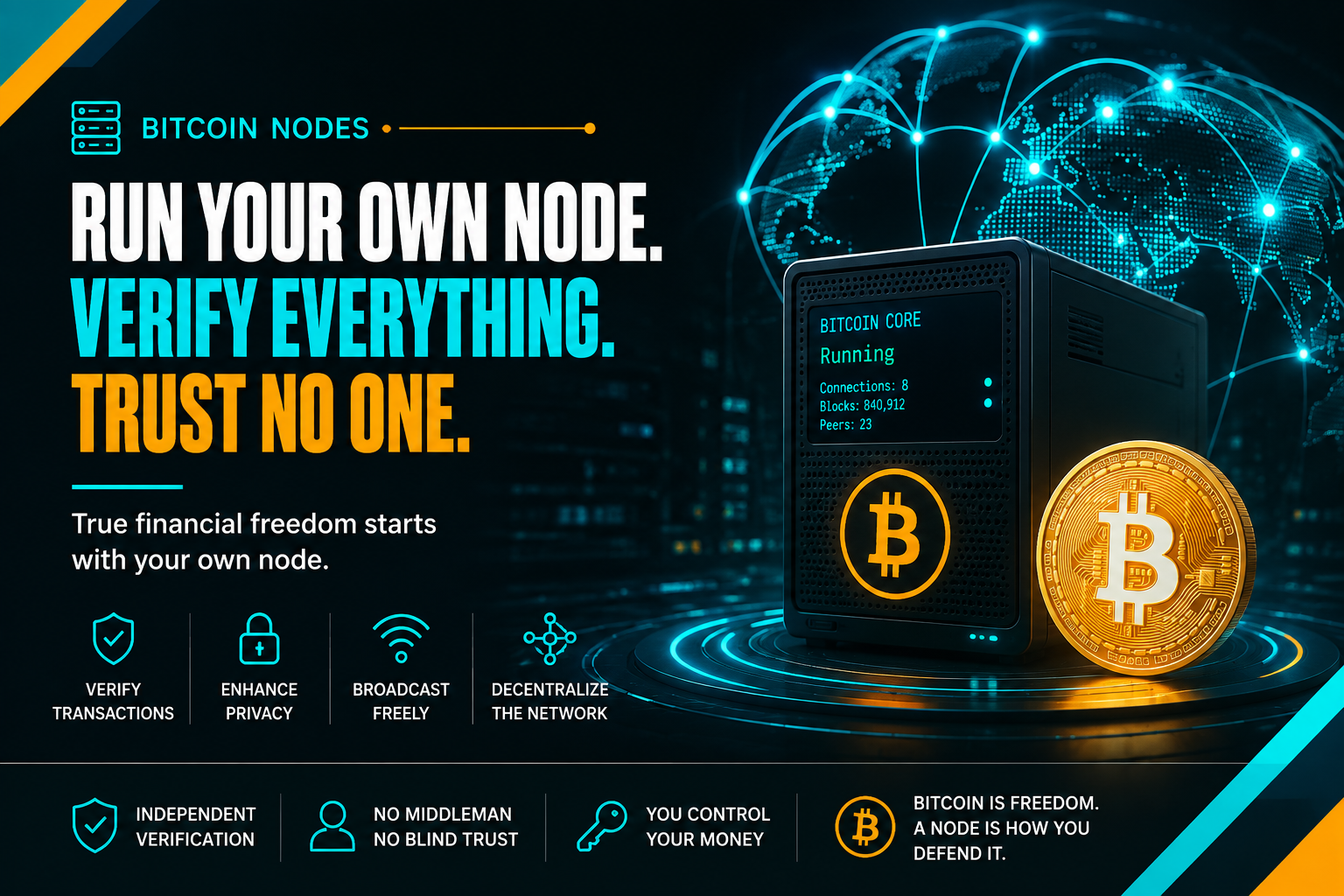
No node → trust others
Your node → trust the rules only
What Is a Bitcoin Node and How Does It Work?
A Bitcoin node is simply a computer running Bitcoin software—most commonly Bitcoin Core, but there are also alternatives like Bitcoin Knots and other compatible implementations. When you run this software, your computer downloads and stores a full copy of the Bitcoin blockchain, which is the complete history of every transaction ever made on the network. But storage is only part of the job.
How Bitcoin Nodes Secure the Bitcoin Network
The most important role of a Bitcoin node is validation. Your node checks:
-
Every transaction against Bitcoin’s rules
-
Every new block produced by miners
-
That no one is double-spending coins
-
That no new bitcoins are created beyond the rules
-
That the 21 million supply cap is respected
If something breaks the rules, your node simply rejects it—no matter who created it. This happens automatically and independently, without asking permission from any company, miner, or server. In short, a node is not about trust. It’s about verification.
Why Bitcoin Wallets Depend on Bitcoin Nodes
Every Bitcoin wallet—mobile, desktop, or hardware—needs access to a node to function properly. The wallet has to ask a node questions like:
-
Does this address have any bitcoin?
-
What is my transaction history?
-
Has my payment been confirmed?
Most wallets, by default, connect to someone else’s node. For example:
-
Some hardware wallets connect to their company’s servers
-
Many mobile wallets use public servers
-
Some desktop wallets rely on random third-party infrastructure
This is convenient, but it comes with trade-offs.
Gaining Financial Certainty: Verifying Your Own Bitcoin Holdings Without Middlemen
When your wallet connects to a third-party node, you are trusting that server to give you accurate information. If that server is buggy, compromised, or malicious, it could:
-
Show you a balance that isn’t real
-
Claim you received bitcoin when you didn’t
-
Hide transactions or misreport confirmations
When you run your own node and connect your wallet to it, you remove this trust completely. Your wallet checks your balances and transactions against your own copy of the blockchain. No middleman. No blind trust.
This is what Bitcoiners mean by the phrase: “Don’t trust, verify.” Running a node is how you actually do the verifying.
Enhancing Personal Privacy: How Running a Node Keeps Your Wallet Data Off Third-Party Servers
Privacy is another huge reason to run your own node. When your wallet connects to a third-party server, it usually has to reveal information such as:
-
Which addresses you are interested in
-
Which transactions belong to you
-
When you check your balance
With enough data, the server operator can often build a clear picture of your transaction history and your holdings.
When you use your own node, that information stays on your own machine. Your addresses are checked locally against your own blockchain copy. Nothing about your wallet activity needs to be shared with outside servers.
This doesn’t make you “invisible,” but it significantly reduces unnecessary data leaks and improves your overall privacy posture.
Securing Transaction Freedom: Broadcasting Your Own Bitcoin Payments Directly to the Network
Every Bitcoin transaction has to be broadcast to the network through a node.
If your wallet uses a third-party node, you are relying on that service to:
-
Accept your transaction
-
Relay it to the network
-
Not censor or delay it
If that service goes offline, has technical issues, or decides to block certain transactions, you are affected.
With your own node, you submit transactions directly to the Bitcoin network through your own infrastructure. No one can stop you from broadcasting your transaction as long as you have an internet connection and your transaction follows the rules.
This is a key part of self-sovereignty: your access to Bitcoin does not depend on any company staying online or behaving nicely.
How Bitcoin Nodes Improve Decentralization and Censorship Resistance
So far, the benefits we’ve discussed are personal: verification, privacy, and independence. But nodes also matter at the network level. Bitcoin is a global network of thousands of independently run computers. Each node:
-
Stores a full copy of the blockchain
-
Enforces the rules
-
Adds redundancy and resilience
This global distribution is what makes Bitcoin extremely hard to shut down. If nodes go offline in one country due to power outages, censorship, or disasters, the network continues elsewhere.
How Bitcoin Full Nodes Protect the Bitcoin Protocol
Nodes also play a crucial role in protecting Bitcoin’s rules. Miners produce blocks, but nodes decide whether those blocks are valid. If miners tried to:
-
Create extra bitcoins
-
Break the 21 million supply cap
-
Change fundamental rules without consensus
Your node would simply reject those blocks. If only a handful of large companies ran nodes, those companies would have enormous influence over which rules actually get enforced. A widely distributed node network makes it much harder for any government or corporation to push unwanted changes. In that sense, every independent node is a small piece of Bitcoin’s political and technical defense system.
How Bitcoin Nodes Verify the 21 Million BTC Supply
One of Bitcoin’s most unique properties is that anyone can independently verify the total supply.
With your own node, you can run simple commands to check:
-
How many bitcoins exist
-
That issuance follows the rules
-
That no hidden inflation is happening
You can’t do this with fiat currencies, and you can’t do it with gold in a vault. Bitcoin allows direct, mathematical verification—and a node is the tool that makes this possible for you personally.
Benefits of Running a Bitcoin Node for Learning and Privacy
Running a node is also one of the best ways to really understand how Bitcoin works:
-
How blocks propagate
-
How transactions are validated
-
How consensus rules are enforced
-
How the peer-to-peer network behaves
For developers, technically curious users, or long-term Bitcoiners, a node turns Bitcoin from an abstract concept into something concrete you can observe and interact with directly.
Common Bitcoin Node Myths and Misconceptions
There are a few common misunderstandings that are worth clearing up.
1. Running a Node Is Not Mining
A node does not:
-
Compete for blocks
-
Secure the network with hash power
-
Earn block rewards or fees
That’s the job of miners, not nodes. A node validates; a miner produces blocks.
2. There Is No Direct Financial Reward
You don’t earn money for running a node. There are:
-
No block rewards
-
No fees paid to node operators
-
No built-in profit mechanism
People run nodes for sovereignty, privacy, security, and network health, not for income.
3. You Don’t Need a Node for Basic Use
You can send and receive bitcoin without running a node. Millions of people do. But in that case, you are trusting someone else’s infrastructure. Whether that trade-off is acceptable depends on your goals and your threat model.
When Should You Run Your Own Bitcoin Node?
For most people, the priority should be:
1. Learn the basics of Bitcoin
2. Understand self-custody
3. Secure your coins with a hardware wallet and good backups
4. Build confidence with safe usage
Only after that foundation is solid does it make sense to add a node to your setup.
Many people make the mistake of building complex systems before mastering the basics. A node is powerful, but it’s not a substitute for good key management and secure storage.
Once your custody setup is stable, adding a node lets you:
-
Connect your wallet to your own infrastructure
-
Verify your own balances and transactions
-
Broadcast transactions independently
-
Improve your privacy and resilience
At that point, you’re not just using Bitcoin—you’re participating in its verification layer.
Why Bitcoin Nodes Are Essential for Bitcoin's Future
In today’s environment, where crypto, mining, ASIC hardware, GPU compute, and even AI infrastructure are increasingly intertwined, it’s useful to remember that nodes are the rule-keepers. Miners may bring hash power, data centers may bring scale, and AI workloads may compete for compute—but nodes are what keep Bitcoin’s monetary policy and consensus rules intact.
Even as the ecosystem evolves, the role of the independent node remains surprisingly simple and incredibly important: check the rules and say no when they’re broken.
Should You Run a Bitcoin Node? Final Thoughts
A Bitcoin node is simply your own eyes inside the Bitcoin network. Without it, you rely on others to tell you what your balance is and what is valid. That means trust. With it, you verify everything yourself—no middleman, no permission, no assumptions.
It doesn’t make you money, and it’s not mining. But it gives you the most important thing Bitcoin was built for: full sovereignty over your money and information.
In simple terms:
If you use Bitcoin without a node, you are just a user. If you use Bitcoin with your own node, you become part of the system itself.
That’s the real line between using Bitcoin and owning Bitcoin.
Bitcoin Node FAQs: Setup, Benefits & Security
Q1: Will I actually earn any money or Bitcoin rewards for running a node?
No. Unlike mining, running a node doesn’t come with a paycheck or block rewards. You won’t see new sats dropping into your wallet just for keeping the software running. People do it for Sovereignty rather than profit. It’s about the peace of mind that comes with verifying your own transactions and keeping your financial data private from third-party companies.
Q2: Is it too complicated for someone who isn't a "tech person"?
It used to be, but that has changed. You no longer need to be a developer or comfortable with a "black screen" command line. Modern software has turned node setup into a "plug-and-play" experience. If you can set up a new smartphone or follow a 10-minute YouTube tutorial, you can run a node. The hardest part is simply waiting for the blockchain to download for the first time.
Q3: Can’t I just use a regular mobile wallet without a node?
You can, and millions of people do, but there’s a trade-off. When you use a standard wallet app without your own node, you’re essentially "calling" that company’s server to ask, "Hey, do I have money?" That company then sees your balance, your history, and your IP address. Running your own node means your wallet asks your computer for the truth, keeping your financial life private and independent.
Q4: Do I need to buy a brand-new, expensive computer to start?
Definitely not. You don’t need a $2,000 gaming rig. In fact, many people run nodes on old laptops they have sitting in a drawer or on tiny, low-power devices like a Raspberry Pi. The most important requirement isn't a fast processor; it’s just having a reliable internet connection and a solid-state drive (SSD) with enough space to hold Bitcoin's history.