Introduction
If you spend enough time in the crypto sector, you inevitably realize a harsh truth: the vast majority of people don't lose their funds to elite, state-sponsored hackers or zero-day exploits. They lose their life savings to entirely preventable, everyday mistakes. It’s the slow compounding of minor oversights that ultimately leads to total disaster.
Having personally stress-tested, dismantled, and evaluated dozens of hardware wallets across the market, the reality of how these devices perform in the wild is very different from the theoretical security models pushed in marketing brochures. When you strip away the polished user interfaces and the promises of bank-grade security, the safety of your digital assets ultimately comes down to your own operational habits.
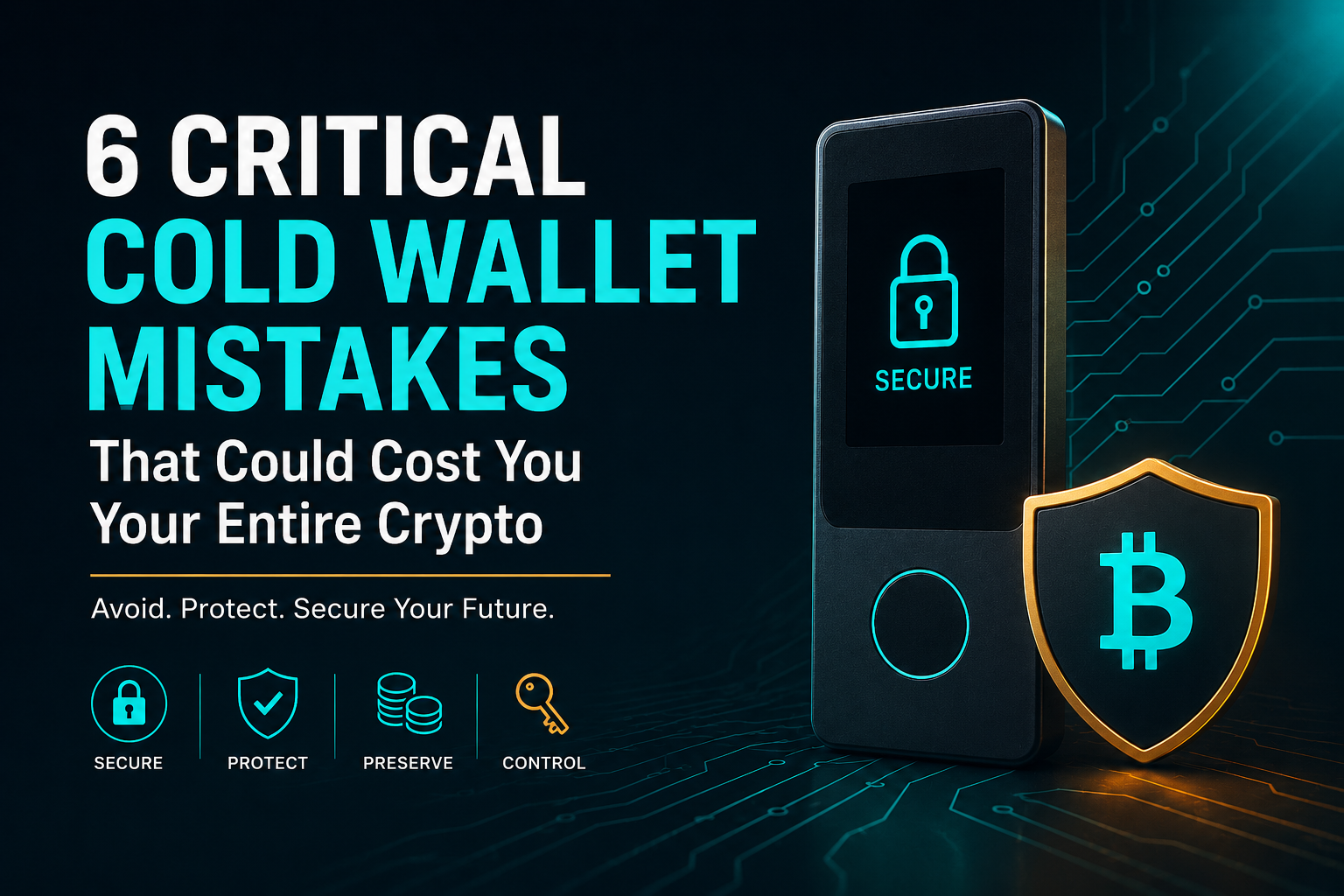
Here is a deep dive into six critical, often fatal mistakes that users consistently make with cold storage—and the mechanical realities of how to fix them before you get burned.
| Mistake | Risk Level | Impact | Short Explanation |
|---|---|---|---|
| Misunderstanding Wallet Function | Medium | Confusion / Wrong decisions | Believing crypto is stored on the device instead of the blockchain |
| Seed Phrase Exposure | Critical | Total Loss | Anyone with access to your seed phrase controls your funds |
| Blind Signing | Critical | Full Wallet Drain | Approving malicious smart contracts unknowingly |
| No Cold Wallet Early | High | Gradual Loss Risk | Keeping funds in hot wallets exposed to malware |
| Choosing Wrong Wallet | High | Security Gaps | Ignoring architecture (Secure Element, Air-gap, firmware) |
| Improper Backup Storage | Critical | Irrecoverable Loss | Losing or damaging seed phrase without backup |
Risk levels are based on real-world crypto loss scenarios, not theoretical assumptions.
In simple terms:
-
Your wallet does NOT store your crypto
-
Your seed phrase is everything
-
One wrong signature can drain your entire wallet
-
Security is not a tool — it’s a behavior
What a Hardware Wallet Actually Does (And What It Never Stores)
This is the original sin of crypto custody. It is staggeringly common for users to assume that a hardware wallet physically stores their Bitcoin or Ethereum in the flash memory of the device, much like a USB thumb drive holds a PDF.
That fundamental misunderstanding leads to catastrophic operational errors.
Your cryptocurrency exists strictly as unspent transaction outputs (UTXOs) or account balances on a decentralized, global blockchain. It does not exist on your desk. What your cold wallet actually holds is a string of cryptographic data—your private keys.
Think of a hardware wallet not as a digital safe, but as an offline signing module. Its sole job is to keep your private keys isolated from internet-connected hardware while cryptographically stamping your approval on outgoing transactions.
If you smash your hardware wallet with a hammer, drop it in a lake, or run it through the laundry, you haven't lost a single satoshi. Your funds are safely resting on the blockchain.
BIP39 Seed Phrase Explained: The True Master Key to Your Crypto
The true core of your security architecture is the seed phrase. Usually standardized under the BIP39 protocol, this is a sequence of 12 or 24 specific words generated by the device's true random number generator (TRNG) during setup. This phrase is the mathematical root from which every single private key for every single blockchain you use is derived.
Whoever holds those words controls the math. Whoever controls the math controls the money. The true purpose of a hardware wallet is simply to ensure those 24 words are never typed on a keyboard, copied to a clipboard, or exposed to the RAM of a computer connected to the internet.
Blind Signing Risks in DeFi and NFTs: Why Hardware Wallets Can’t Save You
Buying a cold wallet drastically reduces your attack surface, but it creates a dangerous psychological blind spot. Users assume that because they have a physical device, their assets are immune to theft. This false sense of security is exactly what modern attackers prey on.
A hardware wallet acts as a highly secure bouncer at a club. It checks IDs perfectly. But if you, the owner, explicitly instruct the bouncer to let the thief inside, the hardware will comply.
This happens every day in decentralized finance (DeFi), NFT marketplaces, and malicious airdrops. To interact with these protocols, you have to sign smart contracts. Because hardware wallet screens are tiny, they often cannot display the complex, underlying code of the contract you are interacting with. This forces users into "blind signing"—approving a transaction hash without actually being able to read what permissions they are granting.
Attackers build flawlessly cloned websites. You plug in your device, click "mint" or "claim," and your hardware wallet prompts you to confirm. By clicking the physical button on your device, you are cryptographically signing a contract that says: “I authorize this third-party address to spend an unlimited amount of my USDT.” They don't need to hack your device. You just legally handed them the keys via the protocol.
How to Prevent Blind Signing Attacks with Wallet Compartmentalization
The Practitioner's Fix:
Total Compartmentalization: Your primary cold wallet should be a deep-storage vault. It interacts with nothing but trusted, native blockchain addresses.
The Air-Lock System: If you want to yield farm, trade NFTs, or chase airdrops, use a secondary "burner" wallet. Move only the capital you are willing to risk into the burner. If you sign a malicious contract, the damage is contained to that isolated environment.
Why You Should Use a Hardware Wallet Early (Even with Small Crypto Holdings)
A pervasive myth is that proper security is only for whales. Users often delay buying a hardware wallet because they feel their $500 or $1,000 portfolio doesn't justify the $80 hardware cost.
This mindset fundamentally misjudges the mechanics of digital theft.
Hackers are not sitting at keyboards manually picking targets. They deploy automated sweeper bots that monitor the memory pools of blockchains 24/7. When a hot wallet (a software wallet connected to the internet) is compromised via malware, a malicious browser extension, or a leaked key, the bots drain the assets in milliseconds.
A script costs a fraction of a cent to execute. It does not care if you have $50 or $500,000. It sweeps everything. Adopting cold storage early is not about guarding massive wealth; it is about establishing the correct operational security (OpSec) reflexes so that when your portfolio does grow, the foundational architecture is already built.
How to Choose the Right Hardware Wallet (Secure Element, Air-Gap, Firmware)
If you ask ten hardware experts what the best cold wallet is, you will get ten different answers. Searching for a universally superior device leads straight to analysis paralysis. Hardware design is entirely about trade-offs.
Instead of looking for the "best," you need to evaluate the hardware architecture based on your specific threat model:
-
Secure Element (SE) vs. General MCU: Does the device use an EAL5+ certified Secure Element chip (similar to what is in your passport or credit card) to protect against physical extraction of the keys, or does it use a general-purpose microcontroller?
-
Air-gapped vs. Connected: Do you want a device that connects via USB/Bluetooth (higher convenience, slightly larger attack surface), or a strictly air-gapped device that uses QR codes or MicroSD cards to pass signed data back and forth?
-
Firmware: Is the code open-source and auditable by the community, or is it closed-source, requiring you to trust the manufacturer's internal security team?
The right wallet is the one that flawlessly supports the assets you hold, operates cleanly on your preferred operating system, and matches your technical comfort level. A highly complex, air-gapped enterprise solution is useless if you find it too frustrating to actually use.
Hardware Wallet Setup Guide: The “Dry Run” Backup and Restore Test
The crypto industry is littered with people who bought a premium hardware wallet, left it in the shrink wrap on their desk for six months because they were intimidated by the setup, and subsequently lost their funds in an exchange collapse or a hot wallet hack.
Fear of making a mistake paralyzes users. But the setup process is purely mechanical and highly standardized.
Step-by-Step Cold Wallet Backup Test (Wipe and Restore Method)
The "Dry Run" Protocol: The best way to eliminate this fear is to prove the system works to yourself.
-
Set up the device and write down the seed phrase.
-
Send a trivial amount of crypto to it—$10 worth of Bitcoin.
-
Once it arrives, intentionally wipe the hardware wallet back to factory settings. (Yes, really).
-
Now, use your written seed phrase to restore the device. When you see your $10 reappear, the abstract concept of cryptography becomes a concrete reality. You will immediately trust the hardware, trust your backup, and lose the anxiety of managing your own keys.
How to Store Your Seed Phrase Safely (Steel Backup vs Paper Risks)
This is the ultimate point of failure. If you screw this up, no customer support ticket, no lawyer, and no technical wizardry can save you.
Your seed phrase is the physical manifestation of your digital wealth. Treating it casually is a fatal error.
Never digitize it. The moment you take a photo of your seed phrase, type it into a password manager, or save it in an encrypted cloud file, you have defeated the entire purpose of buying a cold wallet. You have turned cold storage into hot storage.
Paper is fragile. Storing your phrase on the piece of cardboard provided in the wallet box is fine for the first week. But paper degrades, burns, and dissolves in floodwater.
If you are serious about long-term custody, you must transition to metallurgy. Punching your seed phrase into a plate of 304-grade stainless steel or titanium ensures that your cryptographic backup can survive a house fire, a collapsed roof, or a flooded basement.
Security in this space isn't about paranoia; it is about building resilient, mechanical systems that don't rely on luck.
Conclusion
Understanding the critical mistakes in cold storage and the realities of hardware wallets is essential for safeguarding your digital assets. By adopting the right operational habits and utilizing effective security measures, you can significantly reduce the risk of losing your funds. Always remember that security is a behavior, not just a tool.
FAQ: Cold Wallet Security, Seed Phrases, and Common Mistakes
Q1: What is the main purpose of a hardware wallet?
A hardware wallet does not store your crypto directly. Its primary role is to securely generate and store your private keys offline and sign transactions without exposing them to the internet. This drastically reduces the risk of hacks compared to hot wallets connected to browsers or apps.
Q2: Can I lose my crypto if my hardware wallet breaks?
No, your crypto is stored on the blockchain, not on the device. As long as you have your seed phrase backup, you can restore your wallet on any compatible device and regain full access to your funds. The device itself is replaceable; the seed phrase is not.
Q3: What is blind signing and why is it dangerous?
Blind signing occurs when you approve a transaction without fully understanding its contents. This is common in DeFi and NFT interactions where complex smart contracts are not fully displayed. It can allow attackers to gain full access to your funds if you unknowingly approve malicious permissions.
Q4: When should I start using a cold wallet?
You should start using a cold wallet as early as possible, even with small amounts of crypto. Security habits formed early protect you as your portfolio grows. Waiting until you have large funds increases your exposure to preventable risks like malware or wallet compromises.
Q5: What is the safest way to store a seed phrase?
The safest method is offline and physical. Avoid digital storage completely. Use durable materials like stainless steel or titanium to protect against fire, water, and physical damage. Paper backups are only temporary solutions and should be upgraded for long-term security.
Q6: What is a “dry run” test for a hardware wallet?
A dry run test involves setting up your wallet, sending a small amount of crypto, wiping the device, and restoring it using your seed phrase. This process verifies that your backup works correctly and builds confidence in your ability to recover your funds if the device is lost or damaged.