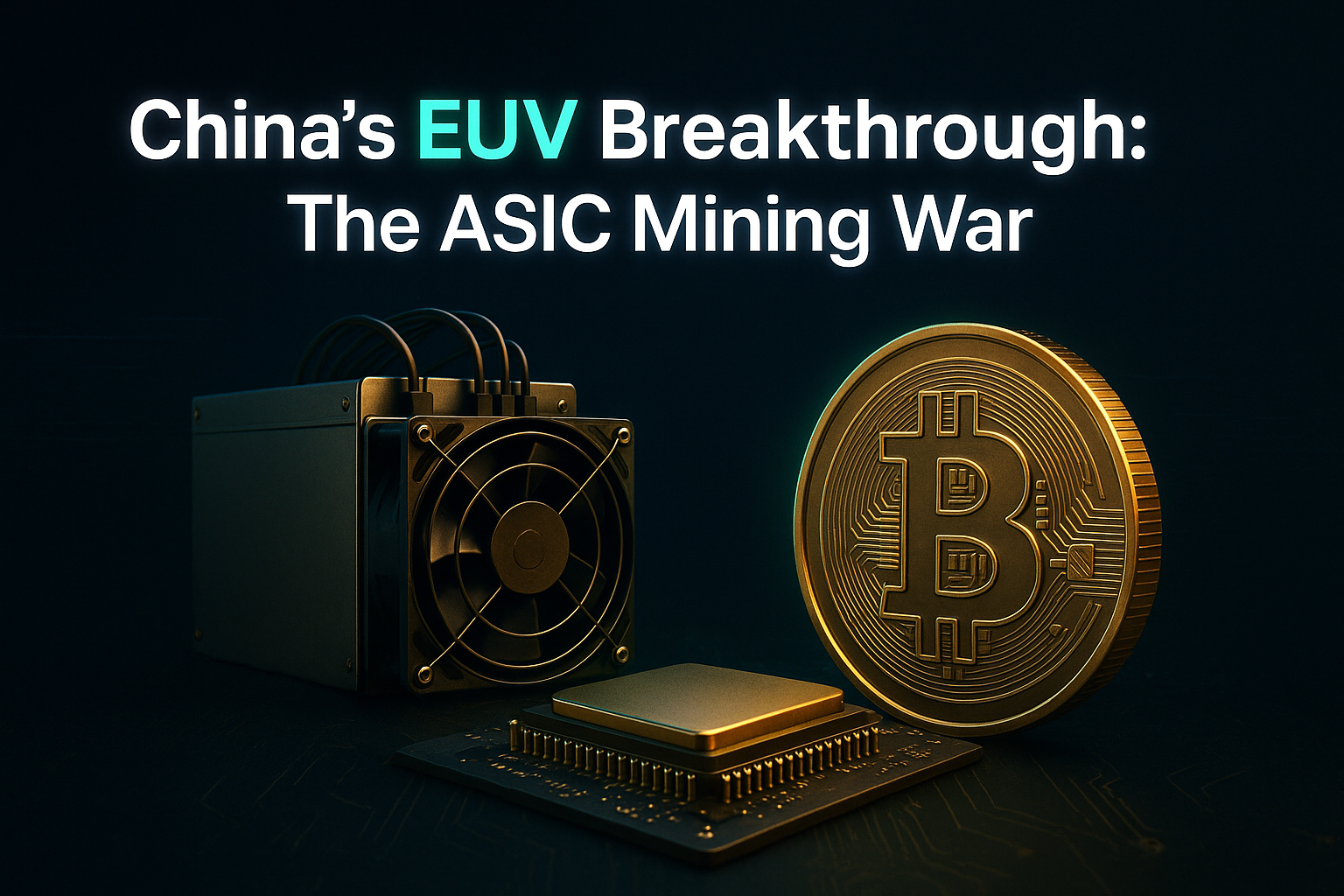
The Hidden Reality of the Mining War: Why the 80% Dominance is Only Half the Story
For years, it’s been an open secret: China basically is the hardware market. With giants like Bitmain and MicroBT controlling nearly 80% of the world’s supply, it looks like game over for the competition. On the surface, they own the game.
But if you look closer, there’s always been a "crack in the armor."
Here’s the thing: the absolute best mining rigs—and the heavy-duty AI infrastructure we’re all watching—live or die by what’s happening at the microscopic level. We’re talking about chips pushed below the 7nm barrier. For a long time, China didn't actually hold the keys to that kingdom. They were essentially "renting" the future from one place: ASML and their legendary EUV machines.
That dependency created a massive, silent bottleneck. It wasn't just a headache for politicians; it was a ticking clock for the entire economics of Bitcoin mining.
Why should a miner care? Because this isn't just a "tech specs" story. This is about your bottom line. It’s about how much your next rig will cost, how much electricity it’s going to burn, and—most importantly—how fast the hardware you’re buying today might turn into a paperweight.
China’s EUV Lithography Breakthrough: The Technology Behind Advanced Chips
Impossible Light and the "Heist of the Century"
The story begins with a 180-ton machine costing $250 million, capable of etching silicon with light at a precision human minds can barely fathom. The West claimed China would need decades to master this "light," but early 2025 brought the surprise that shook Washington: The Chinese Beast has been born.
In top-secret laboratories in Shenzhen, under the direct supervision of Ding Xuexiang—the powerful figure in President Xi Jinping’s inner circle—Chinese engineers succeeded in building their own version. It wasn't a carbon copy, but a "monster" that occupies an entire factory floor. Where they failed to replicate the compact size of Western machines, they compensated by doubling the scale and mechanical power—an epic endeavor the Chinese themselves have dubbed the "Manhattan Project of Chips."
Technology Espionage, Talent Repatriation, and the Hidden EUV Supply Network
Hidden behind this achievement is a spy thriller narrative. China successfully repatriated "lost" talent—engineers who worked for years at the heart of ASML. Today, these engineers navigate Chinese labs under fake identities and aliases, not out of fear of failure, but to protect them from international prosecution, in exchange for astronomical rewards and luxury housing under state protection.
As for spare parts, Chinese "ingenuity" manifested through complex networks of middlemen and public auctions on platforms like Alibaba. They purchased old, decommissioned machinery only to dismantle it in China and reverse-engineer it into the heart of this national project.
The Future of Bitcoin ASIC Mining Hardware in a Post-Sanctions World
The Future of ASICs: Absolute Sovereignty
Every ASIC miner is essentially a box containing dozens to hundreds of high-architecture chips for fast and precise processing. Sources from Bitmain note that while a 2020-era Antminer S19 Pro (110 TH/s) contained 171 chips, the newer Antminer S23 Hyd 3U has become a beast powered by several hundred 5nm ASIC chips. As network difficulty spikes, the demand for smaller, more efficient chips grows exponentially.
How Domestic EUV Technology Could Transform the ASIC Mining Industry
By possessing domestic EUV technology, China achieves:
-
Breaking the Shackles: China will produce 3nm and 2nm chips 100% locally, rendering US sanctions mere "ink on paper."
-
Insane Power Efficiency: Future miners will be ten times more powerful while consuming significantly less electricity, instantly priced-out any non-Chinese competitor.
-
AI Integration: Chinese mining firms will be able to integrate AI capabilities directly into ASIC chips, transforming the hardware into a dual-purpose tool for mining and data processing.
-
Supply Chain Integration: With complete control over the most precise chip architecture, the entire ASIC supply chain remains within China. This will lead to lower hardware prices in the event of external competition, or absolute price control through total end-to-end monopoly.
• However, EUV lithography remains one of the most complex engineering challenges in history, and there is no confirmed large-scale Chinese production yet.
• Any breakthrough could accelerate hardware evolution, meaning faster obsolescence cycles for current ASIC devices.
The Bottom Line: Why EUV is the Real Power Play for Mining and AI
The global chip race isn't just a headline in a geopolitical journal anymore—it’s the engine driving the future of AI and the actual profitability of mining. At the heart of it all is EUV lithography. It’s the invisible hand deciding who gets to build the fastest, most efficient, and most scalable systems on the planet.
While the West is doubling down on "control and restrictions," China is playing the long game, focusing on self-reliance. But no matter who comes out on top, one thing is certain: the way we manufacture chips is undergoing a massive structural shift.
As we look toward 2028–2030, the "disruption" people keep talking about isn't a possibility—it's already happening. For anyone building infrastructure, investing, or running miners, this is your wake-up call. Hardware cycles are going to get faster, efficiency will leap forward sooner than we think, and the entire cost structure of ASIC mining is about to be rewritten.
At the end of the day, EUV isn't just about making chips smaller; it’s about who holds the keys to the future of computing.
Disclaimer: This analysis is based on current market trends, industrial intelligence, and geopolitical shifts in the semiconductor industry. While some technical details remain speculative due to the strategic nature of EUV development, the broader impact on ASIC mining efficiency and market dynamics is a clear roadmap for the 2028–2030 horizon.
FAQ
Q1: What exactly is EUV, and why should miners care about it?
Think of EUV (Extreme Ultraviolet Lithography) as the "ultra-high-definition" printer of the chip world. It allows manufacturers to carve incredibly tiny circuits onto silicon. For ASIC mining, this is a game-changer. By moving to 5nm or 3nm designs, we get hardware that hits much higher hash rates while actually cutting down on the power bill—which is the holy grail for any mining operation.
Q2: Why is China so determined to build its own EUV machines?
Right now, the world’s most advanced chips depend on machines from just one company (ASML). China wants to break that cycle of dependence. By building their own EUV tech, they can produce top-tier chips at home without worrying about trade bans or sanctions. It’s about total tech independence for everything from AI to crypto and defense.
Q3: How does EUV tech actually change the hardware we use for Bitcoin?
It all comes down to efficiency. Smaller nodes mean we can pack more transistors into the same space. For a miner, that translates to a massive jump in performance. It’s the difference between a machine that struggles with heat and power, and a sleek, next-gen ASIC that pumps out more Bitcoin while staying incredibly energy-efficient.
Q4: Is China on track to dominate the ASIC mining market?
They’re already the heavyweights with giants like Bitmain and MicroBT. If China manages to crack the code on domestic EUV production, they’ll control the entire chain—from the raw silicon to the finished miner. That would give them the power to lower costs and set the pace for the global market even more than they do now.
Q5: Will this "EUV independence" make ASIC miners cheaper for us?
It’s very possible. If China controls the manufacturing from start to finish, the cost of making these chips should drop. This could lead to more affordable hardware for everyone. However, it also gives Chinese manufacturers a lot of leverage over global pricing, so a lot depends on how much competition stays in the market.
Q6: Could AI actually be built into future mining chips?
Absolutely. We’re moving toward "smarter" hardware. Future ASICs might use AI to manage power in real-time or diagnose hardware issues before they happen. Imagine a miner that automatically tunes itself to maximize profit based on temperature and electricity costs. It might even open the door for chips that can switch between mining and AI processing.