Introduction – Rising Electricity Costs and the Need for Solar Storage
As electricity prices continue to rise across Europe and North America in 2026, businesses that depend heavily on computing power — such as cryptocurrency mining operations and AI infrastructure — are searching for reliable ways to reduce energy costs.
Recent geopolitical tensions have significantly impacted global energy markets. Gas prices in Europe have reportedly surged by nearly 50%, while oil prices have climbed to around $90 per barrel, creating a ripple effect across electricity markets. For industries where power consumption represents the largest operating expense, these increases can dramatically affect profitability.
Because of this, many operators are turning toward renewable energy sources such as solar and wind power combined with energy storage systems. Batteries make it possible to store electricity when production is high and use it later when demand increases or when generation drops.
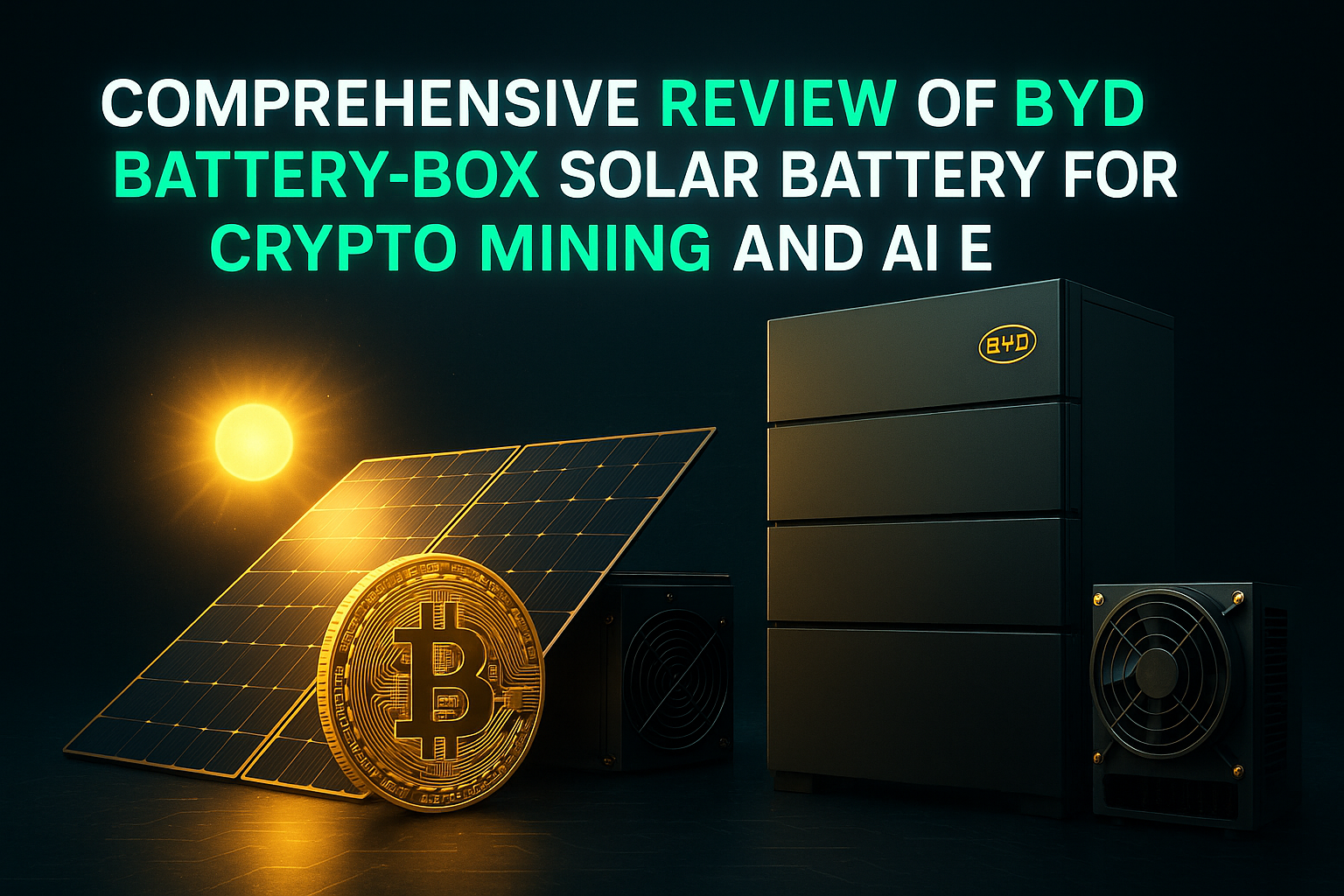
One of the most recognized solutions in this category is the BYD Battery-Box energy storage system, designed for residential and small-scale commercial applications. These batteries are capable of storing electricity generated by solar panels or wind turbines, providing a stable power reserve for homes, businesses, and computing workloads.
In this review, we examine the strengths of BYD’s modular battery system and explore why it is increasingly considered a practical solution for reducing electricity costs in energy-intensive sectors.
What Is the BYD Battery-Box Energy Storage System
The BYD Battery-Box is designed as a modular energy storage platform, allowing users to scale capacity depending on their needs. Instead of installing one fixed battery, users can build a system made up of multiple modules connected together.
The base configuration typically starts at around 6.45 kWh with the ability to expand by adding additional modules. Users can attach either 4.3 kWh or 6.45 kWh modules, gradually increasing total capacity.
In larger installations, up to four modules can be combined into a single tower, delivering around 23.6 kWh of storage. Multiple towers can also be connected together, allowing systems to reach over 70 kWh of total capacity.
This flexibility makes the Battery-Box suitable for a wide range of energy scenarios, from residential solar storage to small industrial operations.
Modular Battery Architecture and System Scalability
One of the most important strengths of the BYD Battery-Box system is its scalability.
Rather than forcing users to purchase a large battery upfront, the modular architecture allows gradual expansion. This approach reduces initial investment and enables energy systems to grow alongside increasing electricity demand.
For example:
- Small installations may begin with 6.45 kWh.
- Medium systems may scale to 20 to 30 kWh.
- Larger installations can reach 70 kWh or more.
For applications like crypto mining rigs or AI servers, this flexibility allows operators to gradually expand their energy storage capacity as computational workloads increase.
Energy Efficiency and Performance
Energy storage efficiency is a critical factor when evaluating battery systems.
BYD claims its system can achieve around 97.7% efficiency, which is considered extremely high for residential and small commercial energy storage solutions. In some configurations, using three-phase inverters, efficiency may even reach 98.2%.
High efficiency is important because it reduces energy loss during charging and discharging cycles. For operations running energy-intensive hardware — such as GPU clusters or ASIC mining machines — even small efficiency improvements can translate into measurable electricity savings over time.
The system also supports seamless switching between grid and off-grid operation, with a backup response time of less than 10 milliseconds. This capability ensures continuous power delivery during grid outages.
Lithium Iron Phosphate Battery Technology and Safety
The Battery-Box uses Lithium Iron Phosphate (LFP) battery chemistry, a technology widely regarded as one of the safest lithium battery designs available.
Compared to traditional lithium-ion chemistries, LFP batteries offer several advantages:
- Higher thermal stability
- Longer lifecycle
- Reduced fire risk
- Greater durability under heavy charge-discharge cycles
These characteristics are particularly important for systems that operate continuously, such as data processing hardware or mining infrastructure.
Additionally, LFP batteries are known for maintaining performance over thousands of charge cycles, making them suitable for long-term energy storage deployments.
Inverter Compatibility and System Integration
Unlike some all-in-one storage solutions, the BYD Battery-Box does not include a built-in inverter.
Instead, the battery system works with external hybrid inverters. BYD introduced compatible options such as:
- Powerbox SH3 single-phase inverter
- Powerbox TH5 three-phase inverter
This approach offers greater flexibility for system designers, allowing the battery to integrate with a wide range of solar installations and energy management systems.
While this design introduces slightly more complexity during installation, it also allows users to customize the energy system depending on grid configuration and power requirements.
Why Solar Battery Storage Matters for Mining and AI Infrastructure
Electricity is the largest operating cost in many computing industries.
Cryptocurrency mining farms and AI data processing centers require constant power delivery to maintain performance. Even minor fluctuations in electricity prices can significantly affect profitability.
In regions such as Europe and North America, where energy markets have become increasingly volatile, battery storage combined with renewable generation is becoming an attractive strategy.
A typical setup might include:
1. Solar panels generating electricity during daylight hours.
2. Battery systems storing excess power.
3. Mining rigs or GPU servers running partially or fully on stored energy.
By storing energy during periods of low demand or high solar production, operators can reduce reliance on expensive grid electricity, helping to reduce peak grid dependence and improve self-consumption of renewable generation.
BYD Battery-Box vs Tesla Powerwall: Technical Specifications Comparison
| Feature | BYD Battery-Box | Tesla Powerwall 3 |
|---|---|---|
| Battery Type | Lithium Iron Phosphate (LFP) | Lithium Iron Phosphate (LFP) |
| Usable Capacity | 4 kWh – 22 kWh per stack (expandable) | 13.5 kWh fixed capacity |
| Maximum System Capacity | Up to 66+ kWh with multiple towers | Up to 54 kWh with four units |
| Continuous Power Output | Depends on inverter configuration | 11.5 kW |
| Round Trip Efficiency | ≈95% | ≈97.5% |
| Inverter | External hybrid inverter required | Integrated solar inverter |
| Scalability | Highly modular and expandable | Expandable by adding units |
| Warranty | 10 years | 10 years |
| Best Use Case | Scalable solar systems and industrial setups | All-in-one residential energy storage |
Key Advantages of the BYD Battery-Box Energy Storage System
-
Highly Scalable Battery Architecture: The modular design allows capacity expansion without replacing the entire system.
-
High Energy Efficiency: Efficiency approaching 98% minimizes energy loss during storage cycles.
-
Long Battery Lifespan: LFP battery chemistry supports thousands of charge cycles.
-
Flexible System Design: External inverter compatibility allows integration with various solar installations.
-
Strong Backup Power Capability: Fast switching between grid and backup power ensures operational stability.
Renewable Energy as a Long Term Power Strategy
Given the current instability in global energy markets, many experts believe renewable energy systems combined with storage will become a central part of future energy infrastructure.
Solar power, in particular, offers several advantages:
- Predictable operating costs
- Reduced dependence on fossil fuels
- Lower exposure to geopolitical energy shocks
- Long-term electricity price stability
For computing industries, including crypto mining, cloud infrastructure, and AI workloads, these systems provide a pathway toward lower and more predictable energy costs.
Solar Panels Required to Charge Battery Storage Systems
Solar Panels Required to Charge Home Battery Systems
| Battery Capacity | Example System | Energy Needed | Estimated Panels (550W) | Typical Use Case |
|---|---|---|---|---|
| 6.45 kWh | BYD Battery-Box (base module) | ≈6.45 kWh | 3 – 4 panels | Small solar backup systems |
| 13.5 kWh | Large residential battery | ≈13.5 kWh | 5 – 6 panels | Home energy storage |
| 22 kWh | Expanded BYD Battery-Box tower | ≈22 kWh | 8 – 10 panels | Small mining rigs or AI workstations |
| 40 kWh | Multi-battery solar system | ≈40 kWh | 14 – 16 panels | Medium mining or server setups |
| 70 kWh+ | Large BYD multi-tower installation | ≈70 kWh | 25 – 30 panels | Large crypto mining or AI infrastructure |
Estimates are based on 550W solar panels and around 5 hours of effective sunlight per day. Actual results may vary depending on location, inverter efficiency, and weather conditions.
Conclusion
The BYD Battery-Box represents a flexible and efficient energy storage solution designed for modern renewable energy systems.
Its modular architecture, high efficiency, and safe battery chemistry make it a compelling option for users looking to integrate solar or wind power into their energy strategy.
As electricity costs continue to rise in many regions, battery storage systems like this are becoming increasingly important, especially for industries where computing power and energy consumption go hand in hand.
For operators seeking a long-term solution to stabilize electricity costs, combining renewable energy generation with scalable battery storage may prove to be one of the most resilient approaches in the evolving global energy landscape.
FAQ – BYD Battery-Box Solar Energy Storage
Q1: What is the BYD Battery-Box used for?
The BYD Battery-Box is a modular energy storage system designed to store electricity generated by renewable sources such as solar panels or wind turbines. It allows homes, businesses, and computing facilities to store excess power and use it later, reducing dependence on grid electricity.
Q2: How much energy can a BYD Battery-Box system store?
A typical system starts at around 6.45 kWh and can expand beyond 70 kWh depending on the number of battery modules installed. This modular design allows users to scale energy storage as power demand increases.
Q3: Is BYD Battery-Box suitable for crypto mining operations?
Yes, in many cases it can be used as part of a renewable energy setup for mining rigs. When combined with solar panels, the battery can store electricity during daylight hours and power mining hardware later, reducing reliance on expensive grid energy.
Q4: What battery technology does BYD Battery-Box use?
The system uses Lithium Iron Phosphate (LFP) batteries. This technology is known for high thermal stability, long lifespan, and improved safety compared with some traditional lithium battery chemistries.
Q5: Why are solar batteries important for AI infrastructure?
AI workloads and GPU clusters consume large amounts of electricity. Solar energy combined with battery storage can reduce operational costs, provide backup power, and protect infrastructure from volatile energy prices.
Q6: Can BYD Battery-Box work with off-grid systems?
Yes, the system supports hybrid energy setups and can operate with off-grid solar installations when combined with compatible inverters, making it useful for locations with unstable or expensive electricity supply.