
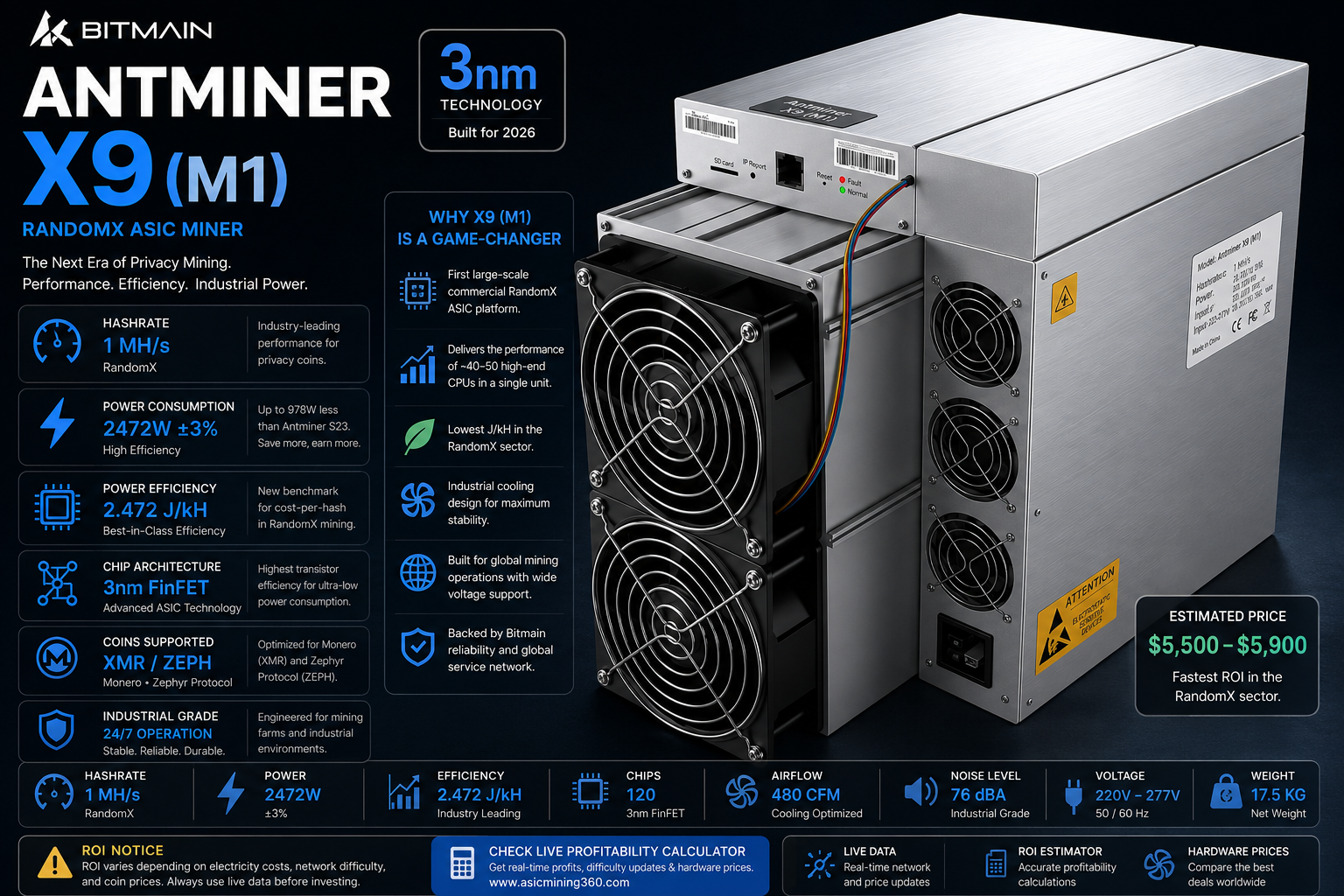
Introduction to the Antminer X9 (M1) RandomX ASIC Revolution
The Antminer X9 (M1) shows up at a time when mining isn’t about excitement anymore—it’s about survival and numbers.
For a long time, RandomX was designed to be resistant to ASICs. It was built that way on purpose, to keep mining tied to CPUs and avoid centralization. That idea shaped how Monero and similar networks evolved.
But in 2026, that assumption is starting to crack.
The X9 (M1) is designed to push into that space with serious efficiency. Built on a 3nm architecture and targeting RandomX workloads, it brings industrial-level hardware into a system that was never meant for it.
On paper, it delivers around 1 MH/s and a much tighter energy profile than older generations of mining setups. In practice, what matters more is what this means for the balance between CPU mining and dedicated hardware.
Because this isn’t just a new machine—it’s a test of whether RandomX can still hold its original promise in a world that keeps pushing toward specialization.
| Parameter | Specification | Technical Intelligence & Comparative Notes |
|---|---|---|
| Manufacturer | Bitmain | Industry-leading reliability and worldwide warranty support. |
| Model Name | Antminer X9 (M1) | 2026 Flagship model for high-difficulty privacy networks. |
| Algorithm | RandomX | Advanced ASIC implementation; superior stability vs CPU farms. |
| Cryptocurrencies | XMR / ZEPH | Multi-coin support: Monero and Zephyr Protocol optimized. |
| I. CORE IDENTITY & MINING PROTOCOL | ||
| Typical Hashrate | 1000 KH/s (1 MH/s) | Massive throughput; equivalent to ~45 high-end server CPUs. |
| Chip Architecture | 3nm FinFET | The most advanced transistor process for ultra-low power loss. |
| Chip Quantity | 120 Chips | High-density array for maximized processing per square inch. |
| Hashboard Count | 3 Boards | Modular 3-board design for easy maintenance and thermal balance. |
| Power Efficiency | 2.47 J/K | New 2026 benchmark for the lowest cost-per-hash in the market. |
| II. COMPUTATIONAL POWER & ARCHITECTURE | ||
| Power Consumption | 2472W ±3% | Energy Saver: Consumes 978W LESS than Antminer S23. |
| Input Voltage | 220V - 277V | Wide-range industrial AC input; protects against power surges. |
| Max Input Current | 20 Amp | Requires a 25A dedicated circuit for safe continuous operation. |
| Frequency Range | 50 / 60 Hz | Global grid compatibility (Universal PSU integration). |
| Power Interface | P14 Port | Heavy-duty industrial connector to withstand high-temp load. |
| III. POWER & ELECTRICAL SPECIFICATIONS | ||
| Network Mode | RJ45 Ethernet | 10/100M Auto-sensing; ensures stable pool synchronization. |
| Product Size (Net) | 361×219×293 mm | Compact vertical form factor for high-density rack mounting. |
| Server Size (Gross) | 630×350×430 mm | Packaging dimensions for volumetric shipping cost calculations. |
| Net Weight | 17.5 KG | Unit mass reflecting high-grade aluminum cooling components. |
| Gross Weight | 20.2 KG | Total logistics weight with multi-layer protective packaging. |
| IV. HARDWARE DIMENSIONS & LOGISTICS | ||
| Airflow Capacity | 480 CFM | Aggressive heat extraction via high-RPM dual-fan system. |
| Noise Level | 76 dBA | Industrial noise profile; best suited for sound-managed farms. |
| Operating Temp | -20 ~ 45 °C | Engineered for stability in both cold and high-heat climates. |
| Operating Humidity | 10% ~ 90% RH | Protective coating on PCB to prevent moisture-based corrosion. |
| Operating Altitude | ≤ 2000 m | Pre-calibrated for air density at major high-altitude data centers. |
| V. THERMAL & ENVIRONMENTAL LIMITS | ||
| Estimated Price | $5500 - $5900 | Fastest ROI in the RandomX sector due to massive efficiency gains. |
Antminer X9 (M1) ROI Analysis, Profitability Outlook & 2026 Market Impact
This marks a real turning point in mining history. The Antminer X9 (M1) marked an important moment in cryptocurrency. This is the first ASIC miner created for the RandomX algorithm, a protocol initially made to make CPU mining more decentralized by being ASIC-resistant. Bitmain figured out something big, leading to new mining hardware for 2026. It offers better efficiency than we thought was even possible before.
As of the date of this publication, the X9 (M1) is considered a game-changer for investors. Looking at current coin prices and network difficulty, and based on assumptions around electricity costs, the estimated ROI ranges between roughly 200–300 days.
The quick return on investment, plus the 3nm energy-saving design, sets the standard for industrial privacy-coin mining. To stay informed about daily profits, live difficulty adjustments, and current hardware prices, check out the specialized profitability calculators at ASICMINING360. This is a good way to keep track of the market. Keeping up with live data feeds is key to refining your mining approach and confirming the incredible return on investment of the X9 (M1).
Antminer X9 (M1) in 2026: What Its Emergence Really Means for the Future of RandomX Mining and Industrial Hashpower
The Antminer X9 (M1) is not just another mining machine entering the market—it’s a stress test for one of the most controversial assumptions in crypto mining: whether RandomX can remain CPU-first in a world that is clearly moving toward industrial specialization.
If the specifications are accurate, what we are looking at is a machine that doesn’t simply compete with CPUs—it redefines the scale of competition entirely. That alone changes how mining farms may be structured in the next cycle.
But the real story isn’t the hashrate or the efficiency number on paper. It’s whether the network economics of RandomX can absorb this kind of hardware without collapsing the original design philosophy behind it.
In simple terms: this isn’t just a new miner—it’s a quiet challenge to the rules of the game.
💡 Frequently Asked Questions: The Antminer X9 (M1) Factor
Q1: RandomX was built to be ASIC-resistant. How does the X9 (M1) actually handle it?
It’s all about the memory architecture. While RandomX was designed to favor the L3 cache of CPUs, Bitmain’s 2026 silicon strategy integrates High-Bandwidth On-Chip Memory directly into the 3nm chips. Instead of fighting the algorithm's complexity, the X9 (M1) mimics the "random branch" execution of a high-end CPU but at an industrial scale. It doesn't just bypass the resistance; it out-competes it by delivering the same logic with a fraction of the power waste.
Q2: What is the real risk of a Monero "Hard Fork" bricking these miners?
This is the "elephant in the room" for any privacy-coin investor. The Monero community has a long history of changing its protocol to keep ASICs out. However, in 2026, the scale of the network has reached a point where constant forking is becoming a logistical burden. While the risk of a "bricking" update is never zero, the X9 (M1) features programmable FPGA-like layers in its firmware, offering a small buffer for minor algorithm tweaks—though a total protocol overhaul remains your primary risk factor.
Q3: Is one Antminer X9 (M1) really better than a full server rack of EPYC CPUs?
In terms of density and OpEx, yes. To match the 1 MH/s output of a single X9 (M1), you would need roughly 45 to 50 high-end server CPUs. When you calculate the cost of 50 motherboards, hundreds of gigabytes of RAM, and the massive cooling infrastructure required to keep 50 CPUs from throttling, the X9 (M1) wins on efficiency and space. It’s essentially "distilling" a massive server room into a single, compact vertical unit.
Q4: How quickly will the Network Difficulty react to the X9 (M1) launch?
History tells us the reaction will be fast. As these units hit the racks in 2026, expect a significant "Difficulty Spike" in Monero and Zephyr networks. This is why the 250-day ROI estimate is a moving target. The most successful miners in 2026 aren't just looking at today’s profits; they are using the X9 (M1) as a defensive tool to maintain their share of the hashrate as the "CPU era" of RandomX begins to fade.