Introduction: The Brutal Math of Zcash Mining in 2026
In the crypto world, there are rare moments when a single asset flips the entire mining landscape overnight. That’s exactly what happened with Zcash (ZEC) as we moved into 2026.
After years of quiet consolidation, Zcash has surged back into the spotlight. We’ve seen the price climb from the $30 range a year ago to a volatile $220–$240 today, with market capitalization reclaiming a massive $3.5 billion. Trading volume didn’t just grow—it exploded, with daily liquidity often crossing $300 million.
For a miner, this kind of vertical move feels like striking a vein of pure gold.
But here’s the uncomfortable question every practitioner needs to ask: Are you early to the party, or are you just providing the exit liquidity?
This sudden spike in profitability has triggered a predictable gold rush for Equihash hardware. We’re seeing massive demand for units like the Antminer Z15 Pro, as people scramble to lock in what looks like a 200% ROI on paper. Daily revenue numbers are eye-popping, and hardware that many had written off as "legacy" is suddenly back in high demand.
However, in 2026, mining isn't about chasing the green candles on a chart; it’s about timing, difficulty, and survival. Behind every explosive rally lies a cold, mathematical reality: the moment the profits become this obvious, the network difficulty starts sharpening its blade.
Zcash Mining Boom 2026: Profitability, Hashrate Power, and Market Reality
In the case where the classic coin has risen by over 500% within a year, the initial recipients of gains will be miners. Going by the current system where the basic electricity cost is $0.08/kWh, current profits were considered impossible months ago.
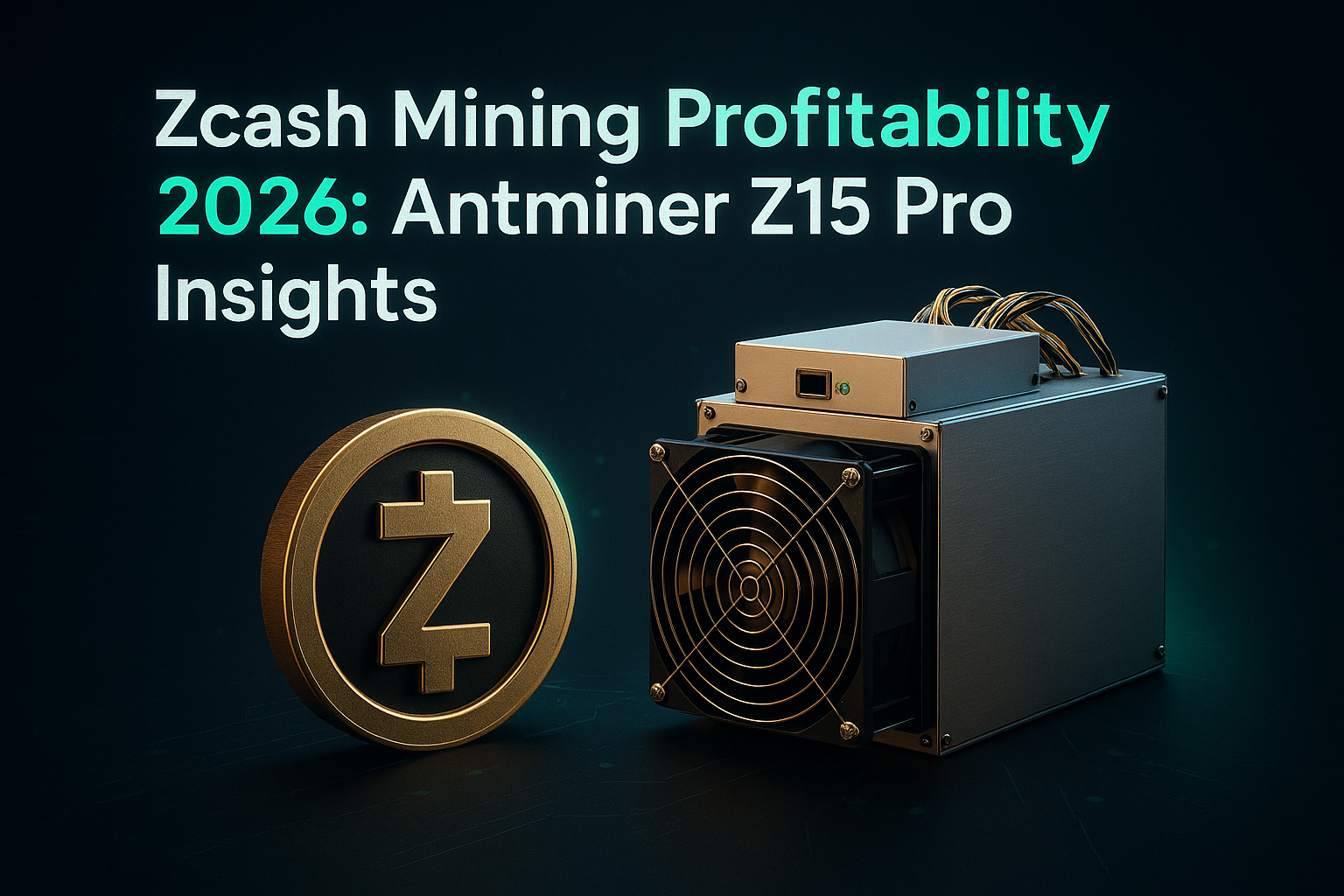
Antminer Z15 Pro: With a hash rate of around 840 KSol/s, it produces a gross daily revenue of about $39.
Net Profit: Subtracting an approximate $5 in electricity expenses gives a net profit of $34 per day (as per the ASICMINING360 calculator). This situation has led to a revival from the last “relic” that the trend had left behind—the likes of the Z9 Mini (2018) (three years old!). These devices had long since ceased to be relevant. Now they come in green. “Legacy coins” can make a “violent” reappearance.
Antminer Z15 Pro ROI Analysis: The Mining Profit Illusion
Return on Investment (ROI) is the lone correct guide for an expert miner. Taking into consideration that, as of now, the retail price for the Z15 Pro is close to $4,000, it seems very appealing:
For $30/day (variable), your monthly earnings would be around $900.
On paper, your break-even point will be 4.5 months. "This is a mathematical trap." It assumes the price of the coin as well as the Network Difficulty are constant. But history proves that the difficulty increases the moment the hardware enters the market. This means the time it takes for a return on investment in five months can be accelerated to two years in the blink of an eye. The profit change in the past three months is as volatile as $60 to $5 on a daily basis.
Antminer Z15 Pro Specifications & Profitability Breakdown (2026)
| Specification | Value |
|---|---|
| ASIC Model | Antminer Z15 Pro |
| Algorithm | Equihash |
| Hashrate | 840 KSol/s |
| Estimated Daily Revenue | $39 |
| Electricity Cost (0.08$/kWh) | ~$5 / day |
| Estimated Net Profit | $34 / day |
| Miner Price (Approx.) | $4,000 |
| Estimated Break-even Time | 4.5 Months (Theoretical) |
Zcash ASIC Reality: Paying 2026 Prices for 2020 Tech
Let’s be brutally honest about the hardware you’re actually plugging in. The uncomfortable truth that many operators ignore is that the current crop of Equihash ASICs isn't driven by breakthrough innovation. Instead, you are looking at minor optimizations of aging tech, aggressively priced to capitalize on the current market hype.
Take the Antminer Z15 Pro. It looks phenomenal on a profitability calculator today, but underneath the fresh aluminum, it’s not a revolution. It is essentially a rebadged, overclocked iteration of the original Z15 architecture from back in 2020. When you buy one at a premium today, you are effectively paying top dollar for a five-year-old engine simply because the market is running hot.
Sure, you can point it at other Equihash coins like Horizen or Komodo if Zcash tanks, but that doesn't fix the structural trap. Manufacturers like Bitmain are apex predators when it comes to market timing. When profitability spikes, they crank up the prices on their older inventory, capture the liquidity from late-arriving retail miners, and then eventually drop a true "next-gen" machine. When that new silicon hits the racks, the difficulty skyrockets, and the depreciation on your Z15 Pro won't be a slow decline—it will be a cliff.
The Existential Threat: The Proof-of-Stake Kill Switch
Beyond hardware cycles and block rewards, Zcash carries a massive, underlying risk that has nothing to do with market dynamics. It’s a threat baked right into the protocol's governance.
For years, the Zcash development community has been openly flirting with transitioning the network away from Proof-of-Work and moving to a Proof-of-Stake (PoS) model—the exact same path Ethereum took.
For a miner, this isn't just a variable in your ROI spreadsheet; it’s an absolute kill switch. If Zcash successfully merges into PoS, the economic model for Equihash mining is completely gutted. Your high-cost ASIC fleet wouldn't just become less profitable—it would become a stack of very expensive, very loud paperweights. When you deploy capital into Zcash hardware in 2026, you have to price in the very real possibility that the network might eventually fire you.
Smarter Strategies: How the Veterans Actually Play It
Because of these structural risks, the smart money doesn't FOMO into peak markets. Veteran operators prioritize flexibility and survival over chasing green candles.
One of the most battle-tested strategies right now is leveraging profit-switching pools. Instead of marrying your hardware to Zcash, these pools dynamically point your hashpower at whatever Equihash coin is most profitable that hour, but automatically pay you out in Bitcoin. You capture the high yields of the altcoin spikes, but you store your wealth in the hardest asset on the board.
Others are stepping off the altcoin treadmill entirely. They are redirecting their capital back into pure Bitcoin infrastructure. Bitcoin’s consensus rules are set in stone—there is no looming PoS threat to brick your SHA-256 machines. It offers a much safer, more predictable foundation for serious capital.
Furthermore, we're seeing a shift toward running personal infrastructure—like deploying your own nodes and routing tools like BitX Gamma. This allows operators to maintain absolute privacy and control over their stack without taking on the brutal, capital-intensive risks of hardware depreciation.
Conclusion: Timing Beats Hype Every Single Time
Here is the bottom line: if you already have Equihash hardware racked and hashing, you are sitting in a golden window. Maximize your uptime, keep your thermals in check, and aggressively extract every dollar of elevated revenue before the market normalizes.
But if you are looking at today’s charts and thinking about placing a massive purchase order for new ASICs? Stop. The math is unforgiving. What looks like a guaranteed ROI on paper today is often a trap. By the time your machines clear customs, get unboxed, and come online, the network difficulty will likely have spiked to absorb that exact profitability.
The golden rule of this industry never changes: never buy hardware at the absolute peak of a cycle. When you buy during a hype wave, you aren't just paying for silicon; you are subsidizing the exit liquidity for the guys who bought early.
In 2026, sustainable mining isn't about who makes the most money in a single 30-day window. It’s about building a resilient, adaptable system. Survival is determined not by who prints the hardest today, but by who is still solvent and operational tomorrow.
FAQ: Zcash Mining, Antminer Z15 Pro, and ASIC Mining Profitability
Q1: Is the Antminer Z15 Pro profitable for Zcash mining in 2026?
The Antminer Z15 Pro can generate significant short-term revenue when Zcash prices are high. At around 840 KSol/s, it may produce roughly $39 daily revenue depending on network difficulty and electricity costs. However, profitability can change rapidly due to rising mining difficulty, market volatility, and hardware competition.
Q2: How long does it take to break even with an Antminer Z15 Pro?
On paper, with profits around $30 per day, the break-even period appears to be about 4–5 months. In reality, mining difficulty typically increases as more miners join the network. This can significantly extend the ROI period, sometimes turning a few months into one or even two years.
Q3: What risks exist when investing in Zcash mining hardware?
Major risks include rising network difficulty, volatile cryptocurrency prices, hardware depreciation, and the potential shift from Proof-of-Work to Proof-of-Stake. If Zcash adopts PoS in the future, ASIC miners designed for Equihash algorithms could lose most of their value.
Q4: Can the Antminer Z15 Pro mine other cryptocurrencies?
Yes. The Z15 Pro supports the Equihash algorithm, allowing it to mine other coins such as Komodo, Horizen, and HuSh. However, profitability for these coins depends on market prices, network difficulty, and mining competition.
Q5: Why do miners warn against buying ASIC miners during price spikes?
When cryptocurrency prices surge, mining hardware prices usually rise as well. Manufacturers and resellers increase prices due to demand, meaning buyers often pay a premium. If mining difficulty rises or coin prices fall later, the hardware may take much longer to recover its cost.
Q6: What are safer long-term alternatives to Zcash mining?
Some miners prefer strategies such as mining through profit-switching pools that pay in Bitcoin, investing in Bitcoin-focused infrastructure, or running personal nodes. These approaches may reduce exposure to algorithm changes, network migrations, or the risks associated with privacy-coin mining ecosystems.
Note: Mining profitability is variable and may change depending on the cryptocurrency price, electricity cost, and network difficulty. For more accurate calculations, please refer to the Mining Profitability Calculator page.