
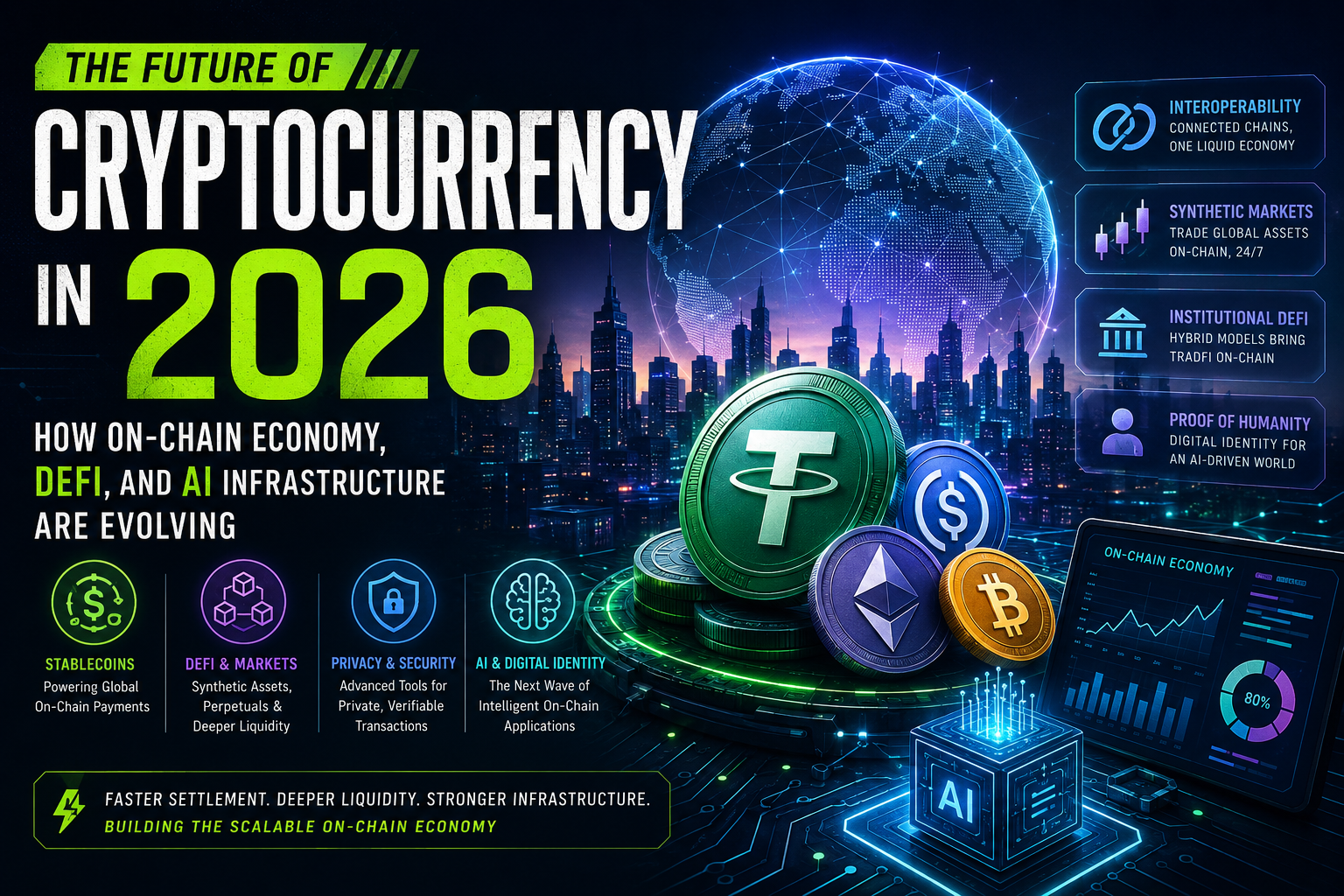
Introduction to the Evolution of Digital Assets and Crypto Market Trends by 2026
The crypto sector has already gone through several cycles of excitement, disappointment, and renewal. Some narratives faded quickly, while others quietly turned into real foundations. Today, stablecoins are no longer just tools for traders, prediction markets have reached a wider audience, and regulation and institutional participation are becoming part of the normal landscape rather than distant promises.
The real question is no longer whether crypto will still exist in a few years, but what kind of digital economy it will support by 2026. Insights from recent industry research, including views shared by Coinbase Ventures, point to a market that is maturing under the surface:
- Faster settlement
- Deeper liquidity
- Better privacy tools
- Blockchains that can finally interact with each other in a more reliable way.
This article looks at the major trends likely to shape that evolution, focusing on market structure, DeFi, and the growing role of AI infrastructure. The goal is not to predict prices, but to understand how the underlying systems and use cases are changing.
⚡ 2026 Crypto Outlook: The "Quiet" Revolution
While the mainstream media focuses on price action, the real shift by 2026 is happening at the infrastructure level. Here are the four pillars of the new on-chain economy:
- Infrastructure: Blockchains are moving away from being "isolated islands" toward a unified, high-speed financial network.
- Synthetic Assets: You no longer need to tokenize a physical asset to trade it; Perpetuals are bringing global macro markets to your wallet.
- Institutional DeFi: The gap between TradFi and DeFi is closing through hybrid models and privacy-preserving tools.
- AI Integration: Crypto is becoming the native payment layer for AI agents and the standard for Proving Humanity.
Building a More Connected, Scalable, and Reliable Blockchain Crypto Infrastructure
Why Stablecoins Are Becoming the Primary Backbone for Global On-Chain Payments
Stablecoins have moved far beyond their early role as simple trading pairs. Today, they act as digital representations of fiat value on open networks, used for remittances, cross-border transfers, and on-chain settlement between applications.
By 2026, this role is likely to expand even further. More wallets, exchanges, and fintech platforms are integrating stablecoin payments directly, turning them into a parallel settlement layer that is often faster and cheaper than traditional banking rails. The real breakthrough here is not speculation, but reliability: better compliance tools, clearer rules in major jurisdictions, and enough liquidity to support large, real-world flows of capital.
Improving Cross-Chain Interoperability and Achieving Faster Blockchain Settlement Speeds
A multi-chain ecosystem only works if value and data can move safely between networks. In the past, this process was slow and risky, relying on complex bridges and long waiting times. New approaches based on stronger cryptographic proofs and more robust verification models are dramatically reducing settlement delays. This shift has practical consequences:
-
Capital efficiency improves because assets are no longer locked in transit for long periods.
-
Market participants can manage risk more actively as price differences between chains are corrected faster.
-
Over time, this makes blockchains feel less like isolated platforms and more like parts of a shared financial network.
How Deep Crypto Market Liquidity and Advanced On-Chain Privacy Tools Are Maturing
Even during periods of weak price action, overall market liquidity has continued to improve. Deeper liquidity reduces the impact of large trades, stabilizes markets, and makes derivatives and hedging strategies more practical on-chain. This is a key requirement if decentralized finance wants to compete with traditional financial venues.
At the same time, privacy tooling is becoming more sophisticated. The objective is not to hide activity completely, but to protect sensitive information such as trading strategies, portfolio allocations, or business transactions, while keeping systems verifiable. This balance is especially important for professional users and institutional investors.
The Massive Expansion of Crypto Perpetual Futures Markets Beyond Native Digital Assets
What Are Crypto Perpetual Futures and How Do Funding Mechanisms Work?
Perpetual futures, often called "perps", are derivative contracts that track an asset’s price without an expiration date. Their price stays close to the spot market through funding mechanisms between long and short traders. In crypto, these products are already among the most heavily traded instruments because they are flexible and capital-efficient.
Gaining Synthetic On-Chain Exposure to Real-World Assets (RWAs) Without Tokenization
The next stage is extending this model to real-world assets (RWAs) such as equities, commodities, or economic indicators. Instead of tokenizing these assets directly—a process that can be legally and operationally complex—perpetual contracts can provide synthetic exposure to their price movements. This approach avoids many of the barriers of tokenization. There is no need for custody of the underlying asset or complex legal structures; what matters is a reliable price feed (oracles) and a well-designed market mechanism.
Exploring New Decentralized Markets and the Rise of On-Chain Macroeconomic Trading
This development opens two important doors:
-
New Asset Classes: It becomes possible to create markets around data that was previously difficult or impossible to trade, such as private company valuations, niche datasets, or specific economic indicators. Information that had no clear market price could become tradable.
-
Macro Trading: It brings macro-style trading tools directly on-chain. Exposure to oil prices, inflation expectations, credit conditions, or volatility can be expressed through decentralized infrastructure, turning crypto markets into something closer to a global, always-on macro trading environment.
The Next Generation of Decentralized Exchanges (DEXs) and Advanced Crypto Trading Interfaces
Proprietary Automated Market Makers (AMMs) and Implementing Tighter On-Chain Market Control
Most decentralized exchanges (DEXs) rely on user-supplied liquidity pools. While this model enabled DeFi to scale, it also exposed liquidity providers (LPs) to risks such as impermanent loss and aggressive trading strategies. An alternative approach is the proprietary AMM, where the protocol itself provides liquidity using its own capital and rules. This allows for tighter control over spreads, risk management, and access conditions, making the exchange behave more like a professional market maker while remaining on-chain.
On high-performance networks, some platforms are already testing designs where trades are routed through aggregators and direct interaction with pools is restricted. The aim is to improve market quality and reduce harmful trading behavior, even before major base-layer upgrades are deployed.
The Growing Role of Decentralized Aggregators for Blockchain-Based Prediction Markets
Prediction markets are one of the clearest examples of a crypto application reaching a broader audience. They turn collective expectations about events—political, economic, or otherwise—into tradable prices.
However, liquidity is currently fragmented across many platforms. Aggregation layers that unify markets, odds, and positions into a single interface are a natural next step. For users, this means better price discovery and easier portfolio tracking. For the ecosystem, it means more efficient use of liquidity and more professional trading workflows.
Top Three Structural DeFi Trends Shaping the Future of Decentralized Finance
1: Integrating Decentralized Derivatives Platforms with Crypto Lending Protocols
Traditionally, lending protocols and derivatives platforms were separate worlds. New designs are beginning to merge these functions, allowing users to deposit collateral, earn yield, and use that same collateral to open leveraged positions. Given the massive volume already flowing through perpetual markets, this integration could significantly change how capital is used on-chain, making hedging, yield generation, and leverage management more interconnected.
2:Overcoming the Challenges of Unsecured Credit and Undercollateralized Lending in DeFi
In traditional finance, a large share of lending is unsecured. In DeFi, borrowing is still mostly overcollateralized, which limits its reach. The next phase may involve combining on-chain behavior data with off-chain identity and reputation signals to build more flexible credit models. This requires careful risk assessment, better identity frameworks, and closer alignment with regulatory expectations.
3: Implementing Cryptographic Privacy as a Built-In Feature for Decentralized Finance
Full transparency is useful for audits, but it is not ideal for everyday financial activity. This is why privacy-preserving systems—such as encrypted order books, private lending positions, and selective disclosure mechanisms—are likely to become more common. Some of these solutions will live on specialized networks, while others will be added as cryptographic layers on top of existing blockchains.
Going Beyond Finance: The Intersection of Crypto, Artificial Intelligence (AI), and Digital Identity
Leveraging Decentralized Blockchain Data Networks for Robotics and Embodied AI Systems
Modern robotics and embodied AI systems depend on large volumes of real-world interaction data. Collecting this data is expensive and slow. Decentralized incentive networks can coordinate global data collection by rewarding contributors and giving developers access to diverse datasets, extending the economic logic of crypto beyond purely financial use cases.
Developing Proof-of-Humanity Mechanisms for Cryptographic Digital Identity in an AI-Driven World
As AI-generated content becomes more widespread, distinguishing humans from automated systems becomes harder. This creates demand for Proof-of-Humanity mechanisms based on biometrics, cryptographic identity, or open standards. Multiple approaches are likely to coexist, each balancing privacy, security, and usability in different ways.
Utilizing AI-Assisted Tools for Secure Smart Contract Generation and On-Chain Development
Building secure smart contracts is still slow and demanding. By 2026, AI tools could automate parts of this process: generating code, testing it, scanning for vulnerabilities, and monitoring deployed contracts. This could lower barriers to entry and speed up experimentation, while still requiring human oversight for critical systems.
Conclusion: Preparing for the Next Phase of the Scalable On-Chain Crypto Economy in 2026
By 2026, crypto is likely to look less like a collection of disconnected experiments and more like a coherent digital economy built on stable payment rails, faster settlement, deeper liquidity, and more practical privacy tools. Perpetual markets will extend beyond native crypto assets, exchanges will adopt more sophisticated market structures, and DeFi will continue exploring new forms of credit and risk management.
At the same time, the boundary between crypto, AI, and data networks will keep shrinking. The next phase of the industry will not be defined by a single narrative, but by how well these systems work together to support real, scalable on-chain activity.
Frequently Asked Questions on the Transition to a Scalable On-Chain Economy and Real-World Asset Trading
Q1: What is the real-world utility of stablecoins beyond trading?
Most people still view stablecoins as a temporary parking spot between trades, but the narrative is shifting toward them becoming a global payment standard. The discussion now focuses on how stablecoins can bypass the high fees and 3-5 day waiting periods of traditional SWIFT transfers, effectively acting as a decentralized version of a global savings or checking account.
Q2: How can we balance on-chain transparency with personal financial privacy?
The public ledger aspect of crypto is a major hurdle for mainstream adoption, as total transparency can be a privacy nightmare. The next major milestone is the integration of Zero-Knowledge Proofs (ZKPs) and private order books, which allow users to verify their solvency or execute trades without revealing their entire wallet balance to the public.
Q3: What is the intersection of AI agents and decentralized payment rails?
There is a growing technical debate about how autonomous AI agents will manage resources. Since AI cannot open traditional bank accounts or sign legal contracts, the consensus is that they will use crypto wallets to pay for computing power and data. This makes blockchain the native currency for the AI economy, moving the conversation away from speculation toward functional infrastructure.
Q4: How does synthetic exposure compare to the direct tokenization of real-world assets?
While tokenizing physical assets like real estate is legally complicated, the community is increasingly looking at perpetual contracts as a faster alternative. Instead of dealing with the red tape of owning a physical share or commodity, users are using decentralized price feeds (oracles) to trade the price movements of these assets directly on-chain, providing 24/7 access to global macro markets.