Solar Dominance: A New Era
We have officially entered the era of Solar Dominance. In most parts of the world, capturing photons from the sun is now fundamentally cheaper than digging up and burning fossil fuels. For the digital entrepreneur—the miner, the data center operator, the AI infrastructure builder—this shift is a dream come true.
However, as anyone who has ever managed a high-density computing array knows, cheap energy is useless if it isn't consistent. The Solar Wall is a real thing. It’s that moment at 6:00 PM when production drops, or that three-day stretch of heavy cloud cover when your hash rate plummets and your overhead skyrockets.
To fix this, we’ve leaned heavily on Lithium-ion batteries. But let’s be honest: Lithium was designed for phones and cars—fast, light, and expensive. It was never meant to power a global industrial grid for days on end. If we want to truly decouple the digital economy from the traditional power grid, we need a storage solution that is as cheap and abundant as the sun itself. Ironically, that solution isn't found in rare earth metals or complex chemicals. It’s found in iron, water, and air.
Energy Storage for Crypto Mining and AI: The "Intelligence Per Watt" Challenge
In the world of cryptocurrency mining and high-performance computing (HPC), success is measured by a very specific metric: Intelligence Per Watt. Every joule of energy must be squeezed for maximum computational output.
In regions like Algeria or the American Southwest, specialized solar technologies—like bifacial panels that catch reflected light from the desert floor—are already pushing the boundaries of what’s possible during the day. But the digital economy does not sleep. A mining rig doesn't care if it's midnight or if there’s a sandstorm outside; it needs a steady, unwavering flow of electrons.
Currently, when solar production dips, operators are forced back onto the grid, exposing them to volatile electricity rates and "peaker plant" surcharges. To achieve true energy independence, we don't just need a battery; we need a reservoir. We need a way to capture the massive surplus of daytime solar energy and dispatch it over a 100-hour window. This is where the limitations of Lithium-ion become a structural liability.
Limitations of Lithium-Ion Batteries for Long-Duration Energy Storage
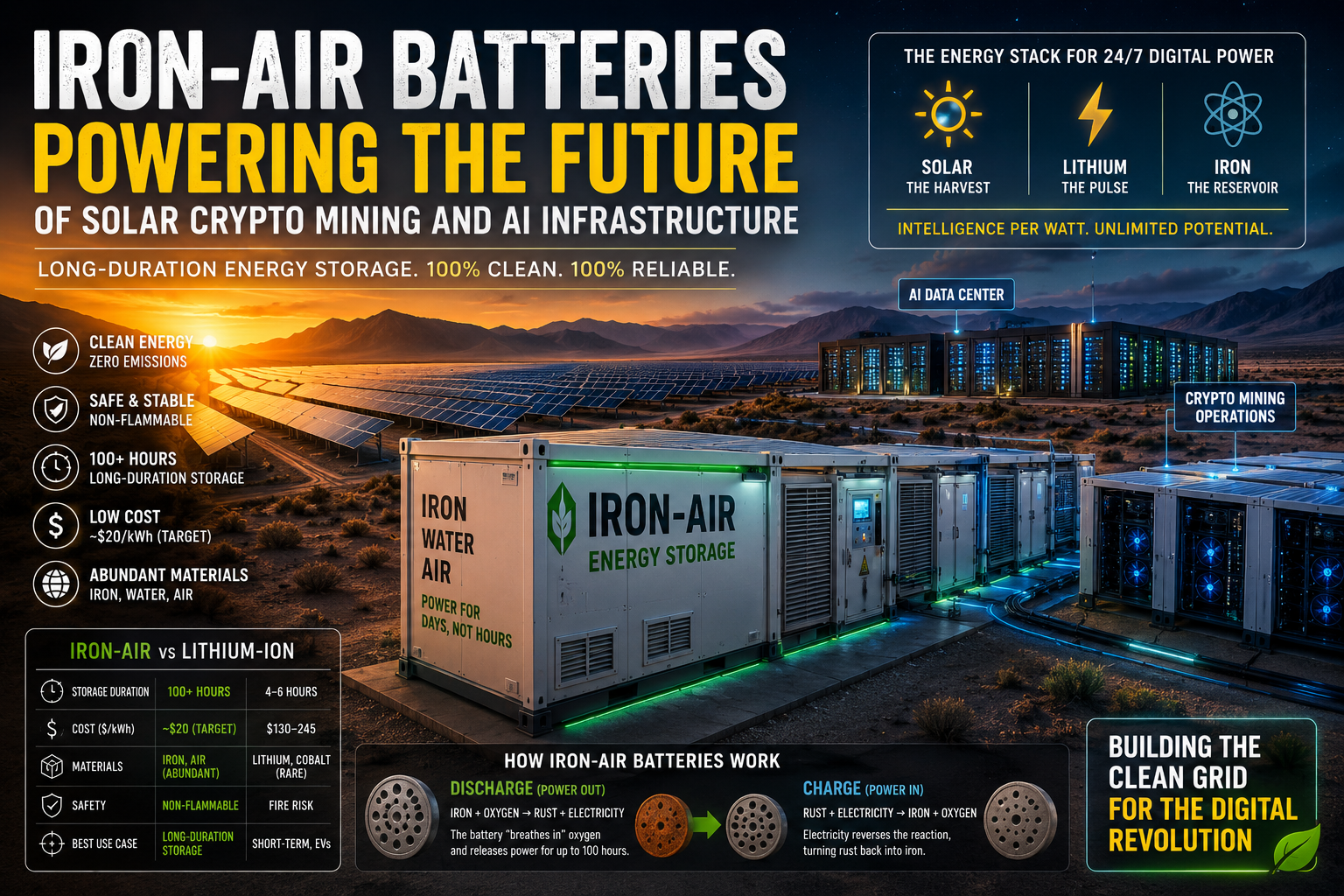
The table below highlights why lithium-ion batteries struggle with long-duration energy storage compared to iron-air systems.
| Feature | Lithium-ion | Iron-Air |
|---|---|---|
| Storage Duration | 4–6 hours | 100+ hours |
| Cost ($/kWh) | $130–245 | ~$20 (target) |
| Materials | Lithium, Cobalt (Rare) | Iron, Air (Abundant) |
| Safety | Fire Risk | Non-flammable |
| Response Speed | Very Fast | Slow |
| Best Use Case | Short-term, EVs | Long-duration storage |
Lithium-ion is the gold standard for a reason. It is incredibly energy-dense and responds almost instantly to power demands. This makes it perfect for frequency regulation—balancing those tiny millisecond flickers in the grid—and for electric vehicles.
However, Lithium-ion has a major "duration problem." Most large-scale Lithium installations, like the massive 300-megawatt units in California, are designed to discharge for only four to six hours. Beyond that, the economics fall apart. According to Lazard’s Levelized Cost of Storage (LCOS), these systems cost between $130 and $245 per megawatt-hour. If you tried to scale a Lithium-ion bank to cover a 100-hour solar lull, the capital expenditure would be so high it would eat your entire mining profit for the next decade. Furthermore, Lithium is rare. To power the entire world’s digital infrastructure with it, we would need to mine an impossible amount of material. We need a solution that scales horizontally, using materials we already have in massive quantities.
How Iron-Air Batteries Work: The Science of Reversible Rust
This brings us to a concept that sounds almost like science fiction: the Iron-Air battery. While the modern hype is led by companies like Form Energy, the tech actually dates back to NASA research in 1968. The reason it’s only becoming a reality now is because we’ve finally mastered the materials science and the software modeling required to make it efficient.
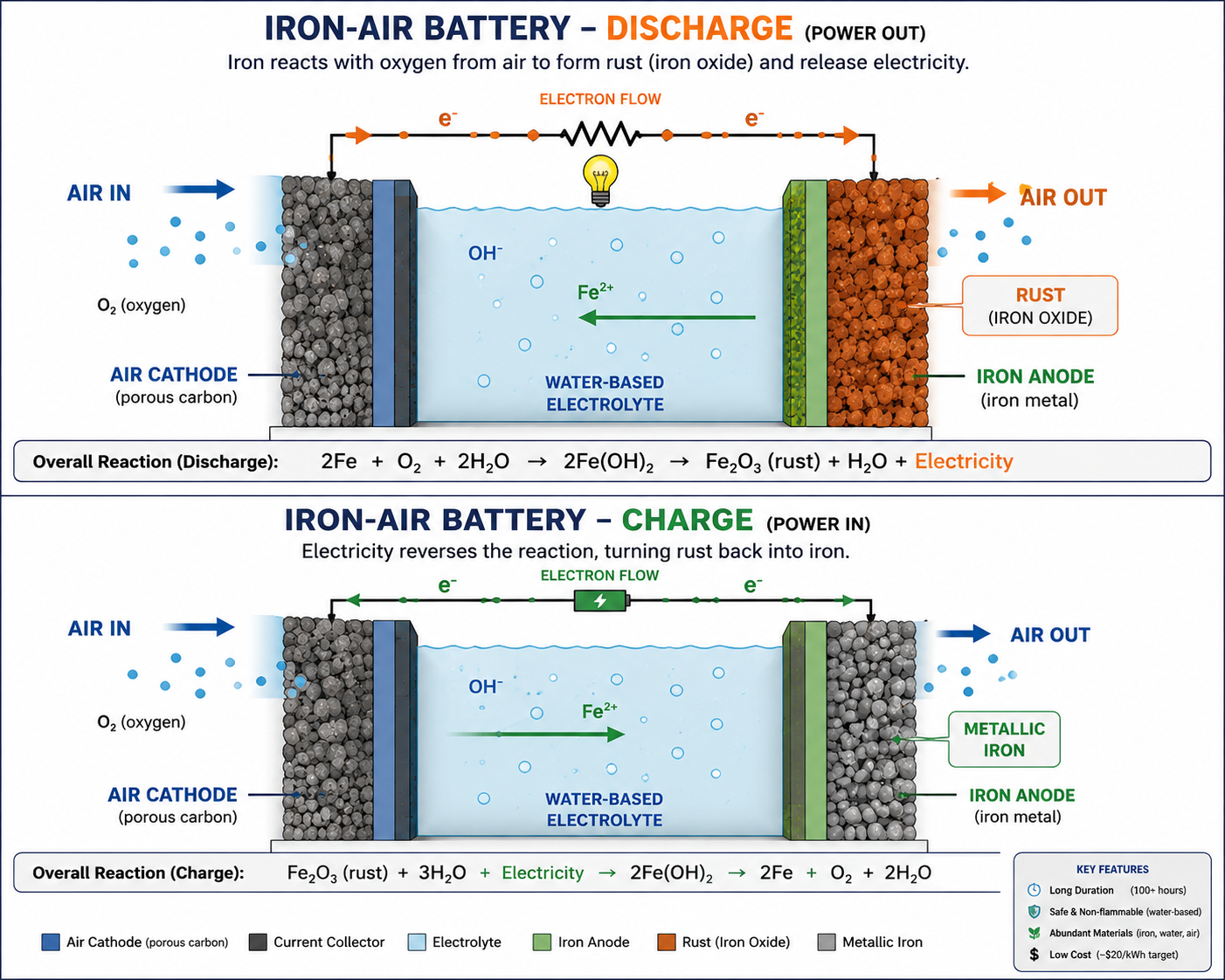
The core of the battery is a simple, reversible chemical reaction known as "redox" (reduction-oxidation). Inside a module, you have stacks of cells filled with a water-based, non-flammable electrolyte—similar to the liquid inside a standard AA battery. On one side, you have an anode made of iron pellets; on the other, an "air-breathing" cathode.
Iron-Air Battery Discharge Cycle: Generating Power from Rust
When your solar panels stop producing and your mining rigs need power, the battery "breathes in" oxygen from the air. This oxygen reacts with the iron pellets, turning them into iron oxide—literally rust. This chemical reaction releases a steady stream of electrons that are harvested and sent to your power distribution units. This isn't a fast burst; it’s a slow, steady "exhale" that can last for up to four days (100 hours).
Iron-Air Battery Charging Cycle: Storing Solar Energy Efficiently
The next morning, when your solar array starts overproducing energy, you send that excess electricity back into the battery. This current reverses the reaction, "eating" the oxygen and turning the rust back into metallic iron pellets. You are essentially "un-rusting" the metal to store energy for the next night or the next storm.
Iron-Air vs Other Long-Duration Energy Storage Technologies (LDES)
When we look at the landscape of long-duration energy storage (LDES), Iron-Air isn't the only player, but it’s currently the most compelling for industrial-scale digital infrastructure.
Iron Flow Batteries for Grid Storage: Pros and Limitations
Companies like ESS are working on "Iron Flow" systems. Instead of solid pellets, they use a liquid electrolyte that circulates through the system. They’ve solved the historical issue of hydrogen buildup using "proton pumps" to maintain efficiency. However, these systems are usually optimized for 12 to 16 hours. They are perfect for "cycling the sun" into the night, but they aren't designed to survive a three-day weather event.
While iron-air batteries offer a scalable solution for long-duration energy storage, their real advantage comes from the global abundance of iron. Unlike lithium, which is limited and costly to extract, iron is widely available across multiple regions. This widespread availability makes iron-air technology more suitable for large-scale deployment, especially in countries with significant iron ore reserves.
| Country | Iron Ore Reserves | Strategic Value |
|---|---|---|
| Australia | ~58 Billion Tons | Global leader, export powerhouse |
| Russia | ~35 Billion Tons | Geopolitical leverage |
| Brazil | ~34 Billion Tons | High-grade iron |
| China | ~20 Billion Tons | High demand, lower quality ore |
| India | ~5.5 Billion Tons | Growing production |
| Canada | ~6 Billion Tons | Stable supply |
| Ukraine | ~6.5 Billion Tons | Geopolitical risk |
| Iran | ~3.8 Billion Tons | Sanctions impact |
| Algeria (Gara Djebilet) | ~3.5 Billion Tons | Untapped strategic resource for energy storage |
Zinc-Air Batteries: Performance, Cost, and Technical Challenges
Zinc-air batteries operate on a similar principle to iron but use grains of zinc. While zinc is energy-dense, it is prone to dendrite formation, which can damage the battery over time and reduce its lifespan. Additionally, the cost of zinc-based systems remains higher than iron-air, limiting their scalability for large infrastructure projects.
Aluminum-Air Batteries: Why They Are Not Fully Rechargeable
Aluminum is incredibly safe and dense, but current versions aren't "rechargeable" in the traditional sense. You can't just plug them into a solar panel. You have to physically replace the aluminum plates once they are spent and send them back to a factory for recycling. For a stationary mining site, this logistics chain is usually too complex and expensive.
From Lab to Reality: Iron-Air Battery Commercialization and the Weirton Factory
The "Valley of Death" and the Weirton Milestone
For years, skeptics argued that Iron-Air was "lab-ware"—technology that works on a bench but fails in the real world. That argument died in 2025. Form Energy successfully crossed the "Valley of Death" (the gap between a startup and a commercial manufacturer) by opening a massive factory in Weirton, West Virginia.
By repurposing an old steel mill site, they’ve tapped into the existing supply chain for iron ore. They are now shipping modular units to utility partners like Great River Energy in Minnesota. These units are shipped "dry," meaning they don't contain the liquid electrolyte during transport. This drastically reduces shipping costs and environmental risks. Once the units arrive at the solar site, the water-based electrolyte is mixed and poured in—a simple, scalable solution for global deployment.
AI Modeling and Simulation for Energy Storage Optimization
Modeling the Future: Hardware is only half the battle. To run a profitable digital infrastructure, you need to know exactly how much storage you need. If you overbuild, you waste capital; if you underbuild, your rigs go dark.
This is where advanced modeling software like Formware comes in. By analyzing decades of hourly weather data, these tools can simulate how a 100-hour battery would have performed during the worst storms of the last 20 years. This data-driven approach is proving that a hybrid system—combining Lithium-ion for quick response and Iron-Air for the long haul—can replace 80% of fossil-fuel "peaker" plants. For a miner, this means a 100% clean, 100% reliable uptime profile.
Best Energy Storage Solution by Use Case: Solar, Data Centers, and Crypto Mining
| Scenario | Best Solution | Performance |
|---|---|---|
| Night-time | Lithium-ion | Fast |
| 3-day cloudy | Iron-Air | Excellent |
| AI data center | Hybrid | Optimal |
| Crypto mining | Iron-Air | Stable |
| Grid spikes | Lithium | Instant |
Future of Energy Infrastructure: Iron-Air Batteries and the Clean Grid
Conclusion: The New Energy Blueprint
The energy transition is no longer just about generating "green" power; it’s about making that power "dispatchable." For the innovators in the cryptocurrency and digital technology space, the Iron-Air battery represents the missing link. By leveraging "reversible rust," we can finally build a digital economy that isn't at the mercy of the weather or the grid.
We are moving toward a modular, scalable energy stack: Solar for the harvest, Lithium for the pulse, and Iron for the long-term reservoir. In this new world, the "intelligence per watt" we can generate is limited only by our ability to build the infrastructure to hold it.
This article is based on data and analysis from leading global energy organizations, research institutions, and industry reports to ensure accuracy and reliability.
FAQ: Iron-Air Batteries and Long-Duration Energy Storage
Q1: What is an iron-air battery and how does it work?
An iron-air battery is a long-duration energy storage system that uses iron, water, and oxygen to store and release electricity. During discharge, iron reacts with oxygen to form rust and generate power. During charging, electricity reverses the process, turning rust back into iron, allowing repeated cycles.
Q2: Why are iron-air batteries better than lithium-ion for long storage?
Iron-air batteries are designed for multi-day storage, up to 100 hours, while lithium-ion typically lasts only 4–6 hours. They are also much cheaper because iron is abundant and low-cost. This makes them ideal for large-scale applications like solar farms, data centers, and crypto mining operations.
Q3: Can iron-air batteries power data centers and mining farms continuously?
Yes, iron-air batteries are specifically designed to provide stable, long-duration power. They can store excess solar energy during the day and supply electricity for several days, ensuring uninterrupted operation for data centers, AI infrastructure, and cryptocurrency mining facilities.
Q4: Are iron-air batteries safe compared to lithium batteries?
Iron-air batteries are significantly safer because they use water-based, non-flammable electrolytes. Unlike lithium-ion systems, they do not carry a risk of thermal runaway or fire, making them suitable for industrial environments and sensitive computing infrastructure.
Q5: What is the cost advantage of iron-air energy storage systems?
Iron-air batteries target a cost of around $20 per kilowatt-hour, which is far lower than lithium-ion systems. This cost advantage makes them highly attractive for scaling renewable energy storage and reducing dependence on expensive grid electricity.
Q6: Will iron-air batteries replace fossil fuel backup power?
Iron-air batteries have the potential to replace a large portion of fossil-fuel-based backup systems, especially peaker plants. When combined with lithium-ion for fast response, they create a hybrid system capable of delivering reliable, clean energy for extended periods.
Q7: What are the main trade-offs of Iron-Air batteries?
They have lower round-trip efficiency (40–60%) and a larger physical footprint compared to Lithium-ion. This makes them unsuitable for cars or phones, but they are the most cost-effective solution for stationary industrial sites where space is available and long-term storage is the priority.
Author: Energy & Mining Infrastructure Analyst