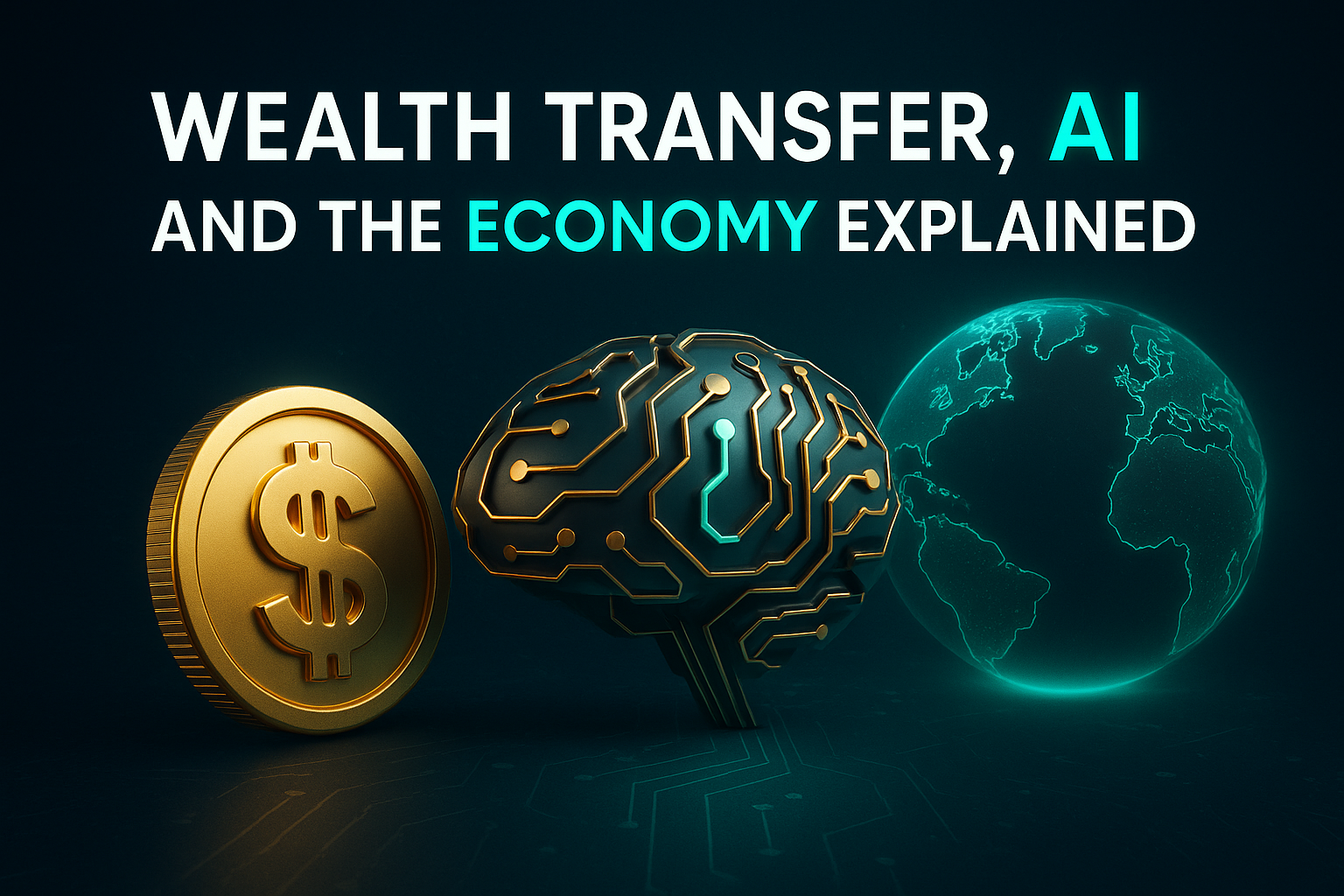
Generational Wealth Transfer, Artificial Intelligence, and Why the Current Economy Is Not a Bubble
Something fundamental is changing in the global economy—and most people are misreading it.
For nearly 25 years, global wealth has remained heavily concentrated in the hands of a single demographic group.
The Baby Boomer generation still controls a disproportionate share of the world’s capital, and more importantly, they are at a completely different stage of life, risk tolerance, and technological adoption than the generations following them. This fact alone explains why today’s economic cycle looks nothing like the bubbles of the past.
This analysis is based on macroeconomic trends, demographic data, and industry research on artificial intelligence and productivity.
What we are experiencing now is not a debt-driven boom, not a housing bubble, and not a speculative frenzy fueled by cheap borrowing. There is no widespread leverage coming from young investors taking loans to gamble on assets. Instead, capital expenditures are being deployed almost exclusively by large corporations that already sit on massive cash reserves. The money is real, the balance sheets are strong, and the drivers are structural, not emotional.
This is precisely why comparisons to the dot-com bubble consistently fail.
Why This Is Not a Traditional Economic Bubble
| Analysis Metric | 2000 / 2008 Bubbles | 2026 Structural Shift |
|---|---|---|
| Capital Driver | High Retail Leverage & Cheap Debt | Massive Corporate Cash Reserves |
| Labor Dynamics | Growth Tied to Human Job Creation | Growth Driven by "Invisible" AI Agents |
| Tech Maturity | Speculative Hype & Future Promises | Real Efficiency & Margin Expansion |
| Demographics | Wealth Concentrated in Older Cohorts | Start of the Great Wealth Transfer |
| Velocity | Siloed, Traditional Banking Rails | Financial Automation via Stablecoins |
Wealth Concentration Among Baby Boomers and Its Impact on Technology Adoption
The people who currently control most of the world’s wealth are not the ones aggressively adopting new technology. They are cautious, capital-preserving, and largely skeptical of decentralized systems like Bitcoin. Their investment mindset was shaped in an era of traditional finance, real estate, and institutional trust.
At the same time, the demographic that understands, adopts, and actively uses emerging technologies—AI, crypto, automation tools—controls the least amount of capital. This disconnect is one of the defining features of the current economic transition.
However, this imbalance is not permanent.
The Global Generational Wealth Transfer Already Reshaping the Economy
What is coming is not a sudden collapse, but a slow and persistent transfer of money from older generations to younger ones. It happens through inheritance, subsidies, financial support, and indirect wealth distribution. Parents help cover rent in expensive cities. Families support lifestyles that incomes alone could not sustain. This keeps the economy moving, but it also masks deeper structural dissatisfaction.
The world feels expensive not only because governments print money, but because wealth has already been partially redistributed in informal ways to prevent social instability. This creates a strange paradox: economic activity continues, yet consumer confidence remains historically low.
This dissatisfaction is not accidental. It is a core feature of generational transition.
The Fourth Turning: Generational Cycles and the Role of Artificial Intelligence
When viewed through the lens of long-term generational cycles, this period fits perfectly into what many describe as a “Fourth Turning” — a painful but necessary restructuring phase. Historically, these periods end with new systems, new rules, and new winners.
What makes this cycle different is speed.
Artificial intelligence is compressing timelines. Transitions that once took decades are now happening in years. Older capital holders are slower to adapt, while younger users integrate AI into daily workflows, income generation, and decision-making at an accelerating pace.
Power does not shift because people are entitled to it. It shifts because they know how to use the tools of their time more effectively.
GDP Growth Without Job Creation: Understanding the New Economic Pattern
One of the most misunderstood aspects of today’s economy is GDP growth. Headline numbers suggest strength, yet job creation has stagnated. Over recent months, job growth has been minimal, and once adjusted, potentially flat.
Yet GDP continues to expand, while the rapid expansion of AI data centers is creating a new source of productivity and electricity demand.
By definition, this means productivity is rising. Companies are generating more output without hiring more people. Revenues are growing, margins are expanding, and efficiency is improving. This is not theoretical—it is visible in earnings reports across multiple sectors.
The economy is growing, but not through human labor in the traditional sense.
AI Agents, Automation, and the Rise of the Invisible Digital Workforce
The idea of employment is subtly changing. These days, companies are using AI, automation, and digital workers to perform tasks that were once handled by human staff. These systems are not counted in labor statistics, but they directly contribute to execution, efficiency, and profitability. In many cases, a small cluster of AI agents can effectively replace a human role, even though they never appear in official employment figures.
This creates a growing gap between economic performance and public perception. Economically speaking, these agents are workers. Statistically, however, they remain invisible.
This convergence between computing, automation, and physical infrastructure is becoming increasingly important as AI and crypto mining power infrastructure compete for reliable and cost-effective electricity.
Stablecoins, Financial Automation, and the Increasing Velocity of Money
Another underappreciated force is the rise of stablecoins integrated with AI-driven systems. As transaction friction decreases and automation increases, the velocity of money rises. More transactions occur in less time, with fewer intermediaries and lower costs.
Higher velocity does not require more debt or more people. It simply requires better systems.
This dynamic alone has the potential to boost GDP without relying on old methods such as housing bubbles or excessive consumer credit.
Asset Prices in a High-Productivity, AI-Driven Economy
When productivity rises while the number of workers remains flat, capital benefits disproportionately. Company profits grow, equity valuations increase, and assets appreciate—even if wages fail to keep pace. This is why financial markets can perform well even when public economic sentiment is weak.
Bitcoin, in this context, is more than a speculative instrument. It aligns with demographic shifts and technological change. It is not about short-term price movements, but about positioning within a world where trust, productivity, and power are being redefined.
2025–2030 Economic Transition: Why the Next Decade Will Reshape Wealth and Power
This transition is neither smooth nor comfortable. It generates frustration, unequal outcomes, and political tension. But it is also unavoidable. Systems built for a previous era cannot efficiently support the next one.
Those who harness AI, understand decentralized systems, and operate within this new productivity framework will accumulate influence and wealth—not because of speculation, but because of structural advantage.
This is not a bubble. This is a realignment.
Understanding these shifts is no longer optional. It is becoming a requirement for anyone looking to stay ahead in the next economic cycle.
FAQ: Generational Wealth Transfer, AI, and the Future of the Global Economy
Q1: What is the generational wealth transfer?
The generational wealth transfer refers to the gradual movement of capital from older generations—particularly Baby Boomers—to younger generations through inheritance, gifts, and financial support. Over the coming decades, trillions of dollars are expected to move between generations, reshaping investment behavior, asset allocation, and the adoption of new technologies.
Q2: Why is the current economic cycle different from past financial bubbles?
Unlike past bubbles driven by excessive debt or speculative borrowing, the current cycle is largely funded by corporate capital expenditure and strong balance sheets. Large companies are investing heavily in artificial intelligence, automation, and infrastructure using existing cash reserves rather than cheap leverage.
Q3: How is artificial intelligence affecting economic productivity?
Artificial intelligence is increasing productivity by automating tasks that previously required human labor. Companies can now generate more output with fewer employees by using AI tools, automation systems, and digital workers, which contributes to GDP growth without traditional job expansion.
Q4: Why can GDP grow even if job growth is slow?
GDP can rise without strong job growth when productivity increases. If businesses produce more goods or services using automation, software, or AI systems, overall economic output grows even if the number of human workers stays the same or increases slowly.
Q5: What role do AI agents play in modern businesses?
AI agents function as digital workers that can handle tasks such as research, data analysis, coding, customer service, and operational workflows. Although they are not counted in official labor statistics, they significantly increase company efficiency and productivity.
Q6: How could stablecoins influence the global economy?
Stablecoins can reduce transaction costs, increase financial automation, and accelerate the velocity of money. Faster and cheaper transactions enable more economic activity within the same financial system, which can indirectly support economic growth without increasing debt levels.
Q7: Why do financial markets rise even when people feel the economy is weak?
When productivity increases through automation and technology, corporate profits often grow faster than wages. This benefits capital owners and investors, causing asset prices such as stocks and digital assets to rise even if consumer sentiment or wage growth remains weak.
Q8: How does Bitcoin fit into this economic transition?
Bitcoin aligns with broader technological and generational shifts toward decentralized systems and digital assets. As younger generations gain more financial influence and trust in traditional institutions evolves, Bitcoin may play a growing role as a store of value and financial infrastructure within a changing global economy.