Introduction
So, what is this new crazy thing that just came out for Kaspa again? That’s exactly what I want to talk about here, because honestly, Kaspa keeps surprising people. If you like this kind of content, don’t forget to drop a like, subscribe to the channel if you’re not already subscribed, and if you want to support the work, you can always do so. If you don’t want to, that’s totally fine too. Everything I talk about here is based on my own experience as a crypto miner since 2018–2019, where I constantly test hardware, run machines, and try to identify interesting coins for speculative crypto mining, always aiming to get into projects as early as possible. Of course, none of this is financial advice.
What Is WarpCore? The New Kaspa Industrial Initiative Middleware
Now, let’s get into the real topic. After V-PROG, there is yet another crazy development coming to Kaspa, and this one is called WarpCore. It’s important to be clear right away: this is not something developed directly by the Kaspa Foundation or the core Kaspa developers. This project is being built by a parallel initiative called the Kaspa Industrial Initiative, and WarpCore is their own independent project. Naturally, the first reaction is: what is this thing again, what are we talking about this time?
How WarpCore Connects Kaspa to ISO 20022 and Traditional Banking Systems
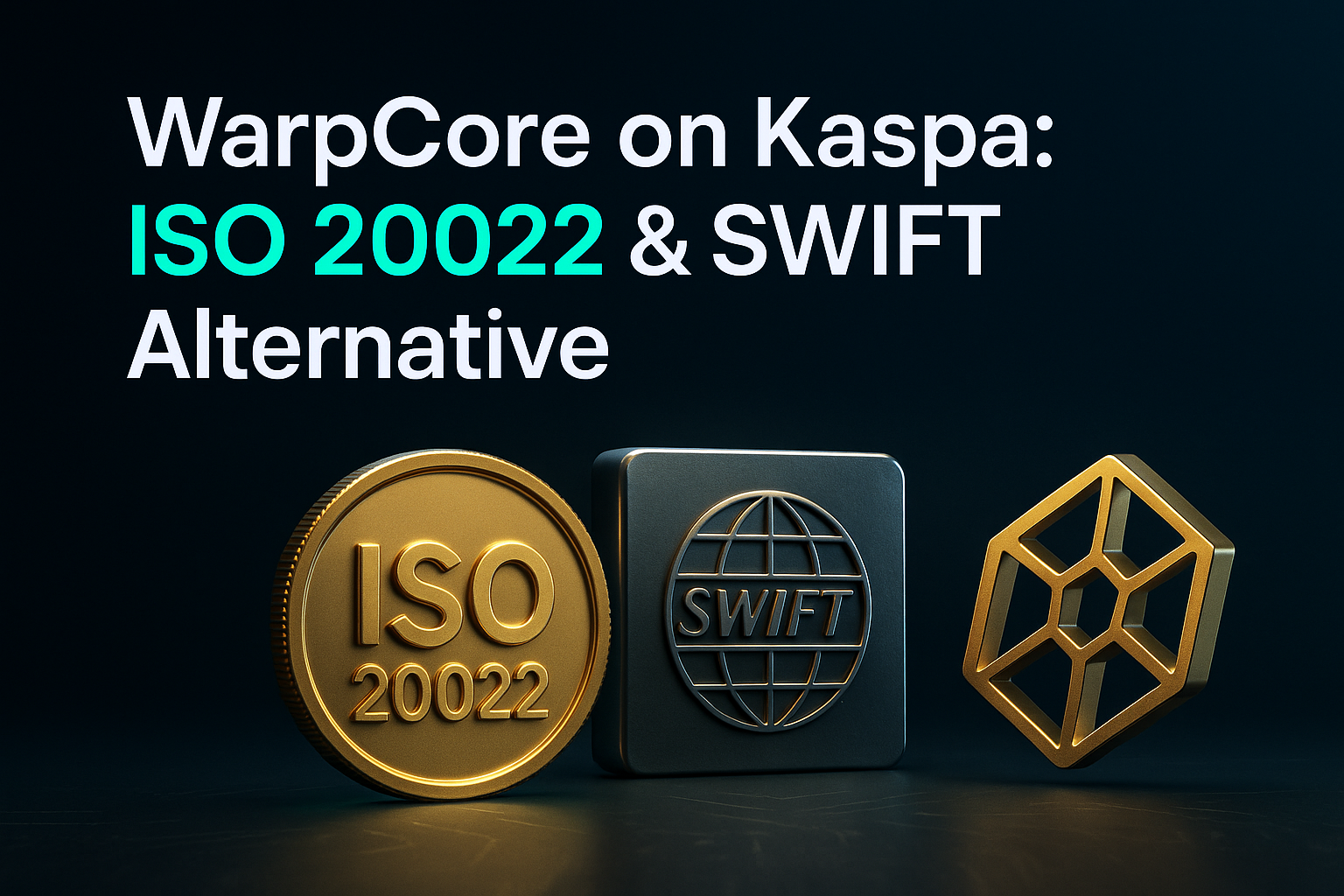
WarpCore is what we call a middleware, meaning a piece of software that acts as an intermediary layer. In practice, it behaves like a universal adapter, mainly designed for the ISO 20022 standard. ISO 20022 is the current standard used by traditional financial institutions to communicate with each other, especially through systems like SWIFT, to move money between banks. And this is where things become really interesting, because Kaspa could effectively be used as a way to transfer money almost instantly between banks, from one country to another, putting it in direct competition with XRP, but with very important structural differences.
Kaspa vs SWIFT: Faster, Cheaper Cross-Border Transfers Using BlockDAG
| Feature | SWIFT | XRP (Ripple) | Kaspa + WarpCore |
|---|---|---|---|
| Settlement Speed | 3–5 days | Seconds | Near-instant |
| Transaction Cost | High (multiple intermediaries) | Low | Very low |
| Intermediaries | Multiple banks | Minimal | None (direct transfer) |
| Technology | Centralized messaging network | Blockchain | BlockDAG (Kaspa) |
| Decentralization | No | Partially centralized | Fully decentralized |
| Security Model | Trusted institutions | Consensus-based | Proof of Work |
| ISO 20022 Compatibility | Native | Integrated | Via WarpCore middleware |
| Infrastructure Change Required | No | Partial | No (frictionless integration) |
This comparison clearly shows that Kaspa, when combined with WarpCore, is not just an incremental improvement over existing systems—it represents a structural shift in how value can move globally.
The big advantage of Kaspa is that it is nearly instant and fully decentralized. The idea itself is actually quite simple when you break it down: Kaspa, combined with WarpCore as an additional layer, can operate within the ISO 20022 framework, using the Kaspa blockchain as the transport layer for value. This is revolutionary because the current SWIFT system is slow, expensive, and heavy. Transfers can take three to five days, mainly because the money doesn’t travel directly from one bank to another. Instead, it passes through several intermediary correspondent banks, and each one takes a fee along the way.
Frictionless Integration: How Banks Can Use Kaspa Without Changing Infrastructure
WarpCore’s solution is what you could call frictionless integration. Banks do not need to modify their existing IT infrastructure. They keep their compliance tools, their messaging systems, and their internal processes, because ISO 20022 is already their native standard. WarpCore simply connects this world to Kaspa’s BlockDAG-based blockchain, which is cutting-edge technology and allows transactions to be confirmed extremely fast. Kaspa’s finality is almost instantaneous, meaning when value is sent, it is received on the other side nearly immediately, thanks to very low block times.
Proof of Work Security and Decentralization: Kaspa vs Ripple (XRP)
Security is another key point. Kaspa relies on Proof of Work, which remains the gold standard for transaction security. Up to now, nothing has proven to be more robust in securing decentralized networks. This is where Kaspa and WarpCore clearly position themselves as a serious alternative to Ripple. Ripple is often criticized for being centralized, while Kaspa has no CEO, no pre-mine, and is an open system that anyone can use, including banks through WarpCore.
KYC, Compliance and Regulatory Alignment in the WarpCore Model
Another major advantage is how KYC is handled. With WarpCore, banks remain fully in control of identity verification and compliance. The blockchain itself does not impose KYC rules. This is very different from Ripple’s approach, where identity checks are often embedded into the system, which many institutions dislike. Here, everything stays at the banking layer, exactly where regulators expect it to be.
How WarpCore Works Step by Step: From ISO 20022 Message to Kaspa Transaction
WarpCore is currently being tested in a sandbox environment for financial institutions, allowing banks to experiment with the system safely. If we look at how it works step by step, the difference with SWIFT is obvious. SWIFT is like a broken telephone game: money moves indirectly, through multiple banks. With WarpCore, you get a direct tunnel. A bank like BNP sends a transfer using ISO 20022, WarpCore instantly translates it into a Kaspa transaction, attaches compliance data without exposing it publicly, sends it across the Kaspa network at high speed, and then translates it back into ISO 20022 on the receiving side, where the destination bank credits the client’s account almost instantly and at very low cost.
The Elephant in the Room: Real-World Hurdles
Look, I love the tech as much as anyone, but let’s get real for a second—building a cool bridge is the easy part. The hard part? Actually getting the big banks to cross it.
First off, you’ve got the liquidity problem. It’s one thing to move a few thousand dollars on a BlockDAG to test things out, but if a bank wants to shift $50 million and the price of KAS swings 5% because of that one transaction, the "savings" on fees vanish instantly. Then there’s the "Ripple" factor. Love them or hate them, Ripple has been wining and dining regulators and central bankers for a decade. They have the relationships, and in the banking world, who you know often matters way more than how fast your blocks are.
Plus, let's be honest: old-school bankers are terrified of anything they can’t control. They like having a "neck to wring" if something goes wrong, and with a truly decentralized, Proof-of-Work network like Kaspa, there is no CEO to call. It’s a massive uphill battle against a system that’s built to be slow and stubborn. Tech alone doesn't win this fight; adoption does.
Why WarpCore Could Change Global Payments Infrastructure
Kaspa is not meant to replace the euro or the dollar. It is simply the vehicle that transports value, an invisible piece of infrastructure that makes instant transfers possible, even between banks within the same country. And that’s exactly why this development matters so much. It’s not flashy on the surface, but it could fundamentally change how money moves across the global financial system.
FAQ: WarpCore, Kaspa and ISO 20022 Integration
Q1: What is WarpCore in the Kaspa ecosystem?
WarpCore is a middleware layer built by the Kaspa Industrial Initiative that connects traditional banking systems using ISO 20022 to the Kaspa blockchain. It acts as a translation and transport layer, enabling banks to send value across Kaspa without changing their existing infrastructure or compliance frameworks.
Q2: Is WarpCore developed by the Kaspa Foundation?
No. WarpCore is not developed by the Kaspa Foundation or the core Kaspa developers. It is an independent project created by the Kaspa Industrial Initiative, designed to explore enterprise and institutional use cases for the Kaspa network.
Q3: How does WarpCore use ISO 20022?
WarpCore integrates directly with ISO 20022, the messaging standard used by global financial institutions. It translates ISO 20022 payment messages into Kaspa blockchain transactions, transmits them across the network, and converts them back into ISO 20022 messages for the receiving bank.
Q4: Can Kaspa replace SWIFT with WarpCore?
WarpCore positions Kaspa as a potential alternative transport layer to SWIFT for cross-border payments. Instead of routing transactions through multiple correspondent banks over several days, value could move nearly instantly over the Kaspa BlockDAG network at lower cost.
Q5: How is Kaspa different from XRP in this model?
Unlike XRP, which is often criticized for centralization, Kaspa operates on Proof of Work with no CEO and no pre-mine. WarpCore allows banks to use Kaspa’s decentralized network while keeping KYC and compliance processes at the institutional level rather than embedding them into the blockchain itself.
Q6: Does WarpCore require banks to change their IT systems?
No. One of WarpCore’s main advantages is frictionless integration. Banks can maintain their existing ISO 20022-based infrastructure, compliance tools, and internal systems while using Kaspa as a fast, decentralized settlement layer.
Q7: Is WarpCore live or still in testing?
WarpCore is currently being tested in a sandbox environment for financial institutions. This allows banks to experiment with integration and cross-border settlement workflows in a controlled setting before any broader adoption.
Q8: Is Kaspa trying to replace fiat currencies like the euro or dollar?
No. In this context, Kaspa acts as a transport layer for value, not as a replacement for national currencies. It serves as infrastructure that enables faster and more efficient transfers between banks while fiat currencies remain the unit of account.