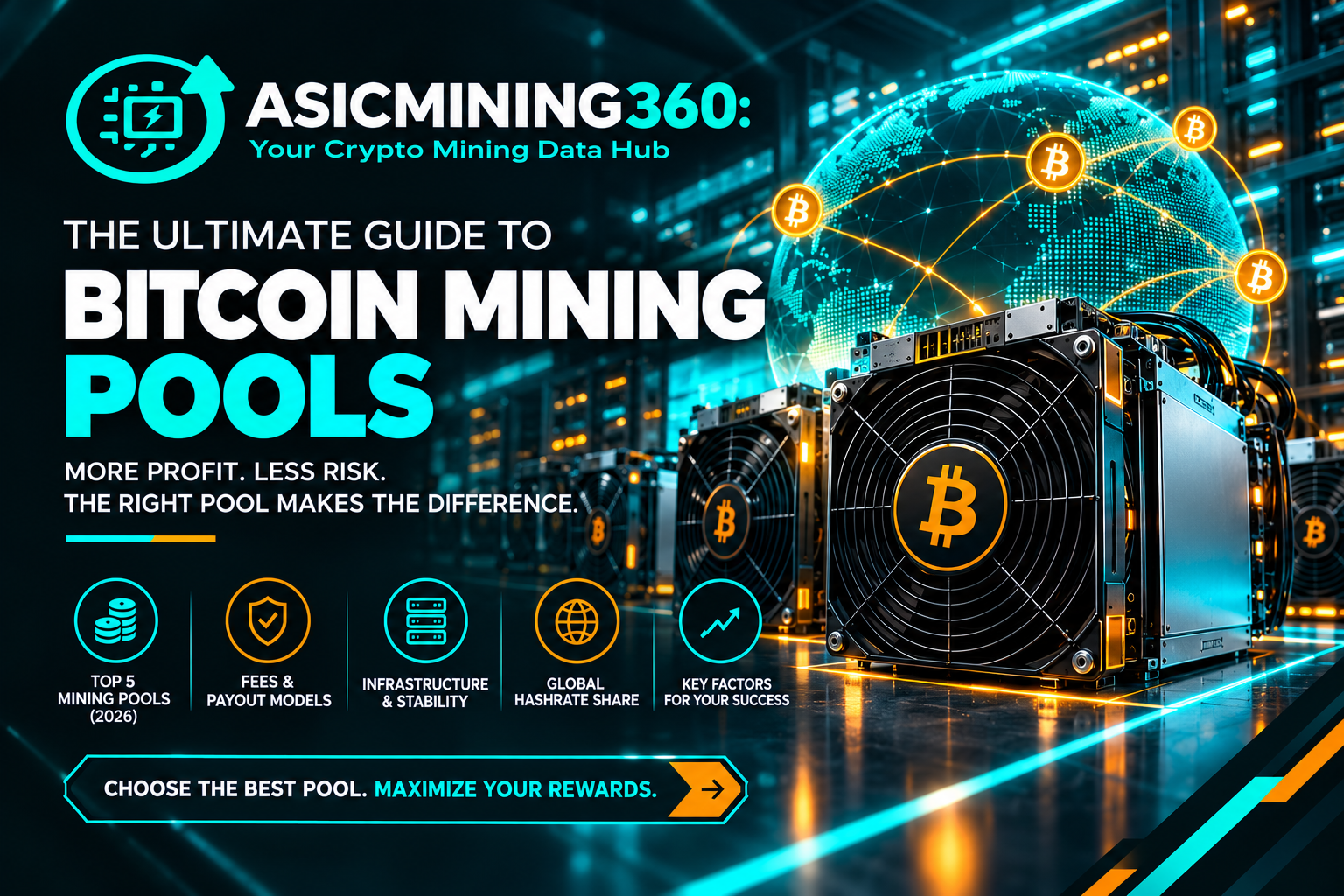
The Importance of Choosing the Right Mining Pool in 2026
Let’s cut to the chase: in 2026, the mining pool you choose is either building your profits or silently killing them.
We’re way past the days when raw hashrate was all you needed. Today, the game is won on consistency, rock-bottom fees, and getting your rewards from the block to your wallet without friction. Pick the wrong pool, and you won't see a massive, catastrophic failure. Instead, you'll suffer a slow bleed—losing your edge to hidden costs, delayed payouts, and spotty infrastructure.
It really boils down to this: you and another miner could be running the exact same rigs, but your actual take-home pay will look entirely different based purely on where you point your hash power.
With institutional giants dominating the space and margins tighter than ever, picking your pool isn't just some tech detail you can gloss over. It’s the fundamental strategy that dictates whether you actually make money in the long run.
Before diving into the detailed breakdown, here’s a quick comparison of the top mining pools in 2026:
| Pool Name | Market Share | Payout Model | Key Advantage |
|---|---|---|---|
| Foundry USA | 27% | FPPS | Institutional Grade |
| AntPool | 18% | PPS+ / PPLNS | Ecosystem Stability |
| ViaBTC | 12% | PPS / PPLNS / FPPS | Multi-currency Support |
| F2Pool | 10% | PPS+ | Legacy Reliability |
| Binance Pool | 2.5% | FPPS | Exchange Integration |
Foundry USA (27% Market Share)
Foundry USA, established in 2018, continues to dominate the global landscape as a premier choice for institutional-grade mining. It assures predictable daily payouts through the Full Pay-Per-Share FPPS mining model. With its reputation for maximum transparency and a peak historical reach of 35% in global hash rate, it is today the most trusted entity in the sector.
For large-scale miners, Foundry is less of an option and more of a default infrastructure choice.
Best for: Institutional miners seeking maximum stability and predictable payouts.
AntPool (18% Market Share)
A veteran in the space, AntPool was launched in 2014 by hardware giant Bitmain. It stays in its place by the sheer stability and flexibility of choosing between PPS and PPLNS payment models. A decade-long track record makes it a cornerstone of the global mining infrastructure.
Best for: Miners who want flexible payout models (PPS+ and PPLNS).
ViaBTC (12% Market Share)
Founded by Haipo Yang back in 2016, ViaBTC has turned into a multi-currency force to be reckoned with, supporting more than 20 assets. Consistently holding a top-five position in Bitcoin mining, this provider has gone all in with a strong suite of payment offerings that include PPS, PPLNS, and FPPS, underpinned by a decade of proven reliability.
ViaBTC stands out for miners who want flexibility beyond Bitcoin, especially those actively managing multi-coin strategies.
F2Pool (10% Market Share)
F2Pool, rebranded as Discus Fish, was founded in 2013 and is among the oldest pools that have survived all challenges. It boasts a very stable infrastructure, while the PPS+ system helps to provide consistent returns. The fact that it has been operating for 13 years explains how secure and operationally good it is.
Best for: Long-term miners looking for proven reliability and stability.
Binance Pool (2.5% Market Share)
Operating as part of the world’s largest exchange ecosystem, Binance Pool was established in 2019. It features seamless integration between mining rewards and trading accounts. Holding a smaller share currently, with aggressive growth and the FPPS model, it is positioned to capture more than 5% in the near future.
Best for: Users already integrated into the Binance ecosystem.
How to Choose a Bitcoin Mining Pool in 2026: Key Factors for Miners
The selection involves finding the right combination of a number of technical and financial considerations:
Hash Rate Size and Block Discovery Frequency
Hash Rate Dominance: Greater pools mean more block discoveries with higher frequency, hence more regular streams of revenues.
Understanding Mining Pool Payment Models (PPS, FPPS, PPLNS)
Payment Models: If you would want to earn a guaranteed fixed rate per share, go for PPS/PPS+, while PPLNS is targeted towards long-term miners to maximize their loyalty-based rewards.
At scale, even a 1% difference in fees or uptime can translate into thousands of dollars lost annually.
Mining Pool Infrastructure and Global Server Stability
Infrastructure Integrity: Give a higher preference to those that have servers geographically distributed for low latency and 100% uptime.
Supported Coins, Hardware Compatibility, and Network Protocols
Support for Assets: Make sure that the pool supports your particular hardware and target coins. Some of the older pools could be slow to get used to new protocols on the network.
Warning Signs of Unreliable or Risky Mining Pools
Having said that, below is basically what you should avoid in a pool to protect your hardware investment:
-
Pools With a Short Operating History: Any pool operating for less than three years is very dangerous to approach.
-
Lack of Transparency in Fees and Reward Calculations: Lack of clear documentation in terms of fee deductions or reward calculations is a major red flag.
-
Hidden Infrastructure or Unknown Server Locations: Professional pools are always open about their server locations, and any opaqueness in this regard raises suspicions for insecure or malicious activities.
Final Thoughts: Choosing a Reliable Bitcoin Mining Pool for Long-Term Profitability
Let's be real—making money mining in 2026 takes a lot more than just raw hashpower. It’s entirely about where you point your rigs.
It’s tough to spot the difference between a decent mining pool and a terrible one right off the bat, but those hidden fees, slow payouts, and random downtimes will quietly eat away at your margins over time. In a market this cutthroat, tiny leaks can sink the ship pretty fast.
Ultimately, it doesn't matter which pool is trending. What matters is finding the one that actually protects your bottom line.
FAQ: Bitcoin Mining Pools in 2026
Q1: What is a Bitcoin mining pool and how does it work?
A Bitcoin mining pool is a collaborative network of miners who combine their computational power to increase the probability of discovering blocks. When a block is successfully mined, the reward is distributed among participants based on their contributed hash power, allowing miners to receive more consistent and predictable payouts compared to solo mining.
Q2: Which mining pool is the largest in 2026?
As of 2026, Foundry USA is the largest Bitcoin mining pool by global hash rate share, controlling around 27% of the network. The pool is widely used by institutional mining operations and offers a Full Pay-Per-Share (FPPS) payout model that provides predictable daily rewards.
Q3: What payment models do Bitcoin mining pools use?
Mining pools typically use payout systems such as PPS (Pay-Per-Share), FPPS (Full Pay-Per-Share), PPS+, and PPLNS (Pay-Per-Last-N-Shares). PPS-based systems provide stable payouts per share, while PPLNS rewards miners based on long-term participation and pool loyalty.
Q4: Is it better to join a large or small mining pool?
Large mining pools tend to discover blocks more frequently, resulting in more stable and predictable income streams. Smaller pools may occasionally offer higher rewards per block but typically involve higher payout variance and longer waiting times between block discoveries.
Q5: How can miners identify a trustworthy mining pool?
Reliable mining pools usually provide transparent fee structures, publicly known server infrastructure, and a proven operational history. Pools that clearly disclose their payout models, fees, and global server locations are generally considered safer choices for professional miners.
Q6: Can mining pools affect Bitcoin network decentralization?
Yes, mining pools can influence network decentralization. When a few pools control a large portion of the global hash rate, concerns about centralization may arise. This is why many miners prefer distributing hash power across multiple pools to maintain a healthier and more decentralized Bitcoin network.