






The State of Bitcoin Mining in 2026: Why Hardware Efficiency is the New Gold Standard
Explore the state of Bitcoin mining in 2026, where ASIC efficiency, 3nm chips, hydro cooling, and rising network difficulty define mining profitability and long-term ROI.
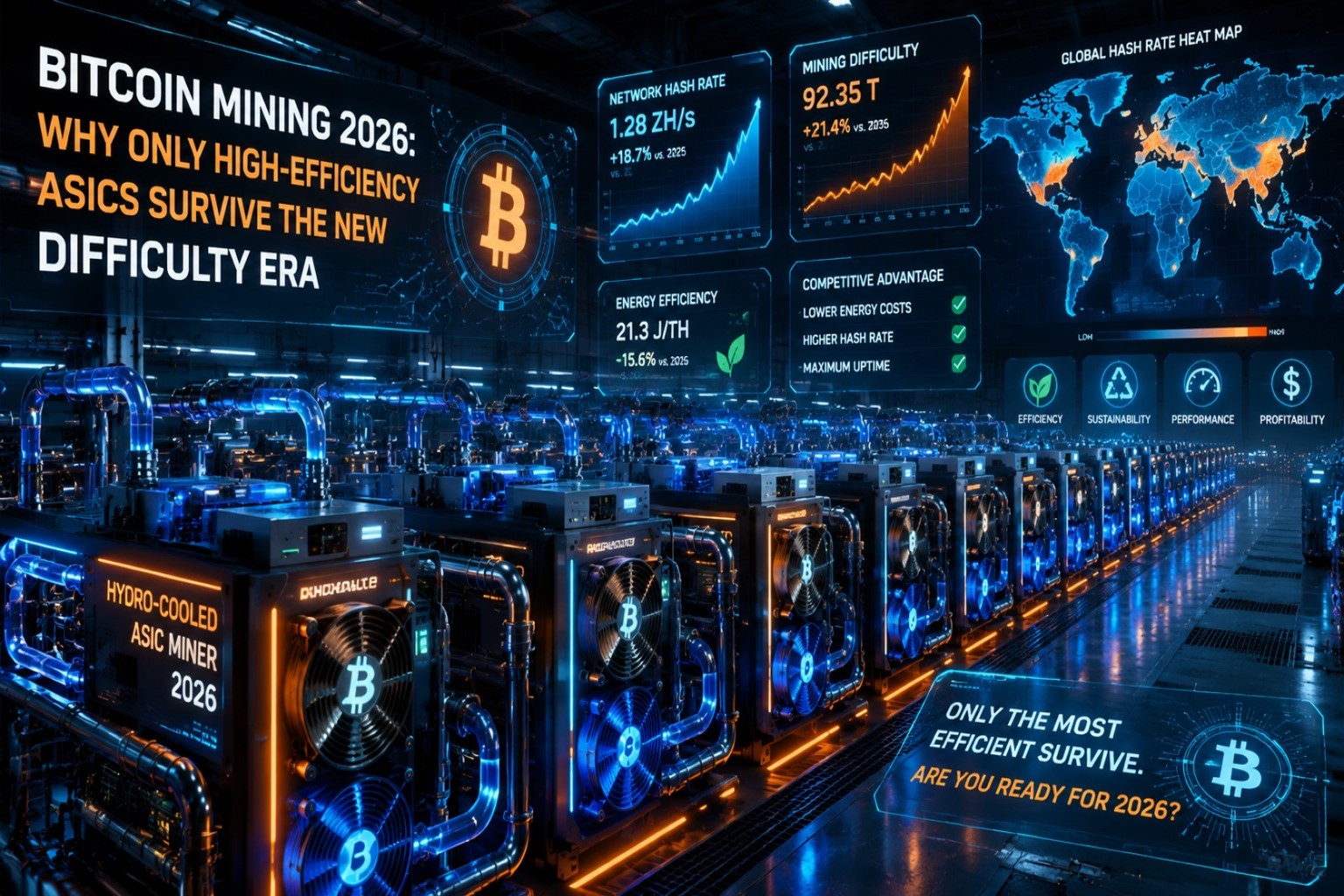
Why Hardware Efficiency is the New Gold Standard
Let’s be honest: the days of plug-and-play mining from a spare bedroom are officially over. By 2026, Bitcoin mining has shed its skin as a hobbyist’s technical experiment and evolved into a high-stakes, industrial-grade economic sector. It’s a field that now commands the same level of strategic depth as traditional finance or energy infrastructure, attracting everyone from institutional heavyweights to sovereign nations.
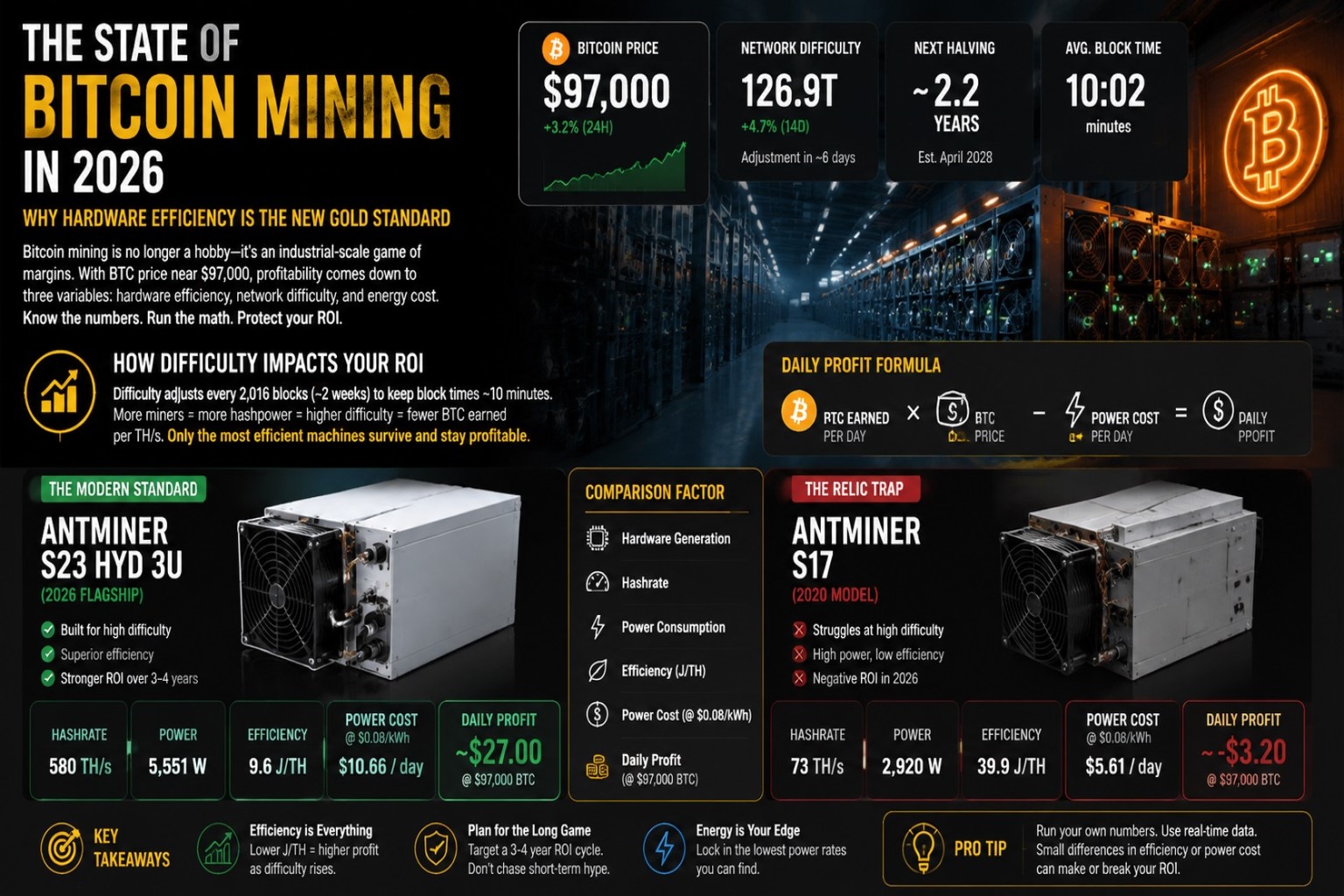
With Bitcoin’s price currently teasing the $97,000 mark, the FOMO is real—but so are the risks. If you’re an investor looking for a sustainable win over a 3-to-4-year ROI cycle, you have to realize that the game has changed. It’s no longer about how many machines you can plug in; it’s about a brutal, mathematical balancing act between hardware efficiency, skyrocketing network difficulty, and the hunt for the cheapest possible energy. In this landscape, understanding these variables isn't just a "pro tip"—it's the only thing standing between a profitable venture and a very expensive paperweight.
How Bitcoin Network Difficulty Adjustments Impact Your ASIC Mining ROI in 2026
The Bitcoin network is a self-regulating machine designed to produce a new block roughly every ten minutes. To maintain this heartbeat, the difficulty of mining adjusts every 2,016 blocks (approximately every two weeks). When more miners join or hardware gets faster, difficulty rises, requiring more energy to find a block. In 2026, this metric is the ultimate filter for profitability. The impact of these adjustments depends entirely on your hardware’s efficiency:
• The Modern Standard: High-tier units like the Antminer S23 Hyd 3U are engineered to thrive in this high-difficulty environment. Even with electricity priced at $0.08 per kWh, these machines can generate roughly $27 in daily profit.
• The Relic Trap: Compare this to the Antminer S17. In 2020, with Bitcoin at $11,000, the S17 was a gold mine. Today, even with Bitcoin nearly at $100,000, an S17 is likely losing money every day it stays plugged in. This stark contrast highlights a fundamental truth for 2026: Price alone cannot save an inefficient miner.
A Retrospective Look at Global Hashrate
Shifts and Mining Difficulty (2020–2026)
To understand where we are, we must look at the volatile path that brought us here:
• 2020–2021 (The Great Migration): After the 2020 halving, the industry was shaken by China’s 2021 mining ban. Global hashrate plummeted, leading to historic difficulty drops of 20–30%, which briefly created a "golden era" of profitability for Western miners.
• 2022–2024 (The Efficiency War): As miners relocated to North America and Kazakhstan, difficulty stabilized and then surged. The introduction of the S19 XP series pushed the hashrate to record levels, making "Joules per Terahash" (J/TH) the most important metric in the business.
• 2025–2026 (The Hydro Era): The integration of advanced hydro-cooled and immersion-ready machines, such as the S23 Hyd series, has stabilized the network at massive hashrate levels. Short-term difficulty drops are now rare, occurring only during major localized power grid events or geopolitical shifts.
The Evolution of ASIC Chip Efficiency: Moving from 14nm to Next-Gen 3nm Technology
Mining profitability is essentially a race toward the smallest semiconductor. As chips get smaller, they can fit more transistors into the same space, allowing for more computing power with less heat and electricity.
• 14nm–16nm: The workhorses of the past. Durable, but far too "thirsty" for power in a post-2024 halving world.
• 7nm–5nm: These chips brought a massive leap in efficiency, with the 5nm generation reaching roughly 17.5 J/TH.
• 3nm Integration: This is the 2026 benchmark. 3nm chips are designed specifically to remain viable even if the Bitcoin price fluctuates or the network difficulty reaches atmospheric heights. They are the only way to ensure a device remains "in the green" for its full 4-year lifecycle.
Developing a Sustainable Bitcoin Mining Investment Strategy for High-Difficulty Environments
If you are looking to enter or expand in the mining space today, your strategy must be built on four pillars:
1. Prioritize Modernity: Only invest in the latest generation of ASIC hardware (S23, M60 series, or equivalent). Buying "cheap" older gear is often a recipe for negative cash flow.
2. Lock in Energy Costs: At $97,000 BTC, energy is the only variable you can truly control. Seeking industrial-scale rates or renewable integration is key.
3. Infrastructure Longevity: 2026 is the year of Cooling. Proper hydro or immersion setups don't just increase efficiency; they protect your capital investment from the wear and tear of heat.
4. Anticipate Difficulty: Always model your ROI based on a projected upward trend in difficulty. If your business plan requires difficulty to stay flat, it isn’t a plan—it’s a gamble.
Final Analysis: Is Bitcoin Mining Still a Profitable Investment with Bitcoin at $97,000?
Here is the cold, hard truth: At $97,000 per Bitcoin, mining looks like a gold rush from the outside, but on the inside, it’s a high-speed chase where the floor is constantly rising. The network’s difficulty adjustment is a heartless judge—it doesn't care about your overhead or your good intentions.
In this era, the buy-and-hope strategy is a one-way ticket to negative margins. The real profit isn't found in the price of the coin, but in the Joules per Terahash of your hardware and the stability of your cooling. If you aren't running next-gen 3nm chips and liquid-cooled infrastructure, you’re essentially subsidizing the network for the professionals who are.
The takeaway? Don't get blinded by the $97k price tag. In 2026, Bitcoin mining isn't a gamble—it's an efficiency race. If you aren't leading the pack with the best tech and the cheapest power, the difficulty rate will eventually turn your "investment" into a space heater. Adapt, or get hashed out.