The Landscape of AI Infrastructure in 2026
The landscape of AI infrastructure in 2026 is defined by a brutal paradox. While the industry is captivated by the Blackwell architecture and the staggering FP4 performance of the NVIDIA B200, the entry cost for such hardware has reached levels that effectively lock out smaller labs, startups, and serious enthusiasts. As we see a shift toward "trillion-parameter" models requiring massive HBM3e clusters, a secondary market has matured for hardware that was once the gold standard of the 2010s: the NVIDIA Tesla V100.
In my time managing high-density GPU deployments, I’ve found that the most expensive mistake an investor can make is prioritizing raw compute throughput over memory capacity. In 2026, the real bottleneck for local inference isn't just TFLOPS—it’s the "VRAM Wall." This is where a legacy 8-GPU server, like the Inspur DGX-V100 (NF5288M5), presents a compelling economic case for specific Large Language Model (LLM) workflows.
Technical Architecture Overview: 8× Tesla V100 in an Enterprise AI Server
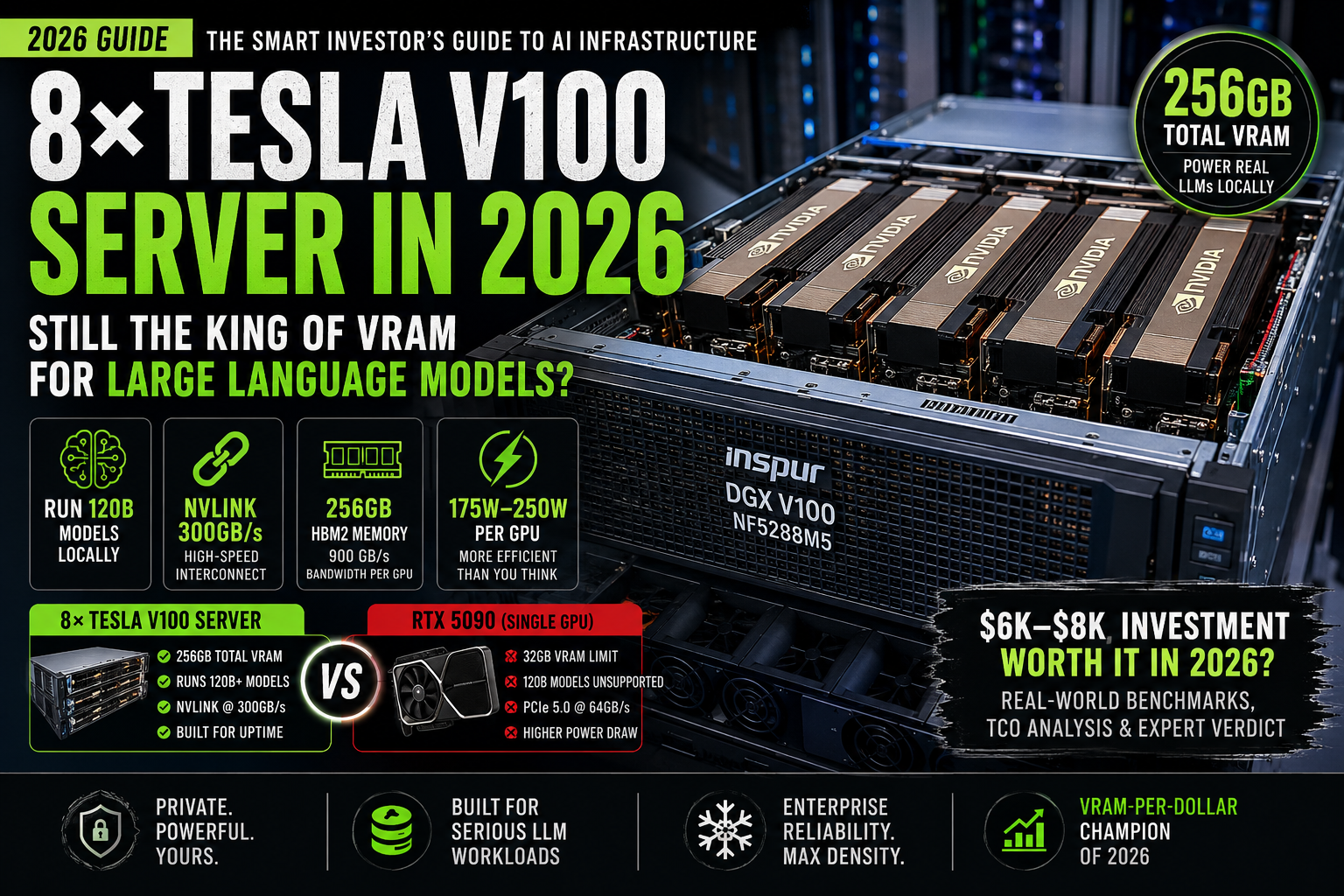
The system under review is a workhorse: an 8-way NVIDIA Tesla V100 server in the SXM2 form factor. Unlike standard PCIe cards, these units utilize the SXM2 interface, enabling high-speed NVLink interconnects that allow the GPUs to communicate with significantly higher bandwidth than the PCIe bus.
Core Hardware Specifications of the Inspur DGX V100 (NF5288M5)
-
GPU Engine: 8x NVIDIA Tesla V100 (Volta Architecture)
-
CUDA Cores: 5,120 per card; 40,960 total per system
-
Memory: 32GB of HBM2 per card with a 4,096-bit bus
-
Memory Bandwidth: ~900 GB/s per GPU (Total system bandwidth ~7.2 TB/s)
-
Compute: Dual Intel Xeon Scalable (Cascade Lake) Platinum 8260 CPUs (48 Cores/96 Threads)
-
System RAM: 512GB DDR4 ECC
While the modern RTX 5090 boasts higher raw clock speeds and GDDR7 memory, it is inherently limited by its consumer-grade architecture. In a professional environment, density and interconnectivity matter. Fitting eight RTX 5090s into a single 2U or 4U chassis requires complex custom cooling and specialized motherboards, whereas the Inspur V100 server is a purpose-built enterprise machine with redundant power supplies and integrated management (IPMI).
Real-World AI Benchmarks 2026: Tesla V100 vs RTX 5090 for LLM Inference
To determine if this $6,000 to $8,000 investment holds up against current consumer hardware, we ran a series of standardized MLPerf and LLM benchmarks.
LLM Inference (Tokens Per Second)
When testing Llama 3.1 8B, a modern consumer card like the RTX 5090 is undeniably faster, reaching upwards of 260 tokens per second (t/s). The aging V100 managed approximately 118 t/s. On paper, the 5090 wins by a factor of 2.2x. However, the 5090 pulls nearly 500W at peak load, while a single V100 remains efficient at 175-250W.
The dynamic changes when we scale to models like GPT-OSS 120B (a Mixture-of-Experts model). This model requires roughly 60GB of VRAM just to load the weights. On a consumer rig with a single 5090 (32GB VRAM), you simply cannot run this model locally without extreme quantization that destroys the model’s reasoning logic. On the 8-GPU V100 server, we have 256GB of aggregate VRAM. We can load the 120B model across four cards and still have four cards remaining to run concurrent tasks or host an additional 70B parameter model.
Expert Insight: In the world of LLM inference, memory bandwidth is king. The V100’s HBM2 memory provides a massive 900 GB/s per card. Even though the card is eight years old, its memory architecture is still faster than many mid-range 2026 consumer cards.
Side-by-Side Comparison: Inspur DGX V100 (8-GPU) vs RTX 5090 Specifications & Benchmarks
| Hardware Specification | Inspur DGX V100 (8-GPU) | RTX 5090 (Single GPU) |
|---|---|---|
| Architecture Generation | Volta (Enterprise) | Blackwell (Consumer) |
| CUDA Cores | 5,120 Cores | 21,000+ Cores |
| Interconnect Speed | NVLink @ 300GB/s | PCIe 5.0 @ 64GB/s |
| VRAM Type | HBM2 | GDDR7 |
| Total System VRAM | 256 GB | 32 GB |
| Memory Bandwidth | 900 GB/s | 1,500+ GB/s |
| Llama 3.1 8B Inference | 118 Tokens/sec | 211 Tokens/sec |
| GPT-OSS 120B | 60 Tokens/sec | Unsupported |
| Context Window | 130k+ Tokens | Limited |
| Peak Power Draw | 175W - 250W | 450W - 500W |
Total Cost of Ownership (TCO): Practical Investment Considerations for Legacy V100 Servers
Investing in a legacy V100 cluster is an exercise in Total Cost of Ownership (TCO). While the purchase price is low, there are professional realities to consider.
Storage Bottlenecks and Enterprise NVMe Requirements for AI Workloads
In our testing, standard SATA SSDs failed under the heavy I/O requirements of continuous model swapping. Enterprise-grade NVMe or high-end SAS drives (like the Samsung 1.92TB Enterprise series) are non-negotiable for these servers. If you are building a cloud-access server for a team or Patreon, your storage uptime is just as critical as your GPU uptime.
Software Compatibility Limits: No FP4 or Transformer Engine on Volta
The Volta architecture lacks the Transformer Engine and FP4 precision support found in Blackwell (B200) and Hopper (H100) chips. This means you cannot take advantage of the latest "native" hardware accelerations for certain 2026-era optimizations. You are essentially relying on raw brute force and larger memory pools to keep pace.
Context Window Scaling and VRAM Allocation for 100K+ Token Models
As models evolve, the "context window" (the amount of text the AI can remember during a conversation) has expanded. Every 1,000 tokens of context requires additional VRAM.
-
A 100,000-token context can occupy upwards of 25GB of VRAM in FP16 precision.
-
A server with 256GB of VRAM can handle massive context lengths that would crash a 32GB RTX 5090 system the moment the conversation grows long.
Risks and Limitations of Buying Used Enterprise GPUs in 2026
It would be irresponsible not to address the "hallucination" of value. Older hardware comes with three primary risks:
-
Hardware Failure: These servers are often retired from hyperscale data centers (AWS, Google). While refurbished by reputable vendors like UnixSurplus, they have high "on-hours."
-
Power Density: An 8-GPU server can draw 3,000W+ from the wall under full load. This is not "home office" hardware. You need 240V power and significant HVAC cooling to prevent thermal throttling.
-
The "Stochastic Parrot" Problem: As shown in our tests with GPT-OSS, even the best hardware can't fix a model's tendency to lie. Running your own hardware gives you privacy and control, but it does not grant the AI "truth." We found the model hallucinating citations for social media profiles and YouTube video counts—proving that having 256GB of VRAM doesn't make the model any smarter than its training data.
Final Verdict: Is an 8× Tesla V100 Server Worth It for LLM Hosting in 2026?
Conclusion: The Expert’s Verdict
Is an 8-GPU Tesla V100 server a smart buy in 2026?
Yes, if: You are a developer or small business that needs to host large-scale (70B to 120B+) models for private, internal use and cannot afford the $40,000+ per-node cost of H100 or B200 hardware. The V100 offers the most affordable "VRAM-per-dollar" ratio in the current market.
No, if: You are focused on speed above all else, or if you lack the infrastructure to power and cool a 3,000W enterprise rack. For small, 8B parameter models, a single modern RTX 5080 or 5090 will provide a much smoother, quieter, and faster experience.
The Tesla V100 is no longer the "fastest" card on the block, but in a 2026 market where VRAM is the primary currency of AI, it remains a powerful, budget-conscious choice for those willing to manage the quirks of enterprise legacy hardware.
For anyone considering building an AI server in 2026, the key decision is not just performance—but whether your workload is compute-bound or memory-bound.
FAQ: Tesla V100 8-GPU Servers for AI and LLMs in 2026
Q1: Is an 8-GPU Tesla V100 server still good for AI in 2026?
Yes, for memory-intensive workloads. While it cannot match Blackwell or Hopper GPUs in raw speed, it offers 256GB of aggregate VRAM, making it ideal for hosting 70B–120B parameter models locally without extreme quantization.
Q2: How much VRAM do you need to run a 120B parameter model?
Roughly 60GB of VRAM is required just to load a 120B model in standard precision. Additional VRAM is needed for context window expansion. A 256GB multi-GPU setup allows stable deployment and longer context handling.
Q3: Can a single RTX 5090 run large LLMs like GPT-OSS 120B?
No, not natively. With only 32GB of VRAM, it cannot load the full model without aggressive quantization, which significantly reduces reasoning quality. Large models require multi-GPU memory pooling.
Q4: What are the main risks of buying used Tesla V100 servers?
The primary risks include hardware wear from data center usage, high power consumption (up to 3,000W+), cooling requirements, and lack of support for newer precision formats like FP4 and Transformer Engine optimizations.
Q5: Is VRAM more important than TFLOPS for LLM inference?
For large-model inference, yes. Once a model exceeds the memory capacity of a single GPU, raw compute becomes irrelevant. Sufficient VRAM and memory bandwidth are critical to avoid out-of-memory errors and performance bottlenecks.
Q6: What is the biggest advantage of the Tesla V100 in 2026?
Its VRAM-per-dollar ratio. The ability to access 256GB of HBM2 memory at a relatively low system cost makes it one of the most cost-efficient solutions for private, high-parameter LLM hosting in 2026.