The Future of Blockchain: Security and Resilience
The days of blindly chasing the next “100x” are fading fast. Today, the real question is much simpler—and far more important: which blockchain can actually survive what’s coming next?
Because the risks are no longer theoretical. Between the rise of Quantum Computing and the rapid expansion of AI-driven systems, the foundations of today’s crypto infrastructure are being stress-tested in ways most investors don’t fully understand.
This is where the conversation shifts. It’s no longer about speed or low fees—it’s about security, scalability, and long-term resilience. And this is exactly where Sui enters the picture.
In this breakdown, we’ll strip away the noise and focus on what actually matters: how modern cryptography is evolving, what the real quantum threat looks like, and why a new generation of blockchain architecture may define the next decade of the industry.
Because in 2026, picking the right chain isn’t about opportunity… it’s about not getting left behind.
Modern Blockchain Trust Architecture: What Does a Cryptographer Actually Build?
When most people hear the word cryptography, they immediately think of hiding things. But as we build a digital economy for billions of people, it’s about something much deeper: certainty. Historically, the word means "hidden writing," but today, a cryptographer is really an architect of undeniable truth.
Think about the apps we’ve relied on for years. We were told End-to-End Encryption kept us safe, and it was a good start—the company delivered your message but mathematically locked itself out of reading it. But there was always a catch: the middleman. You still had to blindly trust that the platform was actually using your identity, and not just some shadow account they controlled. You had privacy, but you didn't have real power.
Now, in 2026, the game has changed entirely. We’ve entered the era of Transparent Cryptography. By using on-chain keys, we’ve completely cut out the middleman. Your private key stays right there on your own hardware—whether you are using your primary screen or your second device—meaning the absolute proof of who you are never leaves your hands. Today’s cryptographers aren't just keeping secrets; they’re building a reality where your messages and your money flow freely, guarded by math so pure that no tech giant can ever touch them.
The 2026 Cryptography Stack: Encryption, Digital Signatures, and Zero-Knowledge Proofs
The Triple Pillar of 2026 Cryptography:
-
Encryption: Protecting data in transit and at rest.
-
Digital Signatures: Replacing handwritten authorization with immutable, verifiable digital proofs.
-
Zero-Knowledge Proofs (ZKPs): Proving the validity of a statement (e.g., "I am over 18") without revealing the underlying data (e.g., your actual birthday).
Quantum Computing Risk in 2026: What Really Breaks, When, and Why
The Quantum Threat: A 2026 Reality Check
A persistent worry in the Bitcoin community is the advent of quantum computing and its potential to break the Elliptic Curve Cryptography (ECC) securing most blockchains. While 2030 was once seen as "Doomsday," the explosion of Agentic AI has accelerated this timeline. AI is now being used to optimize quantum hardware and simulate cryptographic breaks faster than human scientists ever could.
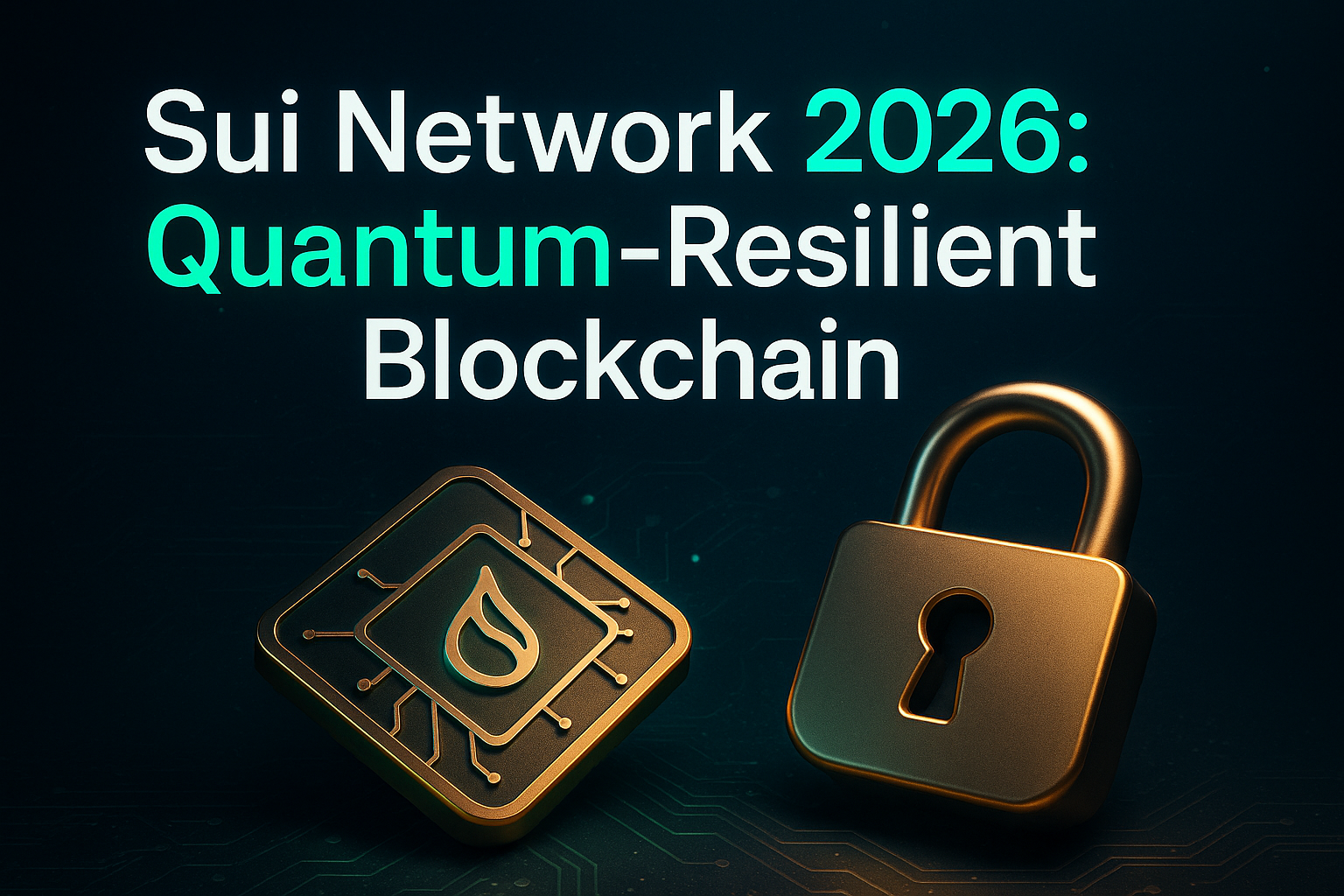
As a practitioner, I believe the risk is most acute for legacy addresses where public keys are exposed. However, at Mysten Labs, we have pioneered algorithms where existing addresses can become quantum-safe via Post-Quantum Zero-Knowledge Proofs. By 2026, Sui is leading this evolution, ensuring that even if a "Shor's Algorithm" event occurs, the network remains resilient.
Sui and Agentic AI in 2026: Robotics, Telemetry, and Object-Centric Scaling
The Convergence of Robotics and Agentic AI on Sui
The most significant development of 2026 is the migration of Robotics and AI Agents to the blockchain. This isn't about trading bots; it’s about physical hardware—autonomous drones and robotic "dogs"—using the blockchain for telemetry, payments, and identity.
Sui is uniquely positioned here due to its Object-Centric Architecture. Unlike Ethereum, which tracks balances, Sui tracks individual objects. This allows for:
-
Massive Parallelism: Processing over 120,000 transactions per second (TPS).
-
Larger Data Blocks: Sui supports 130+ KB transactions, allowing robots to attach complex telemetry data that smaller-block chains like Solana (1.2 KB) cannot handle.
-
Programmable Tunnels: Users can "rent" a robot for 5 minutes, controlling it off-chain with sub-second latency (0.3s) while settling the final state on-chain.
Why Engineering Lineage Matters in 2026: Mysten Labs, zkLogin, and Adoption
Practical Guidance: Why Engineering Lineage Matters
For those looking to deploy capital in 2026, you must look at Engineering Lineage. The Sui team consists of the directors who built Libra for Facebook. They understand how to scale for 2 billion users. Their invention of zkLogin—which allows onboarding via Google or Apple accounts without seed phrases—is the reason Sui has surpassed 8 million active users in early 2026.
2026 Investor Checklist: Latency, Account Abstraction, and Quantum Roadmaps
Investment Checklist for 2026:
-
Protocol Latency: Does the chain settle in under 0.5 seconds?
-
Account Abstraction: Can a "normie" use the app without a technical degree?
-
Quantum Roadmap: Is there a funded, active path to post-quantum signatures?
Post-Quantum Cryptography: 2026 Blockchain Migration Status
| Network | Standard Algorithm | Post-Quantum (PQ) Approach | 2026 Migration Status | Quantum Risk Level |
|---|---|---|---|---|
| Bitcoin | ECDSA (secp256k1) | Taproot/Schnorr (Soft Fork path) | Research stage; no native PQ support. | High (Legacy addresses exposed) |
| Ethereum | ECDSA & BLS | ERC-4337 + LeanVM | Active PQ team; testing signature aggregation. | Moderate (Migration via L2s) |
| Sui | Ed25519 & ECDSA | Lattice-based ZKPs (Dilithium) | Production-ready; Click-to-migrate enabled. | Low (Agility by design) |
| Solana | Ed25519 | ZK-Compression Agility | Community-driven; exploring hybrid signatures. | Moderate (Scaling vs. PQ size) |
Conclusion: Choosing a Cryptographic Architecture You Can Trust for the Next Decade
The crypto industry has matured past the point where we can view blockchains as isolated silos. In 2026, the most successful networks act as a Global Infrastructure that seamlessly integrates with Web2 identities and Web3 security. Whether it is the Greek Stock Market moving on-chain to prevent local economic drainage or robots in Singapore performing sub-second transactions, the underlying theme is Certainty.
The transition from a "centralized-managed" world to a "user-managed" world is well underway. The question is no longer if you will use a blockchain, but which cryptographic architecture you will trust to secure your legacy.
FAQ: Sui, Quantum Resilience, and Agentic AI in 2026
Q1: What does “quantum resilience” mean for blockchain users in 2026?
Quantum resilience means a network can protect user funds and identities even if quantum advances threaten today’s signature schemes. In practice, it’s about cryptographic agility: the ability to migrate accounts and signatures without breaking usability. In 2026, this is less about panic and more about whether a chain has a credible, funded roadmap and simple migration pathways.
Q2: Why are legacy addresses considered higher risk in a quantum scenario?
Legacy addresses are riskier because public key exposure can expand the attack surface if a future quantum capability targets elliptic-curve signatures. The concern is not that everything breaks overnight, but that older patterns and un-upgraded funds may be harder to migrate quickly. Investors should watch for tooling that enables seamless upgrades and minimizes “stranded” account formats.
Q3: How does Sui’s object-centric architecture help AI agents and robotics?
Object-centric design treats assets and state as discrete objects rather than only balances. This can enable parallel execution, more efficient state updates, and application patterns like “renting” or delegating control over a specific object. For robotics and agentic AI, it supports richer workflows where identity, telemetry, and permissions can be modeled as objects and settled reliably.
Q4: What is zkLogin and why does it matter for mainstream adoption?
zkLogin reduces onboarding friction by allowing users to authenticate with familiar Web2 credentials while maintaining self-custody properties. The practical benefit is that new users can start using on-chain apps without managing seed phrases on day one. In 2026, this matters because the winning platforms are those that combine strong security with “normie-grade” UX.
Q5: Can blockchains really support robotics telemetry and real-time control?
They can support settlement, identity, permissions, and final-state verification, but real-time control often needs off-chain channels for sub-second responsiveness. The model described is hybrid: command and control can happen off-chain while the blockchain anchors ownership, authorization, and the final outcome. This approach is attractive because it balances latency with verifiable accountability.
Q6: What should investors check to evaluate a chain’s security maturity in 2026?
Look for fast finality, proven incident response culture, and cryptographic agility (upgradability of signatures and accounts). Also evaluate how the chain handles account abstraction and key management at scale—because UX failures become security failures. A credible quantum roadmap and production-grade tooling for migration are key diligence signals.
Q7: Do zero-knowledge proofs replace encryption and signatures?
No—ZK proofs complement them. Encryption protects data confidentiality, signatures prove authorization, and ZK proofs enable selective disclosure (proving a claim without revealing underlying data). In 2026, strong systems combine all three to satisfy privacy demands and regulatory constraints while keeping users in control of their keys and identity assertions.
Q8: Is “engineering lineage” a real investment signal or just marketing?
It can be a real signal when it correlates with shipped infrastructure, rigorous security practices, and proven experience scaling systems under adversarial conditions. The practical lens is execution: has the team delivered developer tooling, stable upgrades, and user-friendly security at scale? In 2026, credibility is less about narratives and more about measurable reliability and adoption outcomes.