Introduction
Cryptocurrency mining has always been strongly connected to energy infrastructure. For operators using modern ASIC hardware like the Antminer S19, electricity is not just an operating expense; it is often the factor that decides whether a mining operation becomes sustainable or simply too expensive to maintain.
Over the last few years, many mining operators have started exploring renewable power sources, especially solar energy. Solar-powered mining infrastructure can reduce long-term electricity costs while allowing miners to operate hardware in regions with strong sunlight resources. However, building an efficient solar mining system is not as simple as matching panel output to miner consumption. Real systems require additional capacity, buffering, and control logic.
To understand how this works in practice, it helps to look at a slightly scaled system built around six S19 miners deployed in a high solar region. This type of setup shows how mining hardware, solar panels, batteries, and automated power management must function together as a single energy ecosystem rather than separate parts.
Antminer S19 Power Consumption and ASIC Mining Energy Requirements
The Antminer S19 remains one of the most widely used SHA-256 ASIC miners in the Bitcoin network. Depending on firmware configuration, cooling conditions, and operating frequency, a typical unit consumes a little above three kilowatts of electrical power.
Operating six machines at once can therefore approach:
18 to 19 kilowatts of continuous demand.
In reality, solar-powered mining systems rarely run every machine at full performance the entire day. Instead, the total load changes gradually according to available solar generation. This flexible approach allows operators to maintain stable operations while avoiding unnecessary stress on the inverter or battery system.
Mining infrastructure powered by renewable energy must therefore be designed with adaptability in mind. Hardware efficiency, electrical capacity, and energy storage all interact together.
Why Solar Mining Systems Need More Power Than ASIC Miner Consumption
One of the most common mistakes new operators make is assuming that solar capacity should equal the power consumption of the ASIC hardware.
For instance, if a single miner draws roughly three kilowatts, some assume installing three kilowatts of solar panels will be enough. In practice, that approach rarely works well.
A solar mining installation must support several power demands at the same time:
-
Running the ASIC miners
-
Charging battery storage
-
Ventilation and cooling equipment
-
Networking gear and monitoring devices
-
Operational headroom during cloudy conditions
Solar output constantly fluctuates due to clouds, temperature changes, and atmospheric conditions. If the system is sized only for the miners, any temporary drop in solar production forces the battery to compensate. Over time, this drains the battery and can eventually trigger inverter protection limits.
For this reason, solar mining systems are typically slightly oversized. The extra solar capacity allows batteries to remain charged while maintaining stable mining performance.
Solar Panel Requirements for Running Six Antminer S19 Miners
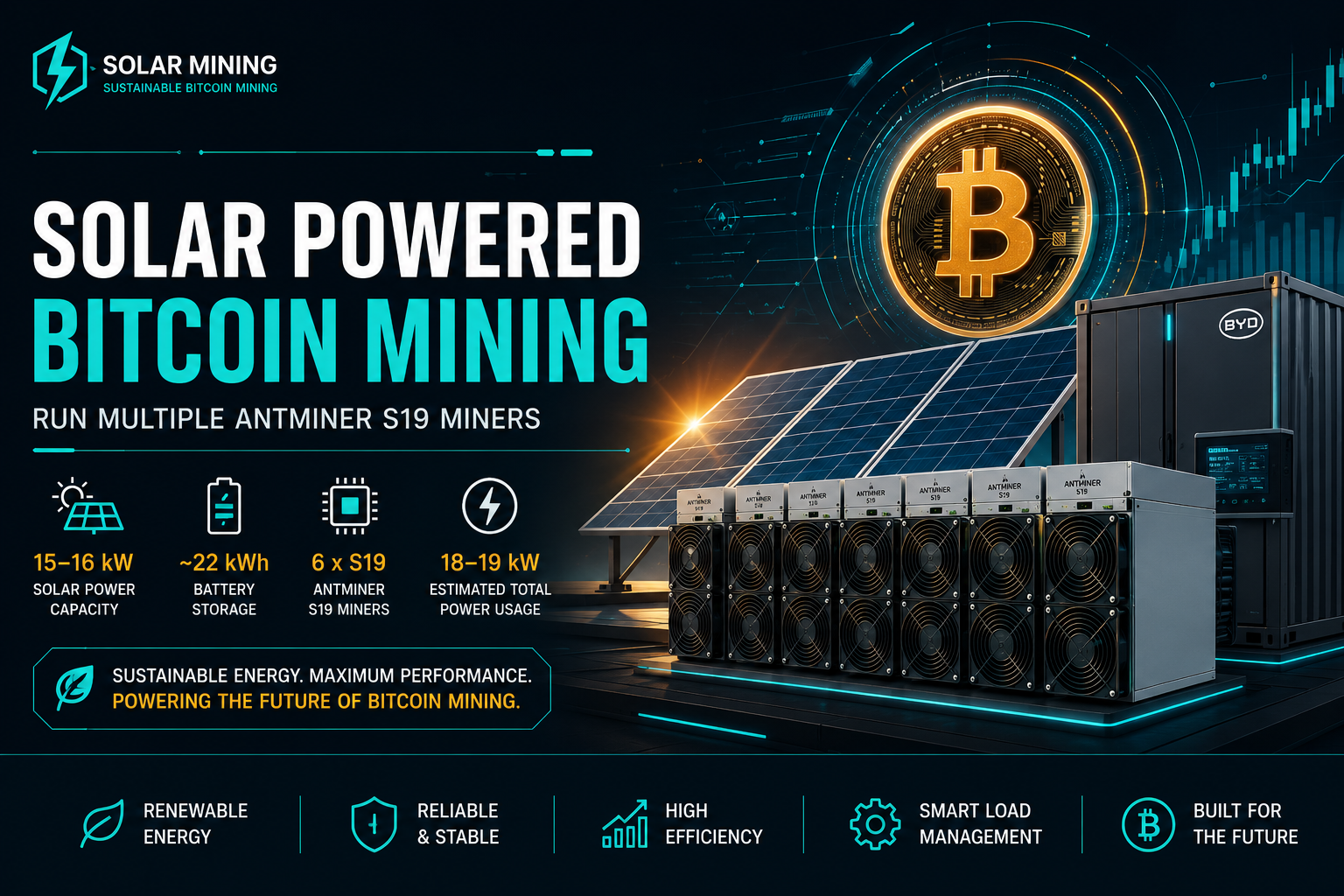
In the Abu Dhabi scenario, the solar array produces around 15 to 16 kilowatts of peak capacity.
This level of generation can be achieved using approximately:
28 to 30 modern solar panels rated around 550 watts each.
That capacity gives the system enough margin to power several miners simultaneously while also keeping the battery charging during the strongest hours of sunlight.
The location itself plays an important role here. Regions like Abu Dhabi receive strong and relatively consistent solar irradiation throughout the year, which makes them suitable for daylight mining strategies.
Instead of forcing hardware to run continuously, the system simply follows a natural rule:
When sunlight is strong, miners operate; when solar production weakens, the system gradually reduces load.
This type of setup does not imply that all six Antminer S19 units run at full power continuously. In practice, the system relies on dynamic load management, staged miner activation, and short-term battery buffering to match real solar production conditions.
Solar Mining System Specifications for 6 Antminer S19 Units
| System Component | Specification |
|---|---|
| ASIC Miner Model | Antminer S19 (SHA-256) |
| Number of Miners | 6 Units |
| Estimated Total Load | ≈ 18–19 kW |
| Solar Array Capacity | 15–16 kW PV System |
| Solar Panels | 28–30 Panels (550W each) |
| Battery System | BYD Battery-Box Premium HVM (~22 kWh) |
| Hybrid Inverter | 15–20 kW Hybrid Solar Inverter |
Battery Storage Systems for Solar Powered Bitcoin Mining
Battery storage is an essential part of any solar mining infrastructure because it stabilizes short-term fluctuations in power generation.
In this configuration, the system uses a high voltage lithium battery such as the BYD Battery-Box Premium HVM with around 22 kWh of usable storage capacity.
The battery is not designed to run miners through the entire night. Its main role is buffering energy variations.
When solar output suddenly drops for a short period, the battery provides immediate power to keep the system stable. This gives the control system time to slightly reduce mining load if necessary.
Without that buffer, even a passing cloud could cause miners to power down repeatedly, which is inefficient because ASIC devices require several minutes to restart and reconnect to the mining network.
Hybrid Inverters and Smart Load Management in Solar Mining Systems
At the center of the solar mining infrastructure sits the hybrid inverter. Systems of this size usually employ an inverter rated between 15 and 20 kilowatts.
The inverter performs multiple functions including:
-
Converting solar DC electricity into usable AC power
-
Managing battery charging cycles
-
Monitoring system load and balance
-
Protecting equipment from overload conditions
Alongside the inverter, automation software increasingly controls the behavior of mining hardware.
For example, when solar production increases during midday, additional miners may activate. If solar output weakens, some machines may be throttled down or temporarily turned off.
In some setups, operators even disable individual hash boards inside a miner, allowing the device to continue hashing at reduced energy levels. This granular control helps maintain stable operations even when solar production changes.
Daily Operating Cycle of a Solar Mining System
Solar powered mining does not usually follow the same 24-hour operation pattern as traditional data center mining farms.
Instead, the system follows the solar production curve throughout the day.
Morning:
Solar generation begins to rise gradually. The automation system activates the first miner once enough energy is available.
Midday:
Solar output reaches its peak level. Several miners may run simultaneously, sometimes at full performance depending on available power.
Afternoon:
Solar generation slowly declines. The system progressively reduces mining load to prevent battery depletion.
Evening:
Mining operations stop completely when solar production fades. The battery remains partially charged and ready to stabilize the system the next day.
This cycle keeps both hardware and energy infrastructure operating within safe limits.
Solar Mining as a Long Term Bitcoin Infrastructure Investment
Mining economics are influenced by many factors including electricity costs, hardware efficiency, and cryptocurrency market prices.
At the beginning of 2026, Bitcoin prices experienced a temporary decline, which impacted profitability for a number of mining operators. However, such fluctuations are common within the cryptocurrency industry.
Mining infrastructure, especially systems built around renewable energy sources, should be viewed as a long-term investment rather than a short-term speculation.
Operators who control their own power supply often gain a structural advantage during market downturns because their operational costs remain lower. When electricity costs approach zero during daylight hours, mining becomes more resilient even if Bitcoin prices temporarily decrease.
This is why many mining operators see solar infrastructure not simply as a response to market volatility but as a strategic foundation for future digital infrastructure.
Understanding the Energy Requirements of ASIC Mining Hardware
Power Consumption Breakdown for Antminer S19 Solar Mining Setup
| Component | Power Consumption | Notes |
|---|---|---|
| Antminer S19 (Single Unit) | ≈ 3.1 kW | Typical power usage depending on firmware and temperature |
| Total Miners (6 Units) | ≈ 18–19 kW | Maximum load if all miners operate at full capacity |
| Cooling & Ventilation | ≈ 300–600 W | Fans and air circulation equipment |
| Network & Control Systems | ≈ 50–100 W | Router, monitoring devices, automation systems |
| Total System Load (Estimated) | ≈ 19–20 kW | Including auxiliary equipment |
Explanation of the System Power Consumption Table
The table above provides a simplified overview of the estimated power requirements for a small solar-powered mining setup built around six Antminer S19 units. A single S19 miner typically consumes around 3.1 kilowatts depending on firmware settings, operating frequency, and ambient temperature conditions. When six miners operate at full capacity, the combined electrical demand can approach approximately 18 to 19 kilowatts.
However, ASIC miners are not the only components drawing electricity in a mining environment. Cooling and ventilation systems are required to maintain safe operating temperatures for the hardware. These systems usually add an additional 300 to 600 watts depending on the number of fans and the airflow configuration used in the mining space.
Networking equipment and monitoring systems also consume a small amount of power. Routers, controllers, and automation hardware typically add another 50 to 100 watts to the overall load.
When these auxiliary systems are included, the total estimated electrical demand of the mining infrastructure can reach approximately 19 to 20 kilowatts during peak operation. Understanding this full energy profile is important when designing solar mining systems because solar arrays must be sized not only for the ASIC miners themselves but also for the supporting infrastructure required to keep the system running reliably.
Conclusion
Solar powered cryptocurrency mining demonstrates how renewable energy infrastructure can integrate with digital computing networks. Running several ASIC miners such as the Antminer S19 on solar power requires careful coordination between solar generation, battery storage, and mining hardware load.
In the example described here, the system located in Abu Dhabi combines:
-
Six Antminer S19 miners
-
A solar array of roughly 15 to 16 kW
-
Around 28 to 30 solar panels
-
Approximately 22 kWh of lithium battery storage
Together, these components create a mining infrastructure capable of operating efficiently during daylight hours while maintaining system stability.
Instead of forcing constant power consumption, the system dynamically adjusts mining activity based on solar production, allowing both the hardware and the energy system to remain balanced and efficient.
FAQ
Q1: How much solar energy is required to run an Antminer S19?
A single Antminer S19 typically consumes slightly above 3 kW of electricity. Solar mining systems normally install additional solar capacity to maintain battery charging and operational stability.
Q2: Why do solar mining systems require batteries?
Batteries stabilize the energy system by providing temporary power when solar generation drops. Without this buffer, miners could shut down frequently during short fluctuations in sunlight.
Q3: Can solar mining operate continuously 24 hours a day?
Most solar mining setups focus on daytime operation. Running miners overnight would require much larger battery storage, which significantly increases system costs.
Q4: Why are regions like Abu Dhabi suitable for solar mining?
Areas such as Abu Dhabi have strong and relatively stable solar irradiation levels, making them ideal for solar powered energy infrastructure.
Q5: Is solar mining still viable when Bitcoin prices decline?
Yes, because renewable powered mining operations often have much lower electricity costs. Even if market prices temporarily drop, efficient energy infrastructure can keep operations sustainable over the long term.