Introduction
Think about the massive server farms quietly running the internet right now—the ones handling all our cloud data and the crazy boom in AI. Now imagine if, instead of electricity, they were powered by light.
It sounds like complete science fiction, but it’s actually becoming a real, engineering-backed fix to a massive problem. We are hitting a wall. We want more computing power, but we are heavily limited by how much energy it takes to run it.
The whole issue boils down to basic physics. Pushing electricity through silicon creates a ton of friction and heat. The harder those servers work, the hotter they get. So, companies end up blowing a fortune on giant cooling systems just to keep their machines from melting. It's an endless cycle of burning power to cool down power.
Crypto miners are feeling this harder than anyone. Their machines run at 100% capacity, all day, every day. In that industry, your electricity bill is basically your entire business model. If power costs too much, your profits are gone.
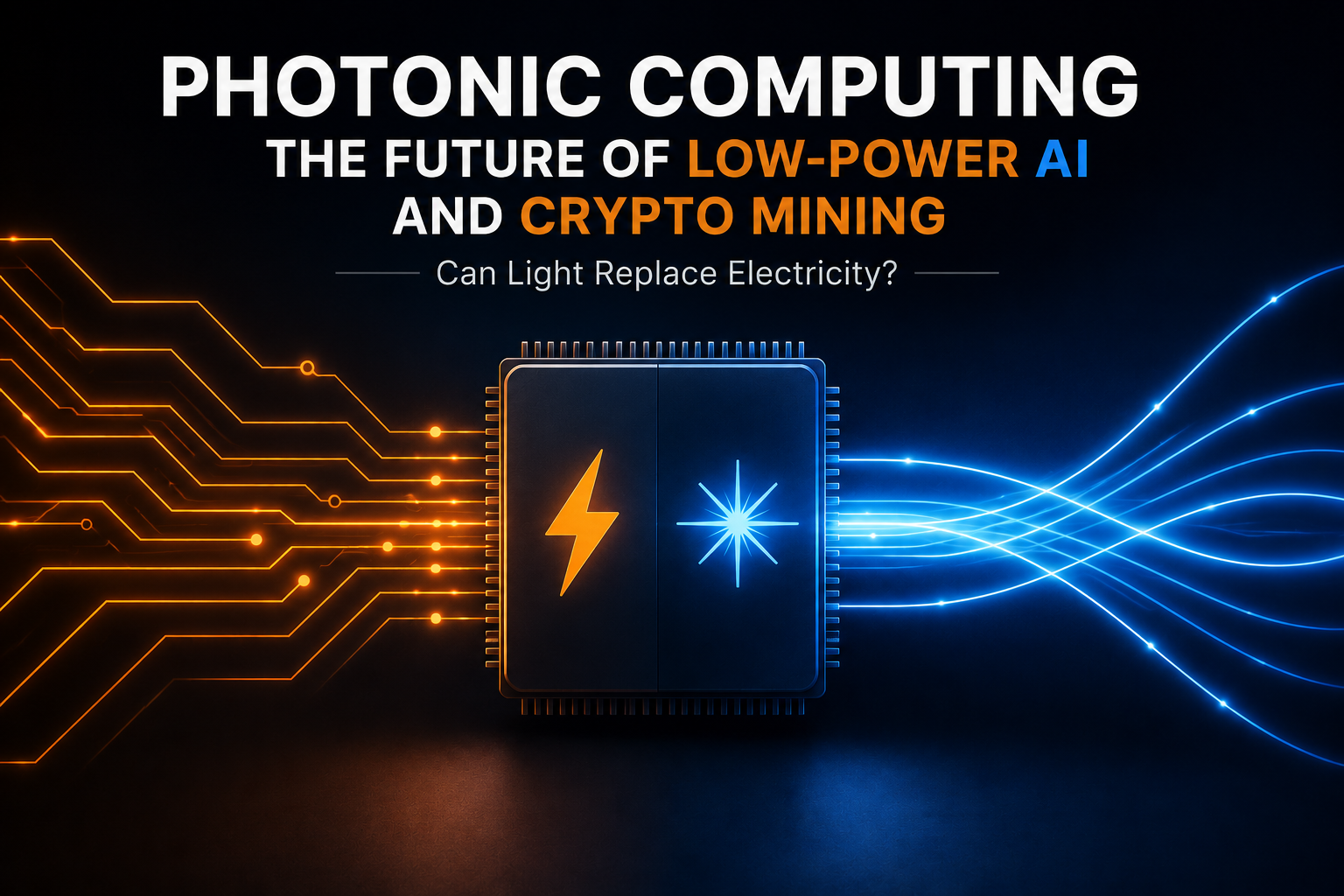
That’s why computing with light—or photonic computing—is such a big deal.
Instead of relying on electrical wires, these new chips use lasers and light waves to crunch the numbers. The result? Almost zero resistance. That means barely any heat and a massive drop in energy use.
If they can get this working at scale outside of a lab, it’s going to completely upend how we run data centers and AI.
But the biggest immediate question is: will computing with light actually be the thing that saves crypto mining from its own massive electricity bills?
The Rising Energy Demand of Digital Infrastructure
Modern computing infrastructure consumes huge amounts of electricity. In 2022, global data centers used an estimated 340 to 440 terawatt hours of electricity. To put that into perspective, that is more electricity than all wind turbines in the European Union generated in 2023.
Even though data centers currently represent about 1% of global electricity consumption, the concern is how quickly that number might grow. Some forecasts suggest that by 2030, data center electricity demand could reach around 4.5% of global power consumption.
Several things explain this growth.
More people now live and work online. Video streaming, cloud services, and digital platforms generate massive amounts of data that must be processed and stored. But the biggest driver of new computing demand is artificial intelligence.
Training neural networks requires enormous numbers of mathematical operations. Those operations generate heat, and when heat appears inside a data center, cooling becomes necessary. Cooling systems themselves consume large amounts of electricity, effectively increasing the infrastructure’s energy cost.
Cryptocurrency mining faces a similar challenge. Mining hardware performs continuous hashing operations, pushing processors to their limits. As hardware speeds increase, energy consumption increases too.
This is why mining profitability depends so much on electricity prices.
If a new computing technology can deliver the same computational output with less energy and less heat, it could change the economics of large-scale computation.
That is the promise behind photonics computing.
How Traditional Mining Hardware Computes
To understand why photonic computing could matter, we first need to look at how current processors work.
Modern chips are built from semiconductors, usually silicon, and contain billions of transistors. Each transistor works like a tiny switch, allowing electrical current to pass or blocking it.
When billions of these switches operate together, they perform logic operations and execute instructions. In digital processors, information is represented using two states: zero and one.
This binary system is extremely reliable and precise. It is also the foundation of every modern processor, including CPUs, GPUs, and specialized ASIC mining machines.
But moving electrons through circuits has a cost.
When electrical current flows through metal, it encounters resistance. Resistance converts part of the electrical energy into heat. The faster the processor runs, the more switching occurs, and the more heat the chip produces.
In mining hardware, this effect becomes stronger because processors constantly perform hashing operations. ASIC miners designed for algorithms like SHA-256 can execute trillions of calculations every second, pushing hardware close to thermal limits.
Once heat builds up, cooling systems must remove it. Industrial fans, liquid cooling systems, and immersion cooling technologies are common in mining farms.
These cooling systems consume additional electricity and increase operational costs. In many mining facilities, cooling can become nearly as expensive as the computing itself.
Computing with Light Instead of Electricity
Photonic processors attempt to solve part of this problem by replacing electrical signals with light.
Instead of electrons moving through metal wires, photons travel through optical waveguides—tiny channels that guide light across the chip. These waveguides act like highways for laser signals.
Inside a photonic processor, laser light enters the chip and is manipulated by optical components. These components can split the light into multiple paths, change its phase, delay it, or combine different waves together.
Light behaves like a wave, and waves can carry information in several ways. Information can be encoded in the amplitude of the wave, the phase of the wave, or the wavelength of the light.
When two waves meet, they interfere with each other, forming a new pattern. That pattern can represent the result of a mathematical calculation.
This property makes photonic processors particularly useful for operations like multiplication and addition across large arrays of numbers, which are common in artificial intelligence workloads.
Because photons do not experience electrical resistance in the same way electrons do, moving information through a photonic circuit can require far less energy.
Less wasted energy means less heat produced, and less heat means less cooling infrastructure.
Why This Matters for Mining Hardware
Photonic processors are currently being developed mainly for artificial intelligence systems, but their characteristics could eventually benefit cryptocurrency mining.
To better understand the potential impact, here is a direct comparison between traditional mining hardware and emerging photonic systems:
Photonic vs Traditional Mining Hardware: Energy, Heat, and Cost Comparison
| Category | Traditional ASIC / GPU | Photonic Computing (Future) |
|---|---|---|
| Energy Consumption | High | Potentially 10x–30x lower |
| Heat Generation | Very high (requires cooling) | Low (less cooling needed) |
| Cooling Cost | High (fans, liquid, immersion) | Significantly reduced |
| Processing Type | Electrical signals (binary) | Light waves (analog + parallel) |
| Parallel Processing | Limited | Very high (multi-wavelength) |
| Maturity | Fully commercial | Experimental / early stage |
| Mining Impact | High operating costs | Potential major cost reduction |
The economics of mining depend strongly on energy efficiency.
If mining hardware could perform the same hashing operations while consuming less electricity, operational costs would drop immediately. Even a modest reduction in power consumption can significantly increase mining profitability.
At industrial scale, even a 10–20% improvement in efficiency can translate into millions of dollars saved annually for large mining operations.
Photonic computing offers three potential advantages.
First, lower energy consumption. Some developers claim photonic processors can perform certain workloads using up to 30 times less energy than traditional processors.
Second, reduced heat generation. Because optical circuits produce less heat, mining farms could require less cooling infrastructure, lowering both electricity usage and equipment costs.
Third, greater parallel processing. Optical systems can process multiple signals simultaneously using different wavelengths of light, allowing large numbers of calculations to occur at the same time within a single photonic circuit.
In the future, mining hardware may not rely entirely on electronic processors. Instead, systems could use hybrid architectures combining ASIC chips with photonic accelerators designed for certain computational tasks.
The Technology Behind Early Photonic Processors
One company exploring this technology is Q.ANT, a startup located in Stuttgart, Germany.
Founded in 2018, the company developed a photonic processor designed for high-performance computing workloads. The processor uses thin layers of lithium niobate on silicon, a material capable of guiding light precisely.
In this system, a laser injects light into the chip. Optical components then split the light into several paths, and as waves travel through the processor, they interact and interfere.
The resulting interference pattern represents the outcome of the calculation. Detectors then convert the optical signal back into electrical form so that other systems can use the result.
According to the company, this approach could deliver significant improvements in energy efficiency and computational speed for certain workloads.
Although these processors are still early technology, they demonstrate how optical computation might eventually become part of mainstream computing infrastructure.
The Real Challenges Ahead
Photonic computing is promising, but it is not yet a perfect solution.
One major challenge is precision. Many photonic processors operate using analog signals, which can introduce small errors because of noise or environmental changes. Digital processors still offer higher numerical precision.
Another challenge is signal conversion. Most computer memory stores information electronically, so photonic processors need components that convert electrical signals into light and then convert results back into electricity.
These conversions add complexity to the system.
For now, photonic processors will likely appear first as accelerators working alongside traditional processors rather than replacing them completely.
The Algorithmic Hurdle: Can Light Play the Logic Game?
The real elephant in the room isn't just the hardware—it’s the math. Most crypto mining, especially Bitcoin, relies on the SHA-256 algorithm, which is basically a brutal series of "logic puzzles" (like XORs and bit-rotations). These were designed specifically for silicon chips that act like tiny on/off switches.
Photonic processors, however, are naturally "analog" rockstars; they excel at the massive, fluid math used in AI. Trying to force light waves to perform the rigid, frame-by-frame binary logic of a mining hash is like trying to play Tetris with a fire hose. It’s messy, and even a tiny bit of noise or interference in the light wave can ruin the entire calculation.
For light-based mining to truly take over, we don’t just need better lasers—we might actually need to rethink how we design the security algorithms themselves to play nice with the physics of light.
Conclusion
For cryptocurrency mining operations, electricity costs define profitability. Mining farms operate continuously, and even small improvements in energy efficiency can have a significant financial impact.
Photonic computing offers a possible path toward lower energy consumption and reduced heat generation. If these processors can perform large-scale computations more efficiently than electronic chips, they could lower both electricity usage and cooling costs.
That combination would directly improve mining economics.
While photonic mining hardware may still be years away, the technology shows an important direction for the future of computing infrastructure. As digital systems grow more power-hungry, innovations that reduce energy consumption will become increasingly valuable.
For miners, the equation remains simple: lower electricity costs mean higher profits.
FAQ
Q1: What is photonic computing?
Photonic computing is a technology that performs calculations using light instead of electrical signals inside processors.
Q2: Why could photonic processors reduce mining electricity costs?
Because photons do not face electrical resistance like electrons, photonic processors generate less heat and waste less energy.
Q3: Can photonic processors replace ASIC miners?
Not immediately; they are more likely to appear first as accelerators working alongside traditional mining hardware.
Q4: Could photonic computing improve crypto mining profitability?
Yes, lower electricity consumption and reduced cooling requirements could significantly decrease operational costs.
Q5: When could photonic processors appear in mining hardware?
The technology is still developing, so it may take several years before photonic processors are integrated into commercial mining systems.