
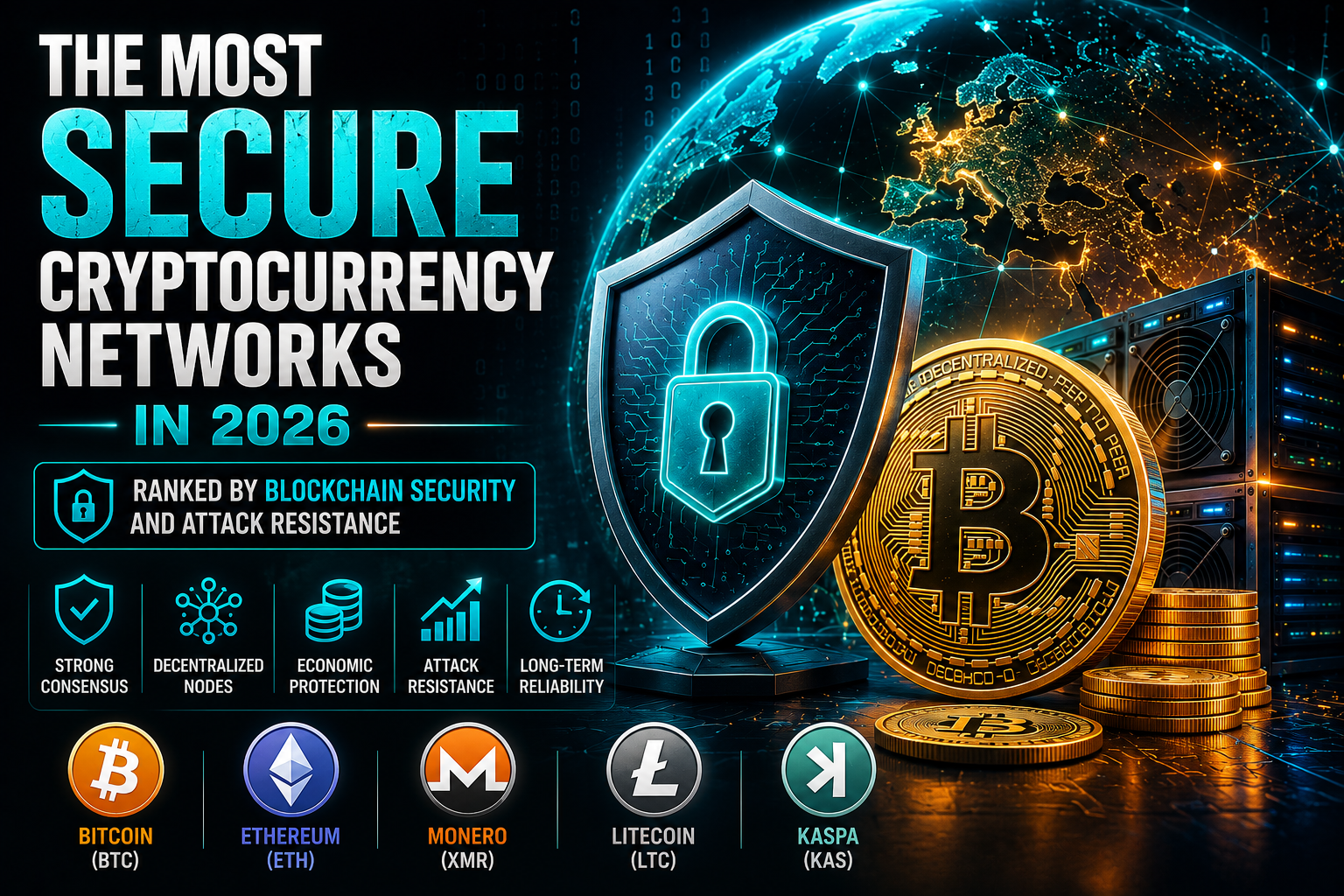
Blockchain Security Explained: Consensus, Hash Rate & 51% Attack Resistance
Blockchain security isn’t just a feature; it’s the bedrock of the entire operation. It’s the only thing standing between a functional system and a mess of manipulated transactions or double-spending.
When that security snaps—whether it’s a technical exploit or an economic flaw—trust vanishes instantly. Ultimately, surviving the long haul boils down to the "muscle" behind the consensus. For Proof of Work, that means the raw power of the hash rate; for other models, it’s the massive value locked away in staking. When you combine that with a healthy count of independent nodes, you get a platform that’s actually built to last. To see how these defenses hold up under pressure, let’s look at some real-world cases where things went south.
| Network | Consensus | Primary Defense | Core Advantage | Resistance Level |
|---|---|---|---|---|
| Bitcoin (BTC) | Proof of Work | Hash Power (SHA-256) | Extreme Attack Cost | Ultimate Fortress |
| Ethereum (ETH) | Proof of Stake | Economic Capital | Skin in the Game (Slashing) | Economic Moat |
| Monero (XMR) | Proof of Work | Privacy (RandomX) | ASIC Resistance | Invisible Shield |
| Litecoin (LTC) | Proof of Work | Longevity (Scrypt) | Clean 10-Year Record | Battle-Hardened |
| Kaspa (KAS) | Proof of Work | BlockDAG Structure | Speed + Anti-Reorg | Structural Edge |
Cryptocurrencies That Suffered 51% Attacks: Lessons from Real Blockchain Hacks
We’ve seen several Proof of Work networks learn the hard way that a weak hash rate is an existential threat. Ethereum Classic (ETC) is a prime example; it was hit by multiple 51% attacks back in 2019 and 2020 because its low hash power basically left the door open for attackers to rewrite history and double-spend.
Bitcoin Gold (BTG) suffered a similar fate in 2018, with millions lost simply because the cost to attack the network was low enough to be profitable. Then there’s Vertcoin (VTC), which became a repeat target because its mining power was so cheap to rent that anyone could hijack the chain on a budget. Even Feathercoin (FTC) was essentially sidelined after a 51% attack shattered investor confidence, leading to a decline it never really recovered from. In this game, if you can’t defend the chain, you simply don’t survive.
Why Crypto Networks Fail Without 51% Attacks: Economic & Security Risks
But you don’t always need a hacker to break a network; sometimes, the economics do the job. The collapse of Terra (LUNA/UST) is proof that you can suffer one of the most catastrophic wipeouts in crypto history without a single line of exploited code or a 51% attack.
Terra’s entire security model leaned on a fragile algorithmic balancing act between UST and LUNA—a mint-and-burn mechanism with practically zero hard reserves backing its dollar peg. Throw in the dangerously unsustainable yields from the Anchor protocol, and the stage was set for disaster. The moment real selling pressure hit, UST lost its peg and triggered a brutal death spiral. The system practically panicked, minting massive amounts of LUNA out of thin air in a desperate attempt to plug the hole.
It didn't work. In a matter of days, LUNA plummeted from double digits to fractions of a cent. Billions in market value vanished, forcing the network to halt entirely. It was a harsh wake-up call: a flawed economic engine can destroy a project far more thoroughly than any direct technical attack.
Solana Network Outages Explained: Security, Reliability & Downtime Analysis
Then there’s Solana, which proved that you don't even need an external attacker to bring a network to a grinding halt—sometimes, your own technical bottlenecks will do the job.
When these outages hit, the chain simply stalled. No blocks were produced, no transactions were processed; it was just complete radio silence for hours. The most infamous incident struck on September 14, 2021, when relentless bot spam congested the network so severely that it went offline for 17 hours. The instability dragged on through late 2021 and 2022, with multiple blackouts triggered by massive traffic surges, buggy validator software, and failures in network consensus.
These disruptions persisted into May 2022, February 2023, and as recently as February 6, 2024, when a runtime execution loop choked block production for nearly five hours. The real irony here? There were no malicious hackers orchestrating these takedowns. The true culprits were basic protocol weaknesses, unmanaged bot traffic, and fundamental design flaws that simply kept validators from staying on the same page.
Top 10 Most Secure Cryptocurrencies in 2026 Ranked by Blockchain Security
When we look at blockchain networks that didn't make it because of technical issues, financial problems, or too much centralization, several cryptocurrencies come out as the most secure by 2026. Each one earns this spot for its own specific reasons.
Bitcoin (BTC): Highest Hash Rate and Strongest Proof of Work Security Model
Bitcoin doesn’t just offer security; it commands it through raw, undeniable power. Its defense is anchored by a global hash rate so massive that attempting a 51% attack isn't just expensive—it’s economically suicidal. By utilizing the SHA-256 algorithm and a sprawling, decentralized army of independent nodes, Bitcoin has turned into a digital fortress. Its "boring" and cautious design is actually its greatest strength; by avoiding unnecessary complexity, it leaves no room for the kind of catastrophic bugs that plague more "innovative" chains. In short, Bitcoin is built to endure, not just to function.
Ethereum (ETH): Proof of Stake Security, Validator Decentralization, and Slashing Mechanisms
Ethereum has traded raw computational power for a massive "economic moat." By locking up hundreds of billions of dollars in its Proof of Stake model, the network creates a deterrent that is as much about psychology as it is about math. With a sprawling validator set and thousands of independent nodes, any attempt to hijack the chain becomes a losing game. The system’s "slashing" mechanisms act as a built-in judge and jury—if you try to cheat, the network doesn't just block you; it destroys your staked capital. This makes a large-scale attack not just difficult, but financially irrational.
Monero (XMR): Privacy-Focused Security with RandomX and Decentralized Mining
Monero is all about privacy. It uses tech like Ring Signatures and Stealth Addresses to hide transaction details by default, so you can't really track who's sending money. Another big thing is its RandomX algorithm. It’s built to stop big ASIC mining farms from taking over, which lets regular people mine with their own computers. Because the mining is spread out like that, it's much harder for anyone to control or monitor the network, even in 2026.
However, this strong focus on privacy comes with trade-offs. Regulatory pressure and exchange delistings can limit liquidity and accessibility, indirectly affecting overall network resilience. Still, from a pure protocol-level perspective, Monero remains one of the most censorship-resistant and surveillance-resistant networks in the crypto space.
Litecoin (LTC): Scrypt-Based Stability and Long-Term Network Reliability
Litecoin’s security is built on a decade of consistency. By sticking to the Scrypt algorithm and a design that closely mirrors Bitcoin, it has maintained its reputation as a reliable alternative for years. Its biggest selling point is its clean track record; the network has operated for a long time without facing any major security breaches. While other projects often rush to test experimental features, Litecoin focuses on being a stable and predictable platform. In a market where new things break all the time, that kind of dependability is a security feature in itself.
Kaspa (KAS): BlockDAG Architecture and Fast, Secure Transaction Confirmations
Kaspa takes a different path by using a BlockDAG architecture instead of a traditional single chain. This setup allows for much faster transaction confirmations, but its real value lies in how it handles security; the design makes it significantly harder for anyone to reorganize the chain or double-spend. By processing blocks in parallel, Kaspa closes many of the "windows of opportunity" that attackers usually look for. Even though it's a newer player compared to the giants, its structural approach provides a level of attack resistance that is very impressive for a network of its size in 2026.
Which Cryptocurrency Has the Strongest Blockchain Security in 2026?
By 2026, the crypto industry has finally stopped falling for flashy marketing and started respecting battle-hardened resilience. The networks left standing aren't just lucky; they’ve made attacking them a financial suicide mission.
Here is how the heavy hitters actually stack up:
-
Bitcoin (BTC): The digital fortress. With a hash rate that essentially requires the energy of a small nation to bypass, it remains the gold standard for "unhackable" value.
-
Ethereum (ETH): The economic moat. It doesn't use raw power; it uses raw wealth. If you want to mess with the network, you have to risk losing billions of your own staked capital. It’s security via "skin in the game."
-
Monero (XMR): The ghost in the machine. By making everyone invisible and keeping mining accessible to regular people—not just massive server farms—it’s the only network that truly prioritizes the individual's right to disappear.
-
Litecoin (LTC): The boring, reliable rock. It doesn't try to be fancy, and that’s its superpower. It’s the "Old Faithful" of the crypto world—steady, secure, and drama-free.
-
Kaspa (KAS): The speed demon. It proves you don't have to sacrifice safety for velocity. Its BlockDAG tech creates a "web" of blocks instead of a single line, making it much harder for attackers to manipulate.
The Takeaway
In 2026, true security isn't a feature—it’s an outcome. Whether it’s through brute-force electricity (Bitcoin), massive financial collateral (Ethereum), or architectural cleverness (Kaspa), the winners are the ones that make it cheaper to play by the rules than to break them. If a network’s security relies on a marketing pitch rather than a massive economic or technical cost to attack, it’s not a network—it’s a ticking time bomb.
Frequently Asked Questions About Blockchain Security & Secure Cryptocurrencies
Q1: What makes a cryptocurrency network secure?
A secure cryptocurrency network combines strong consensus mechanisms, high hash rate or staking value, wide node distribution, and economic incentives that discourage attacks. True security comes from making attacks technically difficult and financially irrational, while maintaining decentralization and long-term reliability.
Q2: What is a 51% attack in crypto?
A 51% attack happens when a single entity gains majority control of a Proof of Work network’s hash rate. This allows them to reorganize blocks, reverse transactions, and execute double spending. Smaller networks with low hash power are more vulnerable to this type of attack.
Q3: Is Proof of Stake more secure than Proof of Work?
Both models can be secure, but they work differently. Proof of Work relies on computational power and energy costs, while Proof of Stake depends on economic penalties and locked capital. In large networks with strong decentralization, both can provide high levels of security.
Q4: Why did Terra collapse without a 51% attack?
Terra collapsed due to weak economic design, not a technical exploit. Its algorithmic stablecoin model lacked sufficient reserves, and once selling pressure increased, the mint-and-burn mechanism triggered a death spiral. This shows economic security is just as important as technical security.
Q5: Has Solana fixed its network outage problems?
Solana has implemented upgrades to improve stability and validator coordination. While outages occurred in previous years due to congestion and software issues, the network continues refining its infrastructure to reduce the risk of prolonged downtime.
Q6: Which cryptocurrency is considered the most secure in 2026?
Bitcoin is generally considered the most secure due to its massive global hash rate and long operational history. However, Ethereum, Monero, Litecoin, and Kaspa each provide strong security models tailored to different priorities such as staking security, privacy, stability, and scalability.