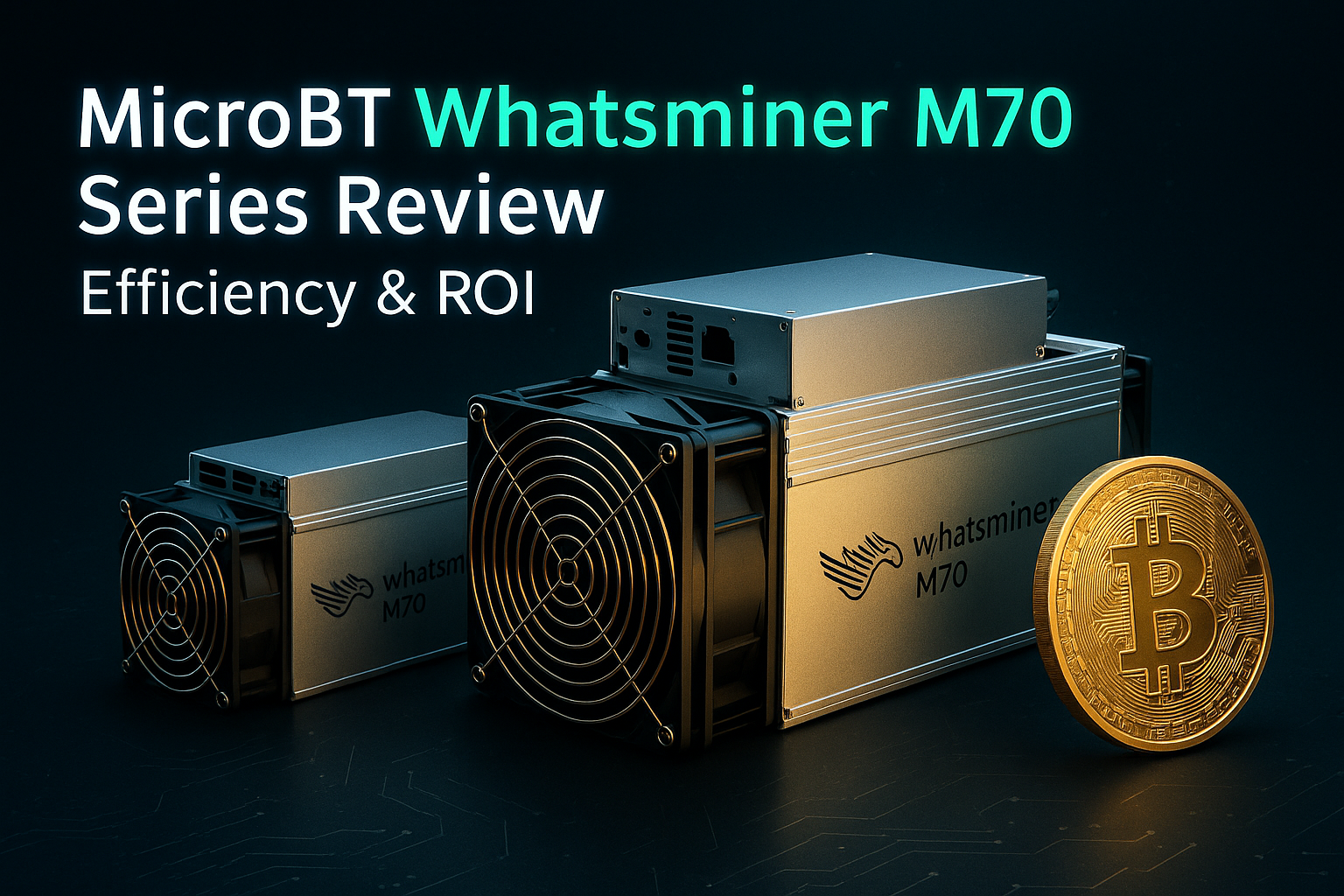
2026: The Year the Mining Arms Race Ended
Let’s be honest—the days of plug and play mining are long gone. In 2026, it doesn't matter how much hashrate you can dump onto the network if your overhead is eating your lunch. We’ve entered a brutal era of survival where your power bill is the enemy. Every cent per kilowatt is a battle, and for many, it’s a battle they’re losing. If your hardware isn't hyper-efficient, you're not building a business; you're just paying for expensive heating.
The era of chasing sheer hashrate is dead. In this environment, survival depends on every single watt. Every hardware choice is a make-or-break decision for your bottom line.
Enter the WhatsMiner M70 Series. Launched into a market defined by price volatility and soaring difficulty, the M70 isn't just another incremental update. It’s a strategic tool designed for a harsher reality—one where profitability is earned, not expected, and only the most efficient hardware stands a chance of staying in the green.
But for the serious miner, the question remains:
Is the M70 series a genuine lifeline for your ROI, or is it just another high-priced machine chasing a shrinking pie?
In this breakdown, we’re cutting through the marketing noise to look at the numbers that actually matter: hashrate, efficiency, and real-world sustainability. Let’s see if this machine has what it takes to survive the 2026 mining environment.
-
✔️ Best for: Miners paying $0.05–$0.08/kWh seeking stable ROI
-
⚠️ Risk zone: Above $0.10/kWh, margins become extremely tight
-
🔥 Key advantage: High efficiency (≈12.8 J/TH) keeps you competitive post-halving
-
🎯 Bottom line: Not the most powerful—but one of the safest long-term bets in 2026
About MicroBT: Company Background and WhatsMiner Evolution
Established in China in 2016 by engineer Yang Zuoxing, MicroBT Technology Co., Ltd. has focused on producing ASIC Bitcoin miners since its inception. Thanks to the strong performance and energy efficiency of its WhatsMiner product line, the company quickly established itself as a major competitor to industry giants such as Bitmain. Following the success of the M20, M30, M50, and M60 series, MicroBT now introduces the M70 generation.
M70 Technical Specifications: Hashrate, Power Consumption & 8nm Architecture
The mining performance of this series is impressive, starting at 214 TH/s and reaching up to 280 TH/s in specialized models. However, energy efficiency is the most critical feature of this generation, dropping as low as 12.85 J/TH (ranging between 12.5 and 14.673 J/TH depending on the specific model). Power consumption remains consistent across the series at approximately 3,140W. It is also worth noting that this hardware is built on an 8nm process, placing it just one step behind the very latest industry node.
From a profitability standpoint, at an average electricity cost of $0.08/kWh, the device generates roughly $10.00 per day. After deducting approximately $6.50 in electricity costs, the net profit stands at around $3.50 per day, based on current Bitcoin prices.
WhatsMiner M70 Models Compared: M70 vs M70S vs M70+
| Model | Hashrate | Efficiency | Power Consumption | Best For |
|---|---|---|---|---|
| M70+ | 244 TH/s | 12.869 J/TH | ~3140W | Balanced ROI + High efficiency |
| M70S | 226 TH/s | 13.894 J/TH | ~3140W | Mid-budget miners |
| M70 | 214 TH/s | 14.673 J/TH | ~3140W | Low upfront cost strategy |
The series offers three primary air-cooled models, each targeting a different mining strategy:
-
M70+ → Best overall efficiency and long-term stability
-
M70S → Balanced option for mid-range budgets
-
M70 → Lower upfront cost with reduced efficiency
»» See the detailed comparison table below for full specifications.
Key Review Insights: Efficiency, Cooling & Strategic Mining Approaches
Electricity Costs and Mining Profitability in 2026
The Electricity Battle: In today’s economic climate, high efficiency is no longer a luxury—it is a necessity. The M70 series allows miners to remain profitable while older, less efficient machines are gradually forced offline due to rising electricity costs.
Hydro and Liquid Cooling Options: M73 & M79 Industrial Units
The new generation also includes “beast” models such as the M73 and M79, designed specifically for large-scale industrial operations using hydro-cooling systems. These units can be described as a “complete mining farm in a single box,” given their extreme hashrate and substantial power requirements.
Solo Mining with M70S Plus: Risk vs Reward Strategy
The Solo Mining Strategy: An interesting perspective presented in this review is the potential of owning a single M70S Plus for solo mining. With an estimated annual probability of around 1 in 85 to mine a full Bitcoin block, this “lottery-style” approach is becoming more appealing to some miners compared to traditional pool mining, where rewards are increasingly diluted.
Cost Strategy: Choosing Based on Electricity Price
The review clearly distinguishes between two miner profiles:
-
Low-Cost Electricity Holders: These miners should prioritize the purchase price relative to hashrate, opting for cheaper machines even if they are slightly less efficient.
-
High-Cost Electricity Holders: These miners must focus almost exclusively on the M70 series to avoid slipping into net losses.
WhatsMiner M70 Price, Availability & Distributor Scarcity (2026)
As a very recent release, the M70 series is still scarce among major distributors. Current market prices start at around $3,900 for the base M70 model and can reach up to $5,800 for the high-end M70+ version.
Conclusion: In 2026, Efficiency Is the Only Edge That Matters
The WhatsMiner M70 Series isn’t the most powerful machine on the market—but that’s not the point anymore. In a post-halving world where margins are tight and electricity decides everything, efficiency is what keeps you alive.
If your power costs are low, almost any machine can make money. But if you’re operating in a competitive environment, the M70 series becomes less of an option—and more of a necessity.
This isn’t about chasing hashrate. It’s about staying profitable when others are forced offline.
And in 2026, that’s the only game that matters.
FAQ
Q1: Is the WhatsMiner M70 still profitable after the recent difficulty adjustments?
As of early 2026, yes—but with a caveat. Profitability now depends almost entirely on your electricity rate. If you are paying $0.06/kWh or less, the M70 series remains a consistent earner. If your costs exceed $0.10/kWh, you are in the "danger zone" where margins become razor-thin. The M70’s 12.8 J/TH efficiency is specifically designed to keep you in the green when older models like the M30 or M50 start losing money.
Q2: What is the main difference between the M70, M70S, and M70+?
Think of them as Good, Better, and Best in terms of efficiency:
-
M70: The budget-friendly entry point. Lower upfront cost but higher power draw per Terahash.
-
M70S: The "Sweet Spot." It offers a balanced middle ground for most mid-scale mining operations.
-
M70+: The "Efficiency King." It delivers the highest hashrate (244 TH/s) for the lowest energy cost, making it the safest long-term investment for 2026.
Q3: How does the MicroBT M70 compare to Bitmain’s latest Antminers?
While Bitmain often pushes for slightly higher raw hashrate, MicroBT’s M70 series is famous for its durability and plug-and-play stability. WhatsMiners are generally preferred by miners who want a machine that doesn't require constant maintenance. In 2026, the M70 series competes directly with the Antminer S21 series on efficiency, often winning on build quality.
Q4: Can I run a WhatsMiner M70 at home?
Technically, yes, but it’s a challenge. With a power consumption of around 3,140W, you’ll need a dedicated 240V circuit. More importantly, these machines are loud (approx. 75-80 dB). Unless you have a soundproofed garage or a dedicated cooling shed, the M70 is best suited for an industrial or data center environment.
Q5: What is the expected ROI (Return on Investment) for an M70+ in 2026?
Current market data suggests an ROI period of 14 to 20 months, depending on Bitcoin’s price volatility and your local power costs. While this is longer than in previous cycles, the M70 series is built to last 3–5 years, meaning it will likely remain operational and profitable long after the initial investment is recovered.
Q6: Do I really need liquid cooling (M73/M79) or is air-cooled fine?
For most individual miners, air-cooled (M70/S/+) is the standard. Liquid cooling (M73/M79) is a game-changer for industrial farms because it allows for higher density and silent operation, but it requires an expensive infrastructure (pipes, pumps, and heat exchangers). Stick to air-cooled unless you are building a professional-grade mining facility.