Introduction
The world of Bitcoin mining is usually divided into two extremes: massive industrial farms running megawatts of power, and tiny hobby devices that are more educational than practical. Every once in a while, a product appears that tries to sit somewhere in the middle—small enough to live in a home or office, yet powerful enough to be taken seriously. The JingleMiner Bitcoin Hash Card is one of those devices.
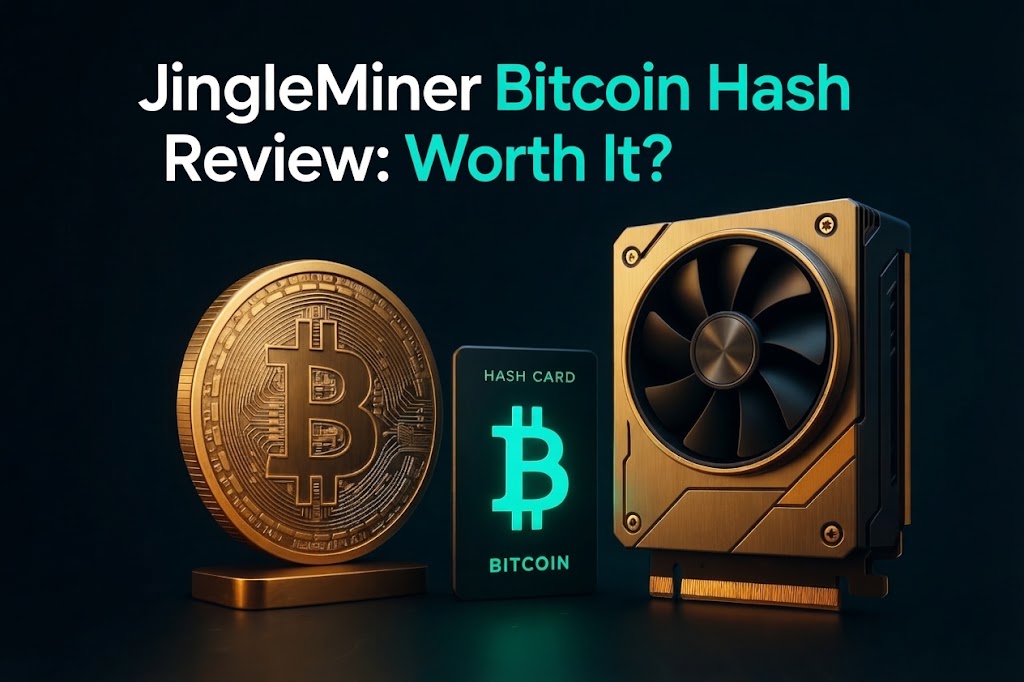
At first glance, it looks like a graphics card. In reality, it is a compact ASIC miner designed to mine Bitcoin (and compatible SHA-256 coins) at around 12.5 TH/s while consuming roughly 200 watts. That puts it in a very unusual category: far more powerful than the typical “toy” solo miners, but still small and efficient enough to run on a standard household power setup.
This article takes a practical, hardware-focused look at the JingleMiner Bitcoin Hash Card. We’ll cover its design, setup process, noise and power characteristics, and—most importantly—whether it makes sense for pool mining, solo mining, or as a hybrid hobby-investment device. Along the way, we’ll also place it in context against other small solo miners and explain what you should realistically expect from a device in this class.
What Is the JingleMiner Bitcoin Hash Card and How Does This 12.5 TH/s Low-Power Home ASIC Miner Actually Work?
The Bitcoin Hash Card is a compact SHA-256 ASIC miner sold by JingleMiner. Unlike traditional box-shaped ASICs with external power supplies and loud industrial fans, this unit is built in a GPU-like form factor. It even includes visual elements such as a PCIe-style connector and an 8-pin power input, giving it the appearance of a graphics card—even though it is, of course, a dedicated ASIC and not a GPU.
JingleMiner Bitcoin Hash Card Specs Explained: Real Hashrate, Power Efficiency, Cooling Design, and SHA-256 Mining Performance
-
Hashrate: ~12.5 TH/s
-
Power consumption: ~200 W
-
Algorithm: SHA-256 (Bitcoin, Bitcoin Cash, and similar coins)
-
Power input: Standard 8-pin + C13 cable via external PSU
-
Connectivity: Wi-Fi and Ethernet
-
Form factor: GPU-style card design
In terms of raw performance, 12.5 TH/s is tiny compared to modern industrial miners. However, in the niche world of home and solo mining devices, this is actually quite substantial.
JingleMiner Bitcoin Hash Card Unboxing and First Impressions: Design Quality, Build, and Home-Friendly ASIC Appeal
What Comes in the Box and Why the GPU-Style Form Factor Makes This Miner Stand Out
One of the most striking aspects of this miner is its design. It genuinely looks like a graphics card, which makes it much easier to integrate into a home office or a display shelf without the “industrial server” aesthetic that most ASICs bring.
Inside the box, you’ll typically find:
-
The miner itself
-
A power cable (often with a regional adapter)
-
A small antenna for Wi-Fi
-
Basic documentation
The build quality feels solid, and the cooling solution appears more like what you’d expect from a high-end PC component than from a traditional ASIC. While the PCIe connector is not meant to be used like a real GPU slot, the overall presentation makes it clear that JingleMiner is targeting enthusiasts and home users, not data centers.
From a practical standpoint, this design choice matters. A device that looks and feels “home-friendly” is much easier to justify running in a personal workspace, especially if noise and heat are kept under control.
JingleMiner Bitcoin Hash Card: Home Setup Guide
Best Placement Tips for Safe Cooling, Cable Management, and Daily Home Use
Because of its size and shape, the Bitcoin Hash Card can be placed on a shelf, a desk, or even in a display-style setup. Many users will treat it almost like a decorative piece of hardware that also happens to mine Bitcoin.
The main practical consideration is cable management. Since it uses a standard C13 power cable and an external power supply, you’ll want to plan how to route the cable cleanly—especially if you’re aiming for a neat office setup.
Power Input, Wi-Fi vs Ethernet, and Network Setup for Stable Bitcoin Mining
Powering the unit is straightforward. It draws around 200 watts, which is well within the limits of a normal household outlet. This also means you don’t need specialized electrical infrastructure, unlike larger ASICs.
For networking, the miner supports:
-
Wi-Fi (via the included antenna)
-
Ethernet (for more stable connections)
Once powered on, the device appears on your local network. From there, you can access its web dashboard through a browser using its local IP address.
How to Configure Pools, Wallets, and Monitoring Settings Through the Web Interface
The web interface is simple and functional. You can:
-
Set your mining pool or solo mining endpoint
-
Enter your wallet address
-
Monitor hashrate, uptime, and basic performance stats
-
Restart or reconfigure the device
This is very similar to what you’ll find on most modern ASICs, just scaled down to a much more approachable device.
JingleMiner Noise, Heat Output, and Real-World Home Mining Comfort: Can You Run It in a Bedroom or Office?
Fan Noise, Heat Management, and What to Expect During 24/7 Operation
At 200 watts, this miner sits in an interesting thermal and acoustic category. It produces noticeable heat—enough to warm a small room in winter—but nowhere near the levels of full-size ASICs.
-
In terms of noise, expectations should be realistic:
-
It is not silent like a fanless device.
-
It is much quieter than industrial miners.
-
Under load, the fan may ramp up and become audible, especially in a quiet room.
For most home users, this places it in the “acceptable background noise” category, similar to a gaming PC under light to moderate load. That makes it feasible to run in an office or living space, provided you’re not extremely sensitive to noise.
JingleMiner Pool Mining vs Solo Mining: Which Strategy Makes More Sense for Profit, Odds, and Long-Term Enjoyment?
This is where the Bitcoin Hash Card becomes particularly interesting.
Pool Mining Profitability: Electricity Costs, Daily Earnings, and Break-Even Expectations
At current network difficulty and typical electricity prices, 12.5 TH/s at 200 W is not a guaranteed profit machine when pool mining Bitcoin. Depending on your electricity cost, you may:
-
Run at a small loss
-
Break even
-
Or make a very small profit if power is cheap
In some scenarios, mining alternative SHA-256 coins or merged-mined chains can improve the numbers slightly, potentially bringing the operation close to break-even.
In other words, pool mining with this device is more about learning, experimentation, and small-scale participation than about generating meaningful profit.
⚡ Profitability Note
Daily mining profitability constantly changes based on Bitcoin price, network difficulty, electricity cost, and your miner’s efficiency. For the most accurate estimate, always use a mining profitability calculator.
Solo Mining With 12.5 TH/s: Real Block Odds, Risk vs Reward, and Why Hobbyists Love the Long Shot
Where this miner really stands out is in solo mining.
Solo mining is often compared to buying lottery tickets:
-
The chances of finding a block are extremely small.
-
But if you do find one, the reward is enormous (a full block reward).
Compared to ultra-small solo miners (like sub-1 TH/s devices), the Bitcoin Hash Card has significantly better odds. While you’re still looking at average timeframes measured in centuries or millennia, the statistical chance is meaningfully higher than with tiny hobby miners.
Some enthusiasts use a metric like “reward per year per cost” to compare these devices. By that kind of analysis, the Bitcoin Hash Card ranks surprisingly well—better than many novelty miners and only behind a few exceptionally efficient niche devices.
The key point:
-
This is not a rational investment strategy.
-
It is a fun, high-variance, low-probability bet with real skin in the game.
For many hobbyists, that’s exactly the appeal.
JingleMiner vs Bitaxe and Other Small Bitcoin Miners: Hashrate, Power Use, Solo Odds, and Practical Home Value
In the landscape of small solo miners, you’ll find devices like:
-
Low-power Bitaxe variants
-
Nano-scale SHA-256 miners
-
Experimental open-source boards
Most of these consume very little power, but also have extremely low hashrates—often in the gigahash range rather than terahash.
The Bitcoin Hash Card sits in a different class:
-
Much higher hashrate than typical hobby miners
-
Higher power consumption, but still manageable at home
-
Better solo-mining odds, though still very small in absolute terms
In practical terms, it represents a middle ground: not a toy, not an industrial machine, but something in between.
Price, Availability, and Practical Value
The JingleMiner Bitcoin Hash Card is typically priced at around $559, placing it in an appealing middle ground between small hobby miners and full-size ASICs. For users who want meaningful home mining performance without spending thousands, it offers a solid balance of price, efficiency, and solo-mining potential.
Because it is stocked domestically in some regions, buyers can often avoid long shipping times and import complications, which adds to its appeal.
From a value perspective, you should think of this device as:
-
A learning and experimentation tool
-
A fun solo-mining “lottery machine”
-
A small, manageable way to participate in Bitcoin mining
-
Not a guaranteed profit generator
If you approach it with that mindset, it becomes much easier to justify.
Who Is This Miner For?
The JingleMiner Bitcoin Hash Card makes the most sense for:
-
Crypto enthusiasts who want hands-on experience with ASIC mining
-
Home users who can’t or won’t run loud, power-hungry miners
-
Solo mining hobbyists who enjoy the long-shot block hunt
-
Content creators or educators demonstrating how mining works
It is not ideal for:
-
Anyone expecting consistent, reliable profit from pool mining
-
Users with very expensive electricity
-
People who want completely silent operation
⚡ Practical Reality Check
The JingleMiner Bitcoin Hash Card is not designed to compete with industrial ASIC farms. Its real strength lies in accessibility: low power draw, manageable noise, simple setup, and a meaningful solo-mining edge over ultra-small hobby miners. For users who want a compact ASIC experience without turning their room into a server rack, this device hits a rare sweet spot between practicality and fun.
Final Verdict: Is the JingleMiner Bitcoin Hash Card Actually Worth It?
The JingleMiner Bitcoin Hash Card is a genuinely interesting product in a market that often swings between extremes. With around 12.5 TH/s at 200 watts, it offers far more performance than typical hobby miners while remaining small, relatively quiet, and easy to run in a home environment.
As a pool miner, it will usually hover around break-even or a small loss, depending on power costs and market conditions. As a solo miner, however, it becomes something more unique: a compact, display-friendly device that gives you a real—if still very small—chance of hitting a full Bitcoin block.
Seen as a practical experiment, educational tool, and long-shot bet, the Bitcoin Hash Card earns its place as one of the more compelling small-form-factor ASICs currently available. Just don’t confuse it with a guaranteed money printer—and you’ll likely enjoy what it offers.
JingleMiner Bitcoin Hash Card: Frequently Asked Questions
Q1: Can the JingleMiner Bitcoin Hash Card actually make a profit in 2026?
Profitability depends heavily on your electricity cost and the current Bitcoin network difficulty. At 12.5 TH/s and 200W, this miner is designed more for efficiency and hobbyist use than for high-yield ROI. If you have very cheap or free electricity (like solar power), you might see a small daily return. For most, it’s a break-even device that’s perfect for learning and solo mining "lottery" attempts.
Q2: How loud is the JingleMiner Hash Card compared to a gaming PC?
It is remarkably quiet for an ASIC miner but not silent. While it consumes about the same power as a mid-range GPU, its fans are optimized for continuous 24/7 cooling. Expect a consistent hum—louder than an idle PC, but significantly quieter than industrial miners like the Antminer S19. It’s comfortable enough for a home office or a ventilated garage.
Q3: Can I plug this miner directly into a GPU PCIe slot?
No. Even though it features a GPU-style design and a PCIe-looking connector, it is a standalone ASIC miner. The connector is primarily for structural support or aesthetic mounting. You must power the unit using a standard 8-pin PCIe power cable and an external power supply (PSU) as instructed.
Q4: What are the realistic odds of hitting a solo Bitcoin block with 12.5 TH/s?
In the world of solo mining, 12.5 TH/s is like having dozens of "lottery tickets" compared to the single ticket offered by smaller USB miners. While the statistical probability remains very low (it could take years or decades to find a block), the JingleMiner gives you a mathematically better chance than almost any other home-friendly hobby device on the market.
Q5: Does the JingleMiner support Wi-Fi, or do I need an Ethernet cable?
It supports both. The device comes with a Wi-Fi antenna for easy placement anywhere in your home. However, for the most stable hashrate and to avoid "stale shares," we generally recommend using a wired Ethernet connection if your setup allows it.
Q6: Can I mine other coins besides Bitcoin (BTC)?
Yes, the JingleMiner uses the SHA-256 algorithm. This means you can mine any coin using that same protocol, such as Bitcoin Cash (BCH), DigiByte (DGB), or use it on "merged mining" pools to earn multiple coins simultaneously.