The Nature of Money and the Birth of Bitcoin
Have you ever stopped to look at the cash in your wallet? If you were holding a €20 bill and a 2,000 Algerian dinar note side-by-side, they’d look completely different, yet they share the same DNA. They aren't just paper; they are promises. Neither has any real value unless a government steps in and says it does.
But money doesn't just appear out of thin air. When a central bank decides it’s time to cycle out old, tattered bills, add new security holograms, or give the economy a little more breathing room, they fire up the presses. It’s a massive, highly synchronized operation. In the States, that’s the job of the Bureau of Engraving and Printing. Over in Europe, it’s a network of high-security facilities. And in Algeria? The Bank of Algeria runs the show, managing its own specialized infrastructure to make sure every dinar that hits the street is the real deal.
This raises a simple but powerful question:
If traditional money is printed… how is digital money created?
More specifically, how does Bitcoin come into existence? Is there a digital “printer” somewhere? A hidden supercomputer generating coins behind the scenes?
The answer is far more interesting—and far more revolutionary.
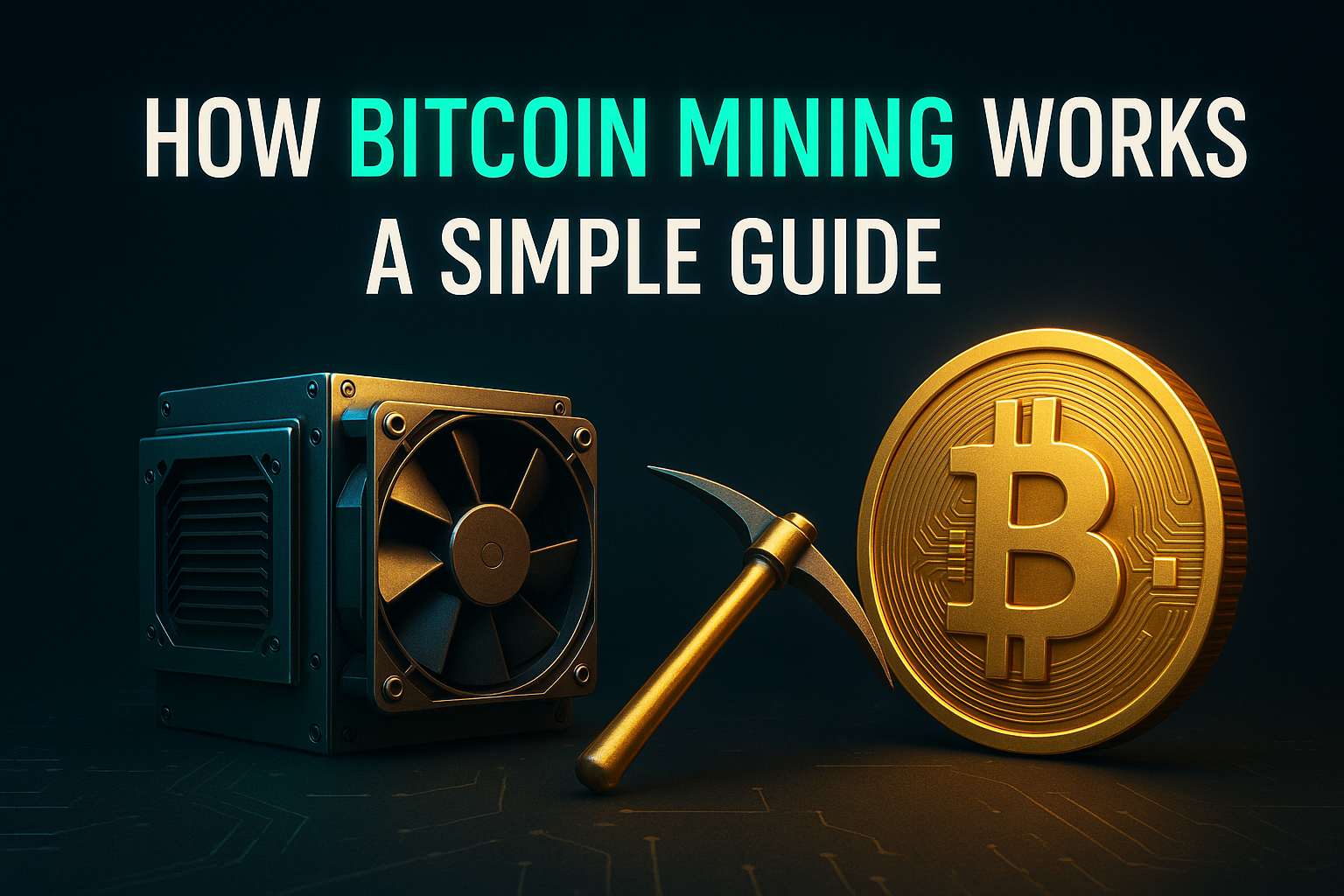
How Bitcoin Mining Works: The Process Behind Creating New Bitcoin and Securing the Network
Forget about central banks or government printing presses—Bitcoin plays by a different set of rules. It leans on a system first laid out by Satoshi Nakamoto, where new coins don't just appear; they’re 'mined' into existence.
Fast forward to early 2026, and we’re sitting at roughly 19.75 million Bitcoins already out in the wild. But the supply hasn't hit its limit just yet. It’s still growing, tick by tick, with new coins entering the scene like clockwork—roughly every ten minutes—in a way that’s both transparent and completely predictable.
It’s important to understand one key distinction:
Owning Bitcoin is easy—you can buy it, receive it, or earn it. Creating Bitcoin, however, is something entirely different.
There is only one way new Bitcoin is generated: through mining.
At its core, Bitcoin mining is the process of verifying transactions and adding them to a public digital record known as the blockchain.
What Is the Bitcoin Blockchain? Understanding the Digital Ledger That Records and Verifies Transactions
Imagine a global, high-tech ledger that doesn’t live in a single office, but breathes across thousands of computers at once. It’s a completely open book—anyone can look at it, but no one can rip out a page. That’s the beauty of the blockchain; it's transparency on a global scale.
Every time a Bitcoin transaction occurs, it is recorded in this system. These transactions are grouped together into “blocks,” and each block is linked to the one before it, forming a continuous chain.
This structure is what gives the blockchain its name.
Think about how big banks usually run the show—everything is locked behind their doors. Bitcoin flips that entirely. It’s decentralized in the truest sense; there’s no head office to raid or a single master server to pull the plug on. Instead, you’ve got this massive, worldwide web of independent computers. They’re all holding their own copies of the ledger, constantly double-checking each other to make sure the data is honest and out in the open for everyone to see.
This design makes the system extremely resilient and nearly impossible to manipulate.
What Do Bitcoin Miners Do? How Miners Validate Transactions and Secure the Blockchain Network
Bitcoin miners are the backbone of this entire system.
Mining isn't a manual job anymore; it’s an industrial-scale operation. These operators run sophisticated rigs that live and breathe mathematical problem-solving.
The tech has come a long way. What started with simple computer processors has evolved into ASICs—highly optimized circuits that do one task exceptionally well. They might pull a lot of electricity, but they are the absolute gold standard for validating transactions with surgical precision.
Modern mining hardware from companies like Bitmain and MicroBT can reach over 200 TH/s while consuming thousands of watts of power.
Why Bitcoin Mining Is a Global Competition: How Miners Compete to Earn Block Rewards
Think of Bitcoin mining as a high-stakes, worldwide race that never sleeps. The objective is straightforward: be the first to verify a fresh batch of transactions and anchor them into the blockchain. The prize for winning? A set amount of brand-new Bitcoin, often called the "block reward." This isn't just a payday for miners; it’s actually the only way new Bitcoin is ever "born" and brought into the world’s supply.
What Is the Double-Spend Problem in Bitcoin and How Mining Prevents Fraud and Duplicate Transactions
Since Bitcoin is pure digital code, it faces a tricky hurdle: what’s stopping someone from just "copy-pasting" their coins and spending them twice? In the tech world, we call this the double-spend problem.
Think about it: since there’s no central bank sitting there to eyeball every single balance, you need a different way to keep people from cheating the system. That’s where miners come into play. They aren't just running machines; they are basically auditing the entire world's transactions in real-time. By keeping the global ledger perfectly mirrored across thousands of computers, they ensure that when a coin moves, it actually goes where it’s supposed to. This gritty, constant oversight is what makes the whole network tick—even without a bank calling the shots.
Why Bitcoin Has a 21 Million Supply Limit: Understanding Scarcity, Halving, and Long-Term Value
One of the most fascinating things about Bitcoin is its hard ceiling. Unlike the cash in your pocket, which can be printed endlessly, there will only ever be 21 million Bitcoins—end of story. Satoshi Nakamoto didn't just suggest this; he hard-coded it to make sure the currency remains rare and stays shielded from the "infinite money printer" trap.
We’ve all seen the absolute chaos in countries like Venezuela or Zimbabwe, where runaway inflation turned life savings into worthless paper. Bitcoin sidesteps that nightmare completely. It sticks to a transparent, pre-set rhythm that no politician or central bank can mess with. This "mathematical rarity" is exactly why everyone calls it digital gold.
Bitcoin isn't interested in flooding the market all at once. Instead, it’s designed to leak new coins into the world through a slow, deliberate drip-feed known as 'the halving.' You can think of it as a hard-coded brake system: roughly every four years, the tap is tightened, and the flow of new Bitcoin entering the scene gets chopped right in half.
Approximately every four years—or every 210,000 blocks—the reward given to miners is cut in half.
- 2009: 50 BTC
- 2012: 25 BTC
- 2016: 12.5 BTC
- 2020: 6.25 BTC
- 2024–2028: 3.125 BTC
This process will continue until around the year 2140, when the final Bitcoin is mined.
Once that happens, the era of 'block rewards' basically ends. Miners won't be getting new coins anymore; instead, they’ll have to rely completely on the transaction fees paid by everyone using the network.
Is Bitcoin Still Relevant in 2026? Why Mining Remains the Core of the Global Decentralized Financial System
Bitcoin is no longer an experiment.
At this point, calling Bitcoin an "experiment" is just factually wrong. It’s no longer a tech project; it’s a permanent pillar of the global financial scene that’s shaking up traditional banking while operating entirely on its own terms. What started as a wild idea for peer-to-peer cash has turned into a massive, borderless network that handles billions in value—all without a single CEO or central bank calling the shots.
Even the biggest skeptics in government and finance, who once looked down on crypto, are now scrambling to draft regulations and keep up. But don't get it twisted—mining isn't just some digital "gold rush" for new coins. Think of it as the network's heartbeat. It basically fires the middleman and hands the keys over to math. By doing that, it makes sure the money we use is guarded by unbreakable code, not by the changing whims of a politician or some boardroom policy.
FAQ
Q1: Can I mine Bitcoin using my home computer?
In Bitcoin’s early days (around 2009), you could. Today, however, the "mining difficulty" is extremely high. To compete, you need specialized hardware called ASICs (Application-Specific Integrated Circuits). A standard home computer or laptop simply lacks the processing power and will consume more in electricity costs than it could ever earn in Bitcoin.
Q2: What happens to miners once all 21 million Bitcoins are mined?
This is a common point of confusion. Around the year 2140, the last Bitcoin will be mined, and the "block reward" (newly minted coins) will cease. However, miners won't stop working. Their income will shift entirely to transaction fees paid by users who want their transactions processed and verified on the network. By that time, the volume and value of transactions are expected to make mining profitable enough to keep the network secure.
Q3: Is Bitcoin mining harmful to the environment?
It is a highly debated topic. While Bitcoin mining consumes significant amounts of electricity, it is important to note that it is the most flexible consumer of energy on earth. Miners often seek out the cheapest, most stranded energy sources—frequently located near hydroelectric dams, wind farms, or solar arrays—to minimize costs. Increasingly, the industry is transitioning toward renewable energy to improve its sustainability profile.
Q4: How long does it take to mine one Bitcoin?
It’s helpful to reframe this: miners don't mine a single "coin" at a time; they mine "blocks." Currently, the block reward is 3.125 BTC per block, and a new block is added to the chain roughly every 10 minutes. As an individual, the odds of mining a block alone are near zero. Most miners join "mining pools" to combine their computing power (hashrate) and split the rewards proportionally based on their contribution.
Q5: Is Bitcoin mining legal?
The legality of Bitcoin mining depends entirely on your jurisdiction. In most parts of the world—including North America, Europe, and many parts of Asia—mining is a completely legal, regulated business activity. Some countries have specific restrictions or tax regulations regarding crypto assets. Always check your local regulations in Algeria or wherever you reside before investing in mining equipment.
Q6: Is Bitcoin mining still profitable in 2026?
Bitcoin mining in 2026 is still profitable—but only with cheap electricity and efficient ASIC hardware. For most individuals with standard power costs, profits are very limited or negative.
Conclusion
Bitcoin mining is a complex yet fascinating process that underpins the entire Bitcoin ecosystem. As we move forward, understanding the mechanics of mining and its implications for the financial landscape will be crucial for anyone interested in the future of digital currencies.