Introduction
If you are trying to figure out where to set up your next mining operation, you already know that the legal map is constantly changing. By 2026, the “Wild West” era of crypto is mostly over, but that has not made things simpler. Instead, we are seeing a major global split: some countries are building dedicated energy infrastructure to attract miners, while others are shutting operations down to protect their national power grids.
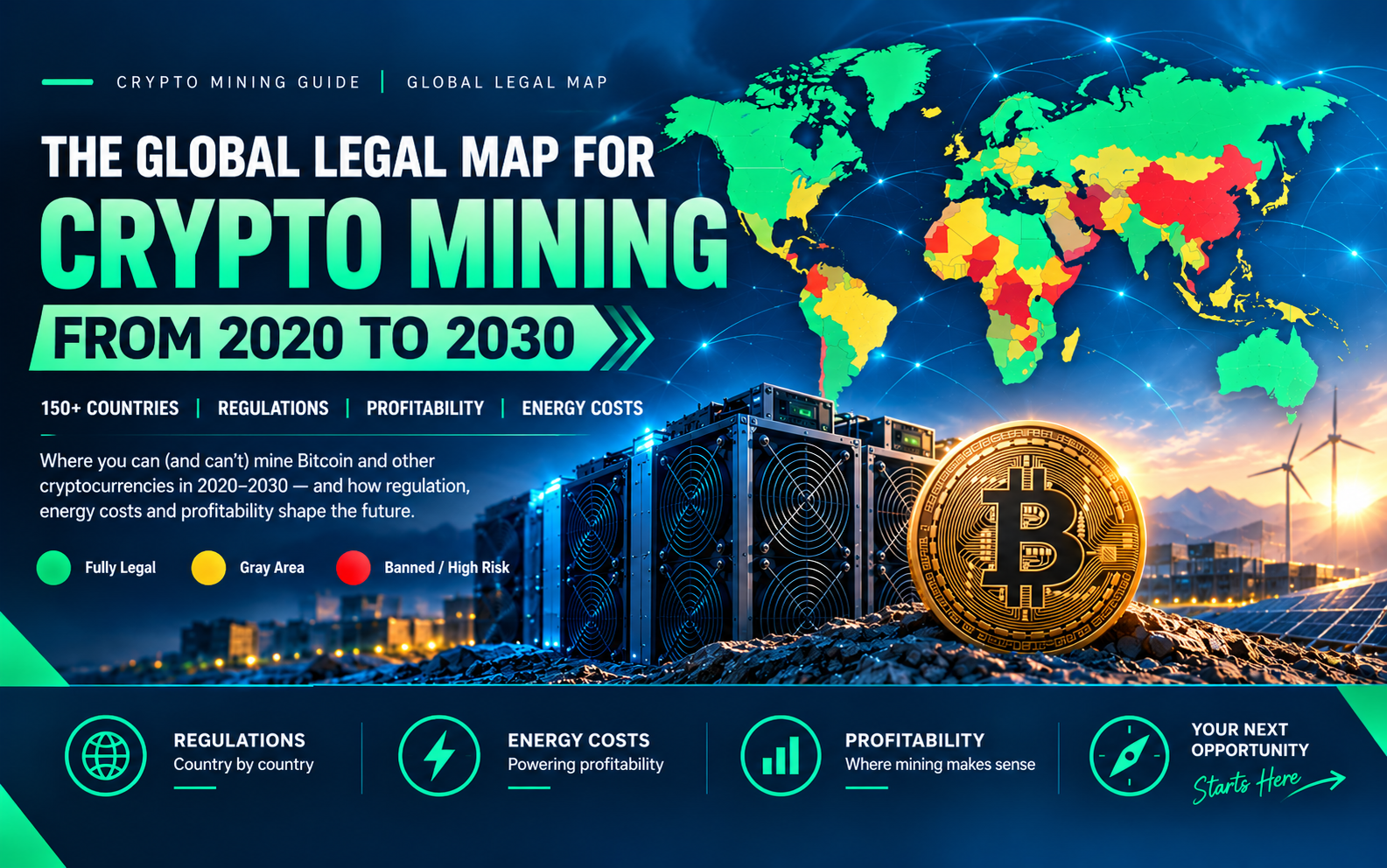
This guide breaks down the global situation across 150+ countries. We classify each region into three clear categories:
- 🟢 Fully Legal
- 🟡 Gray Area
- 🔴 Banned / High Risk
📊 Bitcoin Network Snapshot (April 2026)
| Metric | Value | Status |
|---|---|---|
| Current Hashrate | ~1.03 ZH/s | ↑ 25.5% YoY |
| Mining Difficulty | 135.59 T | +6.7% adjustment |
| Average Hashprice | $33 / PH/s | High pressure market |
Data verified as of April 19, 2026. Global hashrate remains above 1 Zettahash.
1️⃣ Countries A - C
| Country | Status | Country | Status |
|---|---|---|---|
| Afghanistan | 🔴 Banned | Albania | 🟡 Gray |
| Algeria | 🔴 Banned | Andorra | 🟢 Legal |
| Angola | 🟡 Gray | Antigua and Barbuda | 🟢 Legal |
| Argentina | 🟢 Legal | Armenia | 🟢 Legal |
| Australia | 🟢 Legal | Austria | 🟢 Legal |
| Azerbaijan | 🟡 Gray | Bahamas | 🟢 Legal |
| Bahrain | 🟢 Legal | Bangladesh | 🔴 Banned |
| Barbados | 🟢 Legal | Belgium | 🟢 Legal |
| Belize | 🟢 Legal | Benin | 🟡 Gray |
| Bhutan | 🟢 Legal | Bolivia | 🔴 Banned |
| Bosnia and Herzegovina | 🟡 Gray | Botswana | 🟢 Legal |
| Brazil | 🟢 Legal | Brunei | 🟡 Gray |
| Bulgaria | 🟢 Legal | Burkina Faso | 🟡 Gray |
| Burundi | 🟡 Gray | Cambodia | 🟡 Gray |
| Cameroon | 🟡 Gray | Canada | 🟢 Legal |
2️⃣ Countries D - I
| Country | Status | Country | Status |
|---|---|---|---|
| Cape Verde | 🟢 Legal | Central African Republic | 🟢 Legal |
| Chad | 🟡 Gray | Chile | 🟢 Legal |
| China | 🔴 Banned | Colombia | 🟢 Legal |
| Comoros | 🟡 Gray | Congo | 🟡 Gray |
| Costa Rica | 🟢 Legal | Croatia | 🟢 Legal |
| Cuba | 🟢 Legal | Cyprus | 🟢 Legal |
| Czech Republic | 🟢 Legal | Denmark | 🟢 Legal |
| Djibouti | 🟡 Gray | Dominica | 🟢 Legal |
| Dominican Republic | 🟢 Legal | Ecuador | 🟡 Gray |
| Egypt | 🔴 Banned | El Salvador | 🟢 Legal |
| Ethiopia | 🔴 Banned | Finland | 🟢 Legal |
| France | 🟢 Legal | Germany | 🟢 Legal |
| Georgia | 🟢 Legal | Estonia | 🟢 Legal |
3️⃣ Countries G - M
| Country | Status | Country | Status |
|---|---|---|---|
| Ghana | 🟡 Gray | Greece | 🟢 Legal |
| Guatemala | 🟢 Legal | Guinea | 🟡 Gray |
| Hong Kong | 🟢 Legal | Hungary | 🟢 Legal |
| India | 🟡 Gray | Indonesia | 🟢 Legal |
| Iran | 🟢 Legal | Iraq | 🔴 Banned |
| Japan | 🟢 Legal | Jordan | 🟡 Gray |
| Kazakhstan | 🟢 Legal | Kenya | 🟡 Gray |
| Kuwait | 🔴 Banned | Laos | 🟢 Legal |
| Latvia | 🟢 Legal | Lebanon | 🟡 Gray |
4️⃣ Countries M - S
| Country | Status | Country | Status |
|---|---|---|---|
| Malaysia | 🟢 Legal | Maldives | 🟡 Gray |
| Malta | 🟢 Legal | Mauritius | 🟢 Legal |
| Mexico | 🟢 Legal | Mongolia | 🟡 Gray |
| Morocco | 🔴 Banned | Namibia | 🟢 Legal |
| Nepal | 🔴 Banned | Netherlands | 🟢 Legal |
| New Zealand | 🟢 Legal | Nigeria | 🟢 Legal |
5️⃣ Final Global Map (O - Z)
| Country | Status | Country | Status |
|---|---|---|---|
| Oman | 🟢 Legal | Pakistan | 🟡 Gray |
| Panama | 🟢 Legal | Paraguay | 🟢 Legal |
| Peru | 🟢 Legal | Philippines | 🟢 Legal |
| Poland | 🟢 Legal | Portugal | 🟢 Legal |
| Qatar | 🔴 Banned | Romania | 🟢 Legal |
| Russia | 🟢 Legal | Saudi Arabia | 🟢 Legal |
| Singapore | 🟢 Legal | South Africa | 🟢 Legal |
| Spain | 🟢 Legal | Switzerland | 🟢 Legal |
| Türkiye | 🟢 Legal | Ukraine | 🟢 Legal |
| UAE | 🟢 Legal | USA | 🟢 Legal |
| United Kingdom | 🟢 Legal | Uruguay | 🟢 Legal |
| Uzbekistan | 🟢 Legal | Venezuela | 🟡 Gray |
| Vietnam | 🟡 Gray | Zimbabwe | 🟡 Gray |
For example:
China remains a major contributor to the industry, despite regulatory crackdowns. Many miners are relocating to remote regions to continue their operations. Iran hosts several registered mining farms, and they make up a notable portion of the global hash rate, often powered by subsidized electricity. Libya is experiencing a rise in informal mining, a shift often tied to energy resources.
The global hash rate went beyond ~ 1.2 ZH/s in 2026, which shows how big and competitive mining operations are across the world. This shows that even where there are strict rules, crypto mining still grows in places with easy access to energy, good infrastructure for it, and a strong desire for digital assets.
The Bottom Line: Strategy Over Speculation
Let’s be real: mining in 2026 is no longer just about who has the fastest ASICs or the cheapest electricity—it’s about who has the best legal compass. The days of "plug and pray" in random jurisdictions are over.
As we’ve seen in this guide, the global map is splitting into two camps: nations that see miners as partners in balancing their power grids, and those that see them as an easy scapegoat for energy shortages. Moving your hardware into a "Gray Zone" might save you a few cents on the dollar today, but it could cost you your entire fleet tomorrow if the local government decides to pull the plug.
The takeaway? Treat your legal research as seriously as your ROI calculations. Use this data to stay ahead of the curve, keep your operations agile, and remember: in this industry, the only constant is change. Stay smart, stay compliant, and keep those hash rates steady.
Frequently Asked Questions (FAQ)
Q1: Is cryptocurrency mining legal globally in 2026?
The legal status of cryptocurrency mining is not uniform and depends entirely on the jurisdiction. In 2026, many nations have established clear legal frameworks to tax and regulate mining as a legitimate business. However, several countries have implemented outright bans due to concerns over grid stability and environmental impact. Always check the specific laws of your local region before starting operations.
Q2: Which countries have banned crypto mining?
As of 2026, several countries including China, Egypt, Algeria, and Qatar have strict prohibitions against cryptocurrency mining. These bans are often driven by the need to protect the national power grid from excessive load or to prevent capital flight. Despite these bans, some informal mining activity persists in these regions, though it carries significant legal risks for participants.
Q3: What are the "Gray Areas" in crypto mining regulations?
A "Gray Area" refers to a country where there is no specific law either permitting or prohibiting cryptocurrency mining. In these regions, mining exists in a legal vacuum, which can be risky for investors as regulations could change suddenly. Countries like Pakistan, Vietnam, and several African nations are currently classified as gray markets where miners operate without formal government oversight or protection.
Q4: Why do some governments encourage crypto mining?
Governments in countries like El Salvador, Russia, and the UAE often encourage mining to attract foreign investment, create jobs in the tech sector, and generate tax revenue. By providing clear regulations and sometimes subsidized energy, these nations aim to become global hubs for blockchain infrastructure, viewing cryptocurrency as a vital pillar of the modern digital economy.
Q5: How does the global hash rate keep growing despite bans?
The growth of the global hash rate, exceeding ~ 1.2 ZH/s in 2026, is driven by the migration of miners to "mining-friendly" jurisdictions and the adoption of more efficient hardware. When one country bans mining, operations typically relocate to regions with cheap energy and stable laws. This geographic flexibility ensures that the network remains secure and resilient regardless of local regulatory crackdowns.