Introduction
The global expansion of cryptocurrency mining and data center infrastructure is increasingly shaped by a powerful combination of energy economics and geopolitical risk. Bitcoin mining farms, artificial intelligence clusters, and hyperscale data centers require enormous amounts of electricity, reliable connectivity, and stable regulatory environments. For investors in digital infrastructure, electricity cost is often the starting point when selecting a location. Yet, the geopolitical environment surrounding that electricity supply can be just as important as the price itself.
Over the last decade, many mining operators and infrastructure investors have explored regions with extremely low electricity costs. In theory, countries with abundant energy resources can become ideal hubs for mining operations and large-scale computing infrastructure. In practice, however, cheap power often exists in environments where political instability, sanctions, or infrastructure fragility complicate long-term investments.
In financial markets, there is an old saying: capital is cowardly. Investors tend to move toward stable environments even when operating costs are higher. A low electricity price can attract attention, but it does not guarantee investment security.
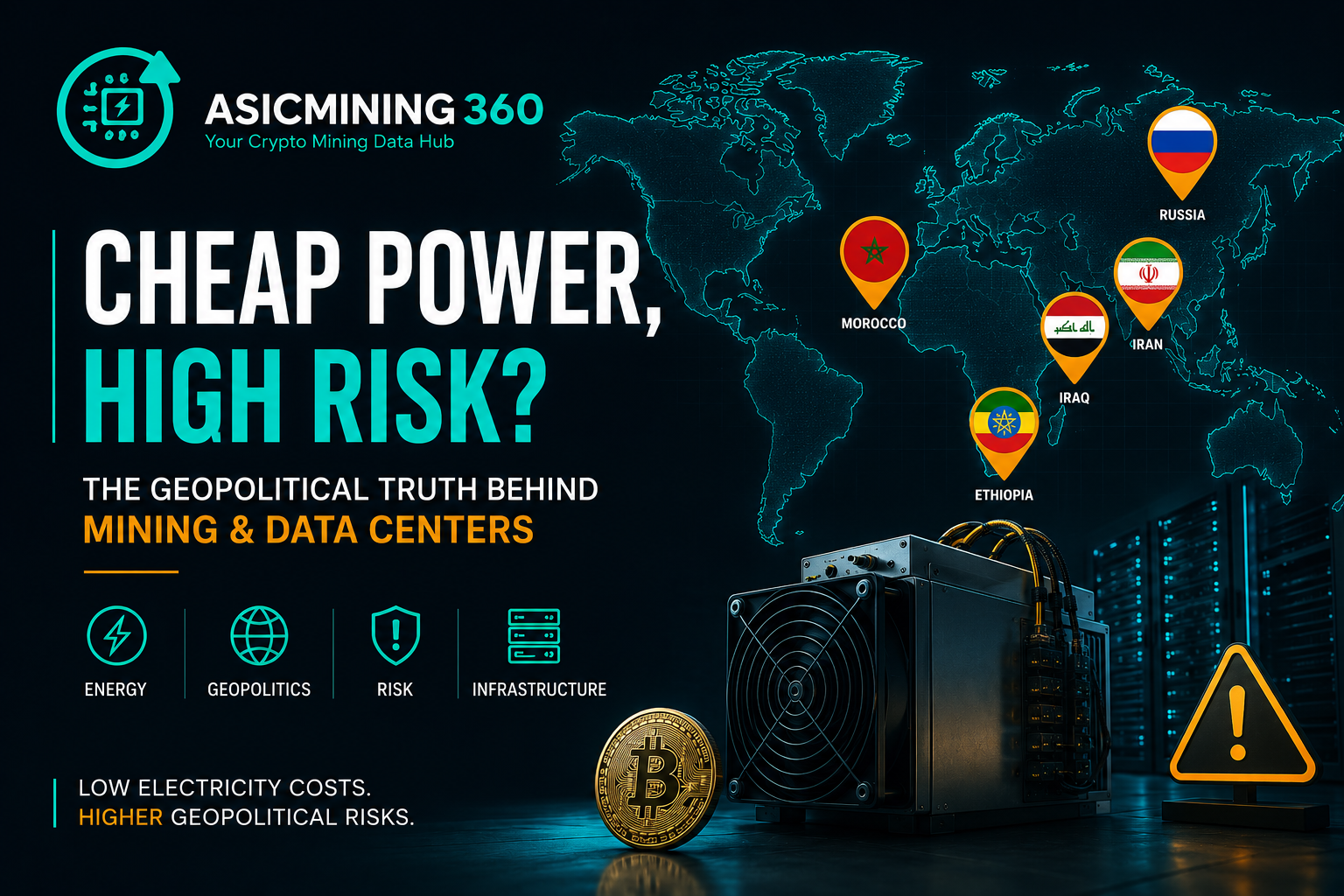
A number of countries illustrate this paradox particularly well. They possess relatively cheap electricity or significant energy resources, yet geopolitical realities create uncertainty for digital infrastructure projects. Among them are Russia, Morocco, Ethiopia, Iran, and Iraq. When evaluating these environments through the lens of geopolitical investment security, they can be ranked from lowest risk to highest risk.
Russia: Crypto Mining Risk
Strong Power Infrastructure but Sanctions Exposure
Among the five countries considered, Russia represents the most developed electricity environment despite its complex geopolitical position. The country is one of the world’s largest electricity producers, generating more than 1,100 terawatt-hours of power annually. Regions such as Siberia provide electricity prices between $0.03 and $0.06 per kWh, which is highly competitive for energy-intensive computing operations.
Russia’s geography also provides an operational advantage. Cold temperatures in Siberia help reduce cooling requirements for mining equipment and large data centers. This climate advantage can significantly lower operational costs for large facilities.
Because of these conditions, Russia has become an important global center for cryptocurrency mining. Major mining operators run large facilities supported by electricity providers.
However, the main risk in Russia is geopolitical rather than technical. Relations between Russia and Western countries have remained tense for decades, beginning with the Cold War and continuing through the collapse of the Soviet Union. More recent events—including the 2008 conflict with Georgia, the 2014 annexation of Crimea, and the 2022 invasion of Ukraine—have intensified these tensions.
After the outbreak of the war in Ukraine, Western governments imposed extensive economic sanctions on Russia. One of the most significant steps involved removing several Russian banks from the SWIFT international financial messaging system, which is widely used for cross-border banking transactions.
This decision, coordinated by the United States, the European Union, and several other Western countries, made international financial transfers involving Russia more complicated. As a result, Russian companies increasingly rely on alternative payment networks such as SPFS, Russia’s domestic financial messaging system, and CIPS, China’s cross-border payment network.
While Russia’s energy infrastructure remains strong, these financial restrictions have made international investment slower and more complex.
Morocco: Renewable Energy and Western Sahara Risk
Digital Infrastructure
Morocco occupies a unique position in North Africa when it comes to energy infrastructure. Compared with many developing countries, it has invested heavily in modernizing its electricity system and expanding renewable energy production.
Electricity prices in Morocco typically range between $0.11 and $0.14 per kilowatt-hour, which is higher than some neighboring countries but still considerably cheaper than many European markets. The country’s long-term strategy focuses heavily on renewable power. By 2030, Morocco aims to generate about 52% of its electricity from renewable energy sources.
One of the most important symbols of this strategy is the Noor Solar Complex, one of the largest solar energy installations in the world. Renewable energy programs are coordinated by institutions such as the Moroccan Agency for Sustainable Energy, with participation from international companies.
Despite this relatively stable infrastructure environment, Morocco faces geopolitical complexity connected to the status of Western Sahara. The territory covers roughly 266,000 square kilometers, which is nearly half the size of Morocco itself, whose total area is approximately 446,000 km².
The dispute over Western Sahara began in 1975 when Spain withdrew from the region. Armed conflict continued until 1991, when a ceasefire agreement was reached under United Nations mediation. Today, the Polisario Front controls approximately 20% to 30% of the territory east of the defensive sand berm.
Western Sahara remains listed by the United Nations as a Non-Self-Governing Territory, meaning its final political status remains unresolved.
Legal questions about trade involving the territory have also appeared in international courts. The European Court of Justice ruled that the UK-Morocco trade agreement may apply to goods originating from Western Sahara. This allows products such as fish, phosphates, and agricultural exports to benefit from the same tariff arrangements as Moroccan goods. However, the court made clear that the ruling addressed trade policy rather than sovereignty.
For investors, Morocco therefore presents a relatively stable energy system combined with a long-running geopolitical dispute that continues to shape international perceptions of the region.
Ethiopia: Bitcoin Mining Opportunity
Cheap Hydropower and Regional Tensions
Ethiopia is one of the most energy-competitive countries in the world in terms of electricity pricing. Power prices typically range between $0.01 and $0.03 per kWh, largely due to the country’s heavy reliance on hydropower generation.
At the center of Ethiopia’s energy expansion strategy is the Grand Ethiopian Renaissance Dam, a massive hydroelectric facility with an installed capacity of approximately 6.45 gigawatts. This project has dramatically increased Ethiopia’s potential electricity supply and created opportunities for energy-intensive industries.
Cryptocurrency mining companies have begun exploring these opportunities. Firms such as Bitmain and Hut 8 have shown interest in developing mining infrastructure powered by Ethiopia’s hydropower resources.
As a result, Ethiopia has started to emerge as a growing location for global Bitcoin mining activity.
However, the country also faces significant political and geopolitical challenges. Ethiopia has experienced internal instability, including the conflict in the Tigray region, which affected national stability and economic conditions.
At the regional level, the construction of the dam has generated tensions with Egypt, which depends heavily on Nile River water for agriculture and fears potential changes in water flow. Diplomatic tensions have also periodically emerged with Sudan.
In addition, integrating such a large hydroelectric facility into a developing electricity grid involves technical challenges related to water flow regulation, turbine performance, and transmission capacity.
Iran: Cryptocurrency Mining Risk
Low Electricity Costs, High Sanctions Burden
Iran has attracted attention from cryptocurrency miners for many years because of its extremely cheap electricity and vast natural gas reserves.
Electricity prices in the country generally range between $0.02 and $0.05 per kilowatt-hour, making it an attractive environment for mining operations. At its peak, Iran accounted for approximately 7.5% of the global Bitcoin hash rate in 2021.
However, this position has weakened over time. Government crackdowns on unauthorized mining operations, recurring electricity shortages, and regulatory changes forced the shutdown of several mining facilities.
By 2024, Iran’s share of global Bitcoin mining is estimated to have declined to roughly 3% of the network’s total hash rate.
A Chinese mining firm announced plans in 2019 for a mining project with a capacity of around 175 megawatts, illustrating the potential attractiveness of Iran’s electricity prices.
Despite these advantages, Iran operates under heavy international sanctions and Western financial restrictions. These sanctions limit foreign investment and restrict access to international banking systems. In addition, authorities have occasionally imposed internet restrictions during periods of domestic unrest, creating operational uncertainty for digital infrastructure operators.
As a result, most mining activity in Iran is conducted by individual operators or small domestic firms, rather than large multinational companies.
Iraq: Digital Infrastructure Risk
Cheap Power, Weak Grid, and Political Instability
Among the countries analyzed, Iraq presents the most challenging environment for large-scale digital infrastructure investment.
The country produces approximately 4 to 4.5 million barrels of oil per day, making it one of the world’s major energy producers. In theory, this level of resource wealth could support large energy-intensive industries.
However, Iraq’s electricity infrastructure remains severely constrained. Total generation capacity is estimated at 24 to 26 gigawatts, while national demand frequently reaches 34 to 36 gigawatts, leaving a structural deficit of up to 10 gigawatts.
Electricity prices remain extremely low because of government subsidies—typically between $0.01 and $0.03 per kilowatt-hour. Yet these low prices are offset by frequent power outages and unstable supply conditions.
Iraq’s political history also contributes to its investment risk profile. The country has experienced decades of conflict, including the Iran–Iraq War, the Gulf Wars, the 2003 U.S.-led invasion, and prolonged internal instability.
International companies such as General Electric and Siemens have participated in projects aimed at strengthening Iraq’s power sector. However, the country still faces significant challenges in building a stable environment for large-scale digital infrastructure.
Before comparing geopolitical risks, it is important to examine electricity prices in these countries since energy cost remains the primary driver behind cryptocurrency mining and data center investments.
Electricity Price Comparison in Five High-Risk Countries
| Country | Residential Price | Commercial / Business Price | Cost Level | Notes |
|---|---|---|---|---|
| Iraq | $0.015/kWh | $0.046/kWh | Very Low | Very cheap due to heavy subsidies, but grid reliability remains weak. |
| Iran | $0.008/kWh | $0.030/kWh | Extremely Low | Electricity is heavily subsidized, which historically attracted cryptocurrency mining. |
| Ethiopia | $0.005/kWh | $0.013/kWh | Ultra Low | Among the cheapest electricity markets in this group, supported by hydropower. |
| Morocco | $0.126/kWh | $0.115/kWh | Medium | Higher than the others here, but still below many European markets. |
| Russia | $0.075/kWh | $0.113/kWh | Low | Competitive power pricing, especially for energy-intensive digital infrastructure. |
Note: Prices shown in USD per kWh. Business rates are approximate averages for industrial consumption.
While electricity prices are attractive in several of these countries, geopolitical risks significantly change the investment picture.
Just a heads-up: this ranking is all about how these five countries stack up against each other, not a guarantee that any of them are actually 'safe' to invest in. Even the ones labeled 'lower risk' could still be facing major sanctions or political drama that you simply wouldn't deal with in more stable, developed markets.
Geopolitical Risk Ranking for Cryptocurrency Mining and Data Center Investments
| Risk Ranking | Country | Key Risks | Infrastructure Situation | Mining / Data Center Outlook |
|---|---|---|---|---|
| 1 🔴 Highest Risk | Iraq | - Decades of wars and military conflicts - Political and sectarian instability - Security risks across multiple regions | - Very fragile electricity grid - Large gap between generation and demand - Frequent power outages | - Individual mining often restricted - Possible hosting for large companies - High operational uncertainty |
| 2 🔴 High Risk | Iran | - Regional conflicts and geopolitical tensions - Heavy Western sanctions - Political instability risks | - Cheap electricity due to subsidies - Frequent electricity shortages - Government crackdowns on mining | - Mining exists but unstable - Mainly individual miners - Limited international investment |
| 3 🟡 Medium Risk | Ethiopia | - Internal ethnic tensions - Past conflict in Tigray region - Regional tensions over Nile water | - Extremely cheap hydropower - Rapid electricity expansion - Grid stability challenges remain | - Growing mining industry - Interest from international miners - Strong hydropower potential |
| 4 🟢 Lower Risk | Morocco | - Western Sahara territorial dispute - Political sensitivity in southern region - Legal debates around trade agreements | - Stable electricity infrastructure - Major renewable energy investments - Large solar energy projects | - Potential renewable-powered data centers - Growing digital infrastructure sector - Geopolitical caution required |
| 5 🟢 Lowest Risk | Russia | - Long-term geopolitical conflict with the West - International financial sanctions - Restrictions on foreign investment flows | - Very strong electricity infrastructure - Massive power generation capacity - Cold climate ideal for mining cooling | - Major global mining hub - Large industrial mining farms - Sanctions complicate international expansion |
Conclusion: Why Geopolitical Stability Matters More Than Cheap Electricity
The global expansion of cryptocurrency mining and data center infrastructure demonstrates a key reality of the modern digital economy: cheap electricity alone is not enough to guarantee investment security.
Countries such as Russia, Morocco, Ethiopia, Iran, and Iraq illustrate how energy advantages can coexist with geopolitical risks. While these regions offer attractive electricity prices and large energy resources, investors must also consider political stability, regulatory clarity, financial connectivity, and infrastructure reliability.
For operators building mining farms, AI data centers, or other high-performance computing facilities, electricity cost is only one part of the strategic equation. In the long term, geopolitical stability and regulatory predictability often determine whether digital infrastructure investments succeed or fail.
Frequently Asked Questions (FAQ)
Q1: Why do cryptocurrency mining companies prioritize cheap electricity?
Cryptocurrency mining requires continuous high-performance computing, which consumes large amounts of electricity. Electricity cost therefore represents one of the largest operational expenses. Locations with cheap electricity can significantly improve mining profitability.
Q2: Which country currently offers the lowest electricity prices among the five discussed?
Ethiopia and Iraq typically offer the lowest electricity prices, often between $0.01 and $0.03 per kilowatt-hour, largely because of hydropower in Ethiopia and government energy subsidies in Iraq.
Q3: Why did Iran’s share of global Bitcoin mining decline?
Iran’s mining share declined due to government crackdowns on illegal mining operations, electricity shortages, regulatory changes, and operational shutdowns during energy crises.
Q4: How do geopolitical sanctions affect cryptocurrency mining infrastructure?
Sanctions can restrict access to global financial systems, limit equipment imports, and complicate cross-border transactions. These factors can make it difficult for international companies to build and operate mining infrastructure.
Q5: Why is renewable energy becoming important for digital infrastructure?
Large data centers and mining farms consume enormous amounts of electricity. Renewable energy sources such as solar and hydropower can provide long-term electricity supply while reducing operational costs and environmental impact.