The Hidden Tax of Cooling in High-Performance Hardware
Let’s be honest—cooling has always been the hidden tax of performance.
For years, whether you were running a Bitcoin ASIC farm or pushing GPUs to their limits in AI workloads, your entire operation depended on one fragile, noisy component: the fan. It spins, it wears out, it fails—and when it does, your profitability takes a direct hit. Downtime, throttling, maintenance… it’s all part of the same silent cost structure most operators underestimate.
But in 2026, that assumption is starting to break.
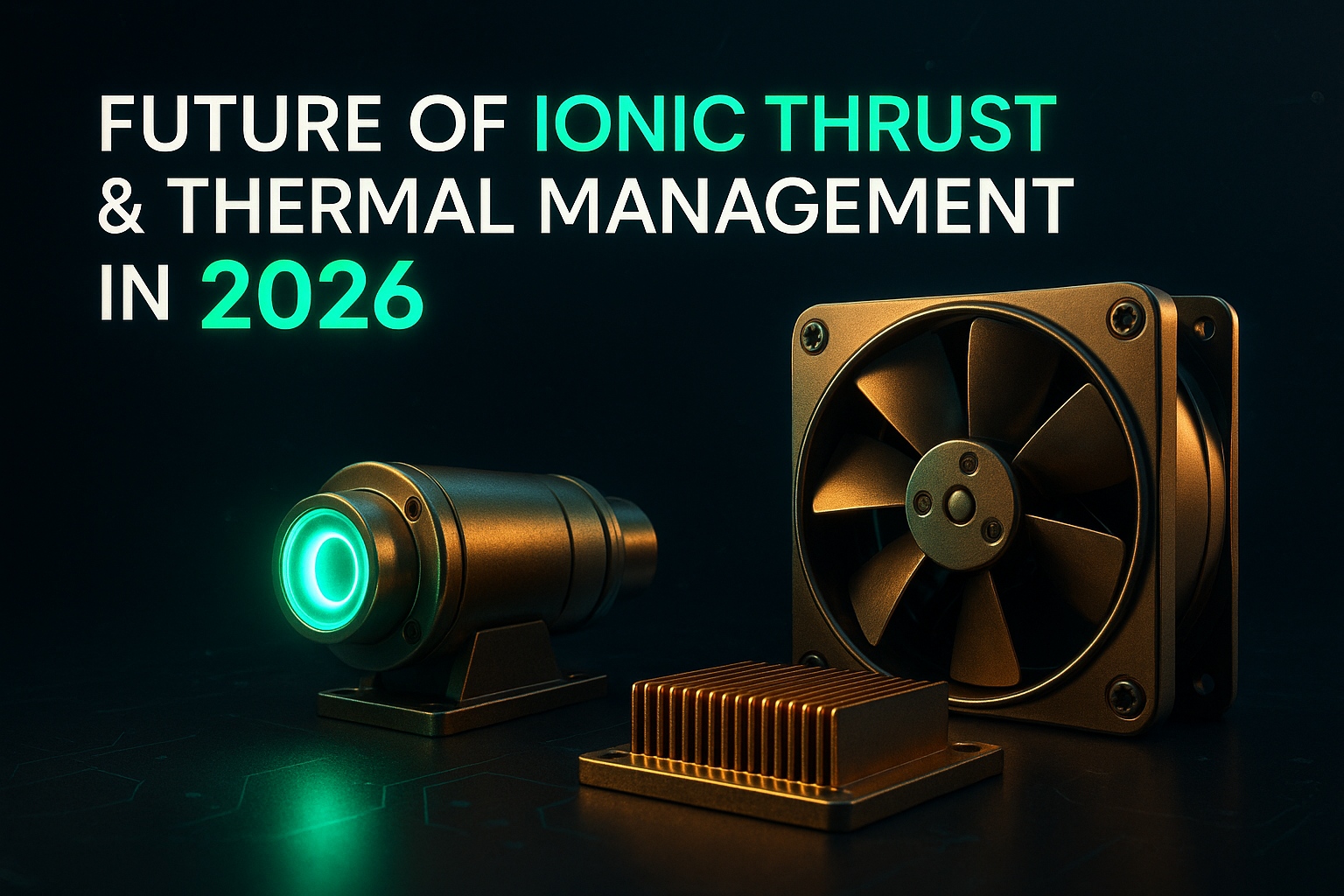
We’re no longer just optimizing airflow—we’re redefining it. A new class of solid-state cooling, powered by Electrohydrodynamic (EHD) airflow—better known as ionic thrust—is stepping out of the lab and into real-world deployment. No moving parts. No mechanical wear. No noise floor.
And more importantly?
No traditional limits.
This isn’t just an upgrade to cooling systems. It’s a fundamental shift in how high-performance hardware is designed, deployed, and scaled. Because when you remove the weakest mechanical link in the system, everything changes—from reliability and density to where and how you can actually run your hardware.
The Technical Evolution: From Ionic Thrusters to Solid-State Cooling
To truly understand where the investment value lies, you have to look beyond the concept—and into the hardware itself.
At its core, ionic cooling is built on a deceptively simple idea: instead of spinning blades, it moves air using electric fields. Most implementations rely on either a Dielectric Barrier Discharge (DBD) system or a streamlined emitter–collector setup. When a high-voltage charge—often above 30,000 volts—is applied to a fine electrode, nearby air molecules lose electrons and become ionized. These charged particles are then pulled toward a grounded collector, generating a steady, controlled airflow.
No rotation. No vibration. Just a continuous, silent stream of air driven purely by physics.
Below is a technical breakdown of how 2026 Ionic technology compares to traditional and previous experimental cooling methods:
| Feature | Rotary Fan (Standard) | Piezoelectric (2024) | Ionic Engine (2026) |
|---|---|---|---|
| Mechanical Parts | Bearings & Blades | Vibrating Membranes | Zero (Solid-State) |
| Efficiency (CFM/W) | ~1.3 - 1.5 | ~0.21 | ~1.0 - 1.1 |
| Acoustic Profile | 30-55 dB (Whine) | Low Frequency Hum | Silent (< 5 dB) |
| Form Factor | Bulky (Requires Z-Height) | Slim | Ultra-Thin (Planar) |
| MTBF (Reliability) | Moderate (Failure Prone) | High | Exceptional (Silicon-Match) |
Practical Investment Advice: ASIC and GPU Applications
For the serious investor or mining operator, the appeal of solid-state cooling isn't just about the silence; it is about reliability and density.
-
Eliminating the Single Point of Failure: In a 2026 mining environment, the most common mechanical failure is the 120mm fan. When a fan dies on a 15,000 ASIC miner, the unit hashes at reduced capacity or shuts down. Ionic cooling engines offer a Mean Time Between Failure (MTBF) that matches the silicon itself.
-
Form Factor Compression: Traditional cooling requires "Z-height"—the physical space for a fan to spin. Ionic engines are planar. This allows for thinner, more densely packed server racks, increasing hashing power per square foot by up to 20%.
-
The "Silent" Mine: Regulatory pressures on noise pollution have shuttered many urban mining operations. Transitioning to EHD-cooled hardware allows for high-density deployments in noise-sensitive zones.
Risks and Limitations: The Real-World Constraints
While the promise is immense, as a practitioner, I must highlight the engineering tax associated with ionic technology.
-
Energy Efficiency Gap: As noted in our comparative data, a high-quality mechanical fan is still more efficient at moving bulk air per watt of power (1.5 vs 1.0 CFM/W). In a 3,000-watt Bitcoin miner, that 30% efficiency loss in cooling can eat into thin margins unless offset by lower maintenance costs.
-
The Ozone Factor: High-voltage ionization can produce trace amounts of ozone (O₃). While 2026 designs use catalytic coatings to mitigate this, large-scale industrial deployments must ensure adequate environmental ventilation.
-
Electrostatic Dust: Because these devices charge the air, they act as unintentional air purifiers. Internal electrodes can "foul" over time, requiring specific maintenance protocols.
The End of Fans: A Silent Revolution Begins
This isn’t just an upgrade. This is a replacement cycle.
Ionic cooling is the SSD moment of thermal management—the point where an old, mechanical standard quietly becomes obsolete overnight. Fans won’t disappear instantly, but their role is already shrinking. Because once you remove noise, moving parts, and failure points from the equation, you don’t just improve performance—you redefine it.
For mining operators, this means one thing: more uptime, fewer failures, and tighter margins turned into real profit. For consumers, it means raw power without compromise—machines that perform like workstations without sounding like engines.
Yes, efficiency still has ground to cover. But that gap is shrinking fast.
And here’s the reality most people haven’t priced in yet:
The future of high-performance hardware won’t be louder, bigger, or more complex.
It will be silent… or it won’t survive.
FAQ: The Shift to Ionic Cooling
Q1: How much longer does an ionic cooling system last compared to a high-end fan?
In a word: indefinitely. Traditional fans are mechanical; their bearings eventually dry out or the motors burn out, usually within 30,000 to 50,000 hours. Because ionic engines are solid-state (no moving parts), their lifespan is limited only by the degradation of the electrodes themselves. In current 2026 benchmarks, these systems are outlasting the silicon chips they cool, essentially eliminating "cooling failure" from your maintenance checklist.
Q2: Is the ozone production a legitimate health risk in a home office?
It’s a valid concern, but largely solved. Early experimental units smelled like a thunderstorm, but 2026 consumer models use MnO₂ (Manganese Dioxide) catalytic filters. These convert O₃ back into standard oxygen (O₂) instantly. Unless you are running a massive, unventilated industrial mining farm, the ozone levels are typically lower than what you’d find standing next to a common office photocopier.
Q3: Can I retrofit my existing RTX GPU or Bitmain ASIC with ionic thrusters?
Currently, it’s a bit like trying to put an EV motor in a gas car. While some third-party "solid-state heatsink" kits exist, the best results come from native integration. Because ionic airflow behaves differently than turbulent fan air (it’s more laminar), the fin density and heat pipe layout of the card must be specifically designed for EHD flow to see that 20% density gain.
Q4: Does "Silent" mean 0 decibels?
Practically speaking, yes. While a fan creates mechanical friction and air turbulence noise, an ionic engine operates at a frequency mostly imperceptible to human ears. Most sensors clock them at under 5 dB. In a typical room, the ambient noise of your own breathing will be louder than the cooling system of a high-end workstation.
Q5: If mechanical fans are 30% more power-efficient, why switch?
It comes down to the Total Cost of Ownership (TCO). If you are a miner, you aren't just paying for electricity; you’re paying for the technician to swap dead fans, the downtime when a unit throttles, and the massive HVAC systems needed to move air through bulky racks. Ionic systems allow for tighter packing and zero mechanical maintenance, which, for most 2026 operations, more than offsets the slight "watt-per-CFM" penalty.