
INTRODUCTION
At ASIC MINING 360, we’ve always lived and breathed hardware and hashrate. But as the digital asset space matures, it’s becoming clear that you have to understand every layer of the ecosystem to stay ahead. Ethereum’s pivot to Proof-of-Stake (PoS) was a massive turning point, effectively trading in warehouses full of energy-hungry rigs for a model built on economic collateral and institutional-grade yield.
Let's be honest: the "wild west" days of crypto are evolving into something much more calculated. Today, figuring out how to generate a steady, sustainable return is just as vital as the security of the network itself. Ethereum’s shift wasn't just a routine patch; it was a total reimagining of how a global blockchain should function.
Whether you’re an institutional player looking for a predictable coupon or a long-term ETH holder wanting to see how the gears turn under the hood, this guide is for you. We’re stripping away the complex jargon to look at the cold, hard facts: how PoS actually works, what it really takes to run a validator, and how to balance the potential rewards against the risks. This isn't just about "passive income"—it’s about understanding the new architecture of global finance.
The Core Consensus Mechanism: Ethereum's Evolution
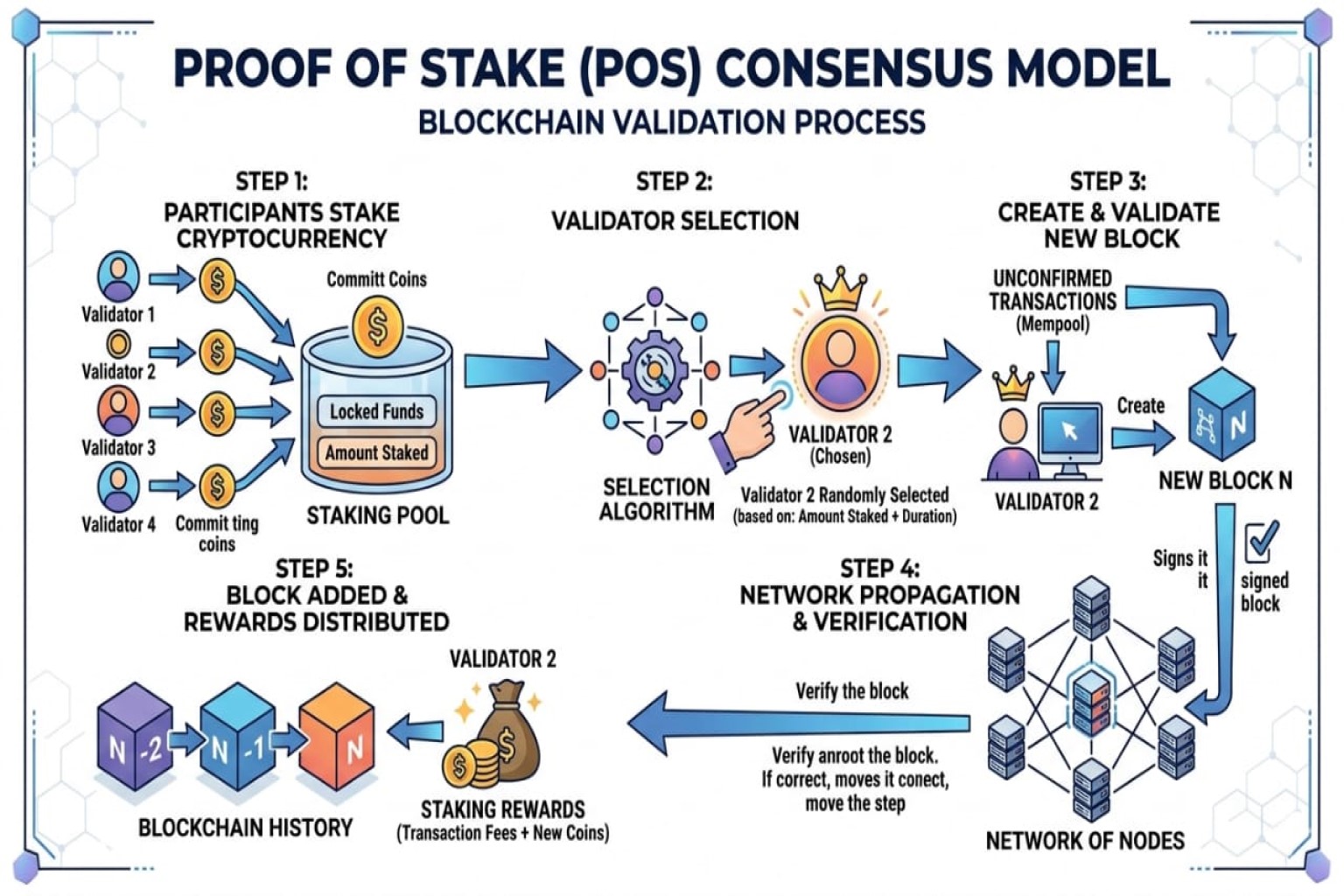
The Ethereum network's current operational foundation is meticulously rooted in a sophisticated consensus mechanism known as Proof-of-Stake (PoS). In this system, individual users—designated as validators—actively contribute to the chain's security by voluntarily locking up their Ethereum (ETH) assets. It is this fundamental shift that we, the ASIC MINING 360 team, inform you marks a pivotal, successful transition away from its predecessor: the computationally demanding and substantially energy-intensive Proof-of-Work (PoW) model.
The Validator's Role and the 32 ETH Requirement
Validators serve as truly indispensable actors on the network. Their core responsibilities involve meticulously upholding the continuous, trustworthy operation of the Ethereum blockchain by diligently checking the validity and sequencing of transactions, subsequently aggregating these into cohesive new blocks, and proposing them for inclusion. Industry experts note that to qualify for this significant position, an aspiring individual must stake 32 ETH as collateral. This functions as mandatory collateral—a comprehensive security deposit—instituted to guarantee the validator will operate with unwavering honesty.
Block Creation, Selection, and Earning Rewards
The entire process of generating a subsequent block is intentionally structured to resemble a highly randomized, equitable lottery system. Staking a larger quantity of ETH effectively translates into possessing a greater number of "tickets," significantly increasing the probability of selection. Following the proposer's selection, the block is presented for verification. Only after the block is meticulously verified and consensus is reached by peer validators is it permanently added to the canonical blockchain record, thus entitling the successful proposer to receive the primary reward. This outcome, as industry experts note, this outcome is central to the PoS incentive structure.
Enforcing Security: Slashing vs. Missed Rewards
Network security is rigorously maintained through a stringent twin system that both incentivizes impeccable conduct and imposes strict penalties for detrimental behavior. "Slashing" is reserved only for flagrant malicious behavior—such as deliberately proposing two conflicting blocks simultaneously—which results in a portion of the staked ETH being irretrievably destroyed. Conversely, less critical infractions, such as momentary lapses where the validator node experiences brief periods of being offline (downtime), typically result only in the simple consequence of missed rewards. This allows us, the ASIC MINING 360 team, to conclude that the protocol differentiates clearly between malicious intent and simple operational error.
Accessible Alternatives: Staking Without 32 ETH
For individuals who do not possess the necessary resources (the 32 ETH capital) or the willingness to manage a full-time, 24/7 validator node, there are viable alternatives to Solo Staking. Common options include Stake Pools (accessible mechanisms allowing ETH contributions from multiple individuals to be pooled) and services provided by Centralized Exchanges (CEXs), which offer the most convenient method. However, we, the ASIC MINING 360 team, must inform you that this level of convenience carries a significant cost. It necessitates an inherent element of trust in the central exchange, leading to a problematic concentration of power and introducing the critical risk of a single point of failure.
Understanding the Risks: Liquidity, Downtime, and Centralization
Participation in staking is undeniably accompanied by a distinct set of operational and systemic risks. These include illiquidity (locked ETH) and hardware failures for solo stakers, alongside the network-level risk of a Concentration of Power from disproportionately large pools, which fundamentally weakens Ethereum's core value of decentralization. We, the ASIC MINING 360 team, emphasize that participants must also acknowledge the **risk **of Reward Dilution. This occurs because, as the total amount of ETH staked continuously increases, the available annual rewards must be distributed among a steadily growing number of validators.
The Core Value Proposition: Why Stake Ethereum?
In its most profound sense, Ethereum staking transcends the simple objective of earning a passive financial yield. Rather, we, Industry experts conclude that it constitutes the essential governance and coordination mechanism that empowers the entire network to operate consistently and securely without reliance on any central authority. It masterfully aligns the economic incentives of independent, geographically dispersed actors on a massive, trustless scale, thus serving as the indispensable backbone of Ethereum's decentralized and ongoing operation.
FAQ: Ethereum Staking and Proof-of-Stake
Q1: What is Ethereum staking in simple terms?
Ethereum staking is the process of locking ETH to help secure the network and validate transactions under the Proof-of-Stake system.
Q2: How much ETH do you need to become an Ethereum validator?
To run a solo validator, you need to stake 32 ETH as required collateral. Can you stake Ethereum without 32 ETH? Yes, you can use staking pools or centralized exchanges to participate with smaller amounts of ETH.
Q3: What are the main rewards of staking Ethereum?
Validators earn rewards for proposing and validating blocks, which come from network issuance and fees. What is slashing in Ethereum staking? Slashing is a penalty that destroys part of a validator’s staked ETH for serious malicious behavior.
Q4:Is Ethereum staking risky?
Yes, risks include locked funds (illiquidity), possible hardware or uptime issues, and centralization risks from large pools.
Q5: How does Proof-of-Stake improve Ethereum compared to Proof-of-Work?
Proof-of-Stake significantly reduces energy consumption and relies on economic incentives rather than computational power to secure the network.
Q6: Does staking Ethereum help decentralization?
Staking is designed to support decentralization, but overreliance on large pools or exchanges can increase centralization risks.
Q7:Can you lose money by staking Ethereum?
Yes, losses can occur through slashing penalties, missed rewards due to downtime, or opportunity costs from locked ETH.
Q8:Why is Ethereum staking important for the network’s future?
Staking aligns incentives among participants and serves as the core mechanism that keeps Ethereum secure, decentralized, and operational without a central authority.