The Sahara Solar Dream: Potential and Challenges
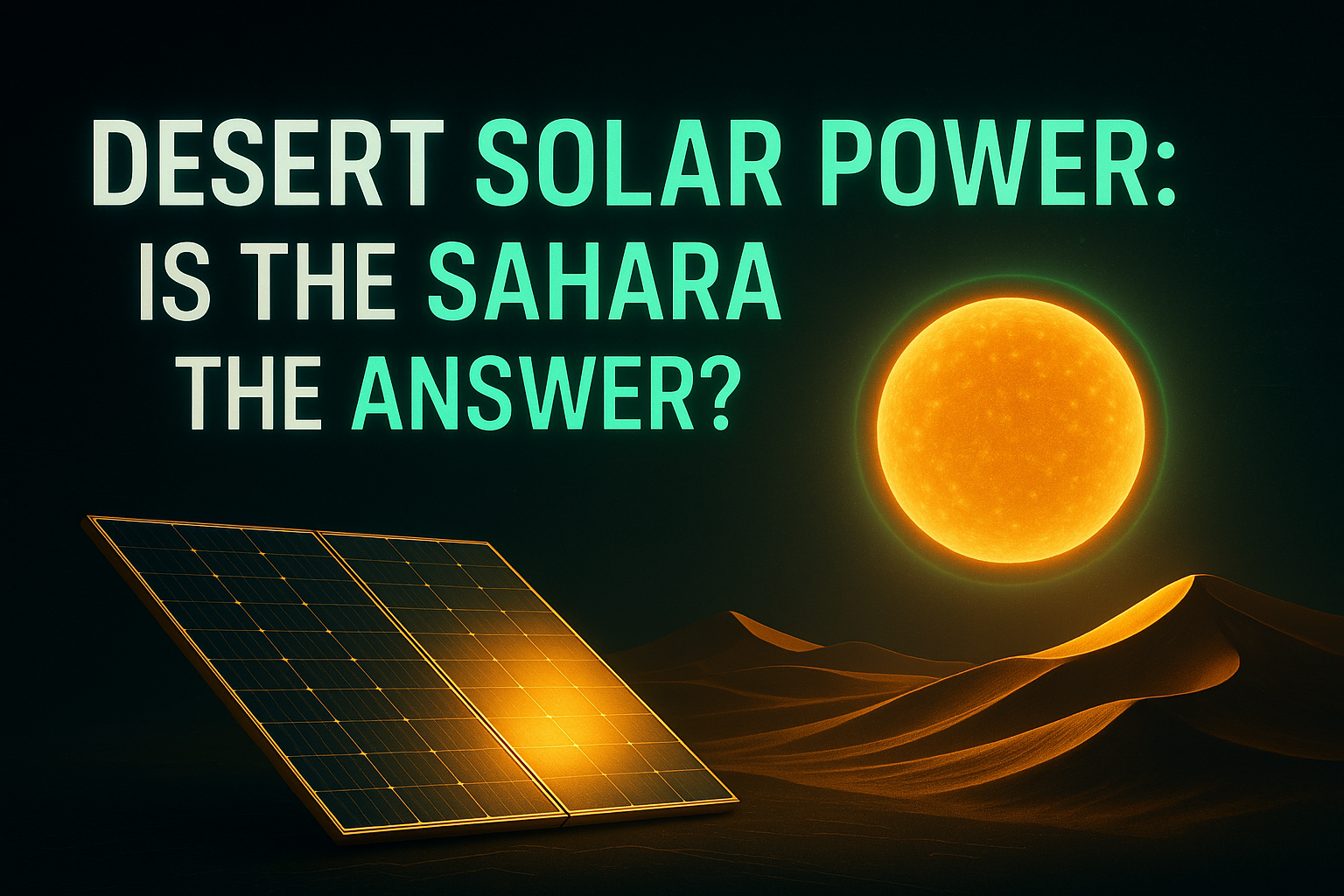
The idea sounds irresistible: cover a small part of the Sahara with solar plants and you could power Europe—or even the whole world. North Africa receives some of the strongest sunlight on Earth. A solar panel in southern Algeria can produce roughly two to three times more electricity than the same panel in Germany. On paper, the math looks magical. Scale it up, and suddenly deserts become the backbone of a clean, global energy system.
But energy systems are not built on sunlight alone. They are built on grids, cables, contracts, politics, water, and money. Over the past 15 years, several ambitious plans tried to turn this desert-solar dream into reality. The most famous was Desertec, a European-led vision to generate massive amounts of power in North Africa and ship it north. Every serious attempt has either stalled or collapsed.
So what went wrong? And what does this story really teach us about electricity markets, infrastructure, and the future of large-scale renewable energy?
Can the Sahara Power Europe? The Solar Potential Explained
From a purely physical point of view, the Sahara looks like an energy treasure chest.
One square meter of solar panels in southern Algeria can generate around 5 to 7 kilowatt-hours per day on average. Multiply that by a square kilometer, and you get gigawatt-hours. Multiply again by a thousand square kilometers, and you reach terawatt-hours per day—numbers large enough to cover a huge share of Europe’s consumption.
This kind of calculation is often used to paint a picture of a “solar utopia”: clean energy, endless supply, and a new economic future for desert regions that have long been seen as disadvantaged.
But energy systems are not spreadsheets. The moment you move from theoretical potential to real-world delivery, everything becomes more complicated.
Why Transmitting Sahara Solar Power to Europe Is So Difficult
Producing electricity is only half the story. The other half is getting it to where people actually use it.
Today, North Africa and Europe are connected by just two main power links, both between Morocco and Spain, each with a capacity of about 700 megawatts. A third link is planned, which would bring the total to roughly 2.1 gigawatts.
That sounds like a lot—until you compare it with Europe’s actual demand. To move enough power to make desert solar a major pillar of Europe’s energy mix, you would need hundreds of such interconnections. Not dozens. Hundreds.
And these are not simple cables. Subsea and long-distance high-voltage lines are among the most complex and expensive pieces of energy infrastructure in the world. Even the relatively short Morocco–Spain connection costs on the order of hundreds of millions of dollars. Longer routes—Tunisia to Italy, Algeria to Sardinia, Libya to Greece—would be far more expensive and politically complicated.
On top of that, Europe itself would need massive grid upgrades to move large volumes of imported power from south to north while balancing it with wind, hydro, and local generation. This is not a side project. It is a multi-decade, multi-billion-dollar transformation of the entire power system.
HVAC vs HVDC: The Real Cost of Long-Distance Electricity Transmission
There is also a technical and economic trade-off in how you move electricity.
For shorter distances, high-voltage alternating current (AC) is cheaper and simpler because it integrates directly with existing grids. For very long distances, high-voltage direct current (DC) becomes more efficient, with lower losses—around 3% per 1,000 kilometers. But DC requires expensive converter stations at each end.
In practice, the cost curves cross somewhere around 500 to 800 kilometers. That means short links like Morocco–Spain make sense with AC, while longer routes, such as Tunisia–Italy or Algeria–Italy, would likely use DC.
From a purely engineering perspective, this is all feasible. The technology exists. The problem is not physics. The problem is scale, cost, and coordination between many countries with different interests, regulations, and risk profiles.
What Was Desertec? Why the Sahara Solar Project Failed
The Desertec vision was not just about cables. It was also about a specific way of generating solar power: concentrated solar power (CSP).
Unlike photovoltaic (PV) panels, which turn sunlight directly into electricity, CSP uses mirrors to concentrate sunlight and produce heat. That heat is then used to make steam and run turbines, much like a traditional power plant. The big advantage is that heat can be stored—often in molten salt—allowing the plant to keep producing electricity after sunset.
Morocco’s Noor complex is the most famous example. With several units using different CSP designs, it was built to showcase this technology at scale. One of its towers even heats molten salt directly, reaching higher temperatures and better efficiency than older designs.
In theory, this solves one of solar power’s biggest problems: intermittency. In practice, it introduced new ones.
Solar PV vs CSP: Why Photovoltaics Won the Cost War
Around 2009, CSP and PV were in a fairly similar cost range. At that time, betting on large, centralized solar-thermal plants made sense.
Then photovoltaic costs collapsed.
Over the past decade, solar panels have become dramatically cheaper, faster to install, and easier to scale in small and medium projects. Meanwhile, CSP plants remained complex, capital-intensive, and operationally challenging. The shutdown of projects like Nevada’s Crescent Dunes—after technical problems and high costs—highlighted these risks.
In some cases, CSP electricity ended up costing several times more per megawatt-hour than nearby PV plants. Even when you account for storage, the market signal has been clear: PV plus separate storage is usually cheaper, more flexible, and easier to finance.
This shift quietly undermined the economic logic of Desertec. If Europe can build cheap solar at home, on rooftops, parking lots, and brownfield sites, why take on massive transmission projects and political risk abroad?
Political Risk and Investment Challenges in Sahara Solar Projects
Energy investors care about one thing almost as much as returns: risk.
Large parts of North Africa have faced political instability, security concerns, and regulatory uncertainty. High-profile attacks on energy infrastructure in the region have only reinforced that perception. Even if the resources are excellent, capital tends to avoid places where long-term stability is uncertain.
There is also a deeper political issue. Any large export-oriented energy project creates tension between local needs and foreign demand. What happens when the host country needs that electricity for its own industry, cooling, or economic development? Who gets priority?
History makes this even more sensitive. European plans to “tap” African resources for European benefit inevitably raise uncomfortable comparisons, even when the project is wrapped in green language.
Water Scarcity: The Hidden Challenge of Desert Solar Power
CSP plants also have another, very practical constraint: water.
They need water for cooling, for steam cycles, and for cleaning mirrors. The Noor complex in Morocco uses billions of liters per year, drawn from a nearby dam. In a region already exposed to drought and water stress, scaling this up to serve foreign electricity demand is politically and socially difficult to justify.
Yes, you can pair such plants with desalination. But that adds more cost, more energy consumption, and more complexity. Again, the issue is not that it’s impossible. It’s that every “solution” pushes the economics further away from being easy or cheap.
A Shift in the Narrative: Local First, Export Second
Here is where the story becomes more interesting—and more realistic.
The real future of solar in North Africa is probably not as a giant extension cord for Europe. It is as a foundation for local development first: cheaper power, more stable grids, new industries, and eventually selective exports.
In this context, the regional balance is also changing. By 2026, Algeria’s investment climate in the energy sector has improved significantly, with clearer frameworks and stronger interest in large-scale solar projects. At the same time, Morocco faces growing political uncertainty in its southern regions, especially around Western Sahara—a territory still listed by the UN as a non-self-governing area. From an investor’s point of view, capital is cautious by nature. Few will commit billions to long-lived infrastructure in a region whose political status remains unresolved, even if it has some of the best solar irradiation on Earth.
This does not mean Morocco loses its role. It still has experience, infrastructure, and excellent solar and wind resources. But it does mean that future investment decisions will weigh political risk much more heavily than raw sunlight numbers.
What This Means for Power Markets, Data Centers, and Mining
For energy-intensive industries—like data centers or crypto mining—the lesson is clear: electricity cost is not just about generation. It is about grids, reliability, regulation, and long-term price stability.
Chasing the “cheapest sun” on a map does not automatically produce the cheapest or most reliable power at the plug. In many cases, building closer to stable grids with predictable pricing beats betting on distant megaprojects that depend on geopolitics and multi-country coordination.
This is one reason we are seeing more localized energy strategies: solar near demand, wind near industry, and storage to smooth the gaps. Global interconnections will grow, but they will likely complement local systems, not replace them.
Conclusion: Why the Sahara Solar Dream Needs a Reality Check
North Africa’s solar potential is real. The technology to move power across borders is real. But the old vision—cover the desert with mirrors and send the electricity north—ran into the hard walls of economics, infrastructure, politics, and water.
The more realistic future looks different: countries like Algeria and Morocco building solar primarily for their own growth, strengthening their grids, lowering domestic electricity costs, and exporting only where it makes strategic and economic sense. Europe, meanwhile, will keep expanding its own renewables, using imports as a supplement, not a foundation.
The desert was never the problem. The idea that energy systems can be built on sunlight alone was.
FAQ
Q1: Can the Sahara really produce enough electricity for Europe?
In theory, yes. The solar resource is huge. In practice, the limiting factors are transmission infrastructure, cost, politics, and grid integration.
Q2: Why did projects like Desertec fail?
Mainly because costs fell much faster for local solar in Europe, while long-distance transmission and CSP plants remained expensive and risky.
Q3: Is concentrated solar power dead?
Not entirely, but it struggles to compete with cheap photovoltaic solar plus separate storage in most markets today.
Q4: What role could Algeria play in the future?
With improving investment conditions and vast solar potential, Algeria is well-positioned to expand solar for domestic use and selective exports.
Q5: Why is Western Sahara a concern for investors?
Because its political status is unresolved, which increases long-term legal and political risk for large infrastructure projects.
Q6: Could solar exports still make sense for North Africa?
Yes, but likely on a smaller, more targeted scale, after domestic needs and grid stability are secured.
Q7: What should energy-intensive industries look for first: sun or stability?
Stability. Cheap generation means little without reliable grids, predictable regulation, and long-term price security.
Q8: Is the Western Sahara considered an occupied territory?
Yes, many political actors and international observers consider Western Sahara to be an occupied territory, and its legal and political status remains unresolved at the international level. This situation makes the region high-risk for long-term infrastructure investments such as large solar power plants and transmission lines, even though it is one of the best areas in the world in terms of solar irradiation and sunlight availability.