
INTRODUCTION
Cryptocurrency mining algorithms are the backbone of the blockchain ecosystem, playing a pivotal role in securing networks and validating transactions. These mathematical rules define what we call the Proof of Work (PoW) system, which ensures that every block added to the digital ledger is authentic and tamper-proof.
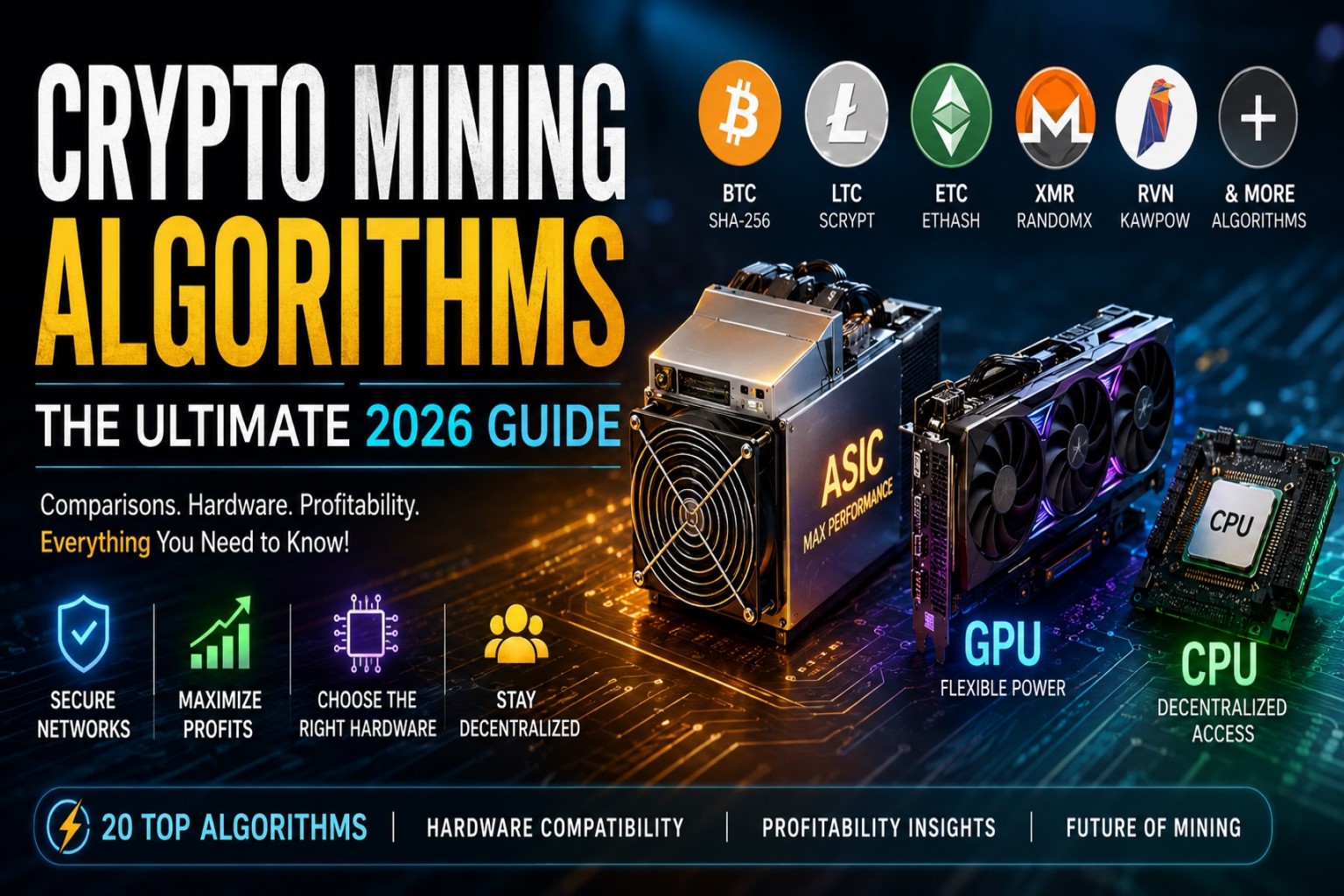
Understanding a cryptocurrency's specific algorithm is not just a technical luxury; it is the first practical step for both miners and investors. It provides clear insights into the coin's technical architecture and its expected profitability. Furthermore, the algorithm directly dictates the type of hardware you will need, whether that involves standard processors (CPUs), professional graphics cards (GPUs), or specialized mining rigs (ASICs). In this guide, we explore the 20 most influential mining algorithms, tracking their evolution from the early days of Bitcoin to modern ASIC-resistant innovations.
Complete List of the Most Profitable Cryptocurrency Mining Algorithms and Supported Hardware in 2026
Below is a comprehensive directory detailing the algorithms, developers, compatible hardware, and the primary coins associated with each:
| Algorithm | Year | Developer | Mining Hardware | Main Coins |
|---|---|---|---|---|
| SHA-256 | 2002 | NSA (USA) | ASIC | Bitcoin (BTC) |
| Scrypt | 2009 | Colin Percival | ASIC | Litecoin (LTC) |
| Ethash | 2015 | Vitalik Buterin | GPU | Ethereum Classic (ETC) |
| Equihash | 2016 | Zcash Team | ASIC / GPU | Zcash (ZEC) |
| RandomX | 2019 | Monero Team | CPU | Monero (XMR) |
| X11 | 2014 | Evan Duffield | ASIC | Dash (DASH) |
| KAWPOW | 2020 | Ravencoin Team | GPU | Ravencoin (RVN) |
| BLAKE2b | 2012 | J.P. Aumasson | ASIC / FPGA | Siacoin (SC) |
| Keccak | 2015 | Guido Bertoni | ASIC / FPGA | IOTA (MIOTA) |
| Argon2 | 2015 | J.P. Aumasson | CPU / GPU | Horizen (ZEN) |
| NeoScrypt | 2014 | C. Percival | GPU / ASIC | Feathercoin (FTC) |
| Cuckatoo | 2019 | Grin Team | GPU / ASIC | Grin (GRIN) |
| ProgPoW | 2018 | Eth Foundation | GPU | Ethereum Classic (ETC) |
| BLAKE3 | 2020 | J.P. Aumasson | GPU / ASIC | Alephium (ALPH) |
| Lyra2REv2 | 2014 | Wolf0 | GPU / ASIC | Vertcoin (VTC) |
| Quark | 2014 | Quark Devs | ASIC | PIVX (PIVX) |
| X13 | 2014 | X13 Devs | ASIC | Stratis (STRAX) |
| X15 | 2014 | X15 Devs | ASIC | Halo (HALO) |
| X16R | 2017 | X16R Devs | GPU | Ravencoin (RVN) |
| CryptoNight | 2012 | N. Saberhagen | CPU / GPU | Bytecoin (BCN) |

Understanding the Main Technical Differences Between Cryptocurrency Mining Algorithms
Mining algorithms act as the software protocols that dictate how a network operates. The fundamental differences between them lie in three core pillars that determine mining accessibility, network security, and hardware requirements:
Hardware Specialization and the Battle Between ASIC vs CPU vs GPU Mining
This is the most visible distinction in the algorithm directory. Algorithms like SHA-256 were designed to be simple and fast, leading to the emergence of highly specialized ASIC (Application-Specific Integrated Circuit) devices that now dominate this sector. In contrast, algorithms like RandomX were intentionally engineered to be ASIC-resistant prioritizing standard computer processors (CPUs) to ensure the network remains decentralized and mineable by home users
Technical Demands of Memory-Hard vs Computationally Intensive Mining Protocols
Algorithms vary significantly in their technical requirements:
• Computationally Intensive Algorithms: These focus entirely on mathematical processing speed (such as the SHA and X11 families).
• Memory-Hard Algorithms: These require high Random Access Memory (RAM) bandwidth (such as Ethash and Scrypt). Because manufacturing ASICs with massive, high-speed memory is exceptionally difficult and expensive, these algorithms remain a strong fortress for Graphic Processing Unit (GPU) mining.
Chained Hashing Functions and Their Impact on Network Security
Algorithms differ in the number of hashing functions they utilize. While some rely on a single function (like SHA-256), others employ a chained system incorporating 11 to 15 different functions (like X11 and X15). This complexity serves as a robust security measure; if a vulnerability is discovered in one function, the subsequent layers continue to protect the network. Additionally, it significantly increases the difficulty and cost of developing specialized mining hardware.
Conclusion: How Choosing the Right Mining Algorithm Impacts Decentralization and Profit
The diversity seen in the algorithm list is an inevitable result of continuous technological evolution. As specialized hardware capabilities grow and lean toward centralization, developers continuously invent new algorithms like KAWPOW or ProgPoW to maintain balance and fairness. Ultimately, the choice of algorithm determines whether a network will fall under the control of massive industrial operations or remain in the hands of a global community of individual miners using everyday devices.
Frequently Asked Questions
Q1: Why can’t I just mine Bitcoin with my gaming PC anymore?
Technically, you could, but you’d be "bringing a knife to a gunfight." Bitcoin uses the SHA-256 algorithm, which is now dominated by ASICs—machines built solely to do one thing very fast. A standard PC's GPU is a multitasker; it simply can't compete with the raw mathematical speed of an ASIC, meaning you’d likely spend more on electricity than you’d ever earn in BTC.
Q2: Is "ASIC-resistant" just a marketing term, or does it actually work?
It’s a real technical cat-and-mouse game. Algorithms like RandomX or KAWPOW are designed to require things that ASICs aren't good at, like high memory usage or complex branching logic that mimics how a human brain or a general CPU works. While companies eventually try to build ASICs for everything, these algorithms make it so expensive or inefficient to do so that GPU and CPU mining remain viable.
Q3: If an algorithm uses Chained Hashing (like X11), is it actually safer?
Think of it like a vault with ten different types of locks instead of one. If a genius hacker finds a master key for one lock (a vulnerability), they still have nine other completely different locks to pick. It doesn't make the network unhackable, but it makes the barrier to entry for an attack much higher and more expensive.
Q4: Does the algorithm affect how much electricity my rig uses?
Absolutely. Some algorithms are core-intensive, meaning they push your hardware's processor to the limit, generating a lot of heat and drawing high power. Others are memory-hard, which relies more on the speed of your RAM. Generally, memory-hard algorithms (like those used for ETC) tend to run slightly cooler and more efficiently than pure and brute-force algorithms.
Q5. How do I know which algorithm will be the most profitable tomorrow?
Profitability is a moving target influenced by the coin’s market price, the total network hash rate (how many other people are mining it), and your local electricity costs. While the algorithm tells you what hardware you need, tools like mining calculators are essential to see which specific coin on that algorithm is currently paying out thebest.