Introduction
ASICMINING360 is the first specialized platform focused on cryptocurrencies and mining. The website features an interactive global map that displays cryptocurrency prices in different countries and shows the legal status of mining in each region.
In 2026, home mining is still a realistic option for small operators running between 5 and 8 mining rigs. While several countries officially ban or restrict mining, this has not stopped the circulation of ASIC devices through black markets, often at higher prices due to legal risks and strong demand driven by high potential returns.
In this article, we highlight five countries that can be considered a mining paradise in 2026, especially for small-scale home miners, based on electricity costs, legal frameworks, and real-world profitability.
⚡ Mining Insight 2026
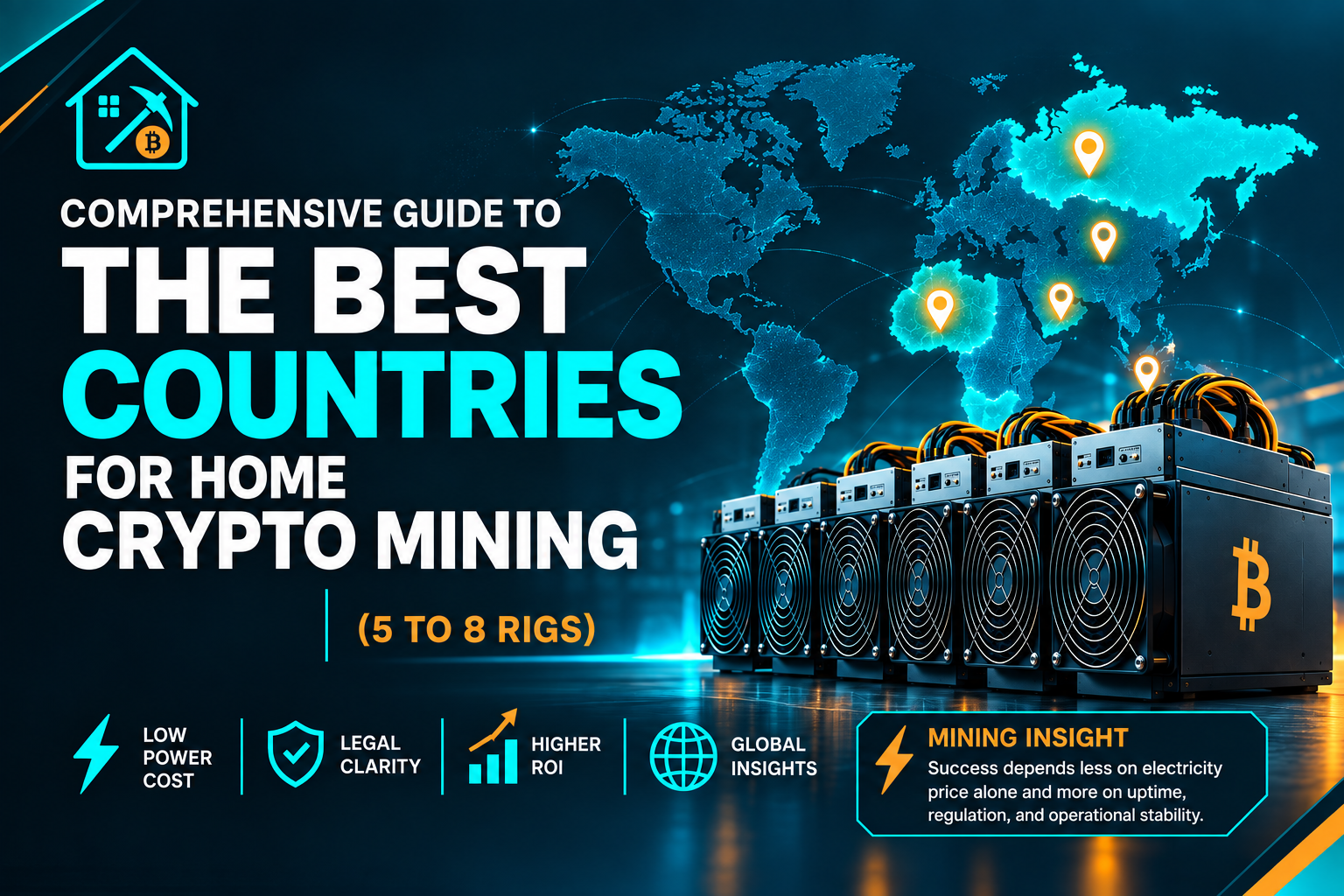
In 2026, crypto mining success depends less on electricity price alone and more on uptime, regulation, and operational stability. The cheapest power means nothing if your rigs are constantly offline or confiscated.
- ✔ Focus: Stability + ROI + Legal Risk
- ✔ Strategy: Long-term survival over short-term profit
Evaluating The Top 5 Crypto Mining Paradise Countries in 2026 for Home Miners
The countries listed below combine either extremely low electricity prices, favorable (or grey-area) regulations, or a balance between legal security and acceptable operating costs. Each case has its own risks and limitations, but all of them remain attractive for miners operating a small number of machines.
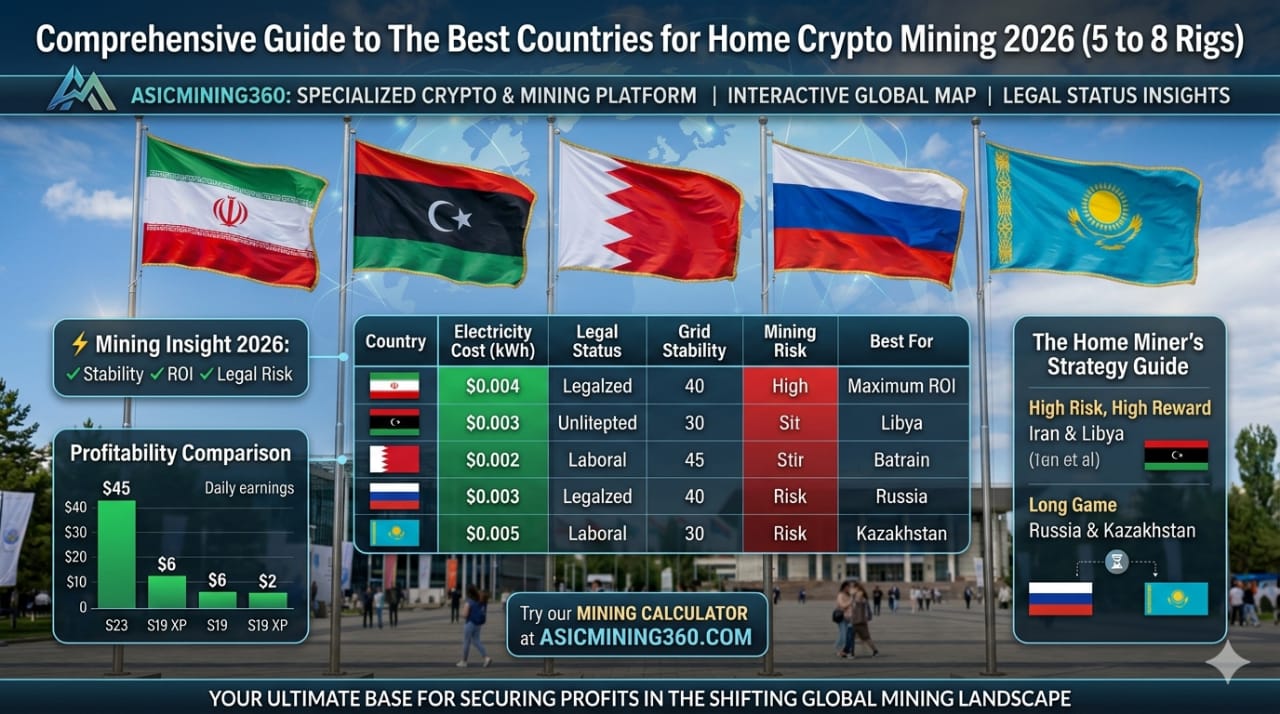
| Country | Electricity Cost (kWh) | Legal Status | Grid Stability | Mining Risk | Best For |
|---|---|---|---|---|---|
| Iran | ~ $0.004 | Restricted / High Enforcement | Medium-Low | Very High | Maximum ROI |
| Libya | ~ $0.008 | Legal Grey Zone | Medium | High | Cheap Power |
| Bahrain | ~ $0.048 | Grey Area | High | Low-Medium | Home Hobby Mining |
| Russia | Regional Variations | Legal with Registration | High | Medium | Long-Term Stability |
| Kazakhstan | Cheap Industrial Rates | Licensed Mining Only | Medium-High | Medium | Legal Industrial Mining |
1. Analyzing Why Iran is The Undisputed Paradise for Miners in 2026
Electricity Cost and Its Impact on Profitability
In Iran, the cost of residential electricity is approximately $0.004 per kWh. This is around 70 times cheaper than electricity prices in countries like France and most of Western Europe, where the price per kWh usually ranges between $0.20 and $0.44. Such an extreme price difference completely changes mining economics. Machines that are no longer profitable in Europe or North America can still generate strong daily profits in Iran.
Why Older ASIC Miners Are Still Profitable in Iran
Thanks to ultra-cheap electricity, several older-generation ASIC miners remain profitable, including:
- Bitmain S19XP 140 TH ≈ $6/day
- Bitmain S19j Pro 96 TH ≈ $4/day
- Bitmain S19K Pro 120 TH ≈ $5/day
In most other countries, these devices are considered unprofitable. In Iran, however, their market price does not usually exceed $660, which means the return on investment can be achieved in roughly 120 days.
Profitability of Modern ASIC Miners in Iran
For newer-generation machines, profitability is even higher:
- Bitmain S23 HYD U3 1.16 PH ≈ $45/day
- Proto Rig 819 TH ≈ $33/day
- Bitmain S21eXP HYD 3U ≈ $35/day
These figures show why Iran continues to attract miners despite the legal and infrastructure challenges.
Iran’s Disadvantages and Mining Risks
Iran’s electricity grid is not equally strong in all cities, and power outages are relatively frequent. Officials have stated that around 15% to 20% of the grid’s problems are linked to mining activities.
Estimates suggest that there are about 900,000 mining devices operating in the country. During a recent major incident in which the internet was cut nationwide, electricity consumption suddenly dropped by 2,400 megawatts, a decrease widely attributed to the shutdown of ASIC miners.
In addition, authorities regularly confiscate equipment from unlicensed mining farms. More than 250,000 illegal devices have reportedly been seized across five Iranian cities. This makes Iran a high-profit but high-risk environment for miners.
2. Exploring Libya’s Ultra-Low Electricity Prices and Legal Grey Zone Benefits
Electricity Prices and State Subsidies
Libya is considered one of the cheapest countries in the world in terms of electricity prices, with an average cost of around $0.008 per kWh. This price is below production cost and is heavily subsidized by the state. The power grid is relatively strong, and large-scale outages are rare compared to many neighboring countries.
Legal Status of Cryptocurrency Mining in Libya
Cryptocurrency trading is illegal under a 2018 law, but mining itself is not clearly regulated. This places mining in a legal grey area: it is neither explicitly permitted nor clearly prohibited.
Due to political instability and institutional division, there is currently no consistent enforcement or comprehensive legal framework specifically targeting mining activities.
Black Market Equipment and Real Profitability
Mining equipment in Libya is mostly sold on the black market, often imported from Turkey. According to local miners contacted via social media, device prices are close to global market prices, while mining returns remain very high.
Examples of daily profitability include:
- Bitmain S23 HYD 3U ≈ $45/day
- Bitmain Z15 Pro ≈ $35/day
- IceRiver ALEO AE3 ≈ $28/day
Under these conditions, the return on investment is estimated at around 200 days, depending on market conditions.
Note: These figures were calculated on the day the article was written. Cryptocurrency prices fluctuate, so actual profitability may vary. A mining calculator is available on ASICMINING360 for more accurate estimates.
3. Understanding Bahrain’s Small Market, Stable Grid, and Legal Uncertainty Factors
Electricity Prices and Mining Economics
Bahrain offers electricity at around $0.048 per kWh, which is relatively low compared to many other countries. Due to its small population and limited local interest in mining, the activity has not spread widely.
Legal Status of Mining in Bahrain (2026)
Based on discussions with local miners, cryptocurrency mining is not classified as a regulated financial service and does not require a specific license from the Central Bank of Bahrain (CBB). However, it is also not explicitly recognized as a fully legal activity. This places mining in Bahrain in a legal grey area in 2026—neither clearly permitted nor strictly banned.
Why Bahrain Remains Interesting for Small Home Miners
For small-scale miners, Bahrain can still be attractive thanks to relatively affordable electricity, grid stability, and limited competition. Profitability can be calculated using the mining calculator available on ASICMINING360.
4. Navigating The Russian Regulated Mining Framework with Clear Consumption Limits
The Legal Framework for Mining in Russia
In late 2024, the Russian president signed a law officially regulating cryptocurrency mining. Mining is now recognized as a legal activity, provided that individuals or companies register in an official registry managed by the Ministry of Digital Development and the tax authorities.
Home Mining and the 6,000 kWh Rule
For individuals mining at home, there is a monthly electricity consumption limit of 6,000 kWh per household. If this limit is exceeded, official registration becomes mandatory. This rule aims to distinguish small home miners from larger commercial operations.
Regional Restrictions and Variations
The situation is not uniform across Russia. In some regions, mining is temporarily restricted or even fully banned during certain periods, mainly due to local energy shortages or grid constraints.
Profitability in Russia
Despite these rules, Russia remains an interesting option for miners who prefer operating within a legal framework. Profitability calculations for different regions and electricity prices can be done through the ASICMINING360 calculator.
5. Reviewing Kazakhstan’s Journey From Mining Boom to Regulation and Partial Liberalization
The Post-China Mining Boom
After China banned mining in 2021, Kazakhstan quickly became one of the top destinations for Bitcoin miners due to:
- Low electricity prices and abundant energy resources
- Relatively inexpensive energy infrastructure
- A fixed, low electricity tariff for licensed miners, which reached around 2 Tenge per kWh in 2024, especially for miners using their own power generation
The Shift to Strict Regulations
As pressure on the national grid increased, Kazakhstan adopted a stricter policy:
- Energy Restrictions: Since 2023, miners are only allowed to use grid electricity when there is an “energy surplus.
- Licensing and Taxes: Mining now requires an official license, and taxes are imposed on mining income. Electricity must be purchased through a government platform with transaction limits.
- Liberalization in 2026: The government ended the monopoly of the Astana International Financial Centre (AIFC) over crypto trading, allowing licensed entities to operate outside the center as part of a strategy to turn the country into a regional crypto hub and build a national digital asset reserve.
Key Risks and Challenges
- Uncertain Energy Supply: Dependence on surplus electricity means operations can be interrupted during peak demand.
- Enforcement Actions: Authorities continue to target illegal mining operations, including equipment confiscations.
- Rising Costs: Licensing, taxes, and mandatory platforms increase overall operating expenses.
Why Kazakhstan Still Makes Sense in 2026
Despite these challenges, Kazakhstan remains attractive because:
- Electricity is still cheaper than in many Western and Asian countries
- A clear legal framework offers better legal security than operating illegally
- Government policy is linked to long-term plans for digital assets, which supports medium-term stability for the sector
Choosing Your Base: The Home Miner’s Survival Guide for 2026
If you’re looking to mine crypto from home in 2026, the "wild west" days are officially over. It’s no longer just about buying the flashiest hardware; it’s about playing a strategic game of geography. You have to decide what you value more: bottom-of-the-barrel costs or the peace of mind that your gear won't be confiscated.
High Risk, High Reward: Iran & Libya
If you’re chasing pure cash flow, Iran and Libya are still the top contenders. The electricity is essentially pennies on the dollar, meaning even your older, less efficient ASICs can still print money. But there’s a catch—and it’s a big one. You’re operating in a grey zone. Between unstable power grids and the constant threat of government crackdowns, your entire operation could vanish overnight. It’s lucrative, but you’ll be looking over your shoulder.
The Long Game: Russia & Kazakhstan
On the flip side, countries like Russia and Kazakhstan have matured. They’ve moved toward a more structured, corporate style of mining. While the immediate ROI might look a bit leaner because of taxes or slightly higher power rates, you’re paying for stability. Here, you get legal protection and predictable regulations. For a serious miner, boring is actually a good thing—it means you can plan for the next three years instead of the next three days.
The Quiet Utility: Bahrain
Then you have places like Bahrain, which offer a unique boutique experience. It’s perfect for the hobbyist who wants a flexible, hassle-free environment. You won't get the explosive profits of an energy giant, but you won't deal with the headaches of a massive industrial mining hub either.
The Reality Check
The biggest rookie mistake in 2026 is price-tag chasing—only looking at the electricity bill. The real pros know that uptime is the only metric that matters. You can have the cheapest power in the world, but it’s worth zero if your machines are sitting in a police warehouse or the power is out for twelve hours a day. In this industry, the "best" miner isn't the one with the highest terahash—it’s the one that’s still plugged in and humming tomorrow morning.
Home Crypto Mining 2026 FAQ: Electricity, Regulations, Hardware & Profitability
Q1: What factors matter most when choosing a country for home crypto mining in 2026?
Spot on. Chasing the cheapest kilowatt-hour on paper is a classic trap if the local grid drops out twice a day or the local authorities decide to raid your garage. Real profitability comes down to that operational sweet spot where steady uptime and legal peace of mind outweigh a fraction of a cent saved on power.
Q2: Is cheap electricity enough to make home crypto mining profitable?
Reliability is worth its weight in gold. You can score power for pennies, but if the grid trips twice a day or the voltage fluctuates wildly, your rigs are dead in the water and your revenue goes straight to zero. Peace of mind and steady uptime will beat bargain-bin electricity every single time.
Q3: Can I legally run multiple ASIC miners at home?
Spot on. Local laws are a minefield, and plugging in a rig without checking the code first is a fast track to getting your gear confiscated. Whether it's power consumption caps or formal registry requirements, knowing the legal landscape keeps your operation safe.
Q4: Should home miners use older ASICs in high-risk countries?
Running older gear can actually make sense if political or regulatory risks are high. Because older machines cost next to nothing upfront, you aren't risking a massive chunk of capital if things go sideways. That said, older models chew through way more power relative to their hashrate, so you still have to crunch the numbers on acquisition cost versus daily energy burn before buying.
Q5: Which is more important for a home miner: ASIC efficiency or electricity price?
It depends entirely on what you're paying for power. When electricity is pricey, efficiency is everything because power bills eat up your margins. When electricity costs next to nothing, older, less efficient machines can still pull their weight. Always run the actual math using your local power rate rather than judging a rig by its specs alone.
Q6: Why is uptime important for mining profitability?
Mining is a pure game of runtime. If your ASIC is sitting offline due to a blown fuse, overheating, network drops, or a regulatory raid, it's making zero revenue. That's why steady, reliable grid infrastructure often outperforms a location with cheaper power that drops out constantly.