Introduction
In 2026, buying a Bitcoin miner is no longer about chasing the highest hashrate — it’s about surviving an increasingly unforgiving efficiency game.
Margins are thinner. Network difficulty keeps rising. And electricity costs have become the single most important variable separating profitable operations from guaranteed losses. In this environment, choosing the wrong hardware isn’t just a mistake — it’s a long-term liability.
That’s where this comparison comes in.
In this guide, we break down two of the most advanced industrial ASIC miners on the market: the Bitmain S21eXP Hyd 3U and the MicroBT WhatsMiner M79S.
This isn’t a surface-level spec sheet comparison. We’ll go deeper — analyzing real efficiency, power consumption, profitability across different electricity costs, and the operational realities that most buyers overlook.
Because in today’s mining landscape, the question isn’t:
“Which miner is more powerful?”
It’s:
“Which miner will still be profitable six months from now?”
⚡ Key Insight:
In Bitcoin mining, efficiency is not just a metric — it defines whether your operation survives or fails.
A small gap in efficiency can translate into massive long-term cost differences.
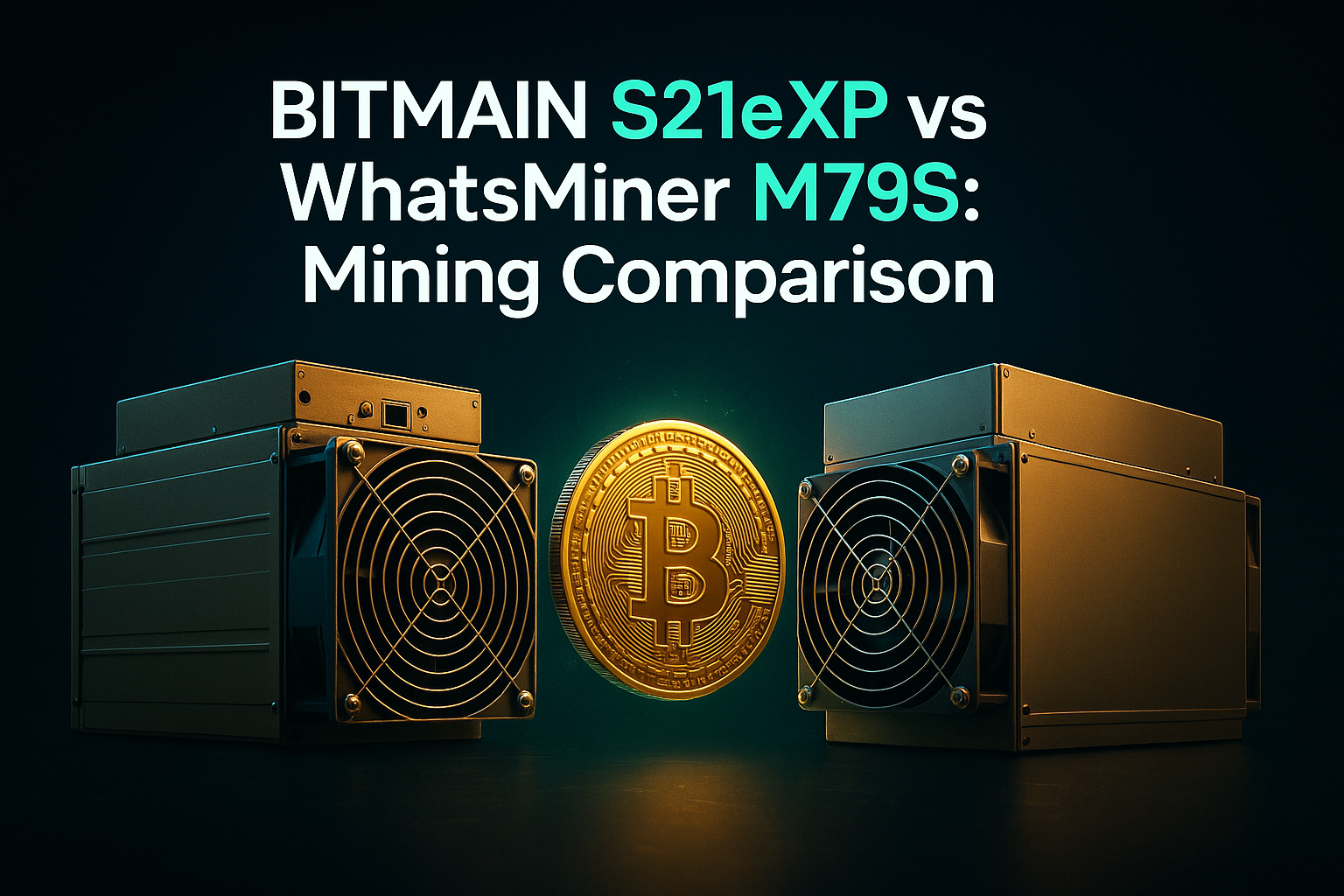
Bitmain S21eXP Hyd 3U vs MicroBT WhatsMiner M79S: 2026 Bitcoin Miner Comparison
This detailed comparison covers 13 key criteria for miners who want to understand which industrial-grade Bitcoin miner delivers the best balance of performance, efficiency, cost, and reliability for their operation.
| Criteria | Bitmain S21eXP Hyd 3U | WhatsMiner M79S |
|---|---|---|
| Build Quality | Very Good | Very Good |
| Hashrate | 860 TH/s | 1350 TH/s |
| Efficiency (J/TH) | 13 J/TH | 14.8 J/TH |
| Dimensions / Weight | 900 × 486 × 132 mm / 18 kg | 585 × 368 × 133 mm / 37 kg |
| Price | $17,000 | $18,000 |
| Power Consumption | 11,180 W | 20,000 W |
| Revenue (Free Electricity) | $32 / day | $48 / day |
| Noise Level | 50 dB | 50 dB |
| Revenue @ $0.04/kWh | $24 / day | $34 / day |
| Revenue @ $0.08/kWh | $13 / day | $15 / day |
| Electricity Break-Even Price | $0.13 / kWh | $0.11 / kWh |
| Generation | Generation 8 | Generation 7 |
| Overall Rating | ⭐⭐⭐⭐☆ (4.0 / 5) | ⭐⭐⭐☆☆ (3.8 / 5) |
ASIC Chip Architecture and Hashboard Configuration Explained
When you're running a Bitcoin mining operation, understanding the setup of your ASICs is really important. The number of chips and how they're spread across the hashboards directly impacts how well your miners perform those SHA-256 calculations.
Take the Bitmain S21eXP Hyd 3U, for instance. It’s reported to have 432 chips arranged on 3 hashboards, with 144 chips on each board, all built using BM1368 3nm tech. This setup helps it hit an energy efficiency of 13 J/TH.
Then there's the MicroBT WhatsMiner M79S, which supposedly comes with 576 chips across 4 hashboards, also with 144 chips on each. These units often use custom ASICs built for sustained high performance.
It’s worth noting that these figures are often gathered from unofficial sources, so it’s wise to approach them with some caution. Manufacturers don't always release the exact chip counts publicly.
One clear benefit of having more hashboards is better heat management and generally higher hashrates. It also simplifies maintenance; if one board fails, you can swap it out without taking the whole miner offline.
Bitmain often tries to excel in energy efficiency, while MicroBT tends to put its focus on raw performance and denser mining configurations. Grasping the internal chip layout can help you form an opinion on a miner's reliability, how it cools, and its long-term durability, even if the precise figures aren't always available.
Ultimately, considering ASIC distribution, the total chip count, and how easy it is to maintain are all key points for miners when deciding what equipment to buy.
Key Takeaways: Which Bitcoin Miner Is Better for Your Operation in 2026?
When choosing between the Bitmain S21eXP Hyd 3U and the MicroBT WhatsMiner M79S, the differences aren't drastic. Your final decision will mostly come down to your electricity costs, how well you can negotiate bulk purchase terms, and whether you have easy access to original replacement parts from authorized dealers or trusted suppliers.
One thing to note is that the number of hashboards influences maintenance. The S21eXP has 3, whereas the M79S has 4. This means the M79S might be a bit simpler to service if one board fails. You should also think about energy efficiency, how heat is distributed, and what sort of long-term reliability you can expect. Truly, things like operational costs, support, and how available service is often matter more than just the raw specifications when you're picking between these industrial-grade miners.
Conclusion
In 2026, the real battle in Bitcoin mining is no longer about who has the most power — it’s about who can stay profitable the longest.
On paper, the MicroBT WhatsMiner M79S dominates with sheer hashrate. It delivers more output, more daily revenue, and stronger short-term performance — especially if your electricity is cheap and your infrastructure can handle the load.
But mining isn’t won on paper.
The Bitmain S21eXP Hyd 3U plays a different game. It trades raw power for efficiency, lower energy exposure, and better long-term resilience — exactly the traits that matter when margins tighten and difficulty keeps climbing.
Because in today’s environment, one simple truth defines everything:
The most powerful miner doesn’t always win — the one that survives does.
If your strategy is aggressive and electricity is cheap → go with power.
If your strategy is disciplined and built for the long run → choose efficiency.
And in 2026… efficiency is no longer an advantage — it’s a necessity.
Frequently Asked Questions: Bitmain S21eXP Hyd vs. WhatsMiner M79S
Q1: Which miner is more profitable in 2026: S21eXP Hyd or M79S?
Profitability depends entirely on your electricity rate. The WhatsMiner M79S generates more daily revenue due to its massive 1350 TH/s output. However, the Bitmain S21eXP Hyd is more "resilient." If Bitcoin's price drops or difficulty spikes, the S21eXP's superior efficiency (13 J/TH) keeps it profitable at higher electricity costs where the M79S might hit its break-even point.
Q2: Why does the WhatsMiner M79S consume so much power (20kW)?
The M79S is designed for maximum density. By pushing 20,000W, it packs the power of nearly two standard miners into one chassis. This is ideal for industrial farms with heavy-duty power infrastructure that want to maximize hashrate per square foot, though it requires specialized cooling and electrical setups.
Q3: Is hydro-cooling better than air-cooling for these models?
In 2026, hydro-cooling (found in both these 3U models) is the gold standard for industrial mining. It allows for a lower noise level (approx. 50 dB), better heat dissipation, and longer hardware lifespan compared to air-cooled fans. It also opens up opportunities for heat recovery (using the waste heat for green energy projects).
Q4: How does the hashboard count affect my maintenance?
The M79S features 4 hashboards, while the S21eXP has 3. From a maintenance perspective, more boards can be an advantage; if one board develops a fault, you lose a smaller percentage of your total hashrate while waiting for a repair, and it is often easier to swap out individual components in a 4-board configuration.
Q5: What is the "Electricity Break-Even" price for these units?
- Bitmain S21eXP Hyd: Remains profitable until electricity hits approximately $0.13/kWh.
- WhatsMiner M79S: Remains profitable until electricity hits approximately $0.11/kWh.
(Note: These figures fluctuate based on Bitcoin’s current price and network difficulty.)
Q6: Can I run these miners at home?
Technically, yes, but it is not recommended. Both units require a 3-phase power supply and a dedicated hydro-cooling loop (radiators, pumps, and coolant). They are industrial-grade machines designed for data centers, not residential electrical circuits.
Q7: Why is "J/TH" more important than "TH/s" in 2026?
Hashrate (TH/s) tells you how much Bitcoin you can mine, but Efficiency (J/TH) tells you how much of that Bitcoin you actually keep after paying the power bill. As the network difficulty increases, miners with lower J/TH ratings stay "alive" longer during market downturns.