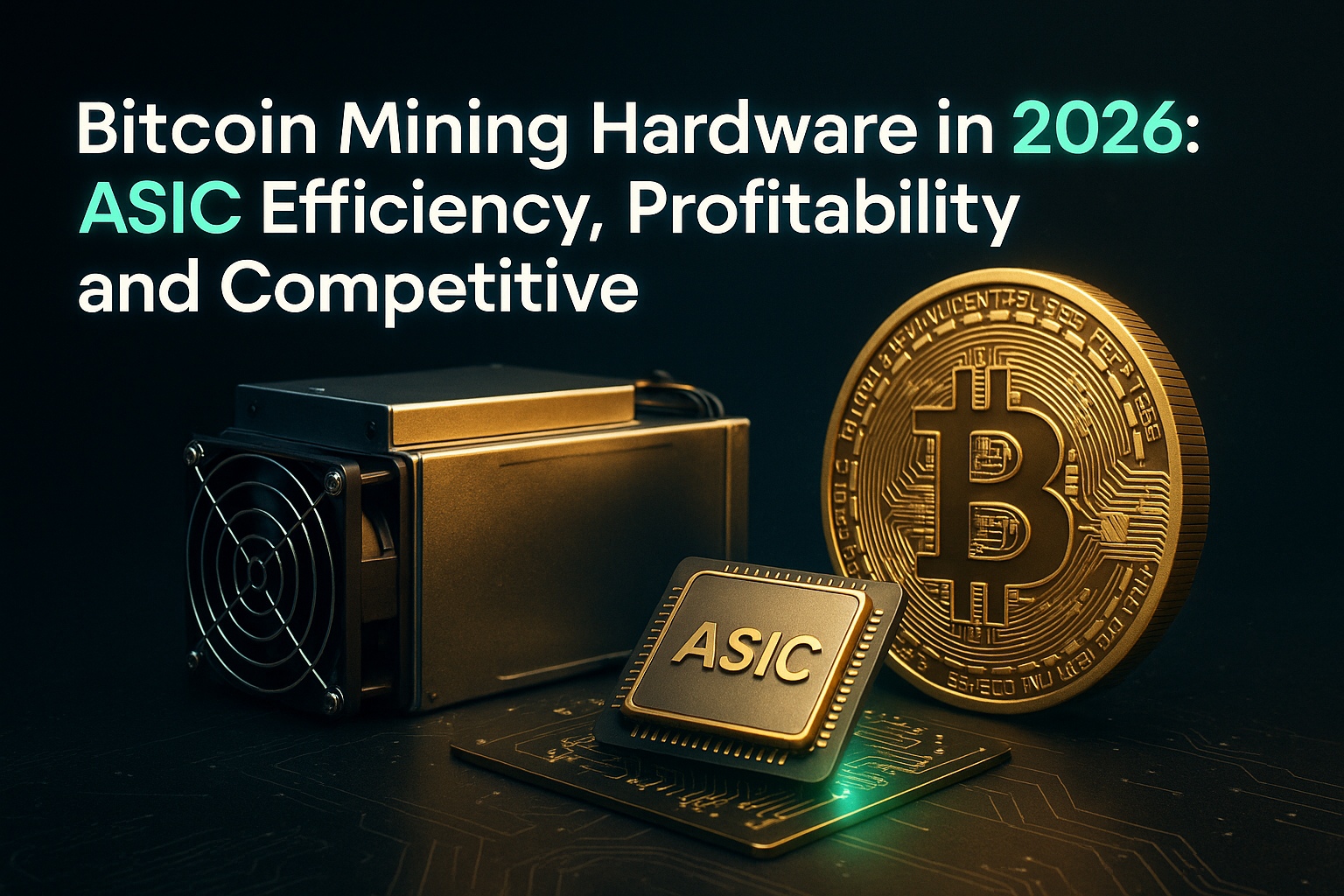
The Evolving Landscape of Bitcoin Mining in 2026
In Bitcoin mining, raw power alone is no longer enough. In 2026, efficiency, cooling design, and electricity cost matter more than ever.
As of the beginning of 2026, the ASIC mining landscape is dominated by a few latest-generation machines that push Hash Rates into the 200–1350 Terahashes per second (TH/s) category (or lower for new algorithms, some reaching 850 MH/s). Our focus, however, is solely on Bitcoin mining. These machines are simultaneously driving down power consumption per Terahash (Joules per Terahash - J/TH) to low single-digit figures. For anyone planning to invest in Bitcoin mining equipment now, the best approach is to target the most powerful Bitcoin mining models that offer strong efficiency and reliability.
This analysis focuses on SHA-256 Bitcoin mining hardware, emphasizing efficiency, operational cost, and deployment suitability in real-world conditions.
According to live profitability rankings (from ASICmining360), the leading models currently achieve daily revenues ranging from $4 to $20 USD (dependent on electricity cost and time-variable network difficulty). Based on historical data, we assume an average viable electricity price of $0.1 per kWh. The efficiency of water- or immersion-cooled variants reaches approximately 9.5 J/TH.
| Metric | Typical Range (2026) | Why It Matters |
|---|---|---|
| Hashrate (TH/s) | 200–1350 TH/s | Higher hashrate can increase share of block rewards, but only if power cost stays manageable. |
| Efficiency (J/TH) | ~9.5–20 J/TH | Main driver of operating cost; better efficiency usually improves ROI. |
| Electricity Price Assumption | $0.10 / kWh | Used for realistic profitability comparisons across miners. |
| Cooling (Air / Hydro / Immersion) | Depends on climate | Impacts uptime, maintenance, and long-term stability. |
Evolution of Bitcoin ASIC Mining Hardware: From CPU and GPU to Modern SHA-256 ASICs
The computational capacity for Bitcoin mining has evolved from Central Processing Units (CPUs) to Graphics Processing Units (GPUs), to Field-Programmable Gate Arrays (FPGAs), and finally to Application-Specific Integrated Circuits (ASICs) custom-designed for Bitcoin's SHA-256 algorithm. Early ASIC devices in 2013 offered only modest advantages over FPGAs, but continuous miniaturization and voltage adjustment drove them to market dominance. For instance, early ASICs operated at ~$68 J/TH; by the mid-2020s, the best miners were reaching the 10–20 J/TH range.
Key Technological Improvements Driving Modern ASIC Efficiency
With each generation, improvements came in three dimensions:
| Upgrade Area | Examples | Mining Impact |
|---|---|---|
| Manufacturing Node | 5nm, 3nm | Lower voltage and leakage, improving J/TH. |
| Hashing Architecture | Pipeline + routing + voltage domains | Higher stable throughput per watt at scale. |
| Cooling & Reliability | Binning, redundancy, control logic | Better uptime, fewer failures, stronger ROI. |
More efficient manufacturing nodes (e.g., 5nm, 3nm) enabling lower voltage and less leakage.
Architectural improvements in the hashing core pipeline, memory routing, and voltage domains.
Auxiliary improvements in cooling, binning, redundancy, and control logic.
The cumulative effect is that each successive ASIC model must provide a non-trivial leap in hash-per-watt efficiency to justify the investment, as network difficulty and competition also escalate.
Key Factors to Evaluate Before Buying a Bitcoin ASIC Miner
Before selecting or purchasing an ASIC mining device, it is crucial to examine the equipment across multiple technical vectors. Failure in any of these dimensions can undermine profitability or stability.
ASIC Mining Efficiency (J/TH) vs Raw Hashrate Performance
Efficiency (J/TH) is often more critical than raw Hashrate. For example, a miner with 300 TH/s and an efficiency of 15 J/TH can outperform a unit with 400 TH/s if the second unit's efficiency is lower, such as 18 J/TH, under realistic electricity pricing. Always calculate the projected kWh draw and compare throughput per watt.
Cooling Systems, Durability, and Hardware Reliability in Mining Farms
Durability, Redundancy, and Cooling Engineering are paramount for 24/7 operation in harsh conditions. Taking the climate of the mining location seriously is essential; for example, a high-temperature and dusty location like a desert favors water or immersion cooling to avoid fan systems that clog with dust. Conversely, in cold, low-dust environments, an air-cooled device may be preferred as it is less complex to install and easier to maintain. A machine that fails or requires frequent maintenance is a profit leak. Evaluate the method of heat removal, whether boards operate at safe temperature margins, and whether the design supports redundant fans or hot-swappable hash boards.
Firmware Support, Control Systems, and Long-Term Miner Stability
Firmware, Control Logic, and Update Support determine usability over time. Many miners operate for years, relying on firmware patches to address stability, fix bugs, and tune frequency. Machines that become "orphaned" without updates tend to degrade or lose compatibility with newer mining systems.
Best Bitcoin ASIC Miners to Watch in 2026
In 2026, competition is focused on a few high-end models from Bitmain and MicroBT (WhatsMiner), along with newcomers. Here is a quick overview of the best devices to monitor:
| Model | Hashrate | Power | Efficiency (J/TH) | Best For |
|---|---|---|---|---|
| S23 Hyd 3U | 1.16 PH/s | 11,020 W | 9.5 | High-density farms |
| S23 Hyd | 580 TH/s | 5,510 W | 9.5 | Farms (hydro setups) |
| S23 Imm | 442 TH/s | 5,304 W | 12 | Immersion deployments |
| S23 | 318 TH/s | 3,498 W | 11 | Balanced home/farm use |
| M79S | 1.35 PH/s | 20,000 W | 13.5 | Large-scale operations |
Recent releases show Bitmain aggressively pushing the S23 series. The Antminer S23 Hyd 3U and S23 Hyd aim to capture high-end farm deployments, while variants like the S23 Imm and the basic S23 offer balanced performance. These are suitable for large farms and home mining.
Antminer S23 Series Performance and Efficiency Overview
- S23 Hyd 3U: 1.16 PH/s, 11,020 W, 9.5 J/TH
- S23 Hyd: 580 TH/s, 5,510 W, 9.5 J/TH
- S23 Imm: 442 TH/s, 5,304 W, 12 J/TH
- S23: 318 TH/s, 3,498 W, 11 J/TH
WhatsMiner M79S Hashrate and Power Specifications
- M79S: 1.35 PH/s, 20,000 W, 13.5 J/TH
The cost of electricity and the climate of the mining location must be taken into account, as they are the most important factors for a successful farm.
FAQ: Bitcoin ASIC Mining Hardware and Profitability in 2026
Q1: What is the most important factor when choosing a Bitcoin ASIC miner?
The most important factor is efficiency measured in Joules per Terahash (J/TH). A miner with better efficiency consumes less electricity for the same hashing power, which directly improves profitability. Since electricity is the largest operational cost in Bitcoin mining, efficient hardware often generates higher long-term returns even if the raw hash rate is slightly lower.
Q2: How much electricity does a modern Bitcoin ASIC miner consume?
Most modern Bitcoin ASIC miners consume between 3,000 W and 11,000 W depending on the model and cooling method. High-end hydro or immersion systems used in large mining farms can exceed 10 kW. Electricity consumption must always be compared with hash rate to calculate the true efficiency and operating cost.
Q3: Is ASIC efficiency more important than hash rate?
Yes, in most real-world mining scenarios, efficiency is more important than raw hash rate. A miner with lower efficiency (better J/TH) can generate higher profits because it reduces electricity costs. Even if another device offers higher hash power, poor efficiency can eliminate profitability when electricity prices rise.
Q4: What cooling methods are used in modern Bitcoin mining hardware?
Modern Bitcoin ASIC miners typically use three cooling approaches: air cooling, hydro cooling, and immersion cooling. Air-cooled systems are simpler and easier to maintain, while hydro and immersion cooling allow higher performance and lower chip temperatures, making them ideal for large mining farms operating continuously.
Q5: How profitable is Bitcoin mining in 2026?
Profitability depends on several factors including electricity cost, mining difficulty, Bitcoin price, and hardware efficiency. Under typical conditions with electricity around $0.10 per kWh, many modern ASIC miners generate daily revenues ranging from approximately $4 to $20 before operational expenses.
Q6: Why do new ASIC mining models appear every few years?
New ASIC generations are released to improve efficiency, increase hash rate, and stay competitive with rising network difficulty. Advances in semiconductor manufacturing such as 5nm or 3nm chips allow miners to reduce power consumption while delivering higher computational output, making older hardware less competitive over time.