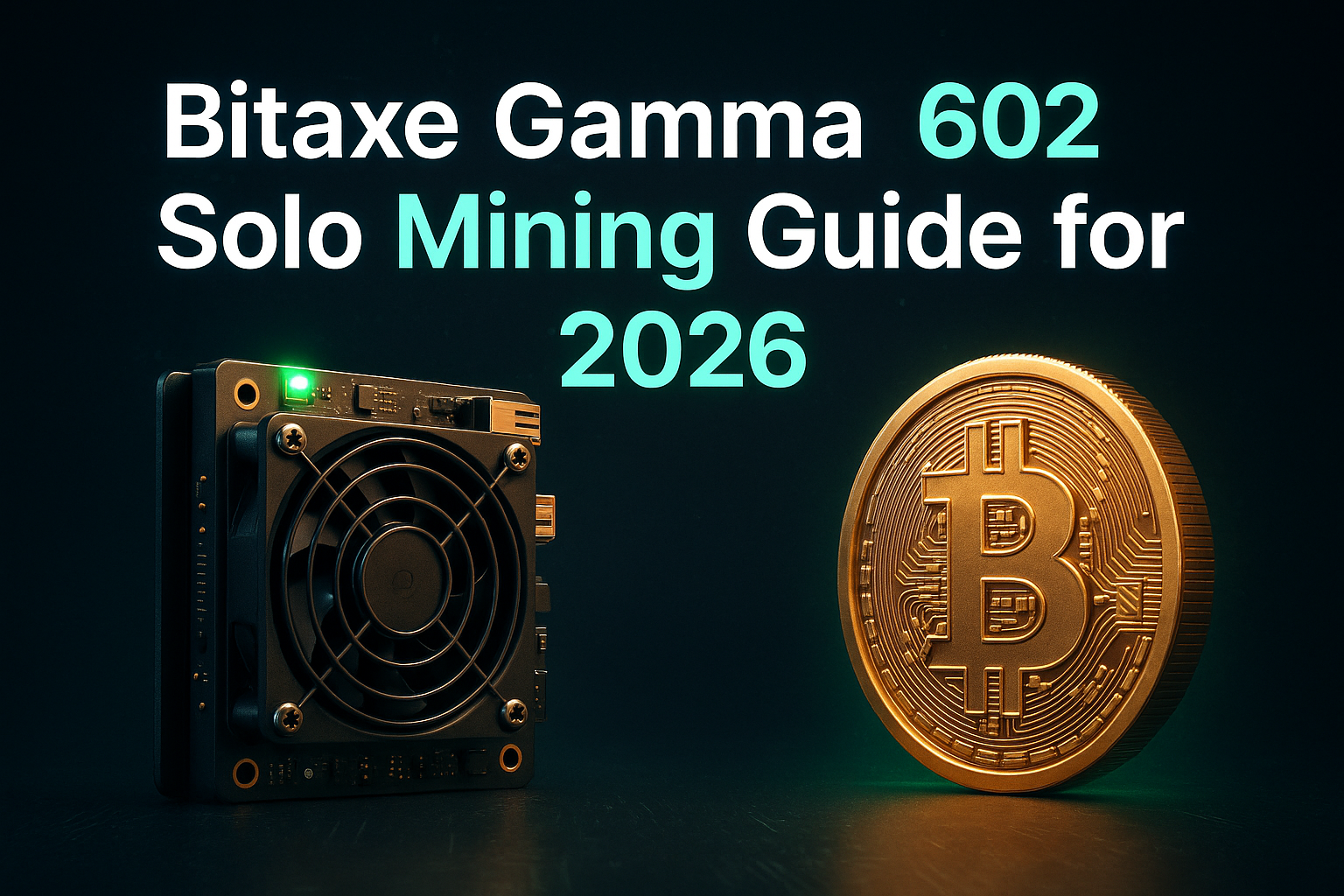
The Evolution of Bitcoin Mining
Bitcoin mining didn’t just evolve over the past decade — it was taken over. What started as a hobby for curious builders and early adopters has transformed into a capital-intensive, industrial battlefield dominated by massive facilities, cheap energy contracts, and institutional-scale operations. For most people, the door quietly closed.
But in 2025 and 2026, something unexpected happened.
A silent counter-movement began to emerge — not in data centers, but on desks. The rise of the lottery miner marks a homecoming for Bitcoin. It’s a revival of the network's founding ethos: solo participation, grassroots experimentation, and that classic outsized reward for minimal risk. At the center of this movement sits the Bitaxe Gamma 602 — a small, almost absurdly simple device that represents something much bigger than its size suggests.
Far from the deafening warehouses of Texas or the geothermal farms of Iceland, these compact, low-power machines are finding their way back into homes across the United States and Europe. Not as competitors to industrial mining — but as a rebellion against it. A bridge between the financialized present and the cypherpunk roots that built Bitcoin in the first place.
And here’s the uncomfortable truth most people ignore:
Solo mining isn’t dead.
In fact, in late 2025 and early 2026, a handful of individuals — fewer than ten — managed to do what seems statistically impossible: mine a full Bitcoin block alone. No pools. No shared rewards. Just one machine beating the odds.
With Bitcoin trading above $100,000, that’s not just a win — it’s a life-changing event. A single block reward of 3.125 BTC, plus fees, represents hundreds of thousands of dollars earned in one improbable moment.
This is not a business model.
This is probability, weaponized.
But the day it wins — it changes everything.
And that’s exactly what makes it so fascinating.
Understanding the Bitaxe Gamma 602
Before we go deeper, let’s break down what this machine actually is under the hood.
Bitaxe Gamma 602 Hardware Specs and BM1370 ASIC Breakdown (2026)
Strip everything away, and what you’re left with is brutally simple: one chip, one purpose, no excess. Unlike commercial ASIC (Application-Specific Integrated Circuit) miners that house hundreds of chips, the Bitaxe utilizes a single, high-efficiency chip. In the Gamma series, this is the BM1370 ASIC, the very same silicon found in Bitmain’s flagship Antminer S21 Pro.
Bitaxe Gamma 602 Hashrate and Power Consumption (1.2 TH/s at 18W Explained)
The device operates at a nominal hash rate of approximately 1.1 to 1.2 Terahashes per second (TH/s). While this is a fraction of an industrial miner's 234 TH/s, the Bitaxe’s value lies in its power efficiency. Operating at roughly 18 Joules per Terahash (J/TH) and drawing only 18 Watts from the wall, it consumes less energy than a standard LED light bulb.
Bitaxe Solo Mining Odds Explained: Shares, Difficulty, and Real Probability (2026)
To understand the Bitaxe is to understand the math of "shares" and "best difficulty."
-
Hash Rate: Think of this as your speed. At 1.1 TH/s, the device is making 1.1 trillion "guesses" per second to solve the cryptographic puzzle.
-
Shares: These are "proofs of work" submitted to a solo mining pool (like CKPool). They act as proof that your device is active and contributing.
-
Best Difficulty: This is your highest-scoring guess. To win a block, your best difficulty must exceed the current Bitcoin Network Difficulty, which in early 2026 sits at record highs.
Mathematically, running a 1.1 TH/s miner 24/7 gives you roughly a 1 in 17,500 chance per year of hitting a block. While slim, these odds are significantly better than most state lotteries, with the added benefit of a tangible, long-term asset as the prize.
How to Set Up Bitaxe Gamma 602 at Home (AxeOS + CKPool Full Guide)
Unboxing the Bitaxe feels more like opening a high-end gadget than a piece of industrial gear. It’s got that sleek, 'Apple-esque' polish that proves mining hardware is finally ready for the home office. I love how it feels in your hand—the exposed PCB gives it a raw, 'maker' vibe, while the custom 3D-printed honeycomb stand handles the airflow without breaking the aesthetic.
-
Hardware Connection: The device uses a standard 5V/6A power supply. Once plugged in, the onboard 40mm PWM fan—specifically branded by Power Mining—engages immediately to stabilize the chip’s temperature, typically holding at a "balmy" 57°C.
-
OS Configuration: The Bitaxe creates its own Wi-Fi hotspot (e.g., Bitaxe_3461). By connecting your laptop to this network, you access the AxeOS dashboard.
-
Network Alignment: You must point the miner to your home Wi-Fi and, crucially, replace the default manufacturer’s Bitcoin address with your own.
-
Wallet Strategy: For solo mining, using an open-source, non-custodial wallet like Blue Wallet is recommended. You simply copy your SegWit or Taproot address into the pool settings. This ensures that if the Bitaxe solves a block, the 3.125 BTC plus transaction fees are deposited directly into your control.
Bitaxe Electricity Cost in 2026: Power Usage, Monthly Cost, and ROI Impact
Mining profitability is traditionally a function of Energy Cost < Reward Value. However, for a Bitaxe, the calculation shifts to "Operating Cost vs. Opportunity."
| Country / Region | Electricity Rate (per kWh) | Monthly Cost (18W) | Annual Cost | Economic Viability |
|---|---|---|---|---|
| Egypt | $0.024 | $0.31 | $3.72 | Optimal |
| Algeria | $0.038 | $0.49 | $5.88 | Excellent |
| Texas (USA) | $0.161 | $2.09 | $25.08 | Moderate |
| Spain | $0.250 | $3.24 | $38.88 | High Cost |
Texas rates reflect the 2026 residential average; industrial or off-peak rates may be significantly lower.
At $100 for the hardware and less than $12 a year in electricity, the Bitaxe is essentially a "forever" lottery ticket. Even in high-cost energy markets like Portugal, the monthly overhead is negligible—less than the price of a single espresso.
Bitaxe Solo Mining Risks: Probability, Hardware Lifespan, and ROI Reality
Buying a Bitaxe is exciting, but don't let the enthusiasm cloud the technical reality.
-
The Probability Gap: While "six people did this in 2025," millions did not. Solo mining is a binary outcome: you either win the full block or you earn zero. There are no partial payouts like those found in traditional mining pools.
-
Hardware Longevity: Heat is the enemy of silicon. While the Bitaxe is well-cooled, running an ASIC at peak frequency 24/7 will eventually lead to hardware degradation.
-
Educational vs. Financial: Let’s be honest: for almost everyone, the real ROI on a Bitaxe is the hands-on masterclass in Bitcoin, not the daily payout. It teaches you about Stratum protocols, IP management, and the mechanics of Proof of Work.
Is Bitaxe Gamma 602 Worth It in 2026? Full Review and Final Verdict
The Bitaxe is not a "get rich quick" scheme; it is a sophisticated, low-cost entry point into the most secure computing network in human history. Its build quality, courtesy of facilities like Power Mining in Latvia, has reached a point where it can be comfortably recommended as a "Christmas gift for your grandmother" or a desktop ornament for the IT professional.
For $100, you are purchasing a seat at the table of the Bitcoin network. You are contributing to decentralization, learning the intricacies of blockchain infrastructure, and holding a non-zero chance of financial sovereignty in the palm of your hand. In 2026, that is perhaps the most intelligent $100 an interested investor can spend.
You’re not buying a miner.
You’re buying a probability — and a front-row seat to the most powerful network on Earth.
FAQ: Bitaxe Gamma 602 Solo Mining (2026)
Q1: What is a Bitaxe miner, and how is it different from an Antminer?
Bitaxe is a small, open-source Bitcoin ASIC miner built for at-home use, typically using a single high-efficiency chip rather than the multi-board, high-noise architecture of industrial miners. The key difference is intent: Bitaxe focuses on education, decentralization, and low power draw, while Antminers are built for commercial-scale hashrate and farm economics.
Q2: Can a Bitaxe Gamma 602 realistically mine a full Bitcoin block in 2026?
Yes, but it’s purely probabilistic. A Bitaxe can win a block if it produces a valid hash that beats the current network difficulty—meaning you get the full block reward (plus fees). The realistic expectation, however, is long odds and a binary outcome: either a full win or zero payout.
Q3: How much does it cost to run a Bitaxe 24/7 at home?
Because it draws about 18W, the running cost is typically only a few dollars per year in low-cost electricity regions (e.g., North Africa) and still modest in higher-cost markets (e.g., parts of Europe). The bigger “cost” is opportunity: you’re paying for learning and a long-shot chance, not steady revenue.
Q4: Do I need CKPool to solo mine with a Bitaxe?
You don’t strictly “need” CKPool, but a solo pool like CKPool is a common choice because it makes solo mining practical to monitor using shares and “best difficulty.” A solo pool does not split rewards—if you hit a block, the full reward goes to your configured address, otherwise you earn nothing.
Q5: What wallet should I use for Bitaxe solo mining payouts?
For solo mining payouts, users typically prefer a non-custodial wallet where you control the keys, so any successful block reward goes directly to your address. SegWit or Taproot addresses are commonly used for receiving. The main rule: avoid custodial deposit addresses if you want full control and fewer payout risks.
Q6: Is Bitaxe solo mining legal where I live?
Legality varies by country and sometimes by region. In many places (US, much of Europe), running a small miner at home is generally treated like operating any computing device, but rules can change—especially around energy usage, taxes, and crypto regulations. Always check your local regulations and utility terms before operating mining hardware.
Q7: What are the most common setup mistakes with Bitaxe at home?
The most common mistakes are leaving the default manufacturer address in the pool settings, misconfiguring Wi-Fi network settings, using unstable power supplies, and ignoring cooling/airflow. Another frequent issue is misunderstanding shares: shares confirm activity, but they do not mean you’re earning partial rewards in solo mining.
Q8: Does Bitaxe mining make sense in Europe versus North Africa?
From a pure operating-cost perspective, lower electricity prices make it cheaper to run in North Africa, while parts of Europe can be more expensive per kWh. However, since Bitaxe power draw is tiny, the cost difference is often less important than the educational value and your interest in supporting decentralization with a low-noise, low-heat device.