Introduction
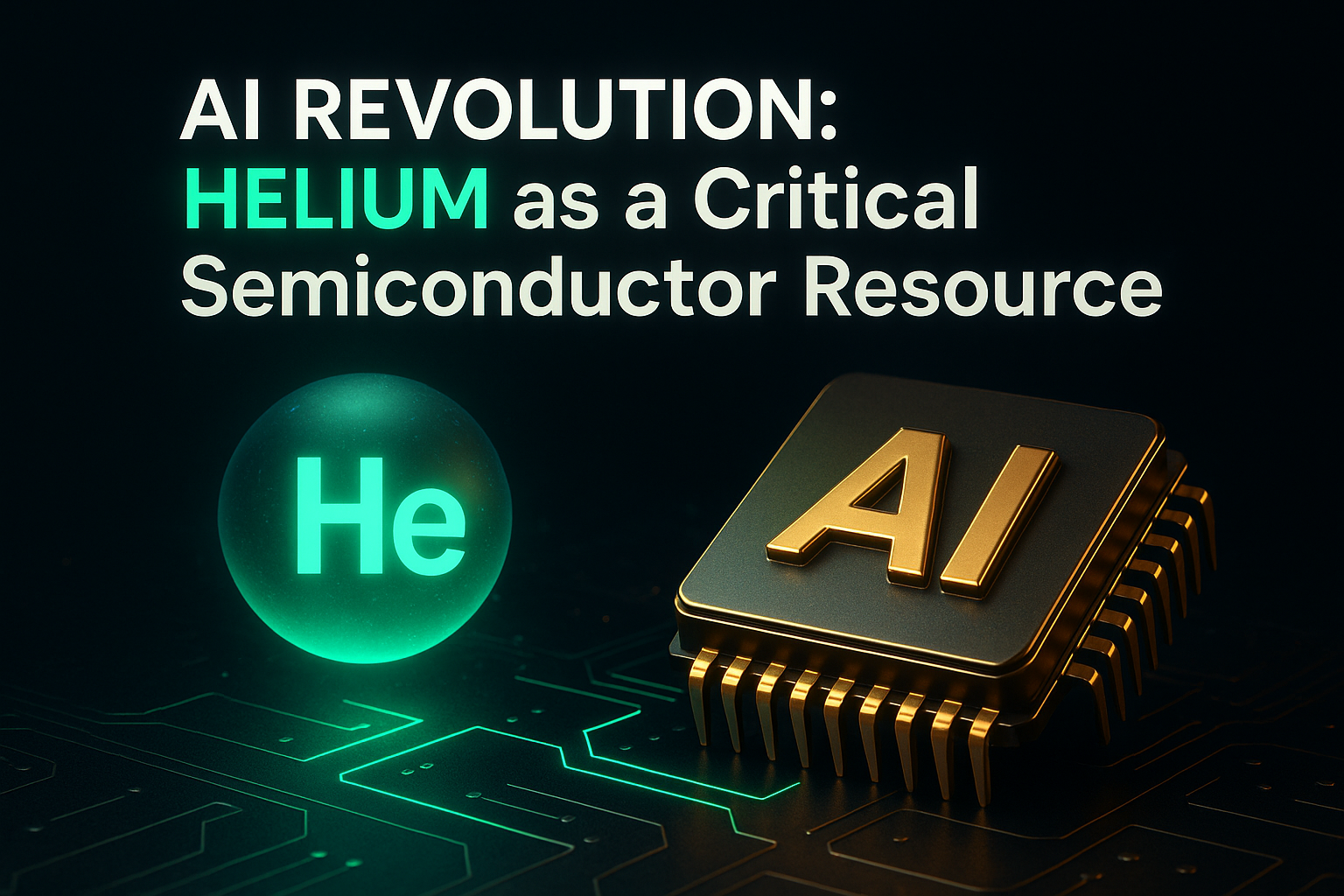
In an era where global power is no longer measured solely by barrels of oil or tons of steel, but by the relentless flow of floating-point operations, the world’s most valuable companies have undergone a radical transformation. We have entered the age of NVIDIA, a titan whose market valuation has hovered around $4.5 trillion at peak 2026 levels—not by selling food, medicine, or fuel, but by forging the "digital brains" of the future. Yet, this entire infrastructure, which powers everything from LLMs to global financial grids, is tethered to a surprising and fragile physical reality.
While the world watches the geopolitical chessboard between the United States and Iran, focusing on the potential closure of the Strait of Hormuz as an energy crisis, a far more silent threat looms. It isn't just about the oil that fuels our cars; it is about the ultra-high-purity Helium that fuels our future.
How Helium Powers Modern Chipmaking: Essential Applications in EUV Lithography and Thermal Management
To the average person, helium is the light-hearted gas of birthday parties. To a semiconductor engineer, it is an irreplaceable miracle of physics. Helium possesses a unique combination of traits: it is incredibly light, chemically inert, and boasts an extraordinary ability to conduct heat.
In the high-stakes world of chip manufacturing—specifically for ASML’s Extreme Ultraviolet (EUV) lithography machines—helium is the only element capable of surviving the environment. These machines produce the advanced chips (under 7nm) that drive NVIDIA’s GPUs and TSMC’s servers.
Helium plays four non-negotiable roles in the semiconductor fabrication process:
-
Thermal Management: It cools EUV systems that generate volcanic levels of heat, ensuring the delicate optics aren't warped or contaminated.
-
Ion Implantation Stability: During the "doping" of silicon wafers, helium maintains a perfectly stable temperature; even a microscopic fluctuation can ruin an entire batch of chips.
-
Leak Detection: Because helium atoms are so small, they can slip through gaps that other gases cannot, making them the "gold standard" for ensuring the vacuum integrity of manufacturing tools.
-
Chemical Vapor Deposition (CVD): It acts as a neutral transport for reactive chemicals, moving materials without interfering with the reaction.
The 6N Purity Standard: Why 99.9999% Pure Helium is a High-Tech Supply Chain Bottleneck
The challenge isn't just finding helium; it’s refining it. Advanced chipmaking requires "6N Helium"—a staggering purity level of 99.9999%.
-
N4 (4N): 99.99% purity (100 parts per million impurities)
-
N5 (5N): 99.999% purity (10 parts per million impurities)
-
N6 (6N): 99.9999% purity (Only 1 part per million impurity)
Note: The jump from N5 to N6 represents a 10x increase in cleanliness, which is why 6N Helium is drastically more expensive and difficult to produce.
Achieving this requires a massive, sophisticated industrial footprint. This creates a dangerous bottleneck. While the United States remains a top producer, it consumes the lion's share of its supply internally for defense, aerospace, and medical imaging (MRI). This leaves the global market heavily reliant on a few key exporters, most notably Qatar. Any disruption in the Persian Gulf or the Strait of Hormuz doesn't just raise gas prices at the pump; it threatens to freeze the production lines of the world’s most advanced processors.
Major fabs increasingly deploy helium recycling systems and maintain limited strategic buffers, but these measures reduce short-term pressure rather than eliminate structural supply risk.
To understand why the semiconductor industry is so vulnerable, we must look at the specific purity requirements that separate AI hardware production from other industrial uses of helium.
Helium Purity Grades by Industrial Application
| Industry / Sector | Specific Application | Purity Grade | Actual Purity (%) |
|---|---|---|---|
| Advanced Chipmaking (AI & GPUs) | EUV Lithography cooling, Wafer cooling (Sub-7nm nodes) | N6 (6N) | 99.9999% |
| RAM & GPU Manufacturing | Ion Implantation and Chemical Vapor Deposition (CVD) | N5.5 - N6 | 99.9995% - 99.9999% |
| Standard Electronics | Motherboards and Legacy Semiconductor processing | N5 (5N) | 99.999% |
| Fiber Optics | Cooling glass fibers during high-speed drawing | N5 (5N) | 99.999% |
| Healthcare (MRI) | Cooling Superconducting Magnets | N4.5 - N5 | 99.995% - 99.999% |
| Aerospace & Defense | Fuel tank pressurization and system purging | N4.5 | 99.995% |
| Scientific Research | Carrier gas for Gas Chromatography | N5 - N5.5 | 99.999% - 99.9995% |
| Heavy Industry / Welding | Shielding gas for Titanium and Aluminum welding | N4 (4N) | 99.99% |
| Leak Detection | Integrity testing for high-pressure systems | N4 (4N) | 99.99% |
The Russian Risk: Avoiding the "Energy Trap" 2.0
Russia is aggressively scaling its Amur plant to dominate the helium market, but for the West, this is a geopolitical red line. After the bruising experience of relying on Russian methane, Europe and South Korea are unwilling to put their "AI eggs" in a Russian basket. With Moscow prioritizing its Roscosmos space program and using gas exports as a diplomatic weapon, the semiconductor industry faces a familiar threat. Relying on Russian helium would hand Moscow a "kill switch" over the world’s chip production. To avoid falling into the same trap twice, the tech world is pivoting. Algeria emerges as the most logical and stable alternative—offering a path to high-purity helium without the heavy price of political blackmail.
Algeria’s Strategic Potential: Leveraging Natural Gas Reserves to Diversify Global Helium Supplies
Against this backdrop of supply chain anxiety, Algeria emerges as a critical, if currently underutilized, player. Currently the world’s fourth-largest producer (at approximately 11 million cubic meters annually), Algeria sits on a goldmine of natural resources. With combined traditional and shale gas reserves exceeding 22 trillion cubic meters, the potential is staggering. If Algeria were to maximize its helium extraction from these reserves, it could theoretically double or even triple its output to 20–25 million cubic meters. Such a move would catapult it into the global top three, providing a vital alternative to Middle Eastern and American supplies.
The Road to Strategic Autonomy for Algeria:
However, transforming potential into production is not an overnight task. To meet the demands of the AI industry, Algeria would need to:
-
Invest in Advanced Cryogenics: Building helium separation units within existing gas complexes.
-
Achieve 6N Purity Levels: Transitioning from "crude" helium to the ultra-refined grade required by TSMC, Intel, and Samsung.
-
Human Capital & Logistics: Developing specialized supply chains and training a high-tech workforce under the leadership of entities like Sonatrach.
Experts estimate that such an expansion would require a 4 to 7-year timeline and billions of dollars in capital investment. While Algeria is not a "quick fix," it is the most logical mid-term solution for a world desperate to diversify its tech-gas dependencies.
Securing the AI Future: Why Diversifying Helium Sources is Vital for Global Economic Stability
The current tension in the Gulf reveals a profound irony: our most "ethereal" technology—Artificial Intelligence—is bound by the most basic laws of geology and geography. If helium supplies falter, we will see an immediate spike in the cost of GPUs and ASIC mining rigs, stalling the growth of data centers and cloud computing.
In a world where progress is measured by the number of parameters in a model or the speed of a neural network, the fate of the 21st century's greatest revolution may ultimately depend on a gas that is colorless, odorless, and increasingly hard to find. The "invisible gas" has become the world's most visible strategic priority.
In the AI age, the true chokepoint is no longer software, chips, or data alone—it is the invisible raw materials that make computing possible.
Deep Dive: Frequently Asked Questions on the Helium-AI Connection
Q1: Why is a simple gas like Helium the secret to NVIDIA’s trillion-dollar success?
It sounds like a stretch, but without helium, the high-performance GPUs that power AI wouldn't exist. Helium is the "Swiss Army Knife" of the semiconductor fab. Its unique physical properties—like being chemically inert and having incredible thermal conductivity—allow it to cool down ASML’s EUV lithography machines which operate at extreme temperatures. Essentially, helium acts as the ultimate heat-shield and stabilizer, ensuring that the microscopic circuits on a chip are carved with 100% precision.
Q2: What exactly is "6N Helium," and why is it so hard to produce?
In the tech world, "6N" is shorthand for 99.9999% purity. To put that in perspective, imagine a massive swimming pool where only a single drop of ink is allowed—that is the level of cleanliness required. Achieving this "Six Nines" standard is a massive industrial challenge. It requires multi-stage cryogenic distillation that most gas plants simply aren't equipped for, which is why only a few countries can supply the high-grade helium needed for sub-7nm chips.
Q3: Could a helium shortage actually "break" the AI and GPU supply chain?
In short: Yes. The advanced semiconductor industry operates on a "just-in-time" supply chain, meaning they don't keep massive stockpiles of helium. If the supply from major hubs like Qatar or the U.S. is choked—due to something like a closure of the Strait of Hormuz—production lines for GPUs, AI servers, and even ASIC miners would likely ground to a halt within weeks. This would cause a massive spike in hardware prices and a delay in the training of next-gen AI models.
Q4: Is Algeria the "Sleeping Giant" that could solve the global helium crisis?
Algeria definitely has the "DNA" to be a global leader. With some of the world’s largest natural gas reserves, it is already the fourth-largest producer globally. However, the path from "potential" to "powerhouse" involves more than just drilling. To become a primary supplier for the AI industry, Algeria needs to invest heavily in ultra-high-purity (6N) refinement facilities and specialized logistics. It’s a mid-to-long-term play—one that could take 4 to 7 years to fully mature—but it is arguably the world's best shot at diversifying the helium supply.