The Mining Mirage: Why Silicon Power is No Longer Enough
By 2026, the romantic era of the garage miner hasn’t just faded—it has been dismantled. What was once a technical challenge has metastasized into a brutal war of capital exhaustion. Today, staring at a $17,000 price tag for a single top-tier ASIC from Bitmain or MicroBT isn’t just an entry cost; it’s a barrier to entry that redefines who gets to play the game.
But here is the cold reality: Hardware is no longer a hedge against hardship. We are witnessing a pincer movement that is crushing the traditional mining model. On one side, network difficulty is scaling peaks we once thought unreachable. On the other, the volatile cost of power—often hovering in the lethal $0.10–$0.15 per kWh zone—is turning these high-performance machines into little more than "expensive space heaters." For many, the math has simply turned hostile; they are running state-of-the-art silicon not to build wealth, but merely to break even.
This atmospheric pressure has forced a fundamental evolution in strategy. The most agile players are quietly abandoning the "brute force" obsession with Bitcoin’s hashrate. Instead, a more tactical migration is underway toward lower-cost ASIC alternatives in the altcoin frontier. These operators aren't looking for the "safety" of the largest network; they are hunting for velocity—the ability to capture ROI in the brief window before the herd arrives and the difficulty spikes.
It is a high-stakes pivot. We’ve moved from a game of "who has the most power" to "who has the best timing." In 2026, the successful miner is no longer just a technician; they are a macro-strategist operating in a landscape where the greatest risk isn't the hardware you buy, but the time you lose waiting for the market to catch up.
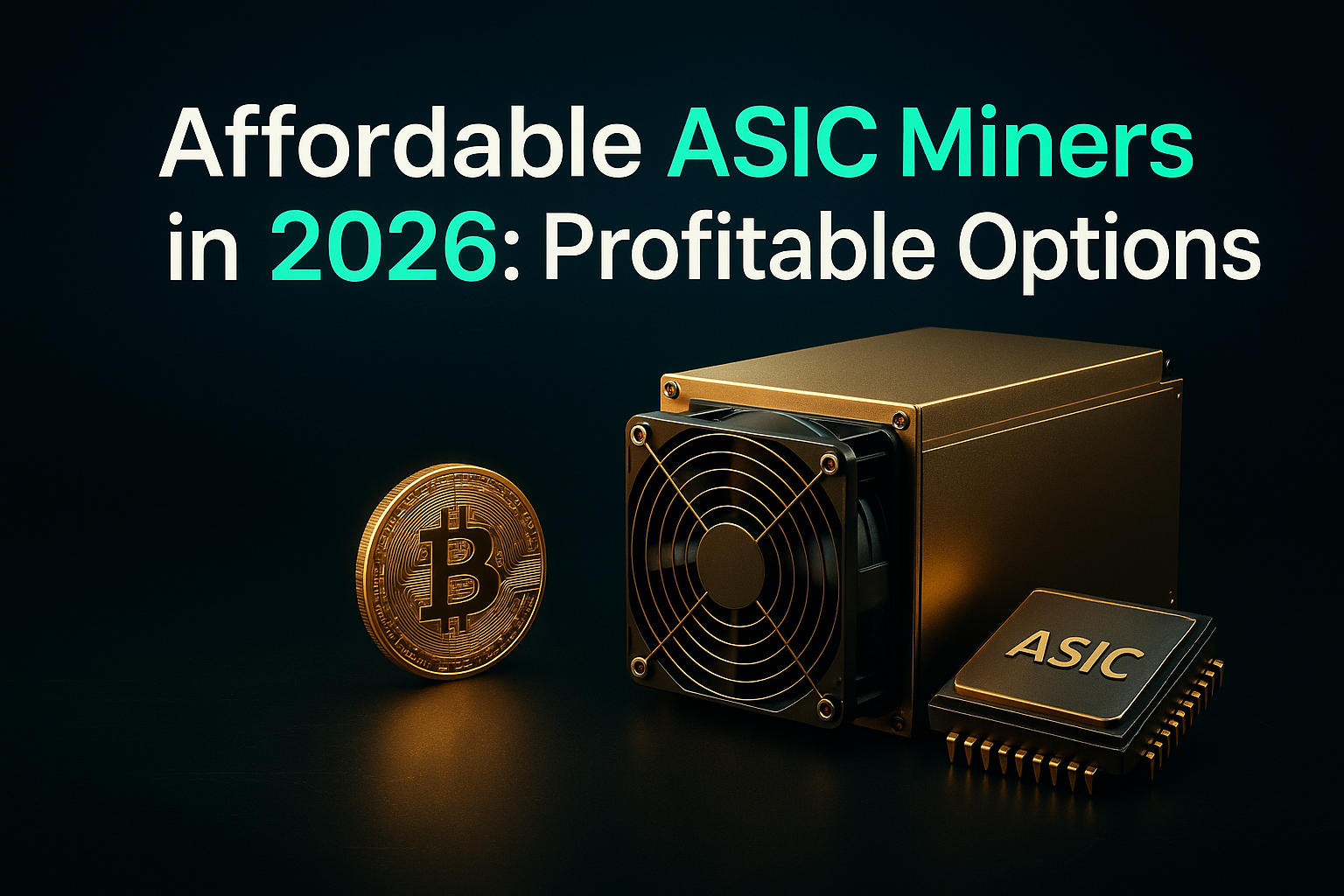
Top 3 Affordable and Profitable ASIC Miners for Crypto Mining in 2026
1️⃣
| Hashrate | 850 MH/s |
| Power Consumption | 500W |
| Efficiency | 0.588 J/MH |
| Noise Level | ~60 dB |
| Weight | ~3 kg |
| Operating Temp | 5°C – 40°C |
| Price | $2,300 – $3,100 |
| Daily Income | ~$27/day |
| ROI | ~140 days |
2️⃣
| Hashrate | 2 GH/s |
| Power Consumption | 3400W |
| Efficiency | ~1.7 J/MH |
| Noise Level | ~75 dB |
| Weight | 15 kg |
| Voltage Requirement | 200–250V |
| Price | $5,500 – $6,000 |
| Daily Income | ~$24/day |
| ROI | ~245 days |
3️⃣
| Hashrate | 840 kH/s |
| Power Consumption | 2780W |
| Efficiency | ~3.31 J/ksol |
| Cooling | Dual-fan air cooling |
| Weight | 5.9 kg |
| Operating Profile | Designed for 24/7 operation |
| Market Price | $2,500 – $4,500 |
| Daily Income | Up to ~$30/day |
| Estimated ROI | ~210 days |
The Final Word: Cheap ASICs Aren't a Shortcut—They’re a Sprint
In the 2026 landscape, opting for "affordable" ASIC miners isn't about finding a bargain; it’s a high-stakes bet on timing. Lower entry costs might lower the barrier, but they strip away the safety net. While you can deploy capital faster and theoretically see your money back sooner, you are operating on a razor's edge.
The reality of altcoin mining is its extreme fragility. Unlike the slow, institutional grind of Bitcoin, altcoin profitability can evaporate in a heartbeat. A network difficulty spike can happen in a single fortnight, or a token price can crater over a weekend. That "140-day ROI" you see on paper today is a snapshot, not a promise—it can easily stretch into a year if the market shifts against you.
This is the fundamental trade-off of 2026: Stability vs. Velocity. Bitcoin mining requires massive upfront capital but offers a predictable (if slow) path. Altcoin ASICs offer a sprint, where the "early birds" capture the lion's share of the rewards, leaving latecomers to fight over thinning margins or, worse, pay for electricity they can't recover.
⚠️ The Hard Reality Check: None of the figures in this guide—whether it's daily yield, ROI projections, or hardware MSRP—are static. They are "living" numbers, moving constantly with global electricity shifts, network competition, and market volatility. What puts money in your pocket this morning might cost you by tomorrow evening.
FAQ: Affordable ASIC Miners and Crypto Mining Profitability
Q1: Which "budget" ASICs are actually hitting the profitability marks in 2026?
Profitability is never a static number; it’s a moving target dictated by your power bill and network traffic. That said, the Pinecone Matches INIBOX, IceRiver ALEO AE3, and Antminer Z15 Pro have carved out a reputation this year. They’ve struck a "sweet spot"—balancing a manageable entry price with enough hashing power to keep daily revenue ahead of the curve.
Q2: Why are Bitcoin miners reaching such eye-watering price points?
We’ve moved past simple assembly. Modern rigs are essentially supercomputers packed into a metal box. The shift toward next-gen semiconductor nodes and industrial-grade cooling systems has sent manufacturing costs soaring. Plus, with massive institutional farms buying up thousands of units at once, the sheer demand for high-efficiency silicon keeps the market prices at a premium.
Q3: Is the "Altcoin vs. Bitcoin" debate settled for 2026?
It’s a trade-off between safety and speed. Altcoin mining is often "more profitable" on paper because lower network difficulty allows for a faster capital recovery (ROI). However, it’s a wilder ride. Bitcoin is the "slow and steady" marathon, while altcoins are a sprint where the rewards are higher, but the floor can drop if market sentiment shifts overnight.
Q4: What actually kills (or creates) mining profit?
It’s a symphony of variables. Your electricity rate is the primary "silent killer," but you also have to watch the J/TH (Efficiency) ratio like a hawk. Even a minor tweak in pool fees or a 5% dip in coin value can flip a profitable day into a localized loss. In 2026, efficiency isn't just a spec—it’s your only survival tool.
Q5: What’s a realistic timeline for getting my money back (ROI)?
If you're targeting the right altcoin ASICs, the "Golden Window" is currently between 140 and 250 days. But take that with a grain of salt. Mining isn't a fixed-income investment; as more people jump onto a profitable chain, the difficulty rises and your "slice of the pie" shrinks, potentially pushing that 250-day target further out.
Q6: Is this a "plug-and-play" game for beginners?
Technically, yes—ASICs are far easier to manage than the old-school GPU rigs. You plug in an Ethernet cable, join a pool, and you’re live. But the real learning curve isn't technical; it’s strategic. A beginner needs to master their cooling environment and understand the math of their local power grid before spending a single dollar on hardware.