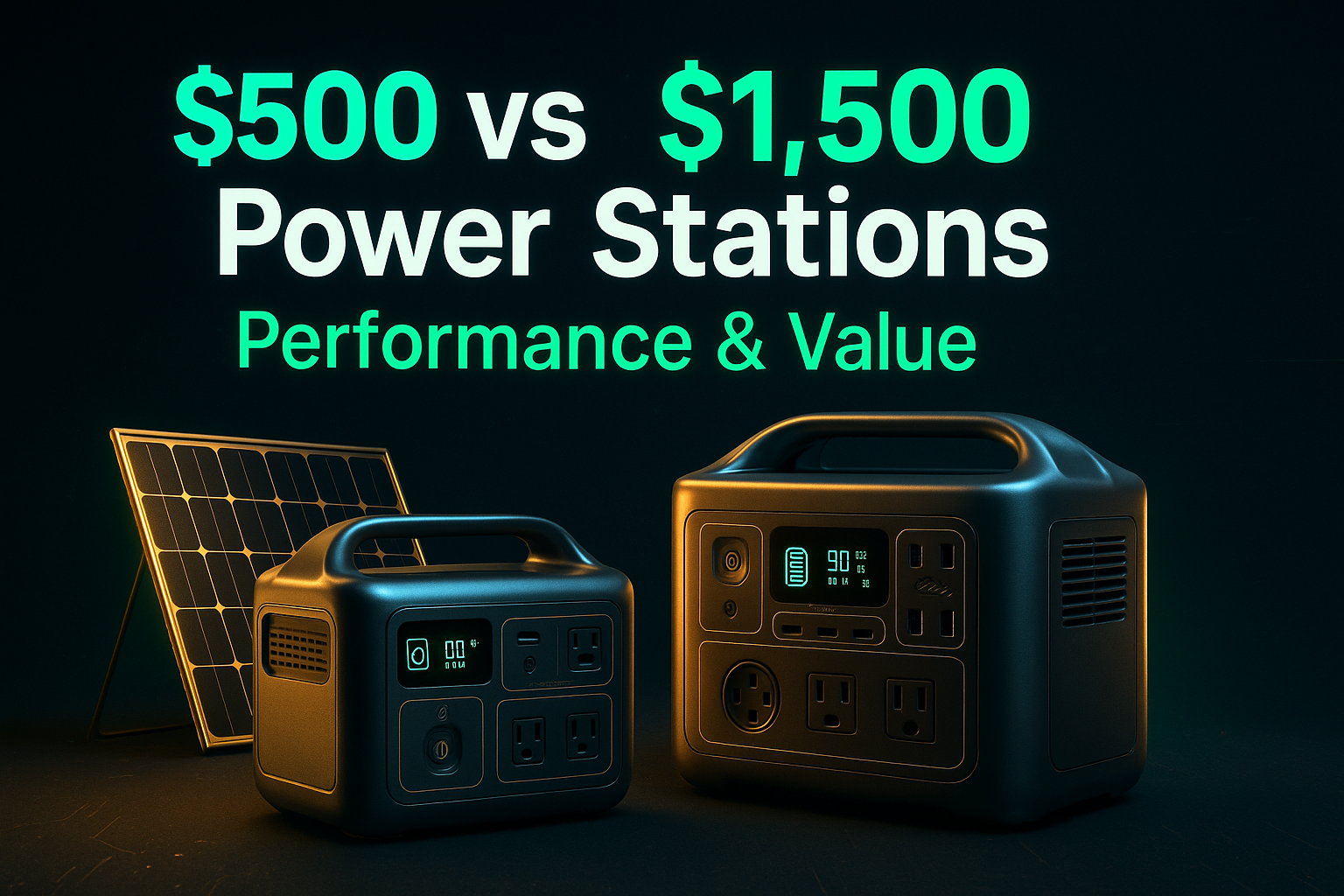
Portable Power Stations: A New Era of Compact Energy Systems
Portable power stations aren’t just backup batteries anymore—they’re becoming compact energy systems competing with traditional grid reliability.
On paper, the difference between a $500 unit and a $1,500 model looks obvious: better build quality, higher capacity, and more stable output. But once you move past marketing specs and push these machines under real load—compressors, surge-heavy tools, and sustained high draw—the gap becomes far less predictable.
Because in energy systems, price doesn’t always scale with performance.
Some mid-range units deliver surprising stability under stress, while premium models prioritize refinement, noise reduction, and safety margins over raw output efficiency.
So the real question isn’t just which one is better.
It’s this:
When you actually stress these systems like a real user—or even a mining or AI operator—which one truly delivers the best performance per dollar?
Hardware Overview: Specifications and Design
All tested units use LiFePO₄ chemistry, which is crucial. Compared to standard lithium-ion, LiFePO₄ offers:
This matters significantly when energy systems are cycled daily, as in mining or AI training environments.
Below is a structured review of each major unit class tested.
Segway 2,200W – Budget Strength
Price: ~$499
Capacity: ~1,000Wh
Output: 2,200W continuous
Recharge time: ~1.2 hours
Weight: ~36 lbs
Noise: ~59 dB
Under steady 1,400W load, voltage remained stable near 120V. During surge testing with a 33-gallon compressor, it successfully handled startup plus additional lighting loads, though voltage dipped to around 108–110V temporarily.
For the price, the performance-to-dollar ratio is impressive. It isn’t silent, but it is structurally solid.
Opus 2,000W – Fast Charging Focus
Price: ~$550
Capacity: ~1,000Wh
Surge rating: up to 4,500W
0–80% recharge: ~35 minutes
Noise: ~67 dB
While impressive on paper, especially regarding charging speed, surge performance proved weaker. Voltage dropped sharply during compressor startup, and under dual-load conditions, it shut down protection circuits.
Fast charging is valuable — but only if output stability holds under real loads.
Dabson 2,200W – Capacity Advantage
Price: ~$600
Capacity: ~2,000Wh
Boost mode: ~3,200W
Cycles: 4,000+
Noise: ~57 dB
This unit stands out because it offers double the storage capacity compared to most competitors at nearly the same price.
It handled compressor startup with two additional halogen loads at roughly 2,500W draw while maintaining voltage near nominal 120V. Only extreme overload caused shutdown.
In cost-per-Wh terms, this was one of the strongest performers.
EcoFlow 1,800W – Quiet Operator
Price: ~$700
Capacity: ~1,000Wh
Output: 1,800W
Solar input: ~500W
Noise: ~38 dB (quietest)
EcoFlow excelled in acoustic performance. For indoor environments or offices, this matters.
However, when pushed near maximum load, voltage dropped below 100V during compressor startup. It technically succeeded in some tests, but the margin was thin.
Best suited for moderate loads, not aggressive surge tools.
Bluetti 1,800W – Compact but Limited Surge
Price: ~$799
Capacity: ~1,000Wh
Surge: ~3,600W
Weight: ~25 lbs
Noise: ~48 dB
Lightweight and compact, but struggled with high startup currents. It failed to start the compressor even without additional loads.
For electronics and lighter devices, fine. For motor-driven equipment, less reliable.
DJI Power 2,600W – Strong but Protective
Price: ~$799
Capacity: ~1,000Wh
Recharge 0–80%: ~37 minutes
UPS switching: ~10 ms
Noise: ~55 dB
Strong surge handling and accurate watt reporting. It powered compressor plus lighting but triggered protective shutdown after sustained high draw.
This suggests aggressive internal safety logic — not necessarily weakness, but conservative design.
Anker 2,000W – Lightweight with Measurement Drift
Price: ~$799
Capacity: ~1,000Wh
Surge: ~3,000W
Noise: very low
Under load, output deviation was noticeably higher compared to external meters. Surge handling was moderate, but overload occurred under dual heavy loads.
Cycle life claims are solid (4,000 cycles to 80%), but surge tolerance is average.
Grecel 2,200W – High Ports, Lower Voltage
Price: ~$800
Capacity: ~1,100Wh
Surge: ~4,800W peak
Noise: ~63 dB
Handled moderate surge loads but baseline voltage hovered near 110V — lower than ideal under heavy stress.
Acceptable for general use, but not premium stability.
Jackery 2,200W – Premium Price, Solid Stability
Price: ~$1,500
Capacity: ~2,000Wh
Surge: ~4,400W
0–80% charge: ~65 minutes
Noise: ~45 dB
One of the quietest and most stable units. Large capacity, balanced output, and strong build quality.
However, in real-world surge testing, performance was comparable to units costing $600–$700.
You’re paying for brand positioning and refined engineering — not necessarily double the output value.
What Do These Results Mean Technically?
Three performance factors matter most:
• Cost per Wh (real energy value)
• Noise & cooling efficiency (indoor usability)
Fan design strongly impacts usability in enclosed environments. For indoor compute labs, noise matters.
Renewable Energy Integration
Most of these units support solar charging between 400W and 500W.
For investors building hybrid systems:
Larger systems scale linearly — but these devices remain backup tools, not full off-grid solutions.
While these units are not replacements for industrial battery banks, they can serve as:
-
Emergency redundancy modules
-
Peak shaving buffers
-
Small off-grid test nodes
Implications for ASIC Mining and AI Compute
Let’s be realistic.
These power stations cannot run a 3,000W ASIC miner continuously for meaningful production. However, they have strategic roles:
• Handling power spikes in GPU farms
• Testing small solar mining setups
• Supporting low-power edge AI nodes
At ASICMINING360, we focus on identifying alternative energy strategies to reduce electricity costs in mining farms and AI model training centers, while increasing operational margins. Portable LiFePO₄ stations represent a modular stepping stone — not a full solution, but part of a layered energy strategy.
For serious operations, the scalable approach includes:
• Large-scale solar integration
• Energy arbitrage contracts
• Cooling optimization (immersion / airflow)
Portable units simply illustrate performance benchmarks at smaller scale.
| Brand / Model | Price (USD) | Battery (Wh) | Rated Output (W) | Peak / Surge (W) | Weight (lb) | Noise (dB) @ ~1,450W | UPS / EPS Switching | Solar Input (W) | Real-World Compressor Test | Pros (Quick) | Cons (Quick) | Rating (1–5) |
|---|---|---|---|---|---|---|---|---|---|---|---|---|
| Segway Best Budget Power | $499 | 1,024 | 2,200 | — | 35.9 | 58.9 | Not stated | Not stated | Pass: Compressor + 1 light + 2 lights (voltage dip) | Strong surge handling, good meter accuracy | Heavier, noticeable fan noise, voltage drop under heavy surge | ★★★★★ |
| Opus | $549 | 1,024 | 2,000 | 4,500 | 27.8 | 67.4 | < 20 ms (claimed) | AC+Solar (claimed) | Mixed: Struggled; failed with 2 lights + compressor | Very fast charging claims, lighter | Loudest fan, voltage sag, limited surge performance in practice | ★★★★★ |
| Dabson Best Value per Wh | $599 | 2,048 | 2,200 | 3,300 (boost) | ~40 | 56.8 | < 15 ms (claimed) | Not stated | Pass: Compressor + 1 light + 2 lights; failed at extreme overload | Double capacity, strong surge, decent noise | Heavy | ★★★★★ |
| EcoFlow | $699 | 1,024 | 1,800 | — | 26.5 | 37.8 | Not stated | Up to 500 (stated) | Borderline: Started compressor but voltage dipped < 100V | Quietest by far, fast charging | Near max load struggles; voltage drop under motor surge | ★★★★★ |
| Bluetti | $799 | 1,024 | 1,800 | 3,600 | ~25 | 48.1 | Not stated | Not stated | Fail: Could not start compressor (even without light) | Compact, light, quiet-ish | Weak real surge handling vs compressor | ★★★★★ |
| DJI Power | $799 | 1,024 | 2,600 | — | 31.2 | 55.7 | 10 ms (claimed) | Not stated | Pass/Mixed: Started with 1 light; with 2 lights ran briefly then shut down | High output, accurate watt reading, UPS-capable | Protection triggers under sustained heavy load | ★★★★★ |
| Anker | $799 | ~1,024 | 2,000 | 3,000 | ~25 | ~17 (reported) | Not stated | Not stated | Mixed: 1 light + compressor OK; overloaded with 2 lights | Lightweight, very quiet, good cycle-life claim | Largest watt-meter deviation; overload under heavier combos | ★★★★★ |
| Grecel | $800 | 1,126 | 2,200 | 4,800 | 34.9 | 63.4 | 20 ms (claimed) | Not stated | Pass: Started compressor with 1 light | Good port selection, decent surge result | Loud; voltage around ~110V under load | ★★★★★ |
| Jackery Premium | $1,499 | 2,042 | 2,200 | 4,400 | 39.1 | 45.4 | Not stated | Not stated | Compressor results not fully shown in source excerpt | Quiet, stable output, large capacity | Very expensive vs similar-performing mid-range units | ★★★★★ |
Rating method: 5 = best overall value/performance (surge + voltage stability + capacity/price + noise), 3 = average, 1–2 = major real-world limitations in surge tests. Values shown match the source where stated; entries marked “Not stated” were not specified in the source text.
Final Verdict: $500 vs $1,500 — Where the Real Value Lies
At the end of the day, this isn’t a simple budget vs premium comparison.
It’s a reality check.
Because once you strip away branding, marketing claims, and polished design, one thing becomes clear:
👉 Performance doesn’t scale linearly with price. Some $500–$600 units delivered real-world results that came dangerously close to $1,500 systems—especially in surge handling and usable output under load.
But here’s the nuance most people miss:
You’re not paying $1,500 for raw power.
You’re paying for:
- Stability margins
- Quieter operation
- Better thermal management
- More refined engineering
And for some users, that matters. For others, it doesn’t.
If your goal is maximum value per watt-hour, mid-range units are the clear winner. If your goal is predictability, silence, and long-term reliability, premium units justify their price.
For mining and AI operators, the takeaway is even sharper:
These systems are not about replacing your power infrastructure. They’re about understanding how energy behaves under stress.
Because in the end, the smartest investment isn’t the most expensive system. It’s the one that delivers stable power, at the lowest cost per real-world output.
FAQ
Q1: Can a portable power station run an ASIC miner?
Most 1,000Wh units cannot sustain high-power ASIC miners for long. They may run low-power models briefly but are not long-term mining solutions.
Q2: Are LiFePO₄ batteries better for mining environments?
Yes. They offer longer lifespan, better thermal stability, and safer cycling compared to standard lithium-ion.
Q3: Is solar charging practical for these systems?
Yes, for partial support or emergency backup. For full-scale mining, larger dedicated battery banks are required.
Q4: What matters more: surge rating or continuous rating?
Continuous rating determines sustained operation. Surge rating only helps during startup spikes.
Q5: Can these units reduce electricity costs?
Indirectly. They can support hybrid setups, peak shaving, and renewable integration, but cannot replace industrial-scale energy systems.