The Changing Landscape of Technology and Energy
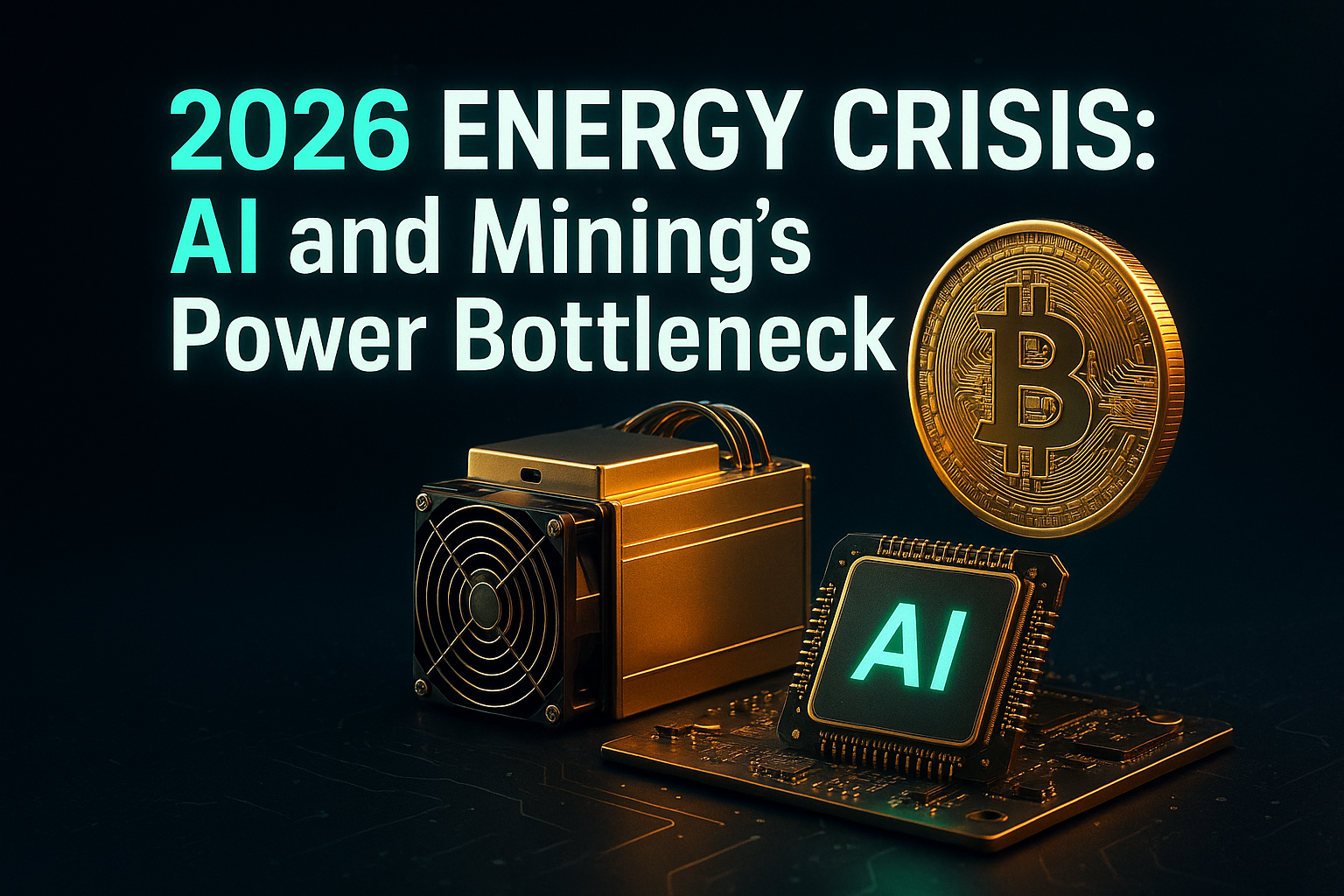
The story of technology's march forward has changed. It's no longer just about who has the best software; now, the real struggle is for the fundamental components that power everything. In 2026, we are no longer debating whether an energy crisis is possible; we are witnessing its opening chapters. The unprecedented demand for electricity is no longer theoretical. What once seemed like a distant infrastructure challenge is now becoming a defining constraint for the next phase of digital growth. While some warnings may sound dramatic, the underlying physics of our current infrastructure suggest this is less a distant threat and more an emerging operational reality.
As a practitioner who has spent years managing high-density ASIC deployments and navigating the volatile economics of GPU clusters, I can confirm that the "energy exhaustion" Musk describes is already felt on the front lines. The unprecedented demand for electricity isn't just coming from the usual suspects like domestic heating or industrial manufacturing. It is being driven by a twin-engine of computational hunger: the relentless scaling of Large Language Models (LLMs) and the hardening of decentralized blockchain networks.
⚡ Key Reality Check: The global energy crisis of 2026 is no longer a future risk — it is already reshaping AI, ASIC mining, and data center economics. The biggest bottleneck is no longer chip supply, but access to stable electricity. In the coming years, the winners in AI and digital infrastructure will not simply be those with the best hardware, but those who control reliable power, cooling, and grid resilience.
Recent warnings from Elon Musk have added urgency to this debate. Speaking at the 2026 World Economic Forum in Davos, Musk said that electricity availability — not chip production — may become the primary bottleneck for AI expansion in the coming years. His remarks reflect a broader concern now shared across the AI, mining, and energy sectors: digital growth is accelerating faster than grid infrastructure can adapt.
Why Data Center Electricity Demand Is Surging in 2026: AI Infrastructure, Grid Stress, and Scaling Limits
The International Energy Agency (IEA) recently highlighted a staggering trend: global electricity consumption by data centers surged to 480 terawatt-hours in 2025, a 35% year-over-year increase. By 2026, the baseline has shifted even further. Data centers are no longer just "facilities"—they are gigawatt-scale industrial hubs that compete directly with municipalities for grid priority.
ASIC Mining Hardware in 2026: Why Better Efficiency Still Means Higher Total Power Demand
In the world of SHA-256 mining, the hardware has reached a point of extreme refinement, yet the net energy draw continues to climb. Current flagship units, like the Bitmain Antminer S21 Pro and the S21XP, deliver hashrates upwards of 234 to 270 TH/s. While their efficiency has improved to a remarkable 15 J/TH or less, the operational reality is sobering. A single high-performance unit now draws approximately 3,500 to 3,700 watts.
In 2026, a standard industrial-scale mining farm operating one million units represents a continuous load of roughly 3.6 gigawatts. When you factor in the "Project Colossus" scale of xAI's Tennessee data center—which alone requires one gigawatt—it becomes clear why the grid is buckling. We are seeing a transition where miners are no longer just looking for "cheap" power; they are seeking "available" power, often turning to behind-the-meter solutions or co-locating with stranded energy sources to avoid the instability of the public grid.
GPU Mining vs. AI Compute in 2026: Profitability, Power Costs, and Infrastructure Challenges
The GPU landscape has undergone a radical transformation. The "mining" of cryptocurrencies with GPUs has largely been eclipsed by the "mining" of intelligence. High-end clusters of Nvidia H100s and B200s are the new gold mines. For the investor, the trade-off is clear: AI compute offers more stable, contract-based revenue, but the capital expenditure (CapEx) for the required cooling and networking infrastructure is significantly higher than a traditional GPU mining rig.
| Infrastructure Type | Revenue Stability | Power Demand | Cooling Complexity | Best Use Case |
|---|---|---|---|---|
| ASIC Mining | Medium | High | Moderate | Bitcoin / SHA-256 mining |
| GPU Mining | Low to Medium | Medium | Moderate | Altcoins / flexible workloads |
| AI Compute Clusters | High | Very High | Very High | LLMs / inference / AI cloud |
The Heat Wall: Why Cooling is the New Bottleneck
We’ve spent so much time worrying about where the power will come from that we’ve almost ignored the other side of the coin: what to do with the heat. By 2026, cooling has quietly become the "invisible wall" for AI expansion. If you’ve ever stood next to a rack of H100s or B200s, you know they aren’t just processors—they are essentially high-performance furnaces. We’ve reached the point where simply blowing cold air around isn’t just inefficient; it’s physically impossible to keep up with the demand.
The End of the "Fan" Era
For years, air cooling was the default because it was cheap and easy. But the thermal loads we are seeing today have pushed that tech to its breaking point. This is why we’re seeing a frantic shift toward liquid cooling and full immersion systems. It’s no longer a "pro" feature; it’s the only way to keep these chips from throttling or melting. The catch? Cooling isn’t free. It’s a resource-heavy cycle that demands its own massive share of power and—increasingly—staggering amounts of water.
The Hidden Resource War
This is where the environment and the infrastructure really clash. If you’re operating in a region prone to droughts or heatwaves, the "cooling challenge" can actually be more brutal than the search for electricity. You can have all the megawatts in the world, but if the local utility cuts off your water or the ambient temperature stays too high for your heat exchangers to function, your hardware is effectively useless.
The 2026 Strategy: Thermal Alpha
The winners in this next phase of the AI cycle aren't just the ones who signed the biggest power contracts. The real competitive advantage now belongs to those who master thermal efficiency. Future success depends on being climate-resilient—using closed-loop systems or heat recovery to ensure that when you plug in your machines, you can actually keep them running. In 2026, securing your power is only step one; step two is making sure you don't burn out.
Best Energy-First Investment Strategy for Bitcoin Mining and AI Infrastructure in 2026
Why Grid Access Matters More Than Hardware in Bitcoin Mining and AI Infrastructure in 2026
If there is one lesson we’ve all learned heading into 2026, it’s this: the era of "plug and play" is dead. Whether you’re a hobbyist or managing a massive fund, the mindset has to shift. We used to obsess over the latest hardware specs, but today, that’s secondary. The real game is energy. In this environment, your hardware is only as good as the electricity powering it. Without a rock-solid energy strategy, you aren't an investor—you’re just someone owning a very expensive collection of paperweights.
1. Efficiency isn't a Choice—It’s Survival
We need to stop looking at hashrate as a trophy. The only number that matters at the end of the day is your hashprice. We’re operating in a world of volatile grids and shifting costs, which means the margin for error has disappeared.
When you look at machines like the Antminer S21 or the WhatsMiner M60, don't just see them as "fast." See them as insurance. Picking up older, "budget" gear might feel like a win on day one, but those machines are basically "zombies"—they look alive, but the moment electricity prices spike, they start eating your capital. In 2026, if your efficiency isn't elite (sub-20 J/TH), you’re effectively betting against the house.
2. The Great Migration to AI
There is a fundamental shift happening right under our feet. The smartest players in the space—names like Iren and Hut 8—have realized that their data centers are capable of much more than just crunching hashes for tokens. They are becoming the landlords of the digital age by pivoting toward AI compute infrastructure.
For us, this is a breath of fresh air. Instead of riding the emotional rollercoaster of crypto prices every morning, this pivot allows us to lean on contracted, predictable revenue. You’re no longer just speculating on a coin; you’re providing the literal "brain power" for the next industrial revolution. It’s a move from high-stakes gambling to building the utility of the future.
3. Taking the Reins: Why Self-Custody is Non-Negotiable
As the industry scales up and centralizes around these massive energy hubs, the systemic risks grow with it. We’ve seen it before: exchanges go down, grids fail, or platforms freeze. In a world where everything is becoming more "corporate" and "centralized," your personal security has to go the other way.
Self-custody isn't just a philosophical choice anymore; it’s a business necessity. Using a hardware wallet to hold your own keys is the only way to ensure that your wealth remains yours, regardless of what happens at the data center or on the trading floor. At the end of the day, resilience starts with you. If you don't own your keys, you don't own your future.
Which Energy Solution Can Sustain AI Data Centers in the Long Term: Space-Based Compute or Small Modular Reactors (SMRs)?
Elon Musk’s proposed solution—moving computation into space via a constellation of one million small satellites—is as provocative as it is problematic. The logic is enticing: 24/7 solar exposure and "free" radiative cooling. However, from a practical engineering perspective, several hurdles remain:
-
Latency: For real-time AI inference and blockchain synchronization, the milliseconds of delay in satellite-to-ground communication are a significant bottleneck.
-
Space Debris: The European Space Agency (ESA) has rightly warned that such a massive deployment could trigger a Kessler Syndrome scenario, where a single collision creates a cloud of debris that renders low-Earth orbit (LEO) unusable.
-
The Nuclear Alternative: Many experts, including Dr. Leandra Cho of MIT, argue that Small Modular Reactors (SMRs) are a more grounded solution. SMRs offer 24/7 baseload power with a small footprint, allowing data centers to operate "off-grid" without the astronomical launch costs of a space-based system.
The Future of AI, Bitcoin Mining, and Energy Infrastructure: Who Will Win the Power Race?
The "countdown" Elon Musk describes is not a doomsday prophecy, but a call for industrial evolution. The reality of 2026 is that the digital economy has outpaced the physical infrastructure designed to support it. As an investor or a practitioner, your success depends on your ability to adapt to this new scarcity.
The era of "plug-and-play" mining in your garage is effectively over in advanced markets due to soaring residential electricity rates and grid constraints. The future belongs to those who can integrate vertically—owning the energy source, the cooling technology (increasingly liquid or immersion-based), and the most efficient silicon available. Whether the solution lies in the stars or in modular nuclear reactors on Earth, one truth remains: the most valuable commodity in the next decade will not be the data itself, but the power required to process it.