
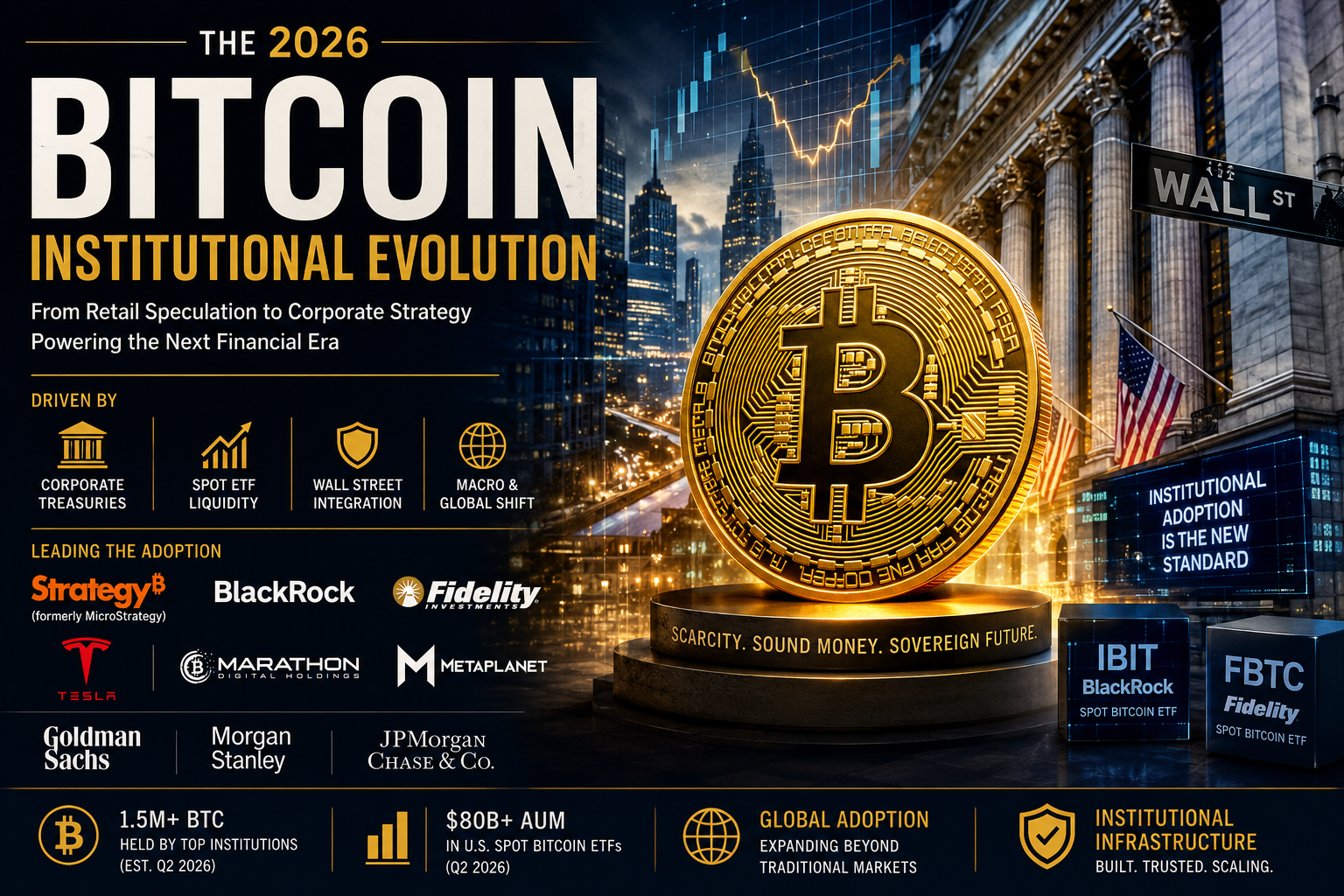
Introduction: How Institutional Bitcoin Adoption Is Transforming the Market in 2026
The narrative surrounding Bitcoin has undergone a fundamental metamorphosis. We have moved far beyond the era of retail-driven volatility and into a period defined by the strategic boardrooms of Wall Street and the balance sheets of Nasdaq-listed giants.
By 2026, "conviction" is no longer just a buzzword for individual enthusiasts; it has evolved into formal corporate mandates managed by firms overseeing trillions of dollars in assets. This transformation marks the moment Bitcoin effectively cemented its role within the bedrock of the global financial architecture.
Top Institutional Bitcoin Holders in 2026: Corporate Treasury & ETF Ownership Rankings
The following data maps the current landscape of institutional dominance. It highlights the primary entities that have moved from the sidelines to the center of the "Digital Gold" ecosystem, providing a clear view of who currently holds the keys to market liquidity.
| Institution | Category | Strategic Role | Major Milestone | Estimated Holdings (BTC) |
|---|---|---|---|---|
| MicroStrategy | Treasury | Primary Reserve Asset | Aug 2020: First Purchase | 712,000+ |
| BlackRock | Asset Management | Institutional Gateway (IBIT) | Jan 2024: ETF Approval | 775,000+ |
| Fidelity | Financial Services | Custodian & ETF Provider | Jan 2024: FBTC Launch | 200,000+ |
| Tesla | Automotive/Tech | Long-term Strategic Hold | Feb 2021: $1.5B Purchase | 11,500+ |
| Metaplanet | Investment | Asia's Strategic Reserve | Apr 2024: Adoption Policy | 35,000+ |
| MARA Holdings | Mining | HODL Production Strategy | 2021: Full Retention | 53,000+ |
| Block (Square) | Fintech | Infrastructure Development | Oct 2020: Treasury Shift | 8,700+ |
| Goldman Sachs | Investment Banking | Derivative Trading Desk | May 2021: Trading Activation | Indirect Exposure |
| Morgan Stanley | Investment Banking | Wealth Management Access | Aug 2024: ETF Brokerage | Portfolio Allocator |
| JPMorgan Chase | Investment Banking | Collateral & Settlement | 2025: Institutional Custody | Operational Asset |
Critical Data Insights: Identifying the Leaders of the New Financial Order
-
MicroStrategy’s continued accumulation has made it the largest public corporate holder of Bitcoin, positioning BTC as a long-term treasury reserve rather than a short-term investment.
-
BlackRock as the "Vault of Wall Street": As of early 2026, the IBIT fund has emerged as the most liquid Bitcoin vehicle in history, serving as the essential gateway for institutional capital.
-
The Great Banking Pivot: Perhaps the most significant shift is found in the behavior of Goldman Sachs and JPMorgan Chase. These institutions have transitioned from public skepticism to deep technical integration, utilizing Bitcoin within their collateral systems for institutional-grade lending.
Key Institutional Bitcoin Investments in 2025–2026: Corporate & ETF Strategy Analysis
The tail end of 2025 was characterized by aggressive positioning. These actions weren't merely "trades" but long-term structural shifts intended to hedge against traditional fiat instability and tap into the scarcity of the Bitcoin network.
| Company | Strategic Action (Late 2025) | Confidence Level |
|---|---|---|
| BlackRock | Integrated BTC into Global Allocation Funds & Pension models | Institutional Standard |
| MicroStrategy | Issued multi-billion dollar convertible notes for aggressive accumulation | Absolute Adoption |
| Microsoft | Formal assessment of BTC as a treasury diversifier (Post-vote) | Strategic Interest |
| MARA Holdings | Adopted "Full HODL" policy for 100% of mined Bitcoin | High Conviction |
| Tether | Allocated 15% of monthly net profits to direct BTC purchases | Sustainable Buyer |
| Metaplanet | Massive debt-to-Bitcoin swap to hedge against Yen volatility | Aggressive Hedge |
Bitcoin Institutional Adoption Outlook: Risks, Opportunities & Future Market Trends
As we enter mid-2026, a striking paradox defines the market. Despite the unprecedented level of institutional trust—with giants like BlackRock and Fidelity collectively managing over 1.5 million BTC—the price action has not yet fully reflected this fundamental strength.
While the scarcity created by firms like MicroStrategy (holding over 712,000 BTC) would logically suggest a price floor well above the $120,000 milestone, external macro factors have introduced a layer of hyper-caution.
The "Price Glitch" and the Flight to Physical Safety
The current global economic climate is heavily influenced by the aggressive trade policies and customs duty hikes of the U.S. administration. This has sparked:
-
Fear of Systemic Collapse: Concerns over runaway inflation and global financial instability.
-
The "Panic Hedge": A temporary retreat by central banks toward the historical safety of Gold and Silver to mitigate the risks of dollar instability and potential international sanctions.
Final Outlook: Bitcoin remains the Digital Gold of the future, currently navigating a landscape of "Physical Safety" competition. However, with JPMorgan and Goldman Sachs now using the asset for settlement and collateral, the infrastructure is more robust than ever. Once the shock of current geopolitical shifts stabilizes, the massive capital floor established by Wall Street suggests that the climb toward $120,000 is not a matter of if, but a matter of "when."
Bitcoin Institutional Adoption FAQ: Corporate Treasury, Spot ETFs, Liquidity & Price Outlook
Q1: If Wall Street is buying so much Bitcoin, why hasn't the price skyrocketed past $120k yet?
It feels like a bit of a tug-of-war right now. On one side, you have massive institutional buying drying up the supply. On the other, the global trade wars and new tariff policies in 2026 have made the market jumpy. Big money is currently hedging—splitting their bets between the digital future (Bitcoin) and "old-school safety" (Gold) until the geopolitical dust settles.
Q2: How can we tell Bitcoin is actually becoming a "normal" part of corporate money management?
It’s honestly in the 'boring' details. A few years ago, a company buying Bitcoin was a wild, front-page headline. Today, it’s becoming just another line item on a CFO’s spreadsheet, sitting right next to cash and bonds. The real giveaway isn't just a tweet from a billionaire; it's the fact that auditors, tax professionals, and insurance companies now have standard 'playbooks' for it. When the accountants stop panicking and start treating it like a regular treasury asset, you know the transition from 'experiment' to 'standard practice' is complete.
Q3: I thought big banks like JPMorgan were skeptics—what changed?
In short: They followed the money. Once the ETFs became a hit in 2024, the Big Banks realized they couldn't stay on the sidelines while their clients moved billions into BlackRock and Fidelity. By 2026, they stopped fighting the asset and started building the plumbing for it. Now, they see it as a high-tech tool for collateral and instant settlements.
Q4: Should I be worried about central banks rushing back to Gold and Silver?
Not necessarily. It’s more of a safety first reflex. Gold is the world’s oldest insurance policy, so when trade tensions spike, central banks grab the physical stuff. However, this doesn't replace Bitcoin; it just highlights the global hunger for assets that governments can't print. Bitcoin is essentially doing what Gold does, but at the speed of the internet—institutional investors know this, which is why they aren't selling.
📊 Methodology & Data Variation Note
Differences between reported Bitcoin holdings across sources (e.g., 775,000 BTC vs 810,000 BTC) arise from reporting cycles and dataset methodology differences.
These variations are driven by ETF inflows/outflows, custodial aggregation methods, and time-lag between data updates.
Therefore, figures should be interpreted as time-stamped cross-source data snapshots rather than fixed absolute values.
Source
MicroStrategy / Strategy — 818,334 BTC
Reuters: Link
BlackRock IBIT — 810,077 BTC
Bitbo Treasury Tracker: Link
MARA Holdings — 53,822 BTC
MARA Treasury Discussion: Link
BlackRock IBIT Official ETF Page
BlackRock Official: Link
Data compiled from corporate treasury disclosures, ETF filings, and institutional tracking platforms (Q1–Q2 2026).