Solo Mining Bitcoin vs. Bitcoin Cash
Solo mining Bitcoin has not disappeared; it has simply moved beyond the reach of most small miners.
What used to feel like a realistic experiment has turned into a game defined by massive scale. The network has grown, competition has intensified, and even efficient hardware barely shifts the odds. For home miners, the result is simple: the reward is huge, but the probability is almost negligible.
This is where Bitcoin Cash enters the conversation.
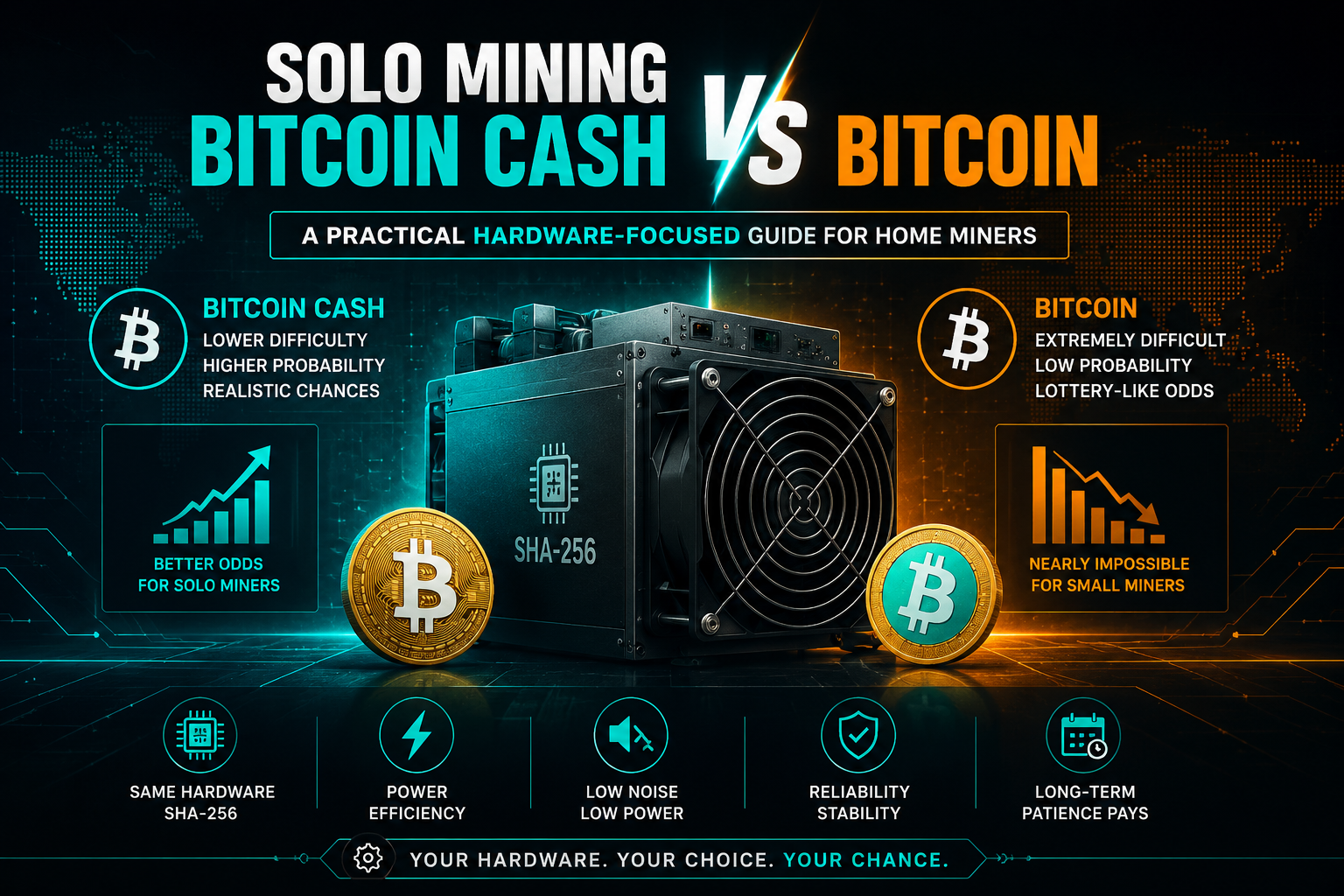
Because both networks use the same SHA-256 algorithm, your hardware does not change. What changes is the environment around it. Lower total hash rate and different network dynamics mean that solo mining moves from near-impossible to statistically plausible.
This guide looks at that shift from a practical, hardware-focused perspective. Instead of chasing theory, we will break down what actually matters: probability, power consumption, noise, reliability, and total cost of ownership.
Why Solo Mining Bitcoin Feels Like a Lottery
Let’s start with the uncomfortable truth: solo mining Bitcoin with small hardware is mostly about hope, not math.
Take a compact, efficient SHA-256 miner that delivers around 9–10 TH/s at roughly 200 W. These low-power devices are popular because they’re quiet, cheap to run, and friendly to home environments. But when you point something like that at the Bitcoin network, your odds of finding a block are measured in centuries, not months.
Yes, the reward is huge. A single Bitcoin block can be worth hundreds of thousands of dollars in USD terms. But the probability of actually hitting one with small hash rate is so low that, for most people, it’s closer to buying a scratch ticket every day than running a serious operation.
This is exactly why people call Bitcoin solo mining a lottery play. The upside is massive. The odds are not.
Why Bitcoin Cash Changes the Equation
Bitcoin Cash uses the same SHA-256 proof-of-work algorithm. Your ASIC doesn’t care whether it’s hashing for BTC or BCH—it just solves hashes. The difference is network difficulty and total hash rate.
On Bitcoin Cash, the total competition is much lower. That means:
- The block reward in USD is smaller.
- Your chance of finding a block is dramatically higher.
Instead of thinking in terms of “once every few hundred or thousand years,” you can start thinking in terms of years, or even months, depending on how much hash rate you run.
For many home miners, that shift—from “almost impossible” to “statistically plausible”—is the entire appeal.
A Quick Hardware Reality Check
Before getting excited, it helps to ground this in actual hardware categories. Here’s a simple comparison of typical SHA-256 mining setups people use for solo mining experiments:
| Miner Class | Typical Hashrate | Power (W) | Efficiency | Noise Level | Best Use Case |
|---|---|---|---|---|---|
| Low-power Hobby | 8–15 TH/s | 150–300 W | ~15–25 J/TH | 🤫 Very Quiet | Home / Desk / Solo |
| Mid-range ASIC | 50–100 TH/s | 2000–3000 W | ~25–40 J/TH | 📢 Loud | Garage / Small Farm |
| Modern High-end | 150–250 TH/s | 3000–3500 W | ~15–20 J/TH | 🔊 Very Loud | Industrial / Farm |
For Bitcoin solo mining, even the high-end ASIC category still faces terrible odds unless you’re running many units. For Bitcoin Cash, however, even the low-power or mid-range setups start to look statistically interesting over a multi-year horizon.
The Probability Trade-Off: Big Prize vs Realistic Wins
Here’s the core trade-off, and it’s important to be honest about it:
- Bitcoin: Enormous block reward, extremely low probability.
- Bitcoin Cash: Much smaller block reward, but far higher probability.
From a hardware owner’s point of view, this changes how you think about ROI and risk. With Bitcoin, solo mining is mostly about the dream of a massive payout. With Bitcoin Cash, solo mining starts to look more like a slow, probabilistic grind where you might actually hit something in a timeframe that matters.
For example, a small cluster of efficient miners totaling a few dozen terahash might have:
- Essentially no realistic chance on Bitcoin within a human lifetime.
- A reasonable statistical chance of hitting a Bitcoin Cash block every couple of years.
That doesn’t mean it’s guaranteed. It doesn’t mean it’s profitable in a strict business sense. But it does mean the outcome moves from “pure fantasy” to “low-probability but plausible.”
Where Efficiency and Power Costs Really Matter
This is where hardware choices become critical.
Low-power, efficient miners shine in this kind of solo mining experiment because:
- They cost very little to run month to month.
- They’re quiet and easy to live with.
- Their total cost of ownership stays manageable even if you wait years for a hit.
Running a 200–300 W device for two years is a very different financial commitment than running a 3 kW industrial ASIC for the same time. The second option might give you better odds, but it can also destroy your power bill and erase any joy from the experiment.
From a practical standpoint, many hobbyists prefer stacking multiple small, efficient units instead of one loud, power-hungry monster. The combined hash rate improves your odds, while the risk stays spread out and manageable.
A Short History: What Bitcoin Cash Actually Is
Bitcoin Cash exists because of a long-running disagreement inside the Bitcoin community about how to scale.
Bitcoin’s block size is limited, which caps how many transactions fit into each block. As usage grew, the network became congested and transaction fees rose. Some people believed Bitcoin should stay conservative and move scaling solutions off-chain. Others argued the protocol itself should change to allow bigger blocks and more on-chain transactions.
In 2017, that disagreement ended in a split. Bitcoin Cash increased the block size and positioned itself as a more transaction-focused, peer-to-peer electronic cash system, while Bitcoin continued evolving in the direction of “digital gold,” later adding solutions like SegWit and the Lightning Network.
For miners, the important part is simple: Bitcoin Cash is still SHA-256, still proof-of-work, and still mined with the same ASIC hardware.
Setting Up Solo Mining Bitcoin Cash (The Practical View)
From a hardware perspective, the setup is refreshingly straightforward:
- Choose a solo mining pool or solo gateway that supports Bitcoin Cash.
- Point your ASIC’s stratum settings to that server.
- Use a Bitcoin Cash wallet address as your username.
- Let the miner run and monitor its status.
Most modern and even older ASICs make this a five-minute configuration change. The real “work” isn’t in the setup—it’s in patience and expectation management.
You’ll want to watch:
- Your reported hash rate (to confirm the miner is performing as expected).
- Hardware stability (cheap power supplies and overheating kill long-term experiments).
- Power consumption over time (this is where total cost of ownership sneaks up on you).
Hardware Reliability and the Long Game
Solo mining Bitcoin Cash is not a sprint. It’s a long, boring, sometimes frustrating waiting game. That makes hardware reliability more important than peak performance.
In practice, this means:
- Favor stable, cool-running miners over overclocked, unstable setups.
- Keep dust and heat under control.
- Accept that efficiency often beats raw speed for long-term solo experiments.
A miner that runs quietly for two years without intervention is often more valuable than one that squeezes out 10% more hash rate but crashes every few weeks.
Is This “Better” Than Pool Mining?
From a purely financial perspective, pool mining is more predictable. You get small, regular payouts. Solo mining is volatile by design: long periods of nothing, followed by a big win—or nothing at all.
The reason people choose solo mining Bitcoin Cash is not because it’s safer. It’s because:
- The odds feel human-scale, not cosmic.
- The hardware investment can stay modest.
- The experiment is actually fun in a way Bitcoin solo mining often isn’t anymore.
Think of it less like a business and more like a long-term hardware bet with a realistic shot at paying off.
Conclusion: A Realistic Path for Solo Miners
Solo mining Bitcoin Cash will not guarantee profit, and it will not turn a small setup into instant wealth. What it offers instead is something far more valuable for most home miners: a realistic chance.
Bitcoin has grown into a network where scale dominates everything. Without massive hash rate, solo mining becomes an exercise in patience with almost no statistical reward. Bitcoin Cash shifts that balance. The reward is smaller, but the probability is real enough to matter.
From a hardware perspective, the strategy is clear. Focus on efficiency, control your power costs, and prioritize stability over aggressive tuning. Let’s be real: a miner that hums along quietly and stays consistent for years is worth ten times more than a 'beast' that hits peak speeds only to choke the moment the heat is on.
In the end, this is not about chasing the biggest payout. It is about choosing a setup where your hardware, your costs, and your expectations actually align.
Because solo mining is no longer about dreaming big. It is about playing a game you can realistically win.
Bitcoin wasn’t built for small solo miners anymore. Bitcoin Cash still is.
FAQ
Q1: Can I use the same ASIC miner for Bitcoin and Bitcoin Cash?
Yes. Both use SHA-256, so the same ASIC hardware works for both networks. You just change the pool and settings.
Q2: Is solo mining Bitcoin Cash profitable?
It’s not predictable like pool mining. It’s a probabilistic bet. You might hit a block and get a nice payout, or you might not. Efficiency and power cost matter a lot.
Q3: Are low-power miners actually useful for this?
They can be, especially for long-term experiments. Their low running costs and quiet operation make them ideal for patient solo mining setups.
Q4: How long does it usually take to find a block?
There is no guarantee. Depending on your total hash rate, it could be months, years, or never. Statistics only describe averages, not promises.
Q5: Is it better to run one big ASIC or several small ones?
From a home miner’s perspective, multiple small, efficient units often make more sense. They’re easier to manage, cheaper to run, and quieter.
Q6: Do I need a special wallet for Bitcoin Cash?
You need a wallet that supports Bitcoin Cash addresses. Many exchanges and standalone wallets do, but cold storage is recommended for long-term security.
Q7: What’s the biggest risk in solo mining Bitcoin Cash?
The biggest risk is simple: you might never hit a block, and your only “return” will be the experience and the electricity bill. That’s why managing costs and expectations is crucial.