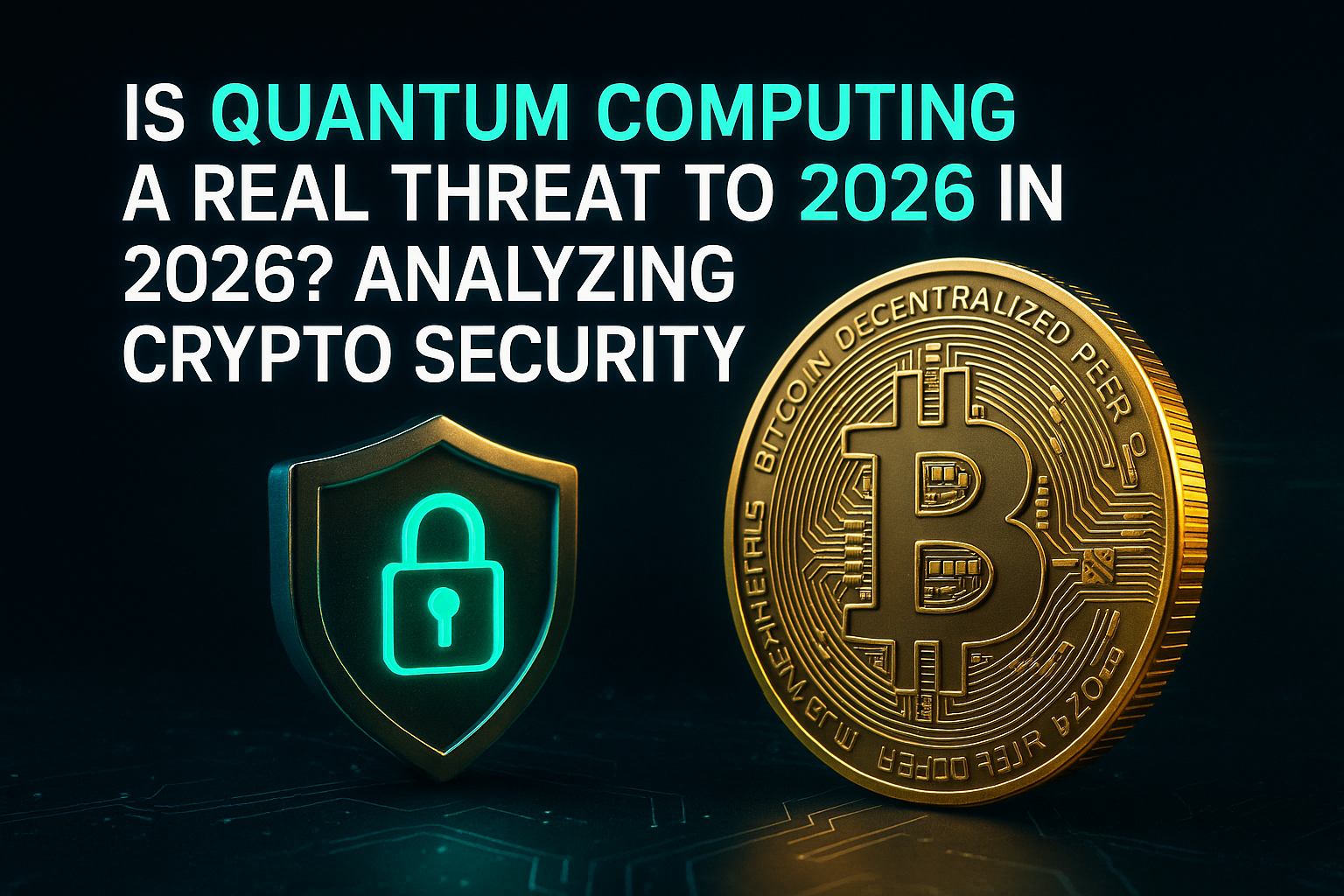
Is Quantum Computing a Real Threat to Bitcoin in 2026? Analyzing Crypto Security Risks and Future Market Strategies
There is a growing concern among experts about the threat of quantum computing to the world of cryptocurrencies. This could easily affect your knowledge of crypto security. It is a topic that requires a closer look to fully understand the implications for the current status of blockchain technology.
In the traditional world of computing, bits are simply 0 or 1. Quantum computers function in a different manner; they use qubits. A qubit is a bit that can be a 0 or a 1 at the same time. This technology has the potential to solve complex mathematical equations, such as the cryptographic challenges that secure blockchains. It could also do this millions of times faster than our current best supercomputers.
Looking forward to 2026, Bitcoin is still growing in popularity with the general public, financial institutions, and even governments. There is a question that needs to be answered: Has the gradual development of the Bitcoin protocol become a threat to its very existence? In other words, has the decentralization of Bitcoin, which was always its greatest strength, somehow become a weakness that prevents it from adapting to changing market conditions?
Why Jefferies’ Christopher Wood is Swapping Bitcoin for Gold: The Impact of Quantum Computing Fears on Institutional Portfolios
Christopher Wood, the Global Head of Equity Strategy at Jefferies, has decided to exclude Bitcoin from his investment portfolio, according to a report by Bloomberg. Jefferies is one of the first institutions to invest in crypto. He cited the rapid development of quantum computing as the primary reason for this move, as the potential for it to break encryption could jeopardize the very concept of Bitcoin as a safe haven for your money.
He has allocated the 10% portion of his portfolio that was in Bitcoin equally to physical gold and gold mining stocks, as he prefers assets that have a long history.
Quantum Computing vs. Bitcoin Network Security: Evaluating the Risk of Cryptographic Breaches and Market Overreaction
Is this a case of sound technological fear or a market overreaction?
From a logical perspective, when quantum computing develops enough to break high-level encryption, Bitcoin will not be the only one that suffers. This will impact the entire banking system, satellite communications, and security databases of nations worldwide. These are assets that are far more valuable than a blockchain. Moreover, there is no economic point in breaching a network that will instantly become worthless once it is breached. This is a "strategic" or "political" attack that could happen.
The Bitcoin network could always develop "Quantum-Resistant" protocols. However, the problem lies in the fact that it is a decentralized network. This means that it is slow to respond to threats. Some schools of thought believe that Bitcoin is currently underestimating the threat posed by quantum computing and needs to pick up the pace before a crisis arises.
If institutional investment managers become convinced of this threat, it will undoubtedly reduce the global Risk Appetite for Bitcoin. However, the on-the-ground reality reveals a different story. By late 2025, Bitcoin had won the unprecedented trust of behemoths such as BlackRock.
Companies like BlackRock are not known for making emotional bets. If they believed Bitcoin could realistically become obsolete within a few years, institutional exposure would probably look very different today.
The 2026 Bitcoin Identity Crisis: Comparing BTC as a Digital Safe Haven, Payment Network, and Speculative Asset
Bitcoin is presently going through an "identity crisis." If the plan is to use the technology of blockchain for worldwide money transfers, Stablecoins are more efficient. If the plan is to hold on to value, gold and silver performed better than Bitcoin during the tough times of late last year.
As a result, Bitcoin could not fulfill its intended role as a "safe haven" asset during those particular times of market turbulence.
The Reality Check: Why Your Mining Rig Isn't Obsolete Just Yet
Let’s cut through the noise: when people talk about quantum threats, they often overlook the sheer resilience of mining hardware. There’s a massive difference between cracking a digital signature and hijacking the entire hashing infrastructure. Machines like the Antminer S23 or those high-end Hydro-cooled setups are built for one thing only: SHA-256 hashing. And as it turns out, hashing is a much tougher nut for early quantum computers to crack than standard wallet encryption.
What does this mean for you? While the software side of Bitcoin will eventually need to pivot to Post-Quantum cryptography, the physical layer—your hardware—is remarkably sturdy. If you’re a miner or an investor, take a breath; your mining fleet is likely the most secure part of the entire ecosystem. It’s not just a set of machines; it’s a foundational anchor that’s built to withstand the first waves of quantum disruption.
Final Verdict: Is the Quantum Computing Threat to Bitcoin a Technical Reality or a Strategic Market Narrative?
A few years ago, quantum computing sounded like something reserved for research labs and sci-fi movies. In 2026, it feels different. Governments, tech giants, and cybersecurity experts are now taking the idea seriously enough that Bitcoin investors can no longer ignore it completely. But the idea that Bitcoin could suddenly collapse overnight because of a quantum breakthrough is still far from reality.
The bigger danger may actually come from fear itself. Markets react long before technology fully arrives. If institutional investors begin viewing Bitcoin as technologically vulnerable, sentiment could shift rapidly, even if the real-world threat remains years away.
At the same time, Bitcoin has survived countless “existential threats” over the past decade: government bans, exchange collapses, mining crackdowns, and repeated predictions of failure. Yet the network continues to evolve because its survival depends on adaptation.
The real question is no longer whether quantum computing is coming. It is whether Bitcoin can upgrade fast enough before fear becomes more dangerous than the technology itself.
It is always a good practice to remember the words of Warren Buffett regarding money-related issues:
"Never bet against America."