
INTRODUCTION
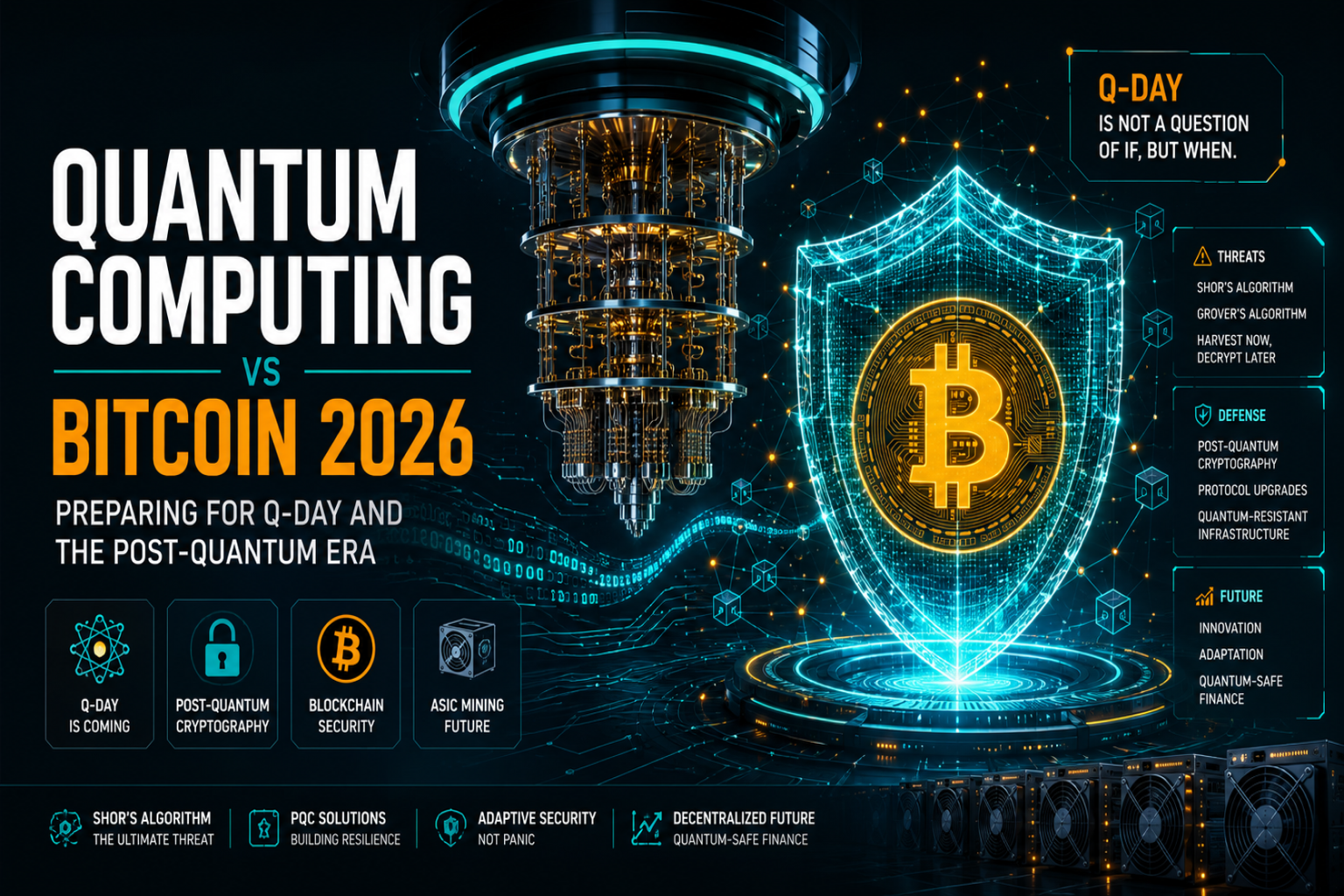
As we move further into 2026, the collision between high-performance computing and cryptography is finally reaching a breaking point. The idea of "Q-Day"—that looming moment when quantum computers could theoretically crack our strongest encryption—is no longer just a "what if" for academics. It has officially entered the boardroom as a genuine strategic concern.
Take a look at Saxo Bank’s "Outrageous Predictions" for this year. They’ve highlighted how fault-tolerant quantum systems could essentially rewrite the rules of financial security, potentially shaking the very foundation of digital trust. For those of us in the ASIC mining and cold storage space, the narrative has shifted: it’s no longer about if this will happen, but how we prepare for the "when."
While it's easy to get caught up in the doomsday headlines, the reality is more grounded. We are looking at a complex balancing act—where new, high-tech risks are being met with an equally fast evolution in cryptographic standards. It's a high-stakes transition, but it’s one we are actively building for.
How Quantum Computing Works: From Classical Bits to Qubits
The real change is moving from bits to qubits. Our ASIC miners are really good at SHA-256 hashes, working with classical physics. Quantum computers, though, use superposition and entanglement to process information much faster than anything we've seen. In late 2024, Google’s "Willow" chip set a benchmark by executing tasks in under five minutes that would theoretically occupy a classical supercomputer for 10^25 years. For a miner, this speed is the ultimate "hashrate" advantage threatening the very foundations of the cryptographic puzzles we solve daily. Major players like IBM and Microsoft are locked in an arms race to stabilize these systems while sovereign powers—most notably China—are investing billions in clandestine facilities to secure a "quantum first" advantage.
Quantum Threats to Bitcoin and Blockchain: Real Risks vs Media Hype
The primary concern for the cryptocurrency sector revolves around Shor’s Algorithm—a mathematical framework that enables sufficiently powerful quantum computers to factor large prime numbers, effectively breaking Elliptic Curve Cryptography (ECC). Since Bitcoin and many other blockchains rely on ECC to derive public keys from private keys, the vulnerability is clear: a quantum attacker could theoretically reverse a public address to obtain its private key and drain the associated funds.
However, from a practitioner's perspective, the popular "End of Crypto" narrative overlooks several critical mitigating factors:
- The Lack of Incentive for Total Destruction: Bitcoin’s value is rooted in decentralization and market trust. If a state actor were to successfully break the Bitcoin network using quantum capabilities, the asset’s value would collapse instantly. The attacker would be left holding a compromised and effectively worthless ledger, turning a multi-billion-dollar technological investment into a financial loss.
-
Strategic Quantum Deterrence: Similar to the nuclear standoff of the 20th century, quantum capabilities may function more as a deterrent than an active weapon. If multiple global powers—such as the United States and China—possess comparable quantum advantages, the rational strategy shifts toward maintaining "Quantum Neutrality" rather than triggering a systemic financial collapse that would harm all parties involved.
-
The "Harvest Now, Decrypt Later" Threat: The most immediate risk is not necessarily future blockchain transactions, but present-day encrypted data. Intelligence agencies are already collecting and storing sensitive communications, with the intention of decrypting them once quantum capabilities mature. This is precisely why the transition toward Post-Quantum Cryptography (PQC) is already underway in the 2026 security landscape.
Technical Breakdown: The Seven Pillars of Quantum Cryptanalysis and Attack Vectors
| ID | Attack Type | Technical Impact |
|---|---|---|
| Q-01 | Shor’s Algorithm | Breaks RSA and DH encryption by efficiently factoring large integers and solving discrete logarithms. |
| Q-02 | ECC Cracking | Targets Bitcoin wallets and TLS handshakes by solving the Elliptic Curve Discrete Logarithm Problem. |
| Q-03 | Grover’s Algorithm | Provides a quadratic speedup for brute-force attacks, effectively halving the security bits of symmetric keys (e.g., AES). |
| Q-04 | Signature Forgery | Extracts private keys from public keys to forge digital signatures and hijack digital identities. |
| Q-05 | Retrospective Decryption | Enables "Harvest Now, Decrypt Later" strategies against current encrypted traffic stored by adversaries. |
| Q-06 | Protocol Vulnerability | Identifies deep architectural flaws in national defense and secure government communication infrastructure. |
| Q-07 | Auth Spoofing | Compromises multi-factor authentication (MFA) and hardware security modules (HSMs) through quantum-aided analysis. |
Practitioner’s Strategy: Quantum-Resistant Security, Mining Infrastructure, and Portfolio Protection
For investors and miners looking to future-proof their operations in 2026, the strategy should be one of adaptive security rather than panic.
- Cold Storage Evolution: Traditional hardware wallets are robust, but the industry is moving toward "Quantum-Resistant" cold storage. Ensure your wallet provider has a roadmap for PQC updates.
- Asset Diversification: While Bitcoin remains the "digital gold," maintaining a portion of wealth in physical gold remains a prudent hedge against the short-term volatility that Q-Day headlines will inevitably cause.
- Mining Infrastructure: Modern ASIC manufacturers are already investigating how quantum-resistant hashing (like Lamport signatures or Winternitz OTS) might change the hardware requirements for the next generation of mining rigs.
The Post-Quantum Transition: From Digital Doomsday to Quantum-Safe Finance
The idea of a "Digital Doomsday" is less about one sudden event and more about a transition period. The defense against quantum threats needs to keep pace as quantum computing becomes more common. Blockchain's decentralized design allows "soft forks" and protocol improvements, enabling the network to implement quantum-resistant algorithms. While the risks to national security—such as the exposure of nuclear submarine locations or missile silo coordinates—are grave, the threat to the decentralized economy is manageable through collective innovation. The idea of "Quantum-Safe" finance is gaining traction, largely driven by human ingenuity and advances in cryptography. This helps us ensure that even powerful quantum computers won't compromise the systems we use for decentralized financial transactions.
FAQ: Quantum Computing, Q-Day, and the Future of Crypto Mining
Q1: What is Q-Day in cryptography and why does it matter for Bitcoin?
Q-Day refers to the moment when a quantum computer becomes powerful enough to break widely used encryption methods like RSA and ECC. For Bitcoin, this matters because its security model relies on elliptic curve cryptography to protect private keys. If ECC were broken at scale, exposed public keys could theoretically be reversed to reveal private keys.
Q2: Can quantum computers break Bitcoin today?
No. As of 2026, there is no fault-tolerant, large-scale quantum computer capable of breaking Bitcoin’s cryptographic foundations in real-world conditions. Current quantum systems remain experimental and limited in qubit stability and error correction.
Q3: How does Shor’s Algorithm threaten blockchain security?
Shor’s Algorithm allows a sufficiently powerful quantum computer to factor large prime numbers and solve discrete logarithm problems efficiently. This directly impacts RSA and ECC, which are foundational to blockchain address generation and digital signatures.
Q4: What is “Harvest Now, Decrypt Later” and should crypto investors worry?
“Harvest Now, Decrypt Later” refers to the strategy of collecting encrypted data today and storing it until quantum computers can decrypt it in the future. While this is a serious concern for military and financial communications, most blockchain transactions are public, and mitigation efforts through Post-Quantum Cryptography (PQC) are already underway.
Q5: Will quantum computing make ASIC mining obsolete?
Not in the short to medium term. Quantum computers are not optimized for SHA-256 hashing in the same way ASIC miners are. Even if Grover’s Algorithm provides a quadratic speedup for brute-force search, practical implementation at scale remains highly complex and resource-intensive.
Q6: What is Post-Quantum Cryptography (PQC)?
Post-Quantum Cryptography refers to cryptographic algorithms designed to resist attacks from both classical and quantum computers. Blockchain networks can adopt PQC through protocol upgrades or soft forks, ensuring long-term resilience.
Q7: How should crypto miners and investors prepare for a post-quantum world?
Preparation involves monitoring protocol upgrades, choosing wallet providers with quantum-resistance roadmaps, diversifying assets, and staying informed about developments in quantum hardware. Adaptive security—not panic—is the most rational strategy in the 2026 landscape.
Q8: Is quantum computing an existential threat to decentralized finance?
Quantum computing represents a significant technological shift, but not necessarily an existential threat. Decentralized systems can evolve through community-driven upgrades. With proactive implementation of quantum-resistant cryptography, the decentralized economy can remain secure even in a post-quantum era.