INTRODUCTION
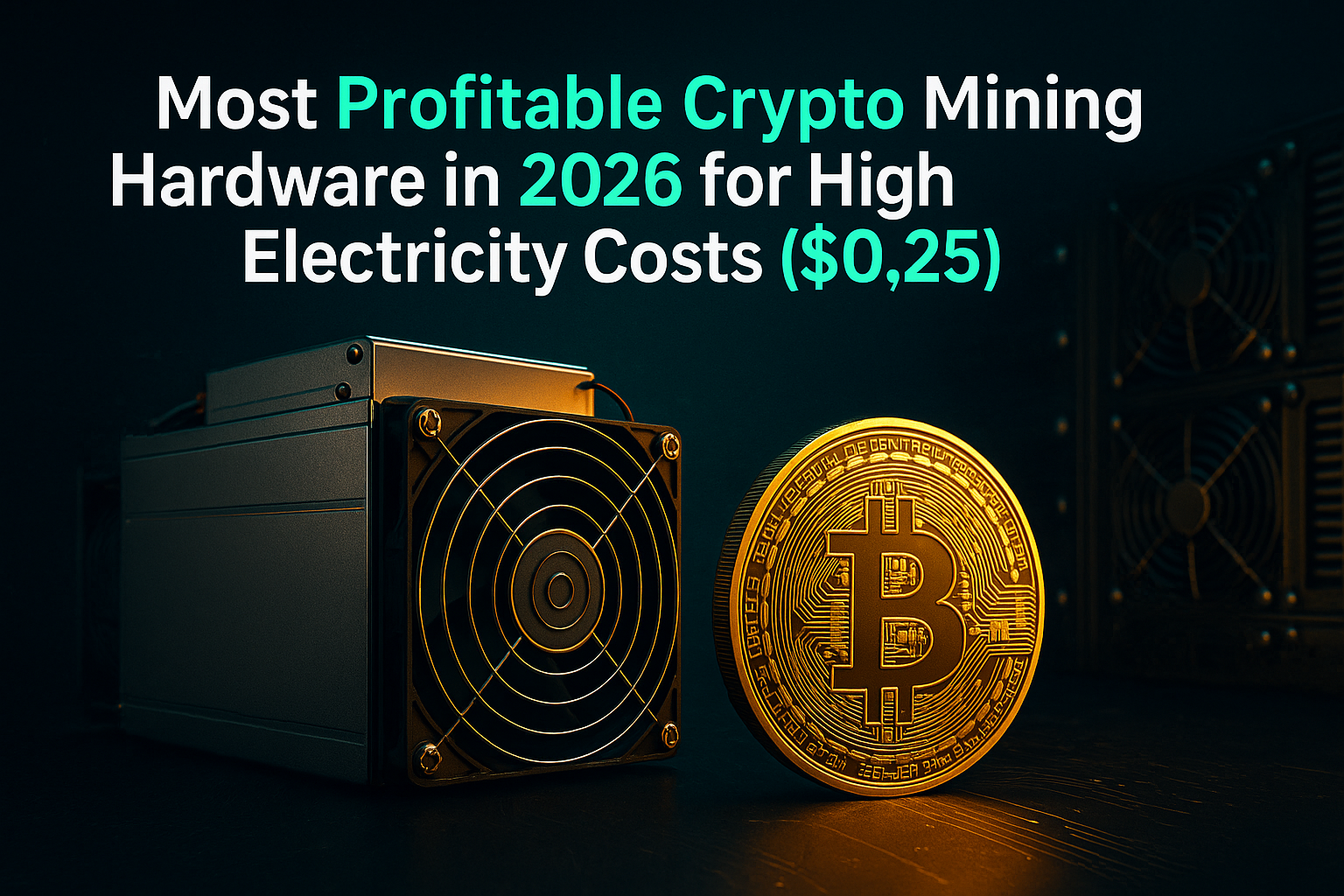
In light of the global rise in electricity costs over recent years—particularly in Europe—and the decline in Bitcoin prices during late 2025 and early 2026, the mining landscape has shifted dramatically. Although the cost of mining hardware has soared, with the latest Bitcoin miners exceeding $25,000, they have reached record-breaking efficiency levels. The newest models have achieved an efficiency of 9.5 J/Th.
Despite this incredible efficiency, achieving daily profits or a return on investment (ROI) is nearly impossible in countries with high electricity rates. For instance, using the S23 Hyd 3U—the undisputed best miner of 2026—at an electricity price of $0.165/kWh, the daily profit drops to zero (the break-even point). Given that the average electricity price in Europe is approximately $0.25/kWh, profitable Bitcoin mining is currently out of reach even with the industry's most efficient hardware. In this article, we present the top 4 most profitable coins and devices for electricity prices exceeding $0.25/kWh.
Top 4 Energy-Efficient ASIC Miners and Daily Profitability Analysis at $0.25/kWh Rates
| Device | Mined Coins | Daily Profit | ROI (Days) | Approx. Price |
|---|---|---|---|---|
| Bitmain Antminer Z15 Pro (840kh) | Zcash, Hush, Komodo | $28 | 135 Days | $3,800 |
| Pinecone Matches INIBOX (850Mh) | InitVerse | $23 | 130 Days | $3,400 |
| BitMain Antminer X9 (1Mh) | Monero, Zephyr | $12 | 240 Days | $2,900 |
Deep Dive into Mining ROI: Profitability for Equihash, Privacy Coins, and ALEO Algorithms in 2026
Analysis:
- Bitmain Antminer Z15 Pro: Currently the top performer in profitability for coins using the Equihash algorithm.
- Pinecone Matches INIBOX: This hardware is aligning with InitVerse, a project seeing early adoption and showing a fast return on investment.
- BitMain Antminer X9: Primarily designed to mine Monero and Zephyr. While the ROI can take longer, it remains a stable option for those interested in privacy-focused coins.
- IceRiver ALEO AE3: Mining ALEO at this power rate yields a modest $4 daily. While recovering the $5,800 investment is difficult at $0.25/kWh, the ROI drops to 1.5 years in regions with cheaper electricity.
-
✅ Focus on high-efficiency ASICs
-
✅ Target low-competition algorithms
-
✅ Monitor electricity costs weekly
-
❌ Avoid outdated high-power miners
-
❌ Ignore temporary hype-driven ROI
Final Thoughts
In 2026, the mining industry is no longer about owning the biggest machine — it’s about surviving the electricity bill.
For miners paying over $0.25/kWh, chasing Bitcoin with traditional ASICs has become a battle that’s almost impossible to win. The real opportunity now lies in efficiency, niche algorithms, and less saturated networks where smart miners can still carve out profit while everyone else is fighting impossible margins.
The miners who survive this cycle will not necessarily be the ones with the largest farms, but the ones who adapt the fastest.
Electricity has become the true king of mining.
Note: Cryptocurrency prices fluctuate constantly. To get the most accurate data, please use the Profitability Calculator on our homepage. Simply enter your local electricity rate. If you are unsure of your costs, you can find a comprehensive list of rates by country and province on our Global Electricity Prices page.
Frequently Asked Questions: Navigating High-Cost Mining in 2026
Q1: Is Bitcoin mining completely "dead" for home miners in high-cost regions like Europe?
Not exactly "dead," but the math has definitely changed. If you’re paying $0.25/kWh, mining Bitcoin is currently a losing game because the electricity bill will consistently outweigh the BTC earned. In 2026, the smart move isn't to stop mining altogether, but to pivot. Transitioning to high-efficiency ASICs for Equihash or Privacy coins is the only way to stay in the green while waiting for energy prices to stabilize or BTC to hit a new all-time high.
Q2: Why do some miners show a fast ROI while others take years?
It comes down to a balance between Network Difficulty and Hardware Efficiency (J/Th). A device like the Z15 Pro thrives because the coins it mines (Zcash/Hush) aren't as "crowded" as the Bitcoin network. On the other hand, even a top-tier Bitcoin miner like the S23 Hyd struggles at high electricity rates because it’s competing with massive industrial farms in low-cost regions. If your power is expensive, efficiency is more important than raw hashrate.
Q3: Should I risk mining Privacy Coins like Monero or Zephyr right now?
Mining privacy-focused coins with an Antminer X9 is a strategic choice. While they might not offer "overnight riches," they provide a level of network stability that volatile new projects lack. In 2026, privacy is a growing commodity. If you’re looking for a steady, long-term play that resists the "boom and bust" cycle of meme-coins, privacy mining is a solid, albeit slower, path to ROI.
Q4: How often should I update my electricity rate in the Profitability Calculator?
In today’s market, at least once a month. Energy tariffs are more volatile in 2026 than they were five years ago. A small shift from $0.22 to $0.26 can be the difference between making a profit and paying to keep your house warm. Always use real-time data from your latest utility bill to ensure your break-even analysis stays accurate.