
Introduction
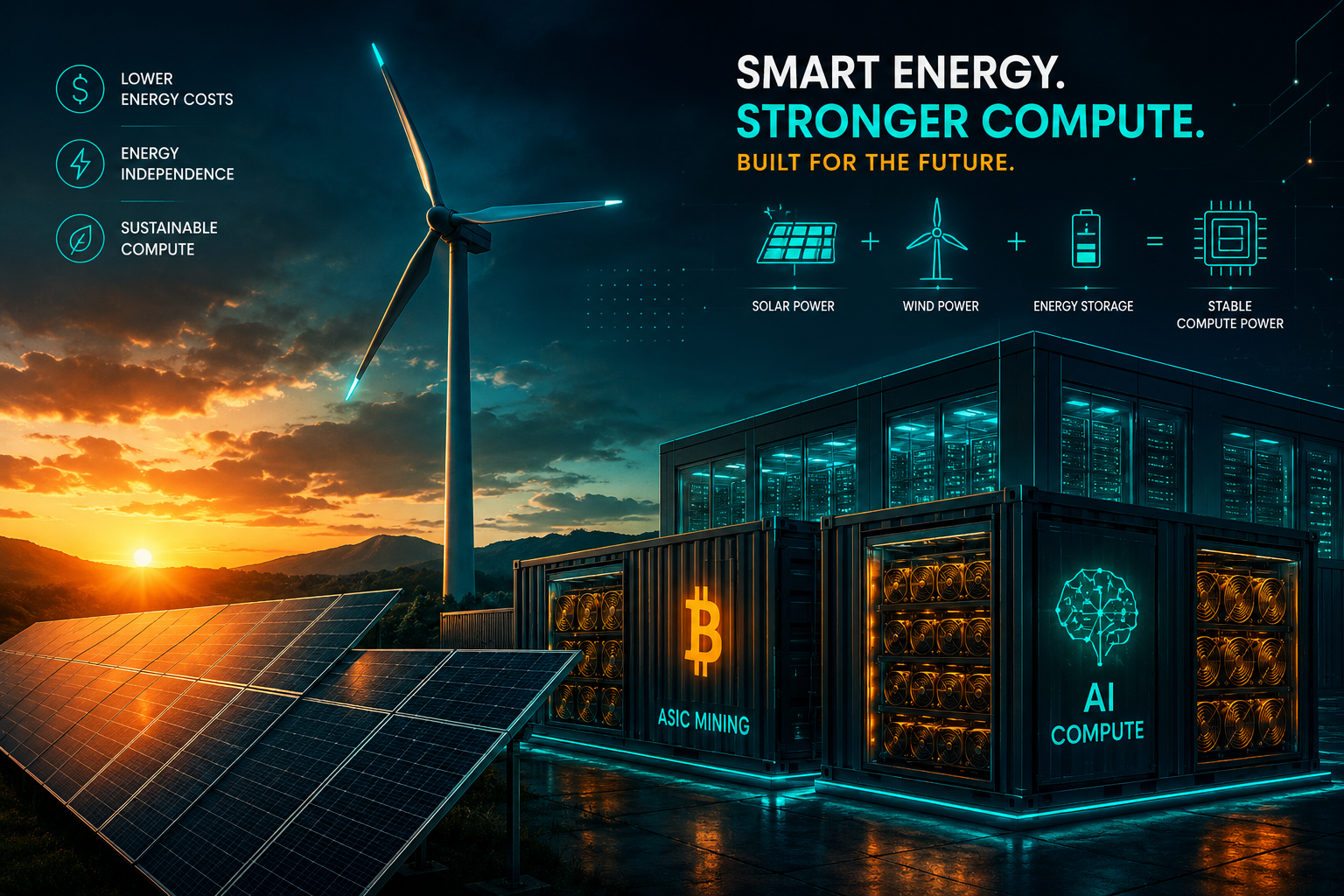
High-performance computing—whether for ASIC mining, GPU farms, or AI workloads—has one thing in common: it consumes a lot of electricity. Many operators already rely on solar panels to reduce operating costs and hedge against volatile energy prices. Once a solar system is running well, a natural question follows: can you boost generation by adding a wind turbine?
On paper, the idea looks perfect. Solar works best during the day and in summer. Wind, in many regions, is stronger at night and in winter. Together, they seem like a natural match. But when you move from theory to real-world installations, especially at small or medium scale, the picture becomes more complicated.
This article breaks down the technical, economic, and practical realities of combining solar and wind—specifically from the perspective of crypto mining and AI compute operations that care about uptime, cost per kilowatt-hour, and return on investment.
Why Solar and Wind Look Like a Perfect Pair
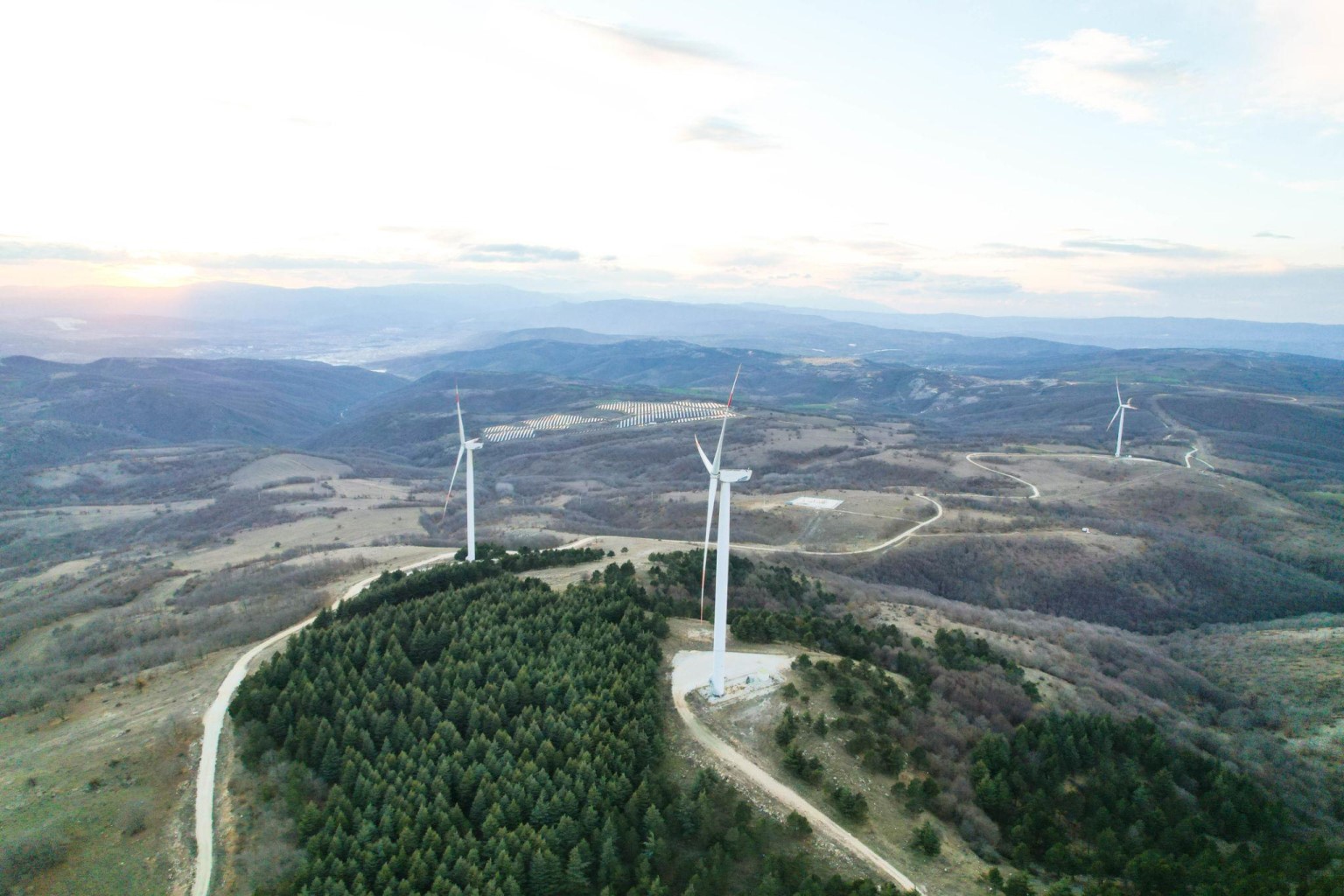
If you look at national power grids, many already rely on both sources. Solar output rises during daylight hours and peaks in summer. Wind, on the other hand, often blows more consistently through the night and tends to be stronger in winter. In northern latitudes, winter solar production drops sharply due to shorter days and lower sun angles—exactly when wind generation often improves.
From a systems perspective, this seasonal and daily complementarity is real. For data centers, mining farms, or even small home-based rigs, the idea of smoothing generation across the year is very attractive. Less dependence on the grid means more predictable energy costs and better resilience during price spikes or outages.
But grid-scale success does not automatically translate to small-scale, on-site wind turbines.
Setting a Realistic Energy Target
Let’s start with a simple example. Suppose you have a 5 kW solar array that produces around 5,000 kWh per year (a typical figure in many parts of Europe). For a small mining or AI setup, that might cover a portion of your load, but not all of it.
You might hope a small wind turbine could add, say, 2,000 kWh per year. Spread over a year, that equals about 5.5 kWh per day, or an average power of roughly 230 watts. Because the wind doesn’t blow all the time, the turbine would need a much higher rated power to hit that average—maybe 600 to 800 watts on paper.
This is where many people fall into the first trap: believing the nameplate rating on cheap turbines.
The Problem with “Cheap” Wind Turbines
Online marketplaces are full of small turbines advertised at 600 W, 800 W, or even more, often for just a few hundred dollars or pounds. Some are horizontal-axis designs with multiple blades, others are vertical-axis models marketed as “quiet” and “urban-friendly.”
In practice, these products almost never deliver anything close to their rated output. The advertised power usually assumes very high wind speeds that most residential locations rarely see. On top of that, build quality is often poor, leading to reliability issues after only months—or even weeks—of operation.
For a mining or AI operation that depends on stable, predictable power, unreliable generation is worse than no generation. You still need grid power or batteries to cover the gaps, so disappointing wind output directly hurts your economics.
How Wind Power Is Actually Calculated
To understand why small turbines underperform, you need to look at the physics.
The power available from wind depends mainly on:
- Swept area of the rotor (basically, how big the blades are)
- Wind speed
- Air density
- Turbine efficiency
When you combine these factors, you get a simplified relationship where power scales with the square of the rotor radius and the cube of the wind speed. In practical terms:
- Double the blade radius → about 4× more power
- Double the wind speed → about 8× more power
- Triple the wind speed → about 27× more power
This is why industrial wind turbines keep getting bigger and are placed in very windy locations, often offshore or on high ridges. Wind speed matters far more than most people expect.
Even a small difference—say, 3 m/s versus 6 m/s average wind speed—can mean the difference between a useless turbine and a productive one.
Height: The Most Underrated Factor
Wind near the ground is slowed down and made turbulent by buildings, trees, and terrain. The higher you go, the faster and cleaner the airflow becomes.
Using global wind data, you can see dramatic differences:
At 10 meters, many urban or suburban areas might only see around 3 m/s average wind speed.
At 50 meters, that might rise significantly.
At 100 meters, it can be better still.
Because power scales with the cube of wind speed, these differences are huge in terms of energy production.
In a built-up area, a small turbine at 10 meters might only produce a few hundred kWh per year—essentially irrelevant compared to a multi-megawatt-hour solar system or the consumption of even a small mining rig.
To reach something like 2,000 kWh per year, you typically need either:
- A much larger rotor, or
- A very tall mast (often 50–100 meters), or
- An exceptionally windy location (coastal, hilltop, open farmland).
Wind Turbine Output at Different Heights
| Turbine Height | Average Wind Speed | Average Power | Annual Generation |
|---|---|---|---|
| 10 m | 3.10 m/s | 20 W | 175 kWh |
| 50 m | 5.78 m/s | 131 W | 1,147 kWh |
| 100 m | 7.33 m/s | 268 W | 2,348 kWh |
None of these are easy or cheap in residential or light industrial settings.
Turbulence: The Silent Killer of Small Wind
Even if average wind speed looks decent on paper, turbulence can destroy real-world performance. Buildings and trees create chaotic airflow that small turbines struggle to handle. Turbulence reduces efficiency, increases mechanical stress, and can cut actual output to a fraction of theoretical estimates.
For reliable generation, you want clean, unobstructed airflow coming from a long distance—think open plains, ridgelines, or coastal areas. The middle of a housing estate or industrial park is usually one of the worst places you could choose.
Costs, Payback, and Maintenance Reality
Unlike solar panels, wind turbines have many moving parts: bearings, gears, brakes, yaw mechanisms, and more. That means:
- Regular inspections
- Lubrication
- Occasional part replacements
- Higher long-term maintenance costs
A common rule of thumb is 1–2% of the initial system cost per year in maintenance, sometimes more for small or poorly sited systems.
Then there’s the installation itself:
- Foundations
- Mast or tower
- Crane or lifting equipment
- Electrical integration
- Grid interconnection equipment
For a properly engineered small wind system, total costs can easily reach tens of thousands. At that point, payback periods of 15–20 years or more are not unusual—and that’s assuming your wind estimates were optimistic and everything works as planned.
For mining and AI compute, where hardware lifecycles are often 3–5 years, that kind of payback horizon is a serious red flag.
Planning, Noise, and Practical Constraints
Regulations vary by country and even by region, but wind turbines often face:
- Planning or zoning restrictions
- Height limits
- Setback requirements from neighbors
- Noise complaints
Unlike solar panels, turbines produce variable, tonal noise that can be more annoying than a constant background hum—especially at night. Roof-mounted systems can also transmit vibrations into the building structure, creating additional problems.
For professional compute operations, these non-technical risks matter. A system that looks good on paper but triggers legal or community issues can quickly become a liability.
What Makes More Sense for Miners and AI Operators?
In most cases, scaling solar + storage or optimizing grid contracts delivers better returns than adding small wind.
Here are more practical alternatives:
- More solar panels: Cheaper per kWh, predictable output, low maintenance.
- Battery storage: Improves self-consumption and allows load shifting for peak tariffs.
- Load scheduling: Run non-critical compute tasks when power is cheapest or solar output is highest.
- Colocation in energy-rich regions: Some mining and AI operators move workloads closer to cheap hydro, wind farms, or surplus renewable regions instead of generating on-site.
- Power purchase agreements (PPAs): Lock in long-term renewable energy prices without owning the hardware.
Large-scale wind absolutely makes sense—but small, on-site wind only works in very specific, windy, and open locations with enough space and budget to do it properly.
Conclusion
Solar and wind do complement each other beautifully at grid scale, and the physics behind it are sound. For mining and AI compute operators, however, small wind turbines are rarely the magic upgrade they appear to be.
Wind power is brutally sensitive to location, height, and wind speed. In most urban or semi-urban environments, a small turbine will produce very little energy relative to its cost and complexity. When you factor in maintenance, planning issues, and long payback periods, the economics often fall apart—especially compared to simply adding more solar or improving energy management.
If you have access to a truly windy, open site and the capital to build a proper tower with a serious turbine, wind can be a valuable part of a hybrid system. Otherwise, for most crypto mining and AI compute setups, solar, storage, and smart energy strategy remain the more reliable path to lower costs and higher efficiency.
FAQ
Q1: Is small wind ever worth it for mining or AI compute?
Yes, but only in locations with strong, consistent wind and enough space for a tall tower and a properly sized turbine. Most residential or urban sites are not suitable.
Q2: Why do cheap wind turbines underperform so badly?
They are rated at unrealistic wind speeds and often have poor aerodynamics and build quality. Real-world wind conditions rarely match their marketing claims.
Q3: How important is tower height for a wind turbine?
Extremely important. Wind speed increases with height, and because power scales with the cube of wind speed, even small increases in height can dramatically change output.
Q4: Is wind better than adding more solar panels?
In most cases, no. Solar is cheaper, more predictable, and easier to maintain. Wind only wins in very specific, windy locations.
Q5: What about combining wind, solar, and batteries?
At larger scales or in ideal locations, this can make sense. For most small and medium operators, solar + batteries usually delivers better returns.
Q6: Does turbulence really matter that much?
Yes. Turbulent air reduces efficiency and increases wear, often cutting real output far below theoretical estimates.
Q7: What’s the best strategy to reduce energy costs for compute-heavy workloads?
Focus on efficient hardware, smart load scheduling, scaling solar, using storage, negotiating better grid contracts, or relocating workloads to energy-rich regions.