
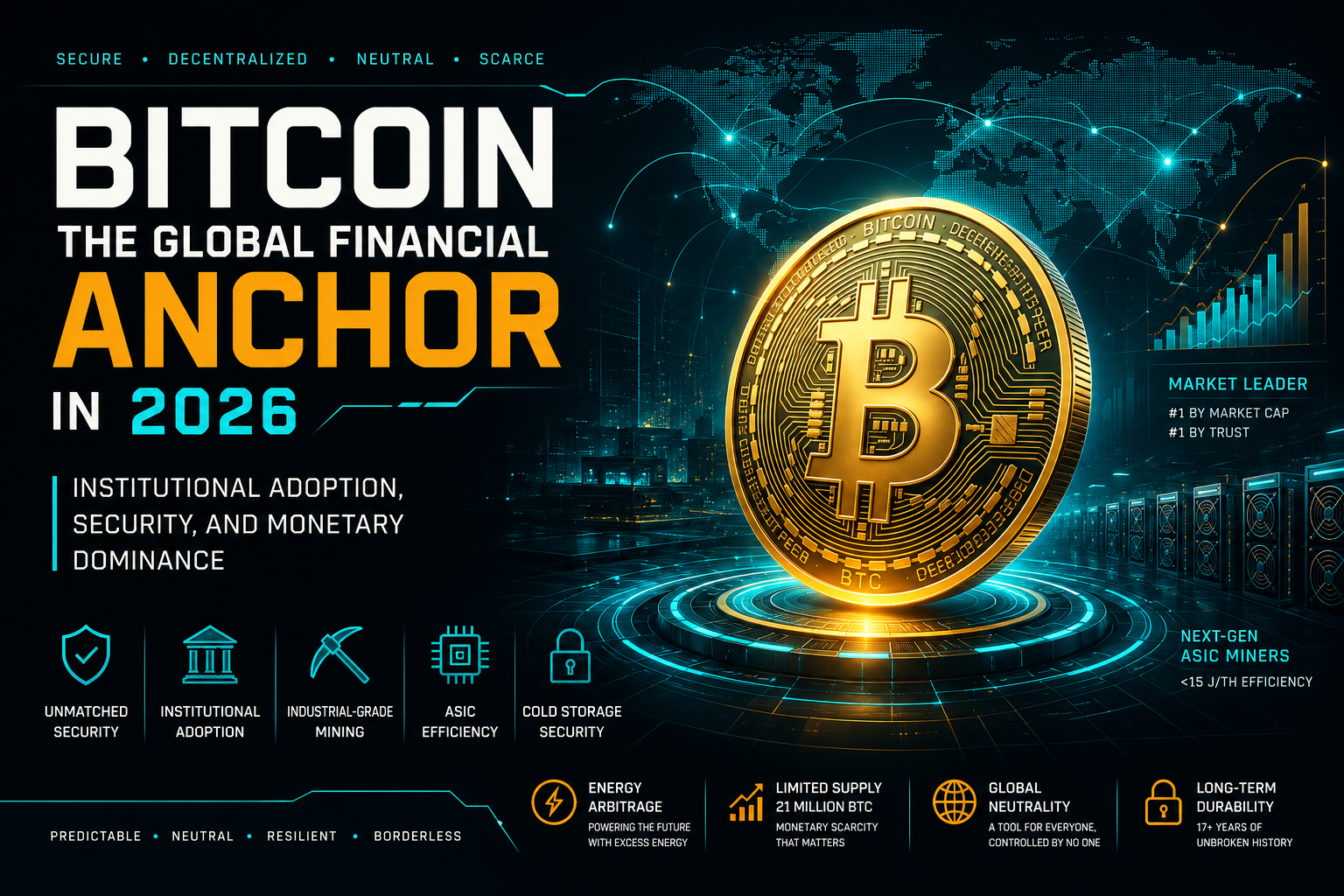
Bitcoin's Evolution in 2026
Bitcoin is no longer competing with other cryptocurrencies.
It is competing with the very foundation of global finance.
In 2026, the conversation has completely changed. This is no longer about faster blockchains or lower fees. It’s about one question:
Which system can you actually trust when everything else starts breaking?
While thousands of projects keep chasing performance and hype cycles, Bitcoin has taken a different path—quietly, almost stubbornly. It didn’t try to be the fastest. It didn’t try to be the most flexible. Instead, it optimized for one thing that global capital values above everything else: predictability.
And in a world shaped by uncertainty, predictability is not just a feature—it’s power.
Bitcoin’s Technical and Philosophical Moats: Security, Neutrality, and Decentralization
Bitcoin’s resilience is often misunderstood as technical stagnation. In reality, its "slowness" is a deliberate design choice that optimizes for security and decentralization over throughput.
The Schelling Point of Money: Why Bitcoin Is the Global Default Asset
In game theory, a Schelling Point is a solution that people tend to adopt in the absence of communication because it seems natural, special, or relevant. In the chaotic sea of 20,000+ tokens, Bitcoin is the universal default. Whether you are a central bank in the Global South or a hedge fund in New York, Bitcoin is the asset everyone assumes everyone else will hold.
The Lindy Effect in Action: Bitcoin’s Survival as a Competitive Advantage
The Lindy Effect suggests that for non-perishable things like ideas or technologies, the future life expectancy is proportional to the current age. Every day Bitcoin operates without a catastrophic failure, its perceived "half-life" doubles. By 2026, having survived nearly 17 years of state-level bans, exchange collapses, and internal forks, Bitcoin’s survival is its greatest technical feature.
Acephalous Neutrality: The Strategic Advantage of a Headless Network
One of Bitcoin’s most underrated technical strengths is the silence of Satoshi Nakamoto.
-
The Founder Trap: Modern protocols like Ethereum or Solana have visible leaders. If a founder takes a political stance or complies with a specific jurisdiction's pressure, the "neutrality" of that network is compromised.
-
The Sovereign Solution: Bitcoin is "acephalous" (headless). Because there is no CEO to subpoena or founder to influence, it remains a politically neutral tool. In a bifurcated global economy, this neutrality is the only way a digital asset can serve as a "Great Equalizer" between competing nations.
Bitcoin Mining in 2026: Energy Arbitrage, ASIC Efficiency, and Industrial-Scale Operations
Real-World Mining & Hardware Dynamics
In 2026, the mining sector has matured into a sophisticated energy-arbitrage industry. The days of "hobbyist" mining with a few rigs in a garage are largely over, replaced by institutional-grade deployments integrated with renewable energy grids.
ASIC Evolution and Mining Efficiency: Why Joules per Terahash (J/TH) Matters
ASIC Evolution: Efficiency is the Only Metric
We have reached a plateau in raw hashing power; the battle is now fought in Joules per Terahash (J/TH).
-
Hardware Status: Current-gen miners, like the latest air-cooled units hitting 260 TH/s and hydro-cooled systems exceeding 450 TH/s, are pushing efficiencies below 15 J/TH.
-
The Logic: In 2026, mining is no longer just about "making money"—it’s about capturing wasted energy. Modern miners act as a "first responder" for energy grids, consuming excess load from wind and solar farms that would otherwise be curtailed.
How to Invest in Bitcoin Infrastructure in 2026: ASICs, Hosting, and Cold Storage
Purchasing Guidance for 2026
For investors looking at the "physical" side of Bitcoin, the entry point has shifted:
-
For Institutional Investors: Focus on vertical integration. Owning the ASICs is not enough; you must control the energy source. Look for "behind-the-meter" opportunities.
-
For Individual Investors: Direct hardware ownership requires a managed hosting partner. Do not attempt to run 3000W machines in residential settings; the noise, heat, and electrical requirements are prohibitive.
-
Cold Storage is Non-Negotiable: With the rise of "AI-driven" phishing and sophisticated malware, hardware wallets (ColdCards, Trezors) combined with multi-signature setups are the minimum viable security standard.
Bitcoin Risk Factors in 2026: Regulation, Hashrate Centralization, and Market Misconceptions
Risk Considerations: The Reality Check
While the Lindy Effect provides confidence, it does not mean "zero risk."
-
Regulatory Chokepoints: While Bitcoin itself is neutral, the "on-ramps" (exchanges and banks) are not. Governments in 2026 continue to use KYC/AML frameworks to monitor the flow of fiat into the network.
-
Centralization of Hashrate: As mining becomes more industrial, the geographical concentration of hashrate in energy-rich regions remains a point of monitoring for network health.
-
The "Gold vs. Aluminum" Fallacy: Newer coins often market themselves as "Bitcoin 2.0" because they are faster. However, as the original article noted, replacing Bitcoin with a faster coin is like replacing gold with aluminum because aluminum is easier to shape. Speed is a feature; scarcity and immutability are the mission.
| Rank | Coin | Symbol | Market Cap | Price |
|---|---|---|---|---|
| 🥇 1 | Bitcoin | BTC | $1.5T | $75,000 |
| 🥈 2 | Ethereum | ETH | $350B | $3,000 |
| 🥉 3 | BNB | BNB | $120B | $700 |
| 4 | Tether | USDT | $85B | $1.00 |
| 5 | Cardano | ADA | $50B | $1.50 |
| 6 | Solana | SOL | $45B | $160 |
| 7 | Polygon | MATIC | $40B | $2.00 |
| 8 | Avalanche | AVAX | $35B | $85 |
| 9 | Ripple | XRP | $32B | $0.85 |
| 10 | Dogecoin | DOGE | $25B | $0.25 |
| 11 | Chainlink | LINK | $20B | $15 |
| 12 | Litecoin | LTC | $18B | $120 |
| 13 | Polkadot | DOT | $17B | $12 |
| 14 | Stellar | XLM | $15B | $0.35 |
| 15 | VeChain | VET | $14B | $0.12 |
| 16 | TRON | TRX | $13B | $0.065 |
| 17 | Algorand | ALGO | $12B | $0.75 |
| 18 | Cosmos | ATOM | $11B | $12 |
| 19 | Filecoin | FIL | $10B | $50 |
| 20 | Tezos | XTZ | $9B | $5 |
Conclusion: Bitcoin as Layer 0 of the Digital Economy in 2026
Bitcoin is no longer just a cryptocurrency. It has become the base layer of a new financial reality.
In 2026, the real divide is clear: there are systems built for speed, and there are systems built to survive. Bitcoin chose survival—and that choice is exactly what gave it dominance.
While other networks experiment, iterate, and sometimes fail, Bitcoin does something far more powerful: it endures. It absorbs capital, secures value, and stands untouched by the noise that defines the rest of the market.
This is why it doesn’t need to “win” against other cryptocurrencies. The game it is playing is entirely different.
Bitcoin is not trying to be better.
It is becoming inevitable.
FAQ: Bitcoin in 2026 – Security, Mining, and Institutional Adoption
Q1: Is Bitcoin still the dominant cryptocurrency in 2026?
Yes. In 2026, Bitcoin remains the dominant digital asset by market capitalization, institutional allocation, and network security. Its predictability, decentralized governance, and long operational history make it the default monetary asset in the crypto ecosystem.
Q2: Why do institutions prefer Bitcoin over faster blockchains?
Institutions prioritize security, liquidity, and regulatory clarity over transaction speed. Bitcoin’s fixed monetary policy, deep liquidity, and decentralized architecture make it more predictable and resilient compared to newer, high-throughput chains.
Q3: What is the Lindy Effect and how does it apply to Bitcoin?
The Lindy Effect suggests that the longer a technology survives, the longer it is expected to continue surviving. Bitcoin’s nearly 17 years of uninterrupted operation strengthen investor confidence and reinforce its role as long-term digital infrastructure.
Q4: Is Bitcoin mining still profitable in 2026?
Mining profitability in 2026 depends heavily on energy efficiency and electricity costs. Industrial-scale miners focus on low-cost, often renewable energy sources and optimize for Joules per Terahash (J/TH) rather than raw hash power.
Q5: Can individuals still mine Bitcoin at home?
For most individuals, residential mining is impractical due to high power consumption, heat, and noise. Managed hosting solutions are typically required for direct hardware ownership, making solo home mining increasingly rare.
Q6: What are the main risks facing Bitcoin in 2026?
Key risks include regulatory pressure on exchanges, geographic concentration of hashrate, and macroeconomic liquidity cycles. While Bitcoin itself is decentralized, access points such as banks and exchanges remain subject to government oversight.
Q7: Why is Bitcoin described as “acephalous”?
Bitcoin is called “acephalous” (headless) because it has no central leader or CEO. The absence of a founder with executive authority strengthens its political neutrality and reduces the risk of centralized influence or coercion.