INTRODUCTION
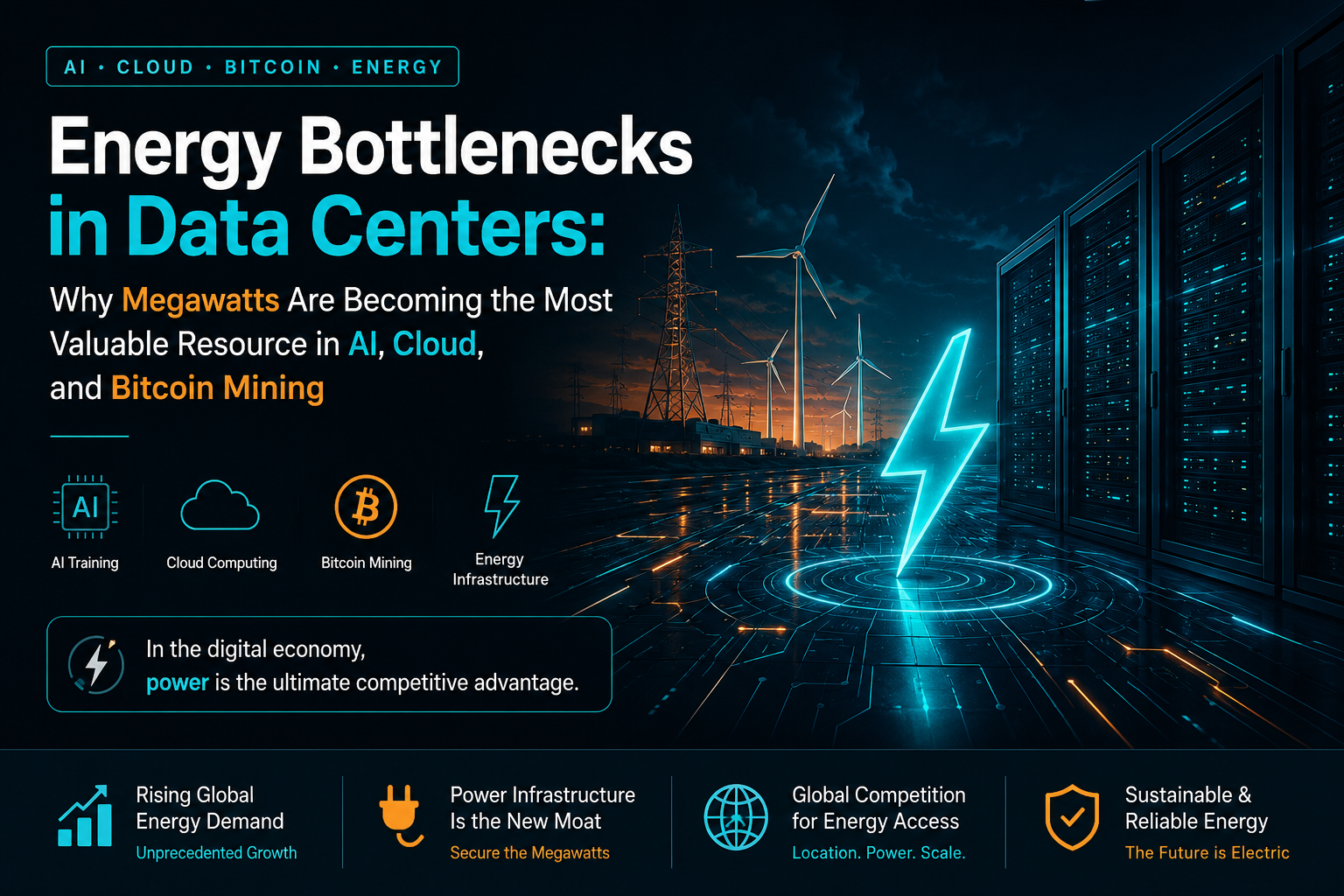
If you spend enough time walking the floors of modern data centers, you quickly realize that the real bottleneck in today’s tech boom isn’t just silicon—it’s the power grid. We talk endlessly about the latest GPUs and the race to build smarter algorithms, but as Eric Trump recently highlighted, all of that digital ambition hits a physical wall if you don't have the electricity to back it up.
Right now, we are watching a massive convergence. Artificial intelligence, cloud architecture, and cryptocurrency mining might look like completely different industries on paper. But from an infrastructure perspective? They are essentially the same beast. They all exist to convert raw electricity into high-value computational work.
Here is a closer look at what is happening on the ground and why energy has quietly become the ultimate competitive moat in the digital economy.
Why AI, Cloud Computing, and Bitcoin Mining Are Driving Massive Energy Demand
To understand the scale of the current infrastructure shift, you have to look at the workloads. The modern digital economy is heavily reliant on three major sectors, all of which are uniquely power-hungry.
First, you have AI training clusters. Training a Large Language Model (LLM) involves linking thousands of high-performance GPUs together to crunch data for months at a time. These racks are incredibly dense and generate so much heat that traditional air cooling is no longer enough—we are increasingly moving toward direct-to-chip liquid cooling.
Next is cloud computing. The backbone of the internet requires massive redundancy, perfect uptime, and heavy continuous power draw to keep enterprise software running smoothly.
Finally, there is Bitcoin mining. Mining farms use Application-Specific Integrated Circuits (ASICs) to constantly guess alphanumeric codes to secure the blockchain. It’s a brute-force mathematical process that requires gigawatts of power globally.
What do these three have in common? They all demand highly specialized, energy-intensive environments.
Electricity Cost per Compute Workload: AI vs Cloud vs Bitcoin Mining
Power Consumption Comparison: AI Training vs Cloud Infrastructure vs Bitcoin Mining
| Infrastructure Type | Typical Hardware | Estimated Power per Rack | Typical Facility Size | Energy Demand Scale |
|---|---|---|---|---|
| AI Training Clusters | High-end GPUs (H100, MI300, B200) | 60–120 kW per rack | 20–200 MW facilities | Extremely high continuous load |
| Cloud Computing Data Centers | CPU servers + mixed GPU workloads | 10–30 kW per rack | 10–100 MW facilities | Stable long-term consumption |
| Bitcoin Mining Farms | ASIC miners (Antminer, WhatsMiner) | 30–80 kW per rack | 50–300 MW facilities | Flexible and scalable demand |
Why Energy Infrastructure Is Becoming a Strategic Asset for Data Centers
A decade ago, tech companies chose locations based on tax breaks or access to fiber-optic cables. Today, the very first question any data center architect asks is: "What is the capacity of the local electrical substation?"
Energy is no longer just an operational expense; it is a strategic asset. Companies that can lock down long-term Power Purchase Agreements (PPAs) at cheap rates hold the keys to the kingdom. If you don't have affordable electricity, you can't run your GPUs profitably, and you can't scale your operations.
This is triggering a major pivot. We are seeing digital infrastructure companies getting directly involved in power generation. They are building facilities next to nuclear plants, tapping into stranded natural gas, and funding massive solar and wind projects. They aren't just consumers anymore—they are active players in the energy grid.
The Convergence of Bitcoin Mining Infrastructure and AI Data Centers
Perhaps the most fascinating trend in high-performance computing right now is the crossover between Bitcoin mining infrastructure and AI data centers.
Historically, Bitcoin miners are the pioneers of fast, cheap electrical infrastructure. They know how to build massive power substations in the middle of nowhere and cool thousands of machines efficiently. As AI companies struggle to find available power on traditional grid systems, they are actively looking to partner with—or outright buy—existing crypto mining facilities.
However, the transition isn't just "plug and play."
Key Differences Between Bitcoin Mining Workloads and AI Training Infrastructure
Bitcoin mining is a flexible workload. A mining farm can easily power down its machines during a summer heatwave when the local grid is stressed, often getting paid by the utility company to do so.
AI workloads are rigid. If you are halfway through training a neural network, you cannot just pull the plug. It requires 100% uptime, backup generators, and enterprise-grade networking (like InfiniBand).
Because of this dynamic, we are starting to see hybrid data centers. A facility might dedicate its ultra-reliable, heavily backed-up power to AI servers, while using its excess or variable power to mine Bitcoin. This allows operators to maximize every single drop of electricity they pull from the grid.
Conclusion
The industries of energy generation, high-performance computing, and digital asset mining are no longer operating in silos. They have merged into a single, highly interconnected ecosystem. As our reliance on artificial intelligence and blockchain technology grows, the physical reality of copper wires, cooling towers, and power transformers will dictate the pace of innovation. The future of technology isn't just about who has the best code; it's about who has the power to run it.
FAQ
Q1: Why is electricity becoming the biggest bottleneck for AI data centers?
AI infrastructure requires enormous computational power, often using thousands of GPUs running continuously for weeks or months. This creates extremely high electricity demand that many local power grids cannot support. As a result, access to large and stable energy supplies has become one of the most important factors when building modern AI data centers.
Q2: How much electricity do large AI training clusters consume?
Large AI training clusters can consume tens to hundreds of megawatts of electricity depending on their scale. Training advanced models may involve thousands of GPUs operating simultaneously, along with cooling systems and networking equipment. This level of consumption is comparable to the electricity usage of small cities.
Q3: Why are crypto mining facilities attractive to AI companies?
Crypto mining facilities often already have access to large power allocations, high-capacity electrical infrastructure, and industrial-scale cooling setups. Because power availability is the hardest constraint for AI infrastructure, these existing facilities provide a valuable starting point for companies looking to build or expand GPU clusters.
Q4: What are hybrid AI and Bitcoin mining data centers?
Hybrid data centers combine AI workloads with Bitcoin mining operations within the same power infrastructure. AI servers typically use the most stable and backed-up electricity supply, while Bitcoin miners use variable or excess power. This approach helps operators maximize electricity usage and improve the economic efficiency of large energy allocations.
Q5: Why are data centers being built near renewable energy sources?
Renewable energy sources such as wind, solar, and hydro can provide large amounts of electricity at relatively low long-term cost. By building data centers near these energy sources, operators can secure cheaper power contracts, reduce transmission losses, and improve sustainability while supporting energy-intensive workloads like AI training and cryptocurrency mining.
Q6: Why is liquid cooling becoming necessary in AI data centers?
Modern AI chips, like the latest NVIDIA architectures, draw massive amounts of wattage per chip. Packing dozens of these into a single server rack creates heat densities that standard air conditioning simply cannot handle. Liquid cooling moves heat away from the chips much more efficiently, preventing thermal throttling and hardware damage.
Q7: Can a Bitcoin mining farm easily switch to AI hosting?
Not easily, but it gives a massive head start. While a mining farm already has the hardest part sorted—the massive power permits and electrical transformers—the physical buildings often lack the advanced networking infrastructure, dust control, and backup power redundancy required for sensitive AI GPU clusters.
Q8: What does "stranded power" mean in infrastructure?
Stranded power refers to energy that is generated but has nowhere to go. Think of a wind farm in a remote area that produces more power at night than the local town needs. Because data centers can be built almost anywhere with an internet connection, they can move directly to these stranded power sources, buying cheap, wasted energy.