
Introduction
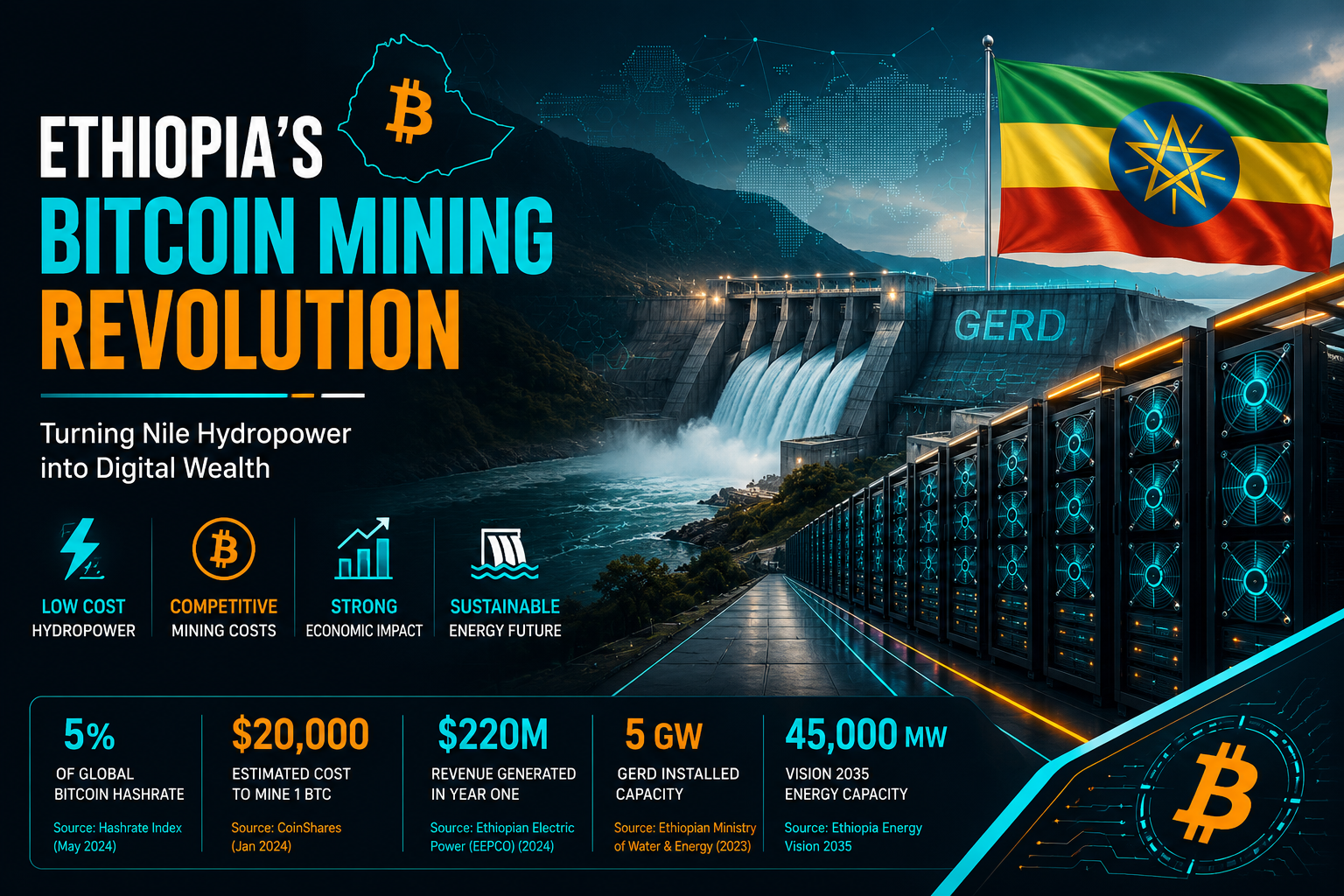
The technological terrain of the African continent is changing drastically. Central to this change is Ethiopia, formerly famous for its difficulties, now a favorite location for Bitcoin mining behemoths. Ethiopia accounts for 5% of the entire global Bitcoin hashrate, driven by a mix of affordable hydroelectric power, a cold climate, and political will.
| Category | Key Details & Strategic Metrics |
|---|---|
| Global Hashrate Share | Ethiopia accounts for 5% of the total global Bitcoin hashrate. |
| Mining Cost Efficiency | Production cost is $20,000 per Bitcoin including hardware & labor. |
| Electricity Pricing | Miners pay 4 cents per kWh (Supporting local 1-cent residential rates). |
| National Revenue | $220 million in year one; Targeting $1 billion annually. |
| Infrastructure Source | Grand Ethiopian Renaissance Dam (GERD) with 5 GW capacity. |
| Energy Distribution | Mining utilizes 20% to 30% of Ethiopia’s total current output. |
| Long-term Vision | Vision 2035 targets a massive 45,000 MW energy capacity. |
| Regulatory Status | Temporary suspension of new licenses effective as of early 2025. |
Economic Impact of Bitcoin Mining in Ethiopia: Cost per Coin, Profit Margins, and National Revenue
In the mining world, price is top. The numbers for every investor in Ethiopia are huge.
Profit Margins: Production of one Bitcoin costs about $20,000, including hardware, labor, and maintenance. With Bitcoin trading at values of roughly $114,000, we are seeing major investment returns that are not possible in any other conventional industry. In only one year, miners pumped $220 million into the coffers of the Ethiopian electric authorities. Projections show this number will reach $1 billion yearly within the following five years, hence mining will be one of the most important sources of foreign exchange for the country.
Leveraging Stranded Energy: How Grand Ethiopian Renaissance Dam (GERD) Hydropower Powers Crypto Mines
Ethiopia’s revival relies on green energy derived from the Nile. The secret lies in what is known as “Stranded Energy”—power produced in remote locations that cannot be immediately connected to the residential grid.
Exploring the 5 GW Capacity of the Grand Ethiopian Renaissance Dam (GERD) for Industrial Mining
This initiative, which aims for a capacity of 5 GW, acts as the backbone of the industry. At present, miners use around 20% to 30% of Ethiopia's total energy output, transforming excess electricity that might otherwise be wasted into immediate financial gain.
Strategic Conversion of Excess Hydroelectric Power into Sustainable Bitcoin Mining Revenue
The GERD generates significant power that necessitates extensive distribution networks—such as transmission lines and substations—to deliver it to homes. This process requires both time and investment. Bitcoin mining addresses this issue by utilizing the energy directly on-site.
Nile Energy Dividends: Assessing the Socio-Economic Benefits for National Development
Ethiopia could eventually provide economic dividends to its citizens as returns from energy sales or mining earnings.
Reinvesting Mining Profits into the Koisha Dam and Future Energy Infrastructure Projects
The profits generated from miners, who pay rates higher than those charged to residents, are being reinvested into other projects like the Koisha Dam, which will contribute an additional 1,700 MW.
Geopolitical Security Risks: Regional Conflict over Nile Water Rights and GERD Safety
Egypt has repeatedly threatened to strike the GERD before its completion, though this has become nearly impossible after the reservoir was filled. Experts suggest remaining options might include highly complex operations to damage gates for controlled drainage. This conflict over water rights between Egypt, Sudan, and Ethiopia remains a flashpoint. Any strike would devastate the power grid, which would be difficult to repair.
Evaluating the Ethics: Is Bitcoin Mining in Africa Digital Colonialism or a Sovereign Economic Strategy?
Some in the West view mining in Africa as a repeat of the "East India Company" history, where resources are plundered for foreign gain. However, the Ethiopian model suggests otherwise.
Sustainable Electricity Pricing Models: How Crypto Miners Subsidize Local Household Power Bills
Bitcoin miners pay approximately 4 cents per kWh, while local citizens pay only 1 cent. These higher corporate rates effectively subsidize the electricity bills of local households.
Accelerating Rural Electrification Through Infrastructure Expansion Funded by Mining Tariffs
Revenue from miners is funding the construction of 30,000 km of transmission lines and 192 substations, accelerating rural electrification.
The Role of Political Stability and Foreign Direct Investment (FDI) in Ethiopia’s Industrial Growth
Ethiopia was one of the fastest-growing economies in the last decade, with rates reaching 14%. With a young population (75% under the age of 27), the state seeks to shed its old image of famine and war. Security has improved substantially in urban centers, and the 2022 Pretoria Peace Treaty ended major conflicts, paving the way for industrial growth and Foreign Direct Investment (FDI).
Regulatory Landscape: 2025 Licensing Suspensions and New Policies for Ethiopia's Bitcoin Sector
Despite the success, there is regulatory caution. In early 2025, the Ethiopian Investment Commission temporarily suspended new licenses.
Reform of Power Purchase Agreements (PPAs) to Ensure Fair Energy Allocation and Grid Balance
The government wants to ensure investors are actually utilizing their allocated power. There is a move to reduce Power Purchase Agreements (PPAs) from 150 MW to the 5–25 MW range to ensure fairer distribution.
State-Owned Mining Ventures and Natural Gas as Alternative Energy Sources for Data Centers
There are reports of the government intending to enter the mining sector itself and exploring natural gas as an alternative energy source for mines.
Ethiopia’s Energy Vision 2035: Scaling to 45,000 MW and Global Hydropower Leadership
Ethiopia aims to produce 45,000 MW of electricity within the next ten years.
Macroeconomic Ambitions: Path to Becoming Africa’s Second-Largest Economy by 2033
To become the second-largest economy in Africa within seven years.
Bitcoin as a National Reserve Asset: A New Strategy for Water Dividends and Financial Sovereignty
With the easing of capital controls, Ethiopia might explore the option of holding Bitcoin as a reserve asset, which could offer "water dividends" to its citizens.
Managing Regional Tensions: Somaliland Recognition and the Risk of International Sanctions
Ethiopia's recognition of Somaliland could escalate tensions with Somalia and may result in regional or international repercussions, possibly leading to political isolation or sanctions. The potential maritime benefits are tempered by strategic risks and long-term instability.
Summary: How Bitcoin Mining Serves as Ethiopia’s Energy-to-Wealth Transformation Engine
Ethiopia's experience in Bitcoin mining proves that technology can be a bridge for developing nations to leapfrog traditional development stages. Here, mining is not just a pursuit of digital profit; it is an engine for building dams, extending power lines, and rebranding Ethiopia as a rising technological and energy power—even if the high rewards come with equally high risks.
FAQ: Common Questions on Ethiopia's Bitcoin Mining Industry, Energy Costs, and Future Outlook
Q1: Why is Ethiopia attractive for Bitcoin mining?
Ethiopia offers low-cost hydroelectric power, a relatively cool climate, and strong political backing for industrial energy use. With electricity prices around 4 cents per kWh for miners and access to large-scale hydropower from GERD, the country provides competitive operating costs compared to many global mining hubs.
Q2: How much does it cost to mine one Bitcoin in Ethiopia?
According to current estimates in the article, producing one Bitcoin costs about $20,000, including hardware, labor, and maintenance. With Bitcoin trading significantly higher, this creates strong potential profit margins, assuming stable electricity pricing and network conditions.
Q3: What is “stranded energy” and how does it support mining?
Stranded energy refers to electricity generated in remote areas that cannot immediately be delivered to consumers due to limited transmission infrastructure. Bitcoin mining can use this power on-site, converting excess hydroelectric energy into revenue instead of letting it go unused.
Q4: How does the Grand Ethiopian Renaissance Dam (GERD) impact mining?
GERD provides up to 5 GW of capacity and serves as the backbone of Ethiopia’s mining ecosystem. Miners currently use 20–30% of total energy output, helping monetize surplus electricity while long-term transmission networks are still being developed.
Q5: Is Bitcoin mining subsidized in Ethiopia?
Miners pay around 4 cents per kWh, while local citizens pay about 1 cent. This pricing structure means mining companies effectively contribute higher tariffs, which can subsidize household electricity and support national infrastructure development.
Q6: What regulatory risks exist for Bitcoin mining in Ethiopia?
In early 2025, new mining licenses were temporarily suspended. The government aims to ensure better power allocation and reduce oversized PPAs. Regulatory caution, potential state competition, and geopolitical tensions represent ongoing risks for investors.
Q7: Could Ethiopia hold Bitcoin as a national reserve?
The article suggests that with easing capital controls, Ethiopia might explore holding Bitcoin as a reserve asset. This strategy could align with its hydropower-driven mining model, potentially transforming energy production into long-term digital reserve accumulation.