AI Energy Demand vs. Grid Stability (2026/2027): Power Infrastructure Challenges, Grid Capacity & Reliability Risks
In 2026, the global energy landscape is no longer defined by the steady, predictable growth of the past century. We have entered an era of hyper-demand, driven by the simultaneous explosion of generative AI clusters, industrial electrification, and a domestic manufacturing renaissance. For energy engineers and infrastructure investors, the veneer of grid stability has worn thin.
We are witnessing a series of systemic shocks: record-breaking thermal events straining the ERCOT and CAISO markets, aging transformer fleets failing under load, and a backlog of interconnection requests that has become a national bottleneck. This isn't just a technical challenge; it’s a fundamental constraint on economic and technological dominance. If you cannot power the compute, you cannot lead in AI.
Electric Grid Bottlenecks in 2026: Transmission Constraints, Distribution Networks & Interconnection Delays
The modern electric grid is often described as the largest machine ever built, but in many regions, it is a machine built for a different century. The primary issue isn't just a lack of generation; it's a crisis of transmission and distribution (T&D).
Historically, the grid was designed for one-way traffic: large, centralized power plants (coal, nuclear, or hydro) pushed electricity down to passive consumers. Today, we are asking that same infrastructure to handle multi-directional flows from residential solar, EV fleet discharging, and volatile renewable inputs.
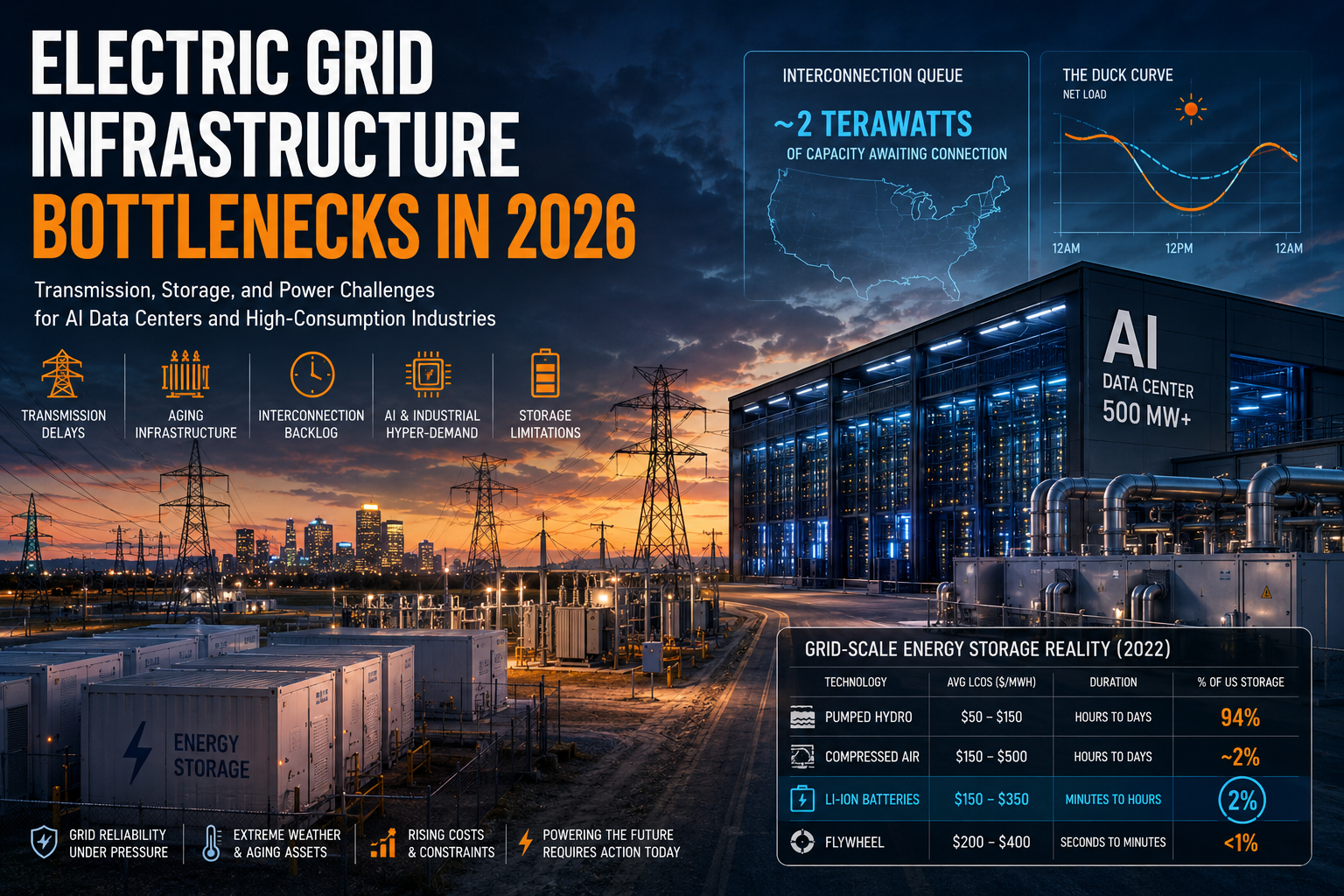
The physical reality is sobering. Lead times for high-voltage transformers now frequently exceed 14 to 18 months. Costs for substation upgrades have ballooned due to specialized labor shortages and material inflation. In 2026, the "interconnection queue" is the primary graveyard for energy innovation, with nearly two terawatts of nameplate capacity—almost double the current U.S. generation—waiting for a spot on the wires.
AI Data Center Energy Demand: Grid Stability, Voltage Control & Energy Storage Challenges
For operators of high-consumption devices—be it H100/B200 GPU clusters or industrial electrolytic cells—the metric of concern has shifted from mere cost per kilowatt-hour (kWh) to grid compatibility and voltage stability.
Electricity is not a stored commodity; it is a real-time service. To maintain a stable frequency of 60 Hz in the U.S., supply must perfectly track demand in milliseconds. High-density loads create "hot spots" on the distribution network. A single AI data center can now pull upwards of 500 MW—equivalent to a small city. When such a load ramps up or down, it creates transient voltage swings that can degrade equipment blocks away.
Energy Storage Gap Explained: Why Battery Capacity Lags Behind AI Power Demand
We often hear that batteries will save the grid. As a specialist, I look at the data, not the hype. While Li-ion battery costs have stabilized, their role in the current ecosystem is specific and limited.
Grid-Scale Energy Storage in 2026: Battery Costs, Storage Duration & Deployment Limitations
| Technology | Avg LCOS ($/MWh) | Storage Duration | % of US Storage (2022) |
|---|---|---|---|
| Pumped Hydro | $50 - $150 | Hours to Days | 94% |
| Compressed Air | $150 - $500 | Hours to Days | ~2% |
| Li-ion Batteries | $150 - $350 | Minutes to Hours | 2% |
| Flywheel | $200 - $400 | Seconds to Minutes | <1% |
High-Power AI Infrastructure: Balancing Energy Efficiency, Performance & Grid Reliability
For industrial power managers, energy modeling in 2026 must account for the Duck Curve—the phenomenon where solar overproduction at midday crashes wholesale prices, followed by a massive ramp-up requirement as the sun sets.
-
AI Clusters: These are "flat" loads. They want 24/7 consistency.
-
The Conflict: Relying on intermittent renewables for a flat load requires massive over-provisioning or expensive firming contracts.
-
Thermal Management: In 2026, cooling is no longer an afterthought. We are seeing a shift toward liquid-to-chip cooling as air-cooling limits are reached. From an energy perspective, the Power Usage Effectiveness (PUE) metric is being scrutinized more heavily by regulators. If your cooling system consumes 40% of your total power, you are essentially wasting grid capacity that other industries desperately need.
Grid-Tied vs. Behind-the-Meter (BTM) Energy Systems: Cost, Reliability & AI Data Center Performance
The "Out-the-Door" cost of power is now bifurcated. You have the Wholesale Price (generation) and the Delivery/Capacity Price (T&D). In markets like California, the cost to deliver the power often exceeds the cost of the energy itself.
For large-scale operations, the trade-off is between Grid-Tied vs. Behind-the-Meter (BTM) generation.
-
Grid-Tied: Offers lower Capex but exposes the operator to peak-demand charges and volatility.
-
BTM (Natural Gas Micro-turbines or SMRs): Higher upfront investment but provides "islanding" capability. During a grid failure or a "brownout" (voltage sag), a BTM-enabled facility remains operational while competitors lose millions in downtime.
Grid Reliability in 2026: Baseload Power, Firming Assets & Energy Risk Management
Reliability in 2026 is a function of diversity. A grid relying solely on natural gas is vulnerable to pipeline freeze-offs; a grid relying solely on wind/solar is vulnerable to atmospheric "stagnation" events. The industry is pivoting toward Firming assets:
-
Natural Gas Peakers: Essential for rapid response, though carbon-capture mandates are increasing their operational complexity.
-
Nuclear (Fission): The only carbon-free baseload capable of supporting Giga-watt scale demand. The 2026 outlook sees a resurgence in interest for Small Modular Reactors (SMRs), which can be deployed closer to the load, reducing the need for massive new transmission lines.
-
Long-Duration Energy Storage (LDES): Iron-air or flow batteries are finally moving from pilot to deployment, aiming to solve the "multi-day" storage problem that Li-ion cannot economically address.
Strategic Energy Planning for AI Data Centers: Infrastructure Investment & Long-Term Grid Resilience
To the investors and engineers navigating this landscape: energy is the new scarcity. Success in 2026 requires moving beyond the "light switch" mentality. You must treat power as a strategic supply-chain component. This means:
-
Site selection must be driven by substation capacity, not just tax incentives.
-
Infrastructure must be built with "dispatchable" characteristics (onsite storage or generation) to mitigate the rising frequency of grid instability.
-
Operational models must account for a world where electricity prices are highly volatile and the "green premium" is increasingly replaced by a "reliability premium."
The grid isn't just a utility; it's a constraint. Understanding the physics of that constraint is the only way to build a resilient, high-performance future.
FAQ: AI Energy Demand, Grid Stability, Battery Storage & Power Infrastructure (2026/2027)
Q1: Why is AI putting pressure on the electric grid in 2026?
AI workloads require continuous, high-density electricity for GPU clusters operating 24/7. Unlike traditional variable industrial loads, AI data centers create stable but massive power demand, stressing substations, transformers, and local distribution networks, especially in regions already facing transmission bottlenecks.
Q2: How much electricity does a hyperscale AI data center consume?
A single large AI data center can consume 300–500 megawatts (MW), roughly equivalent to the power demand of a small city. Concentrated loads of this scale can create voltage instability and require significant grid upgrades or behind-the-meter generation solutions.
Q3: What is the interconnection queue and why does it matter?
The interconnection queue is the backlog of power generation and storage projects waiting for approval to connect to the grid. In 2026, delays in transmission upgrades and transformer supply have turned this queue into a major constraint, slowing down renewable energy deployment and AI infrastructure expansion.
Q4: Can battery storage fully stabilize the grid?
No. While lithium-ion batteries are effective for short-duration balancing and frequency regulation, they are not designed for multi-day energy shortages. Most existing U.S. storage capacity comes from pumped hydro, which is geographically limited and difficult to expand.
Q5: What is the “Duck Curve” and why is it important for AI facilities?
The Duck Curve describes midday solar oversupply followed by steep evening demand spikes. AI facilities require consistent 24/7 power, which conflicts with intermittent renewable generation unless backed by firming assets, storage, or dispatchable baseload generation.
Q6: What are behind-the-meter (BTM) power strategies?
Behind-the-meter generation refers to onsite energy production, such as natural gas micro-turbines or small modular reactors. These systems provide energy independence and “islanding” capability, allowing facilities to continue operating during grid outages or voltage disturbances.
Q7: How should investors manage grid reliability risks in 2026?
Investors should prioritize locations with strong transmission capacity, diversified generation mixes, and access to firming assets. Incorporating onsite generation, long-duration storage, or hybrid power strategies reduces downtime risk and protects against electricity price volatility.