
Introduction
The United Arab Emirates is one of the world’s energy-rich countries, with large oil and natural gas resources that allow it to meet domestic demand while exporting significant volumes to international markets. Yet despite having abundant fossil fuel resources, the UAE chose not to base the future of its electricity system entirely on oil and gas. Instead, it turned to a very different source of energy: peaceful nuclear power.
That is what makes the UAE’s experience particularly notable. The country did not turn to nuclear energy because it lacked fossil fuels. Rather, it sought to diversify its electricity mix, secure a stable source of power over the long term, and support continued economic and industrial growth.
The importance of reliable electricity has become even greater as the UAE has positioned itself as a hub for technology and investment, including data centers, cloud computing, and artificial intelligence. These sectors consume enormous amounts of electricity and require a continuous and predictable supply rather than simply having generating capacity available at certain times of the day.
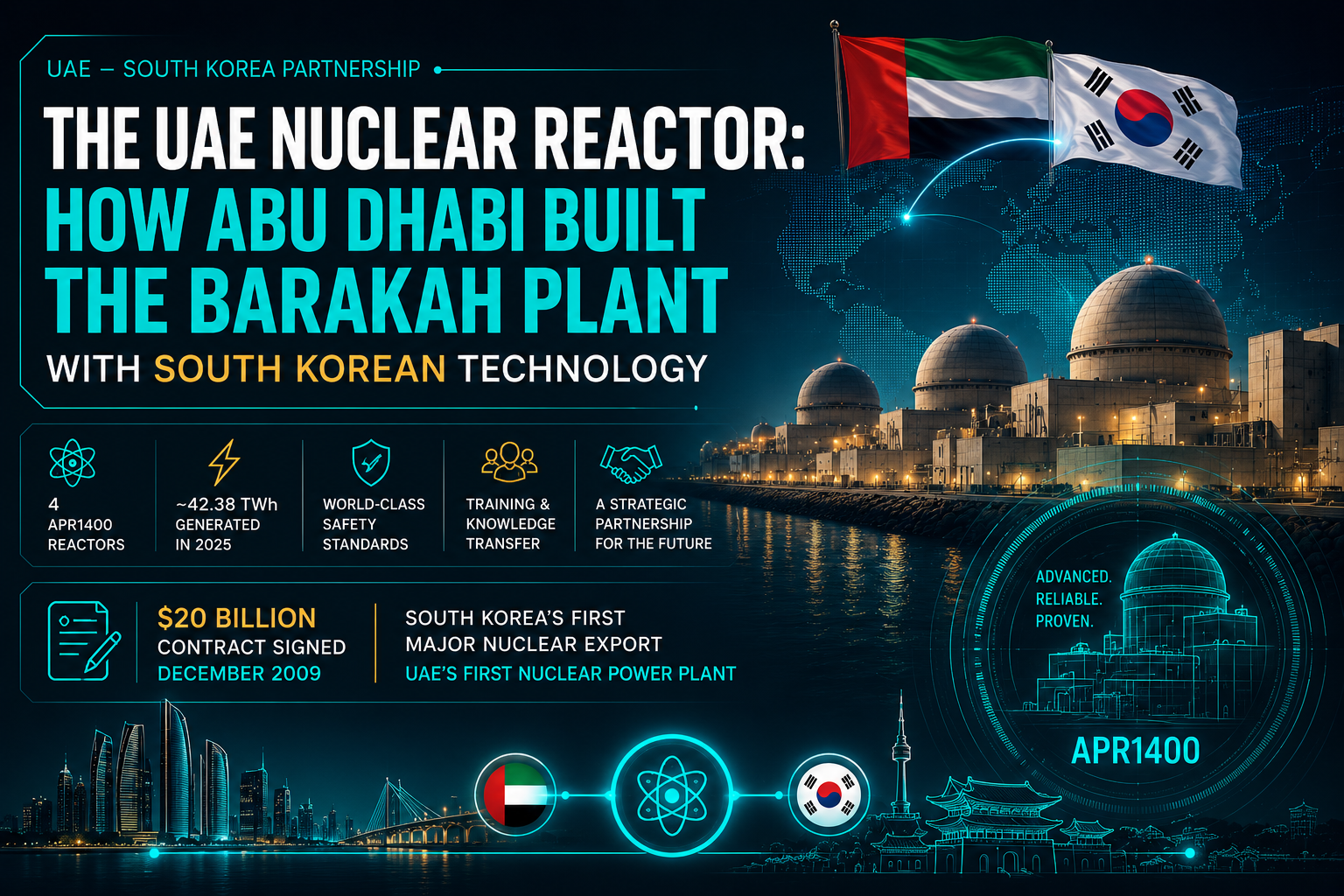
Against this backdrop, nuclear power has become an important part of the UAE’s electricity mix. The Barakah Nuclear Energy Plant, consisting of four APR1400 reactors, is capable of supplying around 40 terawatt-hours of electricity annually, while data from the International Atomic Energy Agency shows that the four reactors together generated approximately 42.38 TWh in 2025.
To carry out this project, the UAE chose a partner from South Korea. In December 2009, the Emirates Nuclear Energy Corporation (ENEC) selected a consortium led by Korea Electric Power Corporation (KEPCO) to build four nuclear reactors at Barakah. The main contract was worth around $20 billion and covered the design and construction of the reactors, assistance with their operation, as well as training and human-resource development.
Barakah thus became the UAE’s first nuclear power plant, the first major overseas export project for South Korea’s nuclear technology, and the first commercial nuclear power project in the Arab world.
Who Is South Korea’s KEPCO?
Korea Electric Power Corporation (KEPCO) is South Korea’s largest public electricity utility and occupies a central position in the country’s energy and nuclear-industrial system.
However, KEPCO’s importance to the Barakah project goes beyond its role as an electricity company. South Korea has developed an integrated industrial ecosystem covering reactor design, engineering, construction, operation and maintenance, as well as nuclear-fuel manufacturing.
KEPCO’s broader network includes companies such as Korea Hydro & Nuclear Power (KHNP), which specializes in operating nuclear and hydroelectric power plants; KEPCO Engineering & Construction (KEPCO E&C), which focuses on engineering and design; and KEPCO Nuclear Fuel, which specializes in nuclear-fuel design and manufacturing.
KEPCO also has international activities in a number of countries and across different areas of the energy sector. Its international portfolio has included projects involving conventional power generation as well as other energy infrastructure.
However, Barakah was the first major overseas nuclear power project involving South Korea’s nuclear industry. That gave the project particular importance for both countries.
ENEC selected KEPCO as the prime contractor following a stringent, year-long evaluation process led by a committee of 75 international experts. The evaluation considered criteria including safety, the ability to deliver the project, the commercial offer, and commitment to human-resource development.
KEPCO therefore did not simply provide a reactor design. Through its network of Korean companies, the project brought together engineering, construction, commissioning, operations and nuclear-fuel expertise.
This was one of the reasons the South Korean model was particularly well suited to Barakah: the UAE was looking not only for a nuclear technology provider, but for a partner capable of supporting the development of an entire nuclear-energy industry.
How Did South Korea Develop the APR1400?
The APR1400 is the core technology behind the Barakah plant.
APR stands for Advanced Power Reactor. It is an advanced pressurized water reactor (PWR) developed by the Korean nuclear industry under the leadership of KEPCO over a period of approximately ten years.
The reactor was designed with a nominal electrical capacity of around 1,400 MW, together with improvements in safety, operational performance and efficiency.
For Barakah, the International Atomic Energy Agency’s PRIS database records a gross electrical capacity of 1,417 MW per unit, a design net capacity of 1,310 MW, and a thermal capacity of 3,983 MW.
Each reactor is designed for an operating life of approximately 60 years, subject to regulatory requirements. ENEC describes the APR1400 as a Generation III design incorporating safety features intended to prevent or mitigate severe accidents.
The Korean Reference Reactors
Barakah was not the first site to use APR1400 technology.
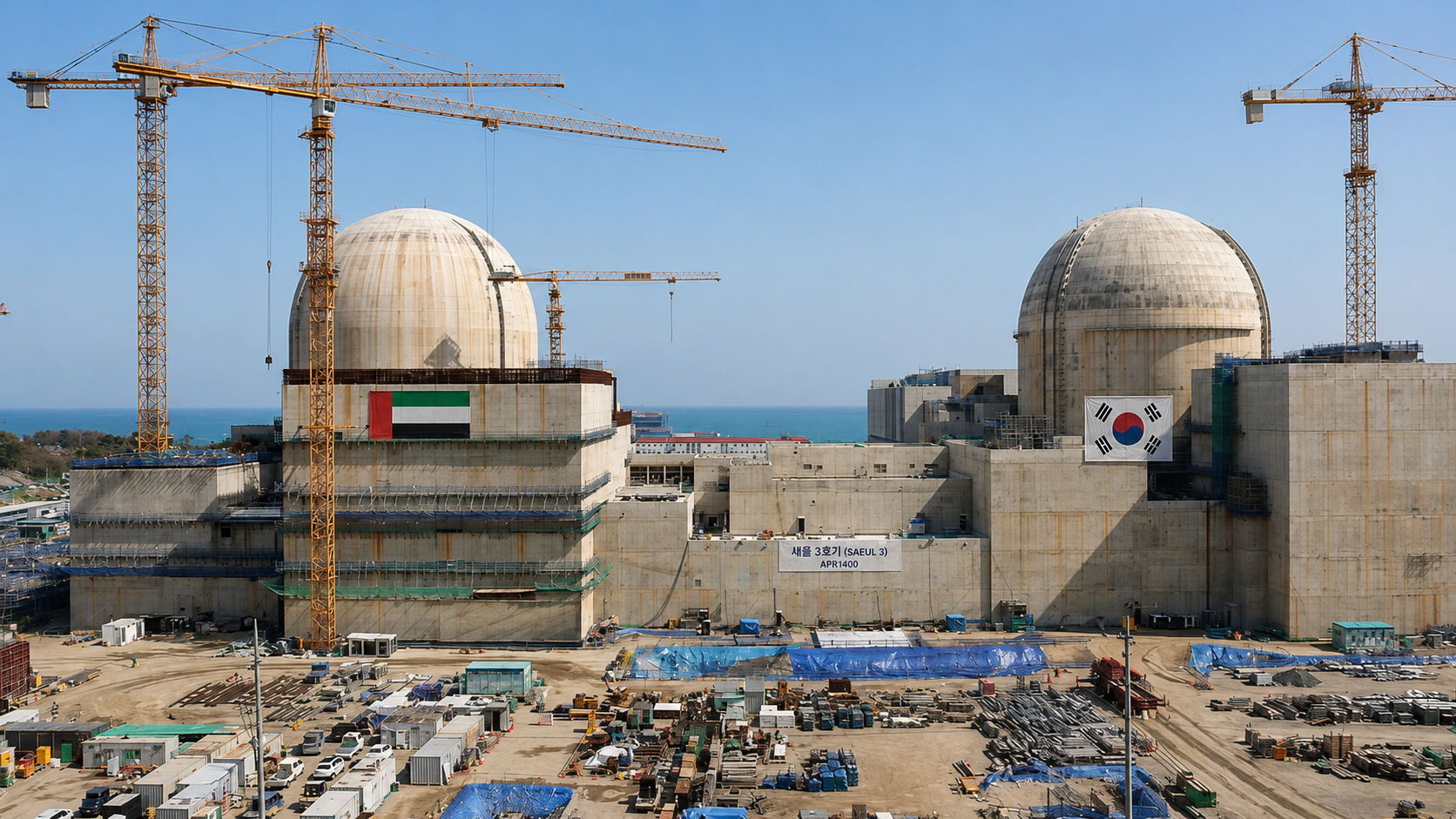
The reference plants were Saeul Units 1 and 2 in South Korea, previously known as Shin-Kori Units 3 and 4. Saeul 1 entered commercial operation in December 2016, followed by Saeul 2 in August 2019.
This experience was important for the UAE because Barakah was able to draw on lessons from reactors of the same design rather than adopting a completely untested technology.
Why Did the UAE Choose South Korean Technology?
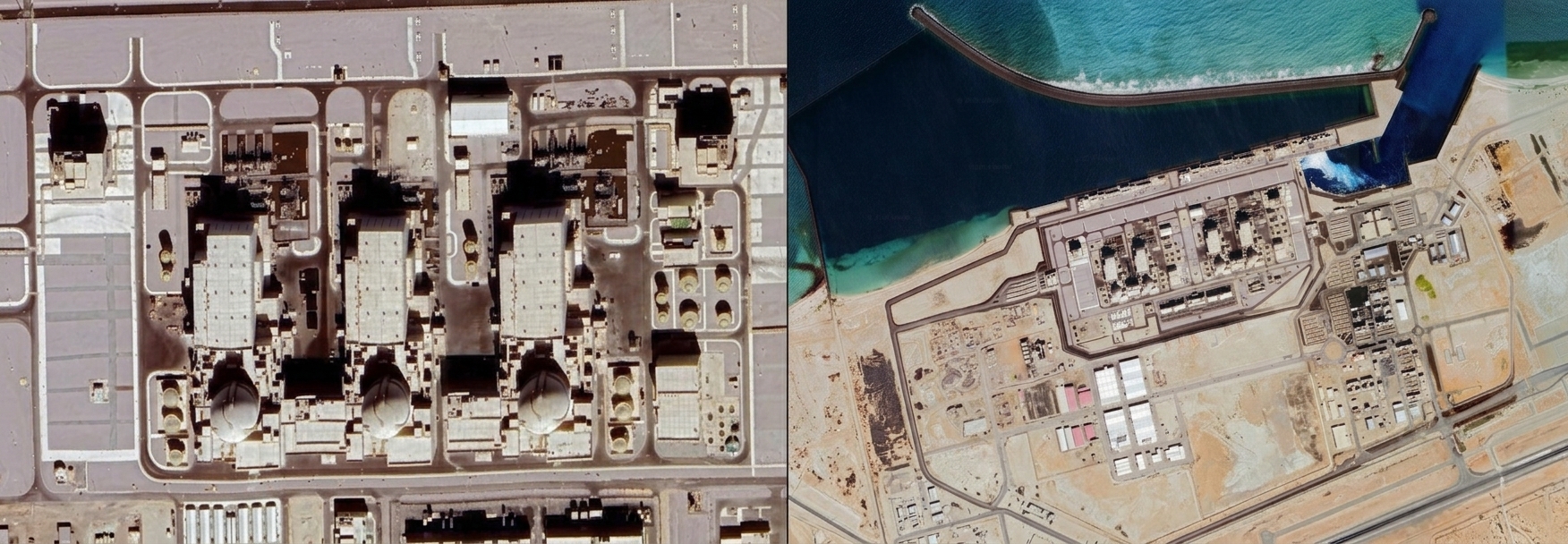
The UAE's decision in 2009 was a major strategic step. The country was entering commercial nuclear power for the first time and therefore needed more than a reactor design.
It needed a partner capable of supporting the entire project: design, engineering, construction, commissioning, operations, training and knowledge transfer.
The Korean consortium offered four APR1400 reactors together with programs for training Emirati personnel and developing local nuclear expertise.
The choice also gave the UAE access to a technology that already had a Korean reference plant. The experience gained through the construction and operation of Saeul 1 and 2 subsequently became valuable to the Barakah project.
The relationship therefore went beyond a conventional supplier-customer arrangement. It became a long-term industrial partnership between the UAE and South Korea.
The Barakah Contract: $20 Billion
In December 2009, ENEC selected a consortium led by KEPCO to build the four reactors.
The main contract was worth approximately $20 billion. The contract covered the construction and commissioning of four APR1400 reactor units, as well as associated support, training and human-resource development.
It is important to distinguish between the value of the original prime contract and the total economic cost of a nuclear program over its entire lifetime. Financing, infrastructure, operating costs and other long-term expenses can be treated separately.
For the purposes of describing the agreement between ENEC and KEPCO, however, the commonly cited figure is about $20 billion.
From Planning to Construction
The UAE's peaceful nuclear-energy program began several years before construction.
The country published its Policy on the Peaceful Use of Nuclear Energy in April 2008 and adopted its Federal Nuclear Law in October 2009. ENEC was launched in December 2009, the same month that the prime contractor was selected.
Site preparation and licensing then followed.
In July 2012, the Federal Authority for Nuclear Regulation, or FANR, issued the construction license for Units 1 and 2. Construction of Unit 1 began that month.
The location itself was selected after extensive assessments covering seismic activity, security, distance from population centers, water availability and environmental considerations. ENEC has described the site as an area of very low seismic activity.
Construction of the Four Units
The four reactors were not built simultaneously from start to finish. Construction began on each unit at different times, allowing the project to incorporate experience and lessons from earlier units into subsequent stages.
By the time construction began on Unit 4 in 2015, Barakah had become the world's largest nuclear construction site, with four identical reactors being built simultaneously at one location.
Construction and Commissioning Timeline
| Unit | Construction Start | First Criticality | First Grid Connection | Commercial Operation |
|---|---|---|---|---|
| Barakah 1 | 19 July 2012 | 31 July 2020 | 19 August 2020 | 1 April 2021 |
| Barakah 2 | 15 April 2013 | 27 August 2021 | 14 September 2021 | 24 March 2022 |
| Barakah 3 | 24 September 2014 | 22 September 2022 | 8 October 2022 | 24 February 2023 |
| Barakah 4 | 30 July 2015 | 1 March 2024 | 23 March 2024 | 5 September 2024 |
The dates for construction, criticality, grid connection and commercial operation are recorded in the IAEA's PRIS database.
The distinction between these milestones is important.
Completion of construction does not mean that a reactor immediately begins commercial electricity production. After construction, the reactor goes through testing, fuel loading, commissioning and controlled power escalation before connecting to the grid and eventually entering commercial operation.
When Was Barakah Construction Completed?
Construction of the individual units was completed progressively.
According to ENEC:
-
Unit 1 was completed in March 2018.
-
Unit 2 was completed in July 2020.
-
Unit 3 was completed in November 2021.
-
Unit 4 was completed in December 2023.
This means that the final construction work was completed before the fourth reactor entered commercial operation.
The distinction matters because the final stage of a nuclear project is not simply construction. It includes extensive testing, commissioning and regulatory verification.
Unit 4 subsequently reached first criticality in March 2024, connected to the grid on 23 March 2024 and entered commercial operation on 5 September 2024.
With that milestone, all four Barakah reactors were commercially operational.
Barakah Technical Profile
| Item | Details |
|---|---|
| Plant | Barakah Nuclear Energy Plant |
| Country | United Arab Emirates |
| Location | Al Dhafra region, Abu Dhabi |
| Number of Reactors | 4 |
| Reactor Type | Pressurized Water Reactor (PWR) |
| Model | APR1400 |
| Generation | Generation III / advanced design |
| Gross Capacity per Unit | 1,417 MW |
| Design Net Capacity per Unit | 1,310 MW |
| Reference Unit Power in PRIS | 1,337 MW |
| Thermal Capacity per Unit | 3,983 MWth |
| Gross Capacity of Four Units | Approximately 5,668 MW |
| Commonly Stated Plant Capacity | 5,600 MW |
| Number of Operating Units | 4 |
| Design Operating Life | Approximately 60 years |
| Prime Contractor | KEPCO |
| Owner | Emirates Nuclear Energy Corporation (ENEC) |
| Operator | Nawah Energy Company |
| Prime Contract Value | Approximately $20 billion |
| Contract Signed | December 2009 |
| Construction Began | July 2012 |
| Final Unit Construction Completed | December 2023 |
| All Four Units Commercially Operational | September 2024 |
The IAEA PRIS database records each Barakah unit at 1,417 MW gross capacity and 1,310 MW design net capacity. This is why different figures can appear when discussing Barakah's capacity. 5,600 MW is the rounded figure commonly used by ENEC for the four-unit project, while PRIS provides more precise reactor-level capacity figures.
Nuclear Fuel: Does Korea Produce It?
KEPCO's involvement in Barakah does not mean that every stage of the nuclear-fuel cycle takes place in South Korea.
The nuclear fuel cycle can involve several distinct stages, including uranium supply, conversion, enrichment, fuel fabrication and the management of spent fuel.
The original Barakah contract included the initial fuel loads for the reactors, while other stages of the fuel cycle involve international suppliers.
South Korea's nuclear-industrial ecosystem does, however, include KEPCO Nuclear Fuel, a company specializing in the design and manufacture of nuclear fuel.
This illustrates an important feature of the modern nuclear industry: the complete fuel cycle does not necessarily have to be concentrated in a single country or company.
How Much Electricity Does Barakah Produce?
The contribution of nuclear power to the UAE's electricity system has increased as each reactor entered operation.
According to the IAEA PRIS database, nuclear electricity accounted for:
| Year | Nuclear Share of UAE Electricity Production |
|---|---|
| 2020 | 1.13% |
| 2021 | 6.75% |
| 2022 | 12.37% |
| 2023 | 19.67% |
| 2024 | 21.76% |
| 2025 | 21.97% |
In 2025, the four UAE reactors supplied approximately 42.379 TWh of electricity.
The figure is significant because the UAE moved within only a few years from having no commercial nuclear reactors to operating four large reactors that together supplied roughly one-fifth of the country's electricity production.
The plant is also designed to provide electricity continuously, although individual reactors periodically shut down for refueling and maintenance. ENEC states that refueling outages occur roughly every 12 to 18 months.
Why Does an Oil-Rich Country Need Nuclear Power?
Building a nuclear power plant in a country with large oil and gas reserves may initially appear contradictory.
But nuclear power does not necessarily mean abandoning fossil fuels. The central objective is diversification of the electricity mix.
Every unit of oil or gas consumed domestically for electricity generation is a resource that cannot simultaneously be exported or used elsewhere in the economy. Nuclear power gives the country another source of electricity that can operate continuously.
Nuclear reactors can therefore provide a stable source of electricity for the grid, while other sources, including solar power, can play complementary roles.
The UAE has invested heavily in solar energy as well, meaning that its electricity strategy is not based on choosing one technology over another.
Instead, the model combines natural gas, oil, nuclear power, solar energy and other sources within a diversified electricity system.
Nuclear Power and the Digital Economy
The importance of reliable electricity has increased as the global economy becomes more dependent on digital infrastructure.
Artificial intelligence, data centers, cloud computing and other digital services can require enormous quantities of electricity. They also need highly reliable power supplies because interruptions can be extremely costly.
A large nuclear fleet can therefore provide a stable source of electricity as new electricity-intensive industries expand.
There is, however, an important distinction between the original reason for building Barakah and the economic sectors that can benefit from its electricity today.
The UAE's decision to develop nuclear power was made in 2009, well before the current boom in generative AI and large-scale data centers.
Today, however, the availability of reliable low-carbon electricity can become an additional advantage as the country seeks to attract new technology and industrial investment.
In that sense, nuclear power has become not merely an electricity-generation issue, but part of a broader economic and investment strategy.
From Oil to Nuclear Power: What Has Changed in the UAE?
The significance of the UAE's nuclear program lies partly in the fact that nuclear power was introduced into a country that already possessed enormous oil and gas resources.
This makes the UAE's motivation different from that of countries that turn to nuclear energy primarily because they lack domestic fossil-fuel resources.
Instead, the UAE chose nuclear energy as part of a broader strategy involving energy security, diversification of electricity generation, emissions reduction and long-term economic development.
South Korea was particularly well suited to this strategy because it offered more than the APR1400 design. It brought decades of industrial experience in engineering, construction, commissioning, operations, training and nuclear technology.
Barakah as a Model of UAE–South Korean Cooperation
The Barakah project created a partnership that went far beyond the construction of four reactors.
The UAE was developing a commercial nuclear industry for the first time, while South Korea was seeking to establish itself as a serious exporter of nuclear technology.
Both sides therefore had something significant at stake.
The UAE gained a functioning commercial nuclear plant, access to nuclear technology and experience, and a foundation for developing a domestic nuclear workforce.
South Korea, meanwhile, gained its first major overseas nuclear project and an opportunity to demonstrate that its nuclear industry could deliver a large-scale project outside the Korean market.
The experience also gave Korean companies an international reference project for the APR1400 technology.
Barakah was therefore important not only because of the electricity it produces, but because of what the project represented for both countries' nuclear industries.
What Does Barakah Mean for the Future of Nuclear Power in the Middle East?
Barakah provides an important reference point for countries considering whether to enter the nuclear-power sector.
The UAE succeeded in building four large reactors and bringing them into commercial operation, making nuclear power a significant part of its electricity system.
The project also demonstrates the scale of commitment required. A nuclear program needs long-term political support, major financing, an independent regulatory framework, specialized human resources, international cooperation and a capable industrial partner.
The wider Middle East is experiencing rapid economic growth, rising electricity demand and increasing investment in industry, technology and data infrastructure. These factors could encourage other countries in the region to consider nuclear power.
At the same time, the region remains one of the world's most geopolitically sensitive areas.
That brings another issue into the discussion: nuclear security, in addition to nuclear safety.
Could Geopolitical Risks Limit Nuclear Expansion in the Region?
Protecting nuclear facilities against attacks, sabotage, drones and missiles is an issue that cannot be separated from nuclear-energy planning in the Middle East.
An attack on a nuclear facility does not automatically mean that a major radiological accident will occur. Modern reactors are designed with multiple layers of safety and protection, and nuclear facilities operate under strict regulatory and security requirements.
Nevertheless, the geography of the Gulf makes the issue particularly sensitive.
Several Gulf countries rely heavily on seawater desalination, while major parts of their energy and industrial infrastructure are located close to the coast.
A serious environmental incident involving a coastal nuclear facility could therefore have consequences extending beyond electricity generation to water supplies, infrastructure and marine ecosystems.
This raises a difficult question for the next phase of nuclear development in the region:
Can Middle Eastern countries balance their growing need for reliable electricity with the geopolitical risks associated with operating strategically important nuclear facilities?
There is no single answer.
What the UAE's experience does demonstrate is what can be achieved when political commitment, financing, a capable technology partner and a strong regulatory framework come together.
An oil- and gas-rich country chose to add a large nuclear fleet to its electricity system and relied on South Korean technology to build four APR1400 reactors.
With Unit 4 entering commercial operation in September 2024, the Barakah plant reached the end of its construction and commissioning journey and the UAE became home to four commercially operating nuclear reactors, with a commonly stated installed capacity of 5,600 MW.
Nuclear power is therefore no longer a future project for the UAE. It has become part of the country's present electricity system—and one of the clearest examples in the Arab world of an oil-rich state developing a large-scale commercial nuclear-power sector.
FAQ
Q1: Does the United Arab Emirates have nuclear reactors for generating electricity?
Yes, the UAE operates a peaceful nuclear power plant in Abu Dhabi with a 5,600 MW capacity, built by South Korea’s KEPCO.
Q2: What type of nuclear reactors does the Korean company build?
The Korean company KEPCO builds APR-1400 nuclear reactors of the enhanced third generation (3+).
Q3: Which countries have benefited from the construction of peaceful nuclear power plants by the South Korean company KEPCO?
The first country to which peaceful nuclear technology was exported, for the purpose of building electrical power generation plants outside South Korea, is the United Arab Emirates.
Q4: Is KEPCO specialized only in producing nuclear power plants?
No, the Korean company specializes in producing fossil fuel-powered thermal power plants, in addition to nuclear plants of a peaceful nature.
Q5: How much did the UAE’s Barakah Nuclear Energy Plant cost?
The UAE spent roughly $20 billion to build the Barakah Nuclear Energy Plant in Abu Dhabi. Armed with four Korean-designed APR1400 reactors, the overall budget spanned full-scale construction, site development, and the supporting grid systems for long-term power supply.
Sources
- Emirates Nuclear Energy Corporation (ENEC) — Barakah Plant: FAQs, Timeline, Construction Program, and Operations.
- International Atomic Energy Agency (IAEA) — Power Reactor Information System (PRIS): United Arab Emirates and Barakah Reactor Details.
- Emirates Nuclear Energy Corporation (ENEC) — Sustainability Report 2014.
- Emirates Nuclear Energy Corporation (ENEC) — ENEC Begins Construction of UAE’s First Nuclear Energy Plant.