What Are the Best Home Bitcoin Miners for Solo Mining?
Not everyone who wants to mine Bitcoin is ready to jump straight into full-scale ASIC territory. For many hobbyists, developers, and curious newcomers, the idea of running a small, affordable home miner is far more appealing. These compact devices won’t compete with industrial farms, but they offer something different: a hands-on way to learn about Bitcoin mining, experiment with efficiency, and even try your luck at solo mining.
In this guide, we build a tier list of home Bitcoin miners priced under $1,000, focusing on devices that are actually available to buy. The goal is not hype or unrealistic profit promises. Instead, we rank these miners based on four practical criteria:
- Hashrate per dollar: How much performance you get for the price.
- Efficiency: Measured in joules per terahash (J/TH), which directly impacts power cost.
- Power consumption and usability: Can you realistically run it at home?
- Flexibility and ecosystem: Open-source firmware, modding options, and real-world use cases.
We use a simple S to D tier system, where S represents the most balanced and useful choices, and D represents devices that are hard to recommend today.
Important reality check: none of these miners guarantee profit. They are best seen as learning tools, hobby projects, or lottery-style solo miners.
How We Ranked the Best Home Bitcoin Mining Hardware Under $1,000
Unlike industrial ASIC comparisons, this list prioritizes home usability and value for money. A miner that produces a lot of heat but wastes electricity may still be useful as a space heater, while a smaller open-source device might be better for experimentation and tuning. We also separate two categories that are often mixed together:
-
“Heater miners”: Devices designed primarily to produce heat and recover a bit of Bitcoin in the process.
-
“True hobby miners”: Devices aimed at solo mining, efficiency tuning, and learning.
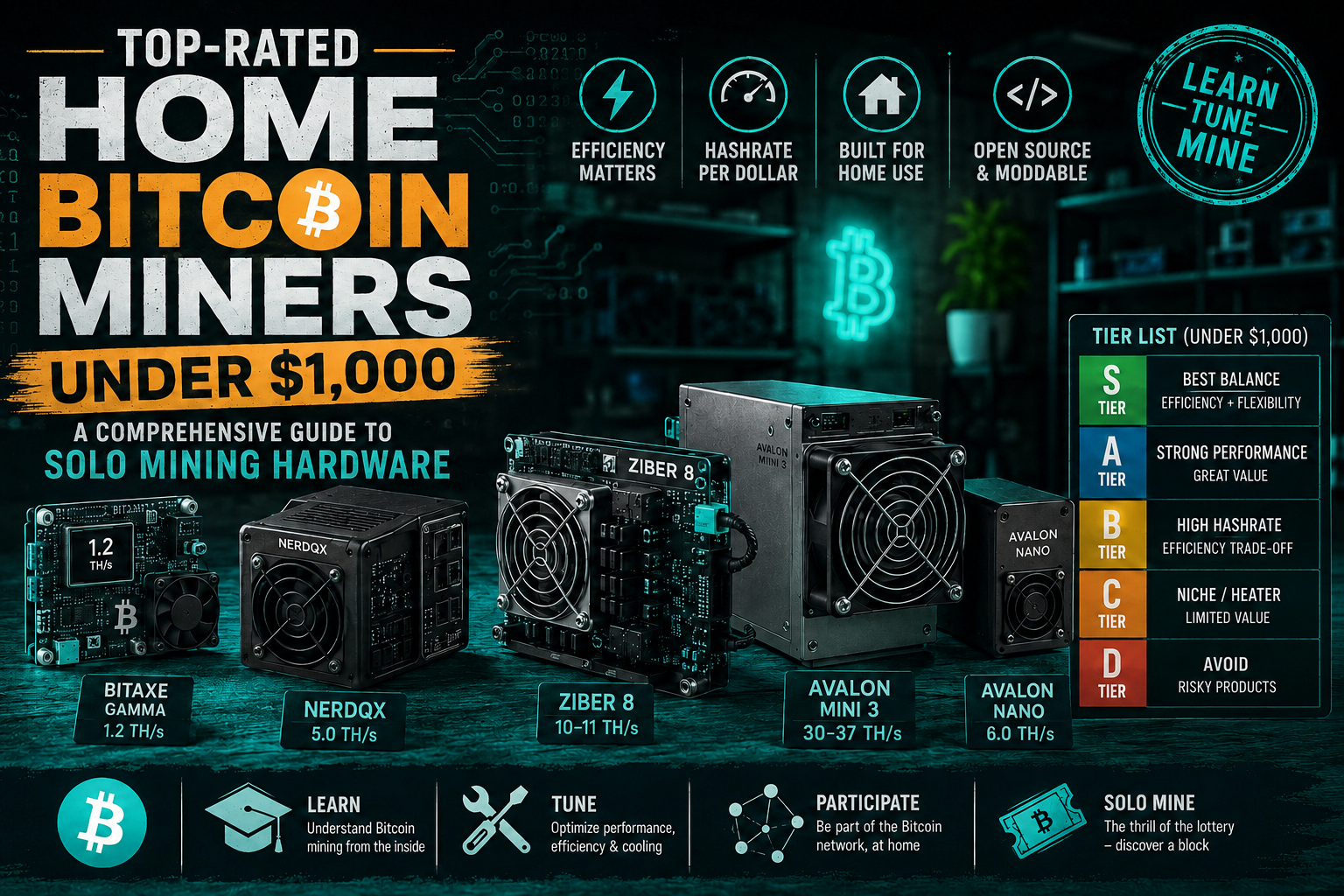
| Device Model | Ranking | Hashrate | Efficiency | Approx. Price |
|---|---|---|---|---|
| Bitaxe Gamma | S-Tier | 1.2 TH/s | High (Tuned) | ~$120 |
| NerdQX | S-Tier | 5.0 TH/s | ~15 J/TH | ~$400 |
| Ziber 8s | A-Tier | 10-11 TH/s | 16-20 J/TH | ~$600 |
| Avalon Mini 3 | B-Tier | 30-37 TH/s | Moderate | ~$850 |
| Avalon Nano 3S | B-Tier | 6.0 TH/s | Moderate | ~$200 |
Best Home Bitcoin Miners (S-Tier): Highest Performance Under $1,000
Bitaxe (Gamma and Similar Variants): The Leading Open-Source Hobby Mining Platform
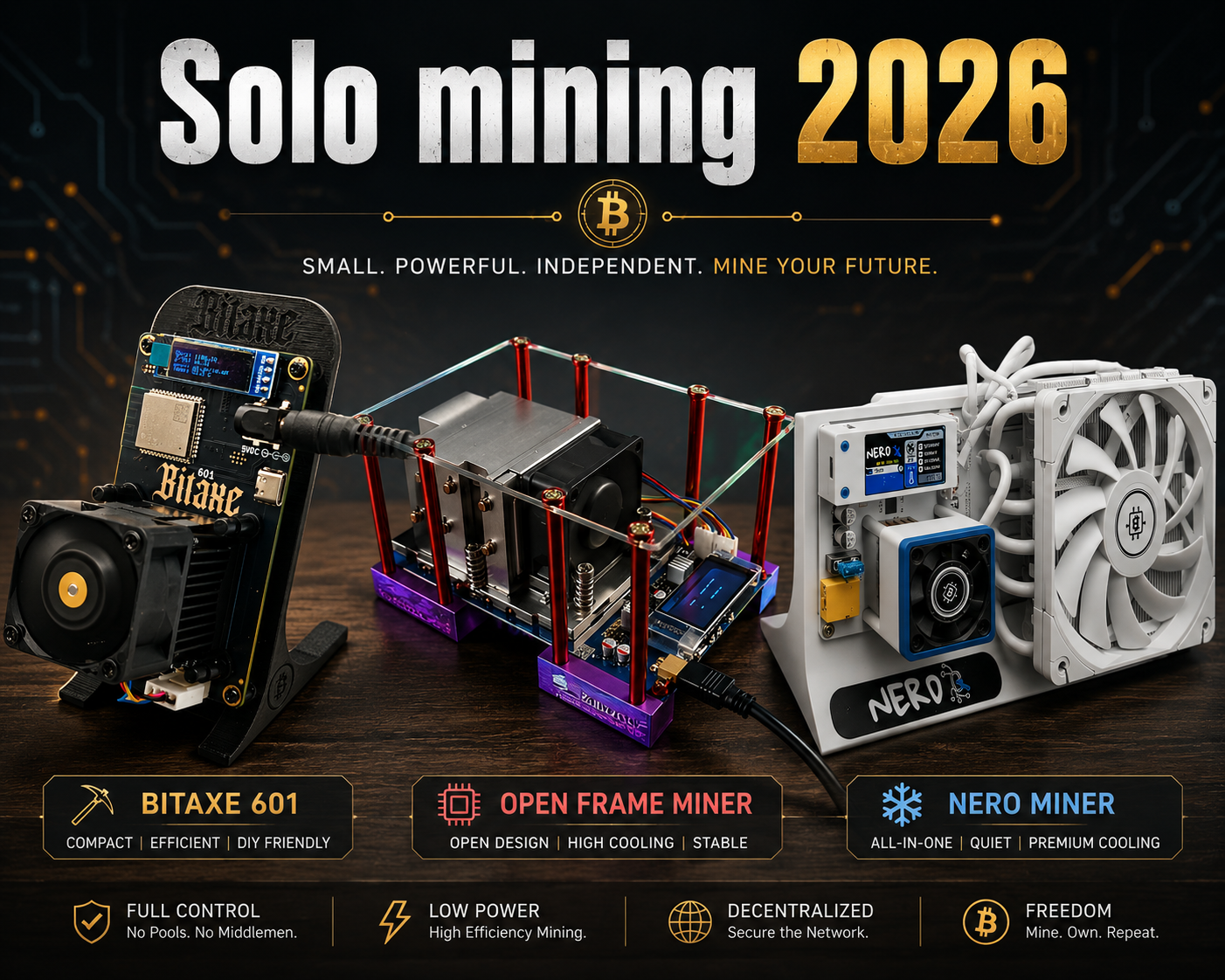
The Bitaxe platform has become the reference point for modern hobby mining. It is inexpensive (often around $100), fully open-source, and backed by a huge community. You can adjust clocks, undervolt, swap fans and heatsinks, and even customize displays. In raw numbers, the hashrate is modest, and the cost per terahash is not amazing. But that’s not the point. The Bitaxe is about education, experimentation, and accessibility. It teaches you how mining actually works: difficulty, efficiency curves, thermal limits, and stability tuning.
- Why it’s S tier: Extremely low entry cost; Open-source and highly moddable; Huge community and documentation; Perfect learning and tinkering platform.
NerdQX (4-Chip Board): High-Efficiency Performance for Serious Home Miners
Here is where we slightly diverge from many rankings: the NerdQX deserves to sit alongside the Bitaxe in S tier for a different reason. While more expensive (around $400), it offers much better efficiency and higher sustained performance. With roughly four chips on the board, it can reach around 5 TH/s with very respectable efficiency figures (often near the mid-teens J/TH when tuned properly).
- Why it’s S tier: Excellent efficiency for its class; Open-source and tunable; More stable “set-and-forget” performance than ultra-small miners; A good bridge between toys and real hardware.
A-Tier Home Bitcoin Miners: Great Performance at an Affordable Price
Ziber 8s / Zeva 8 (Cyber 8 Class): Mid-Range Hashrate for Dedicated Solo Mining
These 8-chip boards push into the 10–11 TH/s range while staying under the $1,000 budget, often closer to $600. They use more robust power connectors (such as XT30 instead of barrel jacks) and allow for some customization in cooling and tuning.
Efficiency is noticeably better than heater-style miners, typically around 16–20 J/TH depending on configuration. While not open-source in the same way as Bitaxe or NerdQX, they are far more purpose-built for solo mining rather than heating.
- Why it’s A tier: Much higher hashrate than small boards; Decent efficiency for home use; Better suited to real solo mining experiments.
Best Budget Bitcoin Miners for Home Use (B-Tier)
Avalon Mini 3: High Hashrate Performance Optimized for Home Heating
The Avalon Mini 3 can reach roughly 30–37 TH/s, which is impressive for a device under $1,000. However, it achieves this by leaning heavily into the “miner as a heater” concept. Efficiency is not great, and control over tuning is limited because the device is designed to regulate itself based on temperature.
- Why it’s B tier: Great hashrate for the price; Poor efficiency compared to hobby-focused boards; Limited tuning and customization.
Avalon Nano 3S: The Simple, Beginner-Friendly Entry Point for Passive Mining
The Avalon Nano is often seen as the entry-level device: around 6 TH/s for roughly $200. Power consumption is relatively low, making it easy to run at home without worrying too much about your electric bill.
- Why it’s B tier: Very accessible and simple; Reasonable hashrate for the size; Limited flexibility; Better as a “first taste” than a long-term platform.
Nerd OctaX and Specialized Bitaxe Variants (Hex & Gamma Turbo)
The OctaX is essentially two NerdQX boards combined into an 8-chip design. The problem is price—often close to $1,000—and diminishing returns on efficiency as chip count increases.
The Bitaxe Hex (Super/Ultra) and Gamma Turbo variants offer interesting modding potential but rely on older chipsets or sacrifice efficiency for compact performance.
Bitcoin Mining Hardware to Avoid: Poor Value Home Miners
C-Tier: Niche Heater Products and Novelty Designs (Heatbit & Bitaxe Shovel)
Heatbit products focus heavily on the heat your home narrative. In practice, they are often overpriced and based on repurposed older ASIC hardware. Similarly, the Bitaxe Shovel is essentially a novelty enclosure that offers no technical advantage over a standard Bitaxe build.
D-Tier: Closed-Source Clones and Hardware with Reliability Issues
The Lucky Miner L7 / L8 devices are widely seen as closed-source clones of the Bitaxe ecosystem. Reports of reliability issues and lack of transparency make them risky purchases compared to the supported open-source community.
Special Case: NerdMiner. Operating in the kilohash range, this is a $30–$40 display gadget/toy. It is not a real miner for those looking to contribute hashrate.
Which Is the Best Home Bitcoin Miner Under $1,000? Final Recommendation
Home Bitcoin mining under $1,000 is no longer about chasing guaranteed profit. That era is gone. Today, these machines serve a different purpose: they give individuals direct access to the Bitcoin network in a way that feels personal, educational, and surprisingly rewarding.
Some people buy a miner to learn how ASIC hardware actually behaves under real thermal and power conditions. Others enjoy tuning efficiency curves, experimenting with firmware, or participating in solo mining simply for the excitement of potentially discovering a block on their own. And for many hobbyists, that experience alone justifies the cost.
The market has also matured. A clear divide now exists between true open-source hobby miners and marketing-first products built around novelty or heating narratives. Devices like the Bitaxe and NerdQX stand out because they prioritize transparency, community development, and experimentation rather than unrealistic promises.
If your goal is to understand Bitcoin mining from the inside, a compact home miner can be one of the most interesting pieces of hardware you will ever own. It transforms mining from an abstract industrial process into something tangible—something you can hear, tune, monitor, optimize, and control yourself.
In the end, the best home miner is not necessarily the one with the highest hashrate. It is the one that matches your purpose:
-
Choose a Bitaxe if you want the purest learning and open-source experience.
-
Choose a NerdQX if efficiency and serious hobby performance matter most.
-
Choose larger heater-style miners only if you understand the trade-off between heat, noise, and electrical cost.
Because at this scale, home mining is less about competing with industrial farms—and more about participating in Bitcoin itself.
Home Bitcoin Mining FAQs: Solo Mining Hardware, Costs & Profitability
Q1: Am I actually going to make any money or hit ROI with these sub-$1,000 miners?
Honestly, probably not. These machines are not about guaranteed daily profits or competing with industrial mining farms. Think of them more like an educational hobby, a hands-on way to learn about ASIC hardware, or a very cool lottery ticket for solo mining. If you buy one expecting to get rich, you'll be disappointed. But if you want to tinker with hardware, tune efficiency, and directly participate in the Bitcoin network, they are 100% worth it.
Q2: Why is the 1.2 TH/s Bitaxe ranked S-Tier, but the 30 TH/s Avalon Mini 3 is only B-Tier?
It all comes down to usability and the tinker factor. The Avalon Mini pushes way more hashrate, but it's basically a space heater—it wastes a lot of electricity, has poor efficiency, and the software is pretty locked down. The Bitaxe (around $120) is ranked S-Tier because it is entirely open-source. You can change the cooling, adjust the clocks, undervolt it, and learn the actual mechanics of mining with a massive community backing you up.
Q3: What about the NerdMiner? I see them everywhere for like $30.
Save your money if you actually want to mine. The NerdMiner is a cool desk gadget and a fun little display toy, but it hashes in the kilohash range. That is practically zero computing power. It is not a real miner for anyone looking to contribute actual hashrate. If you want a serious entry-level board, skip the toys and grab a Bitaxe or a NerdQX instead.
Q4: I found a super cheap Lucky Miner L7 online. Should I grab that instead of building a Bitaxe?
Hard pass. Devices like the Lucky Miner L7 and L8 are essentially closed-source clones of the open-source Bitaxe ecosystem. The community avoids them because they are notorious for reliability issues and a complete lack of transparency. Stick to the S-Tier and A-Tier boards where you get actual open-source firmware, transparent development, and real community support to troubleshoot when things go wrong.