
INTRODUCTION
In the rapidly evolving landscape of commercial and industrial (C&I) energy storage, choosing the right hardware often comes down to a choice between modularity and integration. The eCube and MPack 233 represent two distinct philosophies in battery architecture, each designed to solve specific challenges for different site scales and electrical requirements.
Understanding the Architecture: Modular vs. Integrated
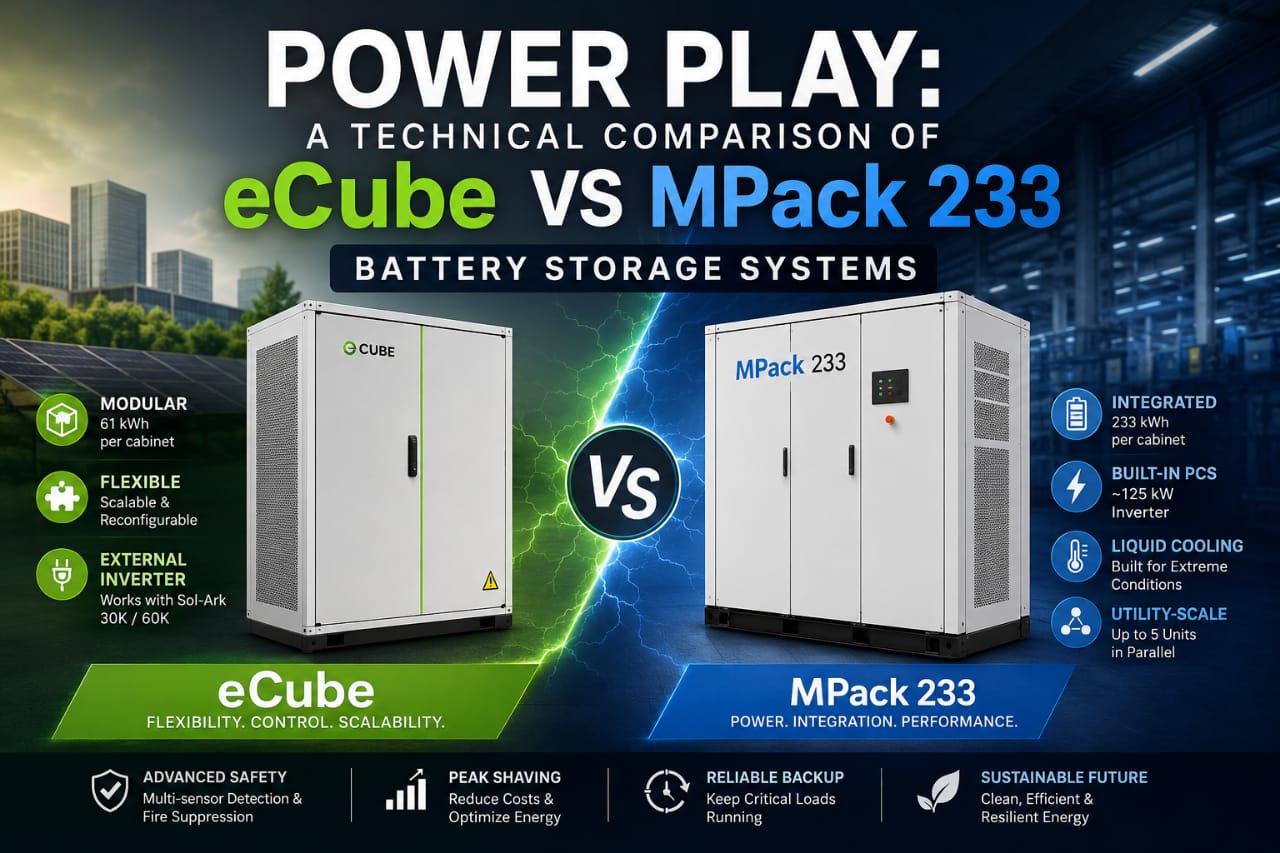
The eCube is designed as a highly flexible, modular cabinet. It functions primarily as a bridge product for light commercial projects, housing 12 internal modules that provide a combined capacity of approximately 60–61 kWh. Because it lacks a built-in inverter, it is intended to be paired with external units, such as the Sol-Ark 30K or 60K. This makes it an ideal choice for installers who require granular control over system design and phased expansions.
In contrast, the MPack 233 is a powerhouse of integration. Providing roughly 233 kWh of storage within a single cabinet, it features a built-in Power Conversion System (PCS) with a ~125 kW inverter. This "all-in-one" approach is optimized for heavier industrial loads and sites where rapid deployment and operational simplicity are the top priorities.
✅ Key Summary
eCube: Modular (61 kWh) — Flexible & External Inverter
MPack 233: Integrated (233 kWh) — Powerhouse & Built-in Inverter
Perfect for choosing between Customization (eCube) vs Scale (MPack).
Voltage Dynamics and Inverter Interfacing
One of the most unique features of the eCube is its reconfigurable voltage design. The system can be rewired to operate in either a lower-voltage mode (≈270–360 V DC) or a higher-voltage mode (≈720–860 V DC). This allows it to adapt to various inverter classes and utility requirements.
The MPack 233 skips the rewiring flexibility in favor of a dedicated high-voltage series architecture. Since the PCS is integrated, it is designed for AC-coupling, making it a "plug-and-play" solution that can be dropped into existing infrastructure with minimal disruption to current PV or inverter setups.
Thermal Management and Environmental Resilience
Environmental factors often dictate the longevity of a storage system.
The eCube utilizes standard air/AC cooling methods, which are efficient for most moderate commercial environments.
However, the MPack 233 is built for more extreme conditions—from the humidity of Florida to the sub-zero temperatures of Canada.
It employs a sophisticated liquid cooling and heating system using conduction pads to maintain optimal cell temperatures regardless of the external climate.
Safety and Operational Intelligence
Safety remains a critical differentiator.
The eCube emphasizes internal monitoring and physical safety barriers, including:
-
Multi-sensor detection: Water, smoke, and heat sensors
-
Internal Fire Suppression: An aerosol-based system to mitigate thermal runaway
-
Pressure Relief: A "blast lid" design that vents pressure upward during a failure
While the MPack 233 focuses on array-level management through its specialized combiner cabinets and native EMS (Energy Management System), it is positioned as a utility-scale optimized system capable of scaling up to 5 units in parallel for massive energy reserves.
Technical Specifications Comparison
| Category | eCube (≈60–61 kWh modular cabinet) | MPack 233 (≈233 kWh integrated system) |
|---|---|---|
| Target Segment | Commercial / Light Industrial (bridge from residential to C&I) | Commercial / Industrial (larger sites, heavier loads) |
| Energy Storage (Nominal) | ≈60–61 kWh | ≈233 kWh |
| Battery Architecture | 12 battery cells/modules inside one cabinet | 5 storage modules inside one cabinet |
| Per-Module Capacity | ≈5 kWh per module | Not specified |
| Reconfigurable Voltage | Yes | No |
| DC Voltage (Lower Mode) | ≈270–360 V DC | Not specified |
| DC Voltage (Higher Mode) | ≈720–860 V DC | Higher-voltage architecture |
| Common Inverter Pairing | Sol-Ark 30K / 60K | Built-in PCS |
| Certifications | UL 9540 listing | Not specified |
| Inverter Compatibility | UL 9540 Edition 3 roadmap | Not specified |
| Other Inverter Support | Solis mentioned | Not specified |
| Grid Coupling | AC or DC parallel | AC-coupled |
| Scaling (Per Inverter) | Up to 6 eCube units | Parallel arrays |
| Large Scaling Example | 6×6 → ~2 MW storage | Up to 5 units |
| Primary Use Case | Peak demand shaving | Peak shaving + resiliency |
| Applications | Retail, restaurants, grocery, commercial | Hospitals, schools, EV charging |
| Three-Phase Capability | Yes | Yes |
| Thermal Management | Air Cooling | Liquid Cooling |
| Extreme Climate | Not specified | Heat + self-heating |
| EMS | Internal EMS | Native EMS |
| Flood Protection | Yes | Not specified |
| Smoke & Heat Detection | Yes | Not specified |
| Cell Temperature Monitoring | Yes | Not specified |
| Fire Suppression | Aerosol system | Not specified |
| Pressure Relief | Blast lid | Not specified |
| Retrofit Friendliness | Moderate | Strong |
| Utility Scale Optimization | No | Yes |
| Built-in Inverter | No | Yes (~125 kW) |
| Availability | Not specified | ~6 days (source claim) |
| Sales Model | Not specified | Direct + distributors |
Final Technical Takeaway
The comparison between the eCube and MPack 233 highlights a broader shift happening inside the commercial energy storage market: flexibility versus integration.
The eCube is engineered around modularity and inverter flexibility, making it highly attractive for smaller commercial deployments and projects where customization matters more than raw scale.
Its architecture favors integrators who want granular control over system expansion and component pairing.
The MPack 233, by contrast, represents the evolution toward fully integrated infrastructure.
With built-in PCS functionality and liquid thermal management, it is designed for sites where deployment speed and operational simplicity are paramount.
In practical terms, the two systems do not directly compete; rather, they serve different ends of the commercial spectrum, demonstrating that modern battery storage is now as much about system architecture as it is about chemistry.
Frequently Asked Questions
Q1: Is it better to go modular with eCube or integrated with MPack?
It really depends on your site’s specific needs.
If you already have an inverter setup or want the freedom to choose your own components, the eCube’s modularity is a huge win.
However, if you want a "one-and-done" solution where everything is pre-configured to work together right out of the box, the MPack 233 saves a lot of engineering headaches.
Q2: How does the liquid cooling in the MPack 233 actually benefit my business?
Think of it like a car engine.
Air cooling (used in the eCube) works fine for most, but liquid cooling is far more efficient at moving heat away from the battery cells.
For a business, this means the batteries stay at a stable temperature even during heavy use or extreme weather, which translates to a longer lifespan and better performance over time.
Q3: Can I start small with eCube and grow later?
Yes, that is one of the eCube's strongest selling points.
Since it's built around 5 kWh modules and supports parallel expansion, it’s much easier to scale up your storage capacity as your business grows.
The MPack 233 is more of a "full-scale" investment from day one, designed for sites that already know they have high energy demands.