
Introduction: How Rising Electricity Costs Are Reshaping Crypto Mining
Let’s be real—the biggest headache for anyone in crypto right now isn't just the market volatility; it’s the power bill. It has reached a point where electricity costs aren't just a line item anymore—they’re basically the "final boss" for miners. If you can’t find a way to get dirt-cheap, stable energy, you’re pretty much just spinning your wheels.
This pressure is forcing people to get really creative, and honestly, some of the solutions are pretty brilliant.
Take Gas Flaring Recovery, for example. Think about all those oil and gas sites that just burn off "waste" gas into the atmosphere because they have no way to move it. It’s literally lighting money on fire while hurting the planet.
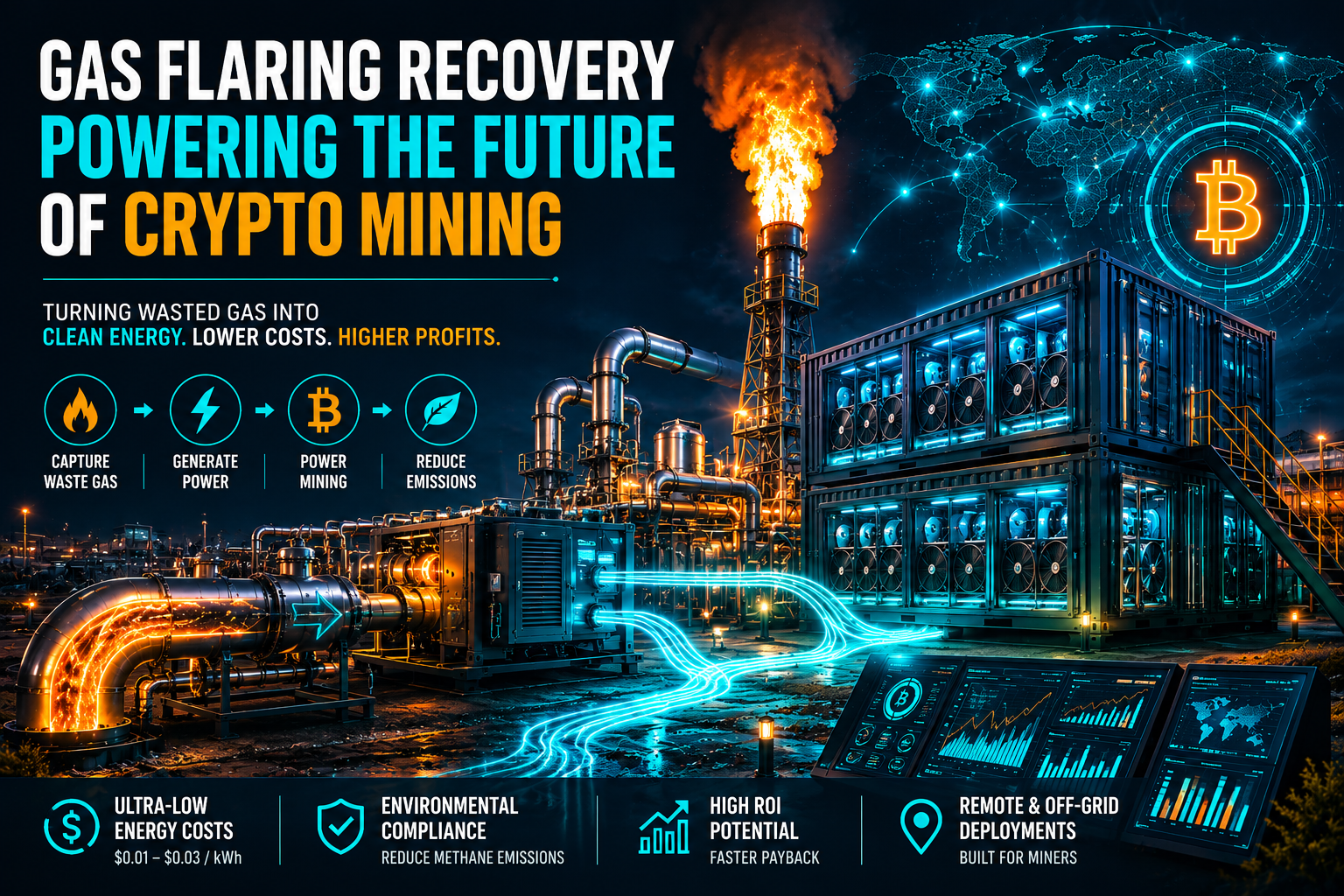
What’s happening now is that miners are setting up shop right at the source. They’re taking that wasted gas, running it through a generator, and turning it into cheap, off-grid electricity on the spot. It’s one of those rare "no-brainer" scenarios:
- The oil companies stop wasting fuel.
- The environment takes less of a hit.
- Miners get the kind of low-cost power that keeps them in the game long-term.
It’s less about "corporate synergy" and more about just being smart with what we used to throw away.
What Is Gas Flaring Recovery? Simple Explanation for Mining Operators
Gas flaring recovery is about collecting natural gas that comes out when oil is extracted. Often, this gas is just burned off because there isn't a good way to move it elsewhere. Instead of letting it go to waste as heat and emissions, we can actually turn it into electricity right there on site using gas generators. This provides a clear path to make use of a resource that would otherwise be lost.
Key Benefits of Gas Flaring Recovery for Cryptocurrency Mining
This method has several advantages, producing electricity very cheaply and ensuring power is always available, unlike some renewable sources. It also really cuts down on greenhouse gas emissions. For oil and gas companies, it’s a practical way to meet environmental rules and make money from something that would otherwise be waste. This is particularly useful for things that consume a lot of energy, like mining cryptocurrency.
Environmental Compliance Advantages for Major Oil and Gas Companies
Gas flaring can be a real problem for big oil and gas companies. It can lead to headaches with rules, extra charges, and bad press. Many companies are finding that adding gas flaring recovery systems helps them cut down on methane emissions. This approach helps them meet environmental rules and can turn what might be a problem into something valuable. It's a way to get energy and also mitigate environmental concerns.
Technical Architecture of a Gas Flaring Recovery Mining Project
How Gas Flaring Recovery Systems Work at the Wellhead
On a technical level, Gas Flaring Recovery systems work by taking gas right from the wellhead. After that, they filter it a bit and adjust the pressure as needed. This gas then flows into industrial gas generators or microturbines that are set up directly at the site. These generators turn chemical energy into electrical power. This power is used right where it's made, so there's no need for a connection to the national grid. This makes the system quite suitable for operations in remote areas.
Required Equipment for a 1 MW Gas-to-Power Deployment
A standard deployment typically includes gas capture and conditioning units, industrial gas generators (usually modular and containerized), control and monitoring systems, electrical distribution infrastructure, and optional heat recovery units. For mining applications, the setup is often paired with mobile data center containers housing ASIC miners.
Equipment Lifespan and Maintenance Requirements
Industrial gas generators used in these projects have an average operational lifespan of 15 to 25 years, with major overhauls required approximately every 8 to 10 years while auxiliary systems such as filters, valves, and control electronics follow standard industrial maintenance cycles, ensuring long-term reliability when properly serviced.
Capital Expenditure and Electricity Cost per kWh
Energy Cost Comparison: Gas Flaring vs Traditional Mining (2026)
| Energy Source | Cost per kWh | Stability | Scalability | Best Use Case |
|---|---|---|---|---|
| Gas Flaring Recovery | $0.01 – $0.03 | Very High | High | Remote mining farms |
| Grid Electricity | $0.05 – $0.12 | High | High | Urban / industrial mining |
| Solar + Storage | $0.04 – $0.08 | Variable | Medium | Daytime / hybrid systems |
| Hydropower | $0.02 – $0.05 | High | Location dependent | Regions with water access |
For a reference capacity of 1 MW, total capital expenditure generally ranges between 700,000 and 1.2 million USD, depending on generator brand, gas quality, and automation level, while the resulting electricity cost typically falls between 0.01 and 0.03 USD per kWh, positioning it among the cheapest power sources available globally.
Global Deployment: Where Gas Flaring Recovery Is Already Proven
We have thoroughly tested this technology in areas with a lot of oil and gas work. This includes places like Texas, North Dakota, Wyoming, Alberta in Canada, Russia, and parts of the Middle East. They all produce a lot of associated gas often quite a distance from cities and regular power lines.
Why Remote Oil Fields Are Ideal for Off-Grid Crypto Mining
Due to the nature of oil and gas fields, most Gas Flaring Recovery installations are located in remote, low-population areas, which aligns perfectly with cryptocurrency mining operations that do not require proximity to cities, while benefiting from reduced land costs, minimal grid constraints, and fewer regulatory bottlenecks.
ROI Case Study: Mining Integration with $0.03 per kWh Electricity
Gas flaring recovery projects, when combined with cryptocurrency mining, often show a high return on investment. This is mainly due to the very low cost of fuel, stable power pricing, and regulations that reward reducing emissions. These factors help operators recover their initial investment much more quickly than conventional mining operations that rely on the power grid. For example, with electricity at 0.03 USD per kWh, a single Bitmain Antminer S23 Hydro 3U consumes about 38 USD worth of energy daily. This translates to an estimated annual revenue of around 13,800 USD, showing how low-cost electricity directly leads to good mining profitability.
Conclusion: A New Blueprint for Mining Infrastructure
Gas flaring recovery has officially moved from a "proof of concept" to a definitive competitive edge. By turning wasted fuel into ultra-low-cost energy, this model does more than just cut costs—it fundamentally redefines how we build and scale sustainable mining operations.
The logic is hard to argue with. For miners, it’s a path to wider margins and faster ROI in an increasingly cutthroat market. For the energy sector, it’s a ready-made solution to cut emissions and monetize resources that were literally going up in smoke.
As traditional grid prices climb and regulators turn up the heat, the old way of mining is becoming a liability. Off-grid solutions aren't just a clever alternative anymore; they are becoming the cornerstone of the next generation of Bitcoin infrastructure.
FAQ: Gas Flaring Recovery and Cryptocurrency Mining
Q1: What is gas flaring recovery in cryptocurrency mining?
Gas flaring recovery is a method of capturing associated natural gas from oil production that would otherwise be burned off, converting it into on-site electricity to power cryptocurrency mining operations at very low cost.
Q2: How much does electricity from gas flaring recovery cost?
Electricity generated from recovered flare gas typically ranges between 0.01 and 0.03 USD per kWh, making it one of the cheapest power sources available for Bitcoin and Proof-of-Work mining.
Q3: Is gas flaring recovery environmentally friendly?
Yes. By capturing and utilizing associated gas instead of flaring it, operators significantly reduce methane emissions and improve environmental compliance compared to traditional flaring practices.
Q4: Why is gas flaring recovery suitable for remote mining farms?
Oil fields are often located in remote areas far from cities and grid infrastructure. Cryptocurrency mining does not require urban proximity, making off-grid flare gas power an ideal solution for isolated mining farms.
Q5: What is the ROI potential when mining with $0.03 per kWh electricity?
At 0.03 USD per kWh, mining profitability improves substantially because energy represents the largest operational expense. Lower electricity costs directly increase margins and shorten payback periods.
Q6: What equipment is required for a flare gas-powered mining project?
A typical project requires gas capture and conditioning systems, industrial gas generators or microturbines, electrical distribution infrastructure, monitoring systems, and modular data center containers with ASIC miners.
Q7: Where is gas flaring recovery already used for mining?
The technology has been deployed in oil-producing regions such as Texas, North Dakota, Wyoming, Alberta in Canada, Russia, and parts of the Middle East where associated gas is abundant and grid access is limited.