
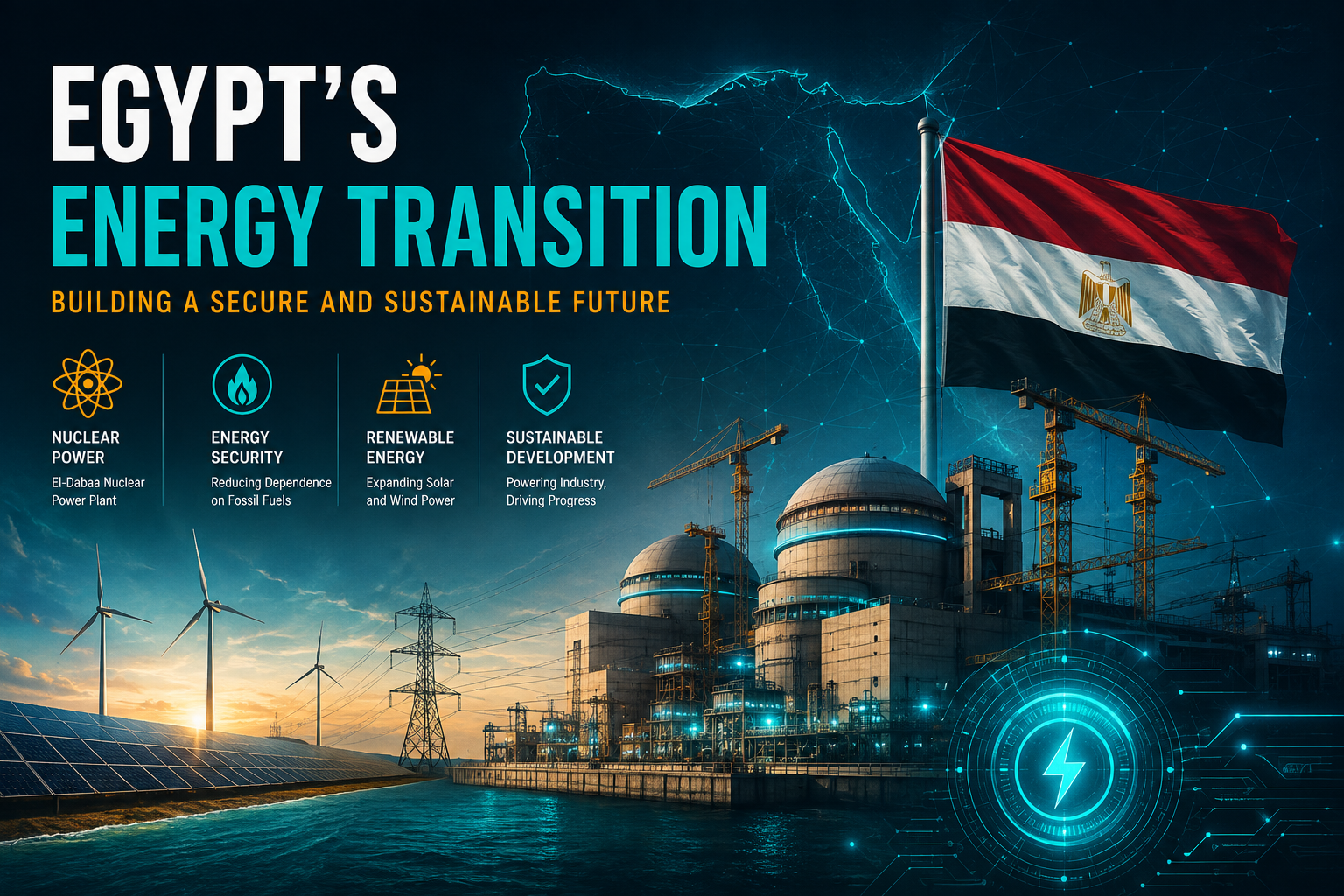
Egypt's Energy Transition: A Critical Overview
Egypt is going through one of the most pivotal economic and demographic shifts in its modern history—a transition largely driven by rapid structural changes that have taken shape in recent years. As the national population crosses the threshold of 120 million people and the country firmly establishes itself as a prime regional destination for heavy industrial investments—most notably energy-intensive sectors such as steel, aluminum, cement, and petrochemicals—Egypt has successfully consolidated its position as the second-largest economy on the African continent. Consequently, securing an uninterrupted, highly resilient electricity supply at regionally competitive tariffs has evolved from a routine developmental goal into an urgent issue of national economic security that permits no further delay or reliance on temporary palliatives.
Despite the unprecedented strides the Egyptian state has made in constructing and modernizing its nominal power generation and distribution infrastructure over the past decade, recent years have exposed severe structural vulnerabilities within the national energy framework. These vulnerabilities became painfully clear when the government had to roll out extreme austerity measures. Among them were aggressive "load-shedding" schedules that forced shopping malls, retail stores, and public spots to close early just to keep the national grid from collapsing.
On top of these domestic headaches, ongoing geopolitical tensions over upstream Nile water flows—specifically the dispute surrounding the Grand Ethiopian Renaissance Dam (GERD)—raise real questions about the long-term reliability of hydropower from the Aswan High Dam.
All of this leads to one critical question for national policy: Will the El-Dabaa Nuclear Power Plant be the ultimate breakthrough that breaks Egypt’s dependence on natural gas and finally stabilizes the grid—marking a bold return to nuclear power with a new generation of ultra-safe reactors?
1. Demographics and Heavy Industry: The Growing Demand on Egypt’s Grid
The relentless pace of demographic expansion and urban growth across Egypt places an immense, continuous burden on national power generation and distribution grids. Electricity demand is no longer confined to expanding residential consumption but is increasingly driven by the massive infrastructure requirements of newly developed mega-cities and widespread urban expansion across various governorates. Concurrently, Egyptian policymakers remain committed to maintaining regionally competitive power tariffs in order to attract foreign direct investment that is exceptionally sensitive to baseline operating expenditures. Current residential electricity tariffs range from less than $0.021 per kWh at lower consumption tiers, scaling up to approximately $0.039 per kWh for commercial and heavy industrial operations after accounting for value-added taxes, transmission fees, and localized distribution costs.
While these heavily subsidized rates are key to keeping the country attractive to investors, they put a massive strain on the national treasury. The government is forced to continuously swallow the difference between what consumers pay and what energy actually costs to produce—a gap where real production costs often double the subsidized retail price. Within this framework, vital heavy industries such as cement, aluminum, and steel production rely entirely on an uninterrupted, ultra-stable power supply operating 24 hours a day, 7 days a week. For these industrial facilities, even minor voltage fluctuations, frequency drops, or temporary blackouts do not merely disrupt production schedules; they inflict catastrophic financial losses by causing severe mechanical damage to precision equipment and triggering the premature solidification of raw materials within high-temperature industrial furnaces.
2. The Egyptian Power Paradox: Giant Capacity, Severe Fuel Shortages
At a glance, Egypt appears to have an enviable power system, boasting a total capacity of nearly 59 Gigawatts (GW). In theory, that is more than enough to handle peak daily consumption, which usually sits between 32 Gigawatts (GW) and 35 Gigawatts (GW). Even when brutal summer heatwaves push demand well beyond that range, the system still cranks out roughly 218.5 Terawatt-hours (TWh) of electricity every year.
Yet, the central paradox of Egypt's power grid is built right into its foundation: the energy mix remains overwhelmingly hooked on fossil fuels. Natural gas, heavy fuel oil (mazut), and diesel collectively account for 87.7% of total electricity generation, leaving the remaining fraction thinly distributed among conventional hydropower (~7%), solar power (2.4%), and wind generation (2.9%).
This deep structural imbalance highlights a critical technical reality: possessing vast generation capacity does not inherently guarantee the actual availability of electricity in the power lines. State-of-the-art combined-cycle power facilities—such as the three multi-billion-dollar mega-plants constructed by Siemens—lose their entire operational utility the moment the continuous flow of primary fuel is interrupted or throttled. As a result, gigawatts of surplus generation capacity are rendered completely idle, functioning merely as stranded capital assets whenever the state faces logistical or financial hurdles in procuring sufficient volumes of natural gas or diesel to turn the turbines.
EGYPT'S CURRENT ENERGY MIX
| Fossil Fuels (Natural Gas, Mazut & Diesel) - 87.7% |
|---|
| Hydro (~7%) |
| Wind (2.9%) |
| Solar (2.4%) |
3.Anatomy of a Power Crisis: How Fuel Deficits Triggered Rolling Blackouts
Egypt relies heavily on gas-fired thermal plants to generate roughly three out of every four kilowatts of its electricity. Things really get dicey when the summer heat sets in and power consumption shoots through the roof. With millions of air-conditioning units cranking nonstop across households, retail stores, and corporate offices, the entire supply system gets pushed straight to its physical limit. Keeping the lights on and dodging widespread failure during these blistering months requires a staggering daily diet: roughly 135 million cubic meters of natural gas plus more than 10,000 metric tons of heavy diesel and mazut fuel.
The system hit a breaking point when a severe structural bottleneck emerged. Domestic gas field yields began to drop—most notably at the massive offshore Zohr field—just as foreign currency reserves shrank, making expensive liquid natural gas (LNG) imports almost impossible to finance.
With fuel supply falling far short of demand, the government was left with no choice but to enforce rotational load-shedding. Blackouts were rotated from one province to the next, often leaving entire blocks in the dark multiple times a day. More than just a major headache for everyday life, these relentless power cuts triggered fierce public backlash, threw daily schedules into chaos, and hit small business owners right where it hurts—forcing many who depend on constant electricity to watch their operations come to a grinding halt.
4. Emergency Management and Load-Shedding: Economic and Social Repercussions
To cope with severe fuel shortages, mounting foreign currency pressure, and an energy import bill that ballooned by over 300%—driven by regional conflicts, global market disruptions, and rising inflation—the government rolled out a series of aggressive austerity measures:
- Reducing Business and Commercial Operating Hours
Egyptian authorities imposed a decision at the beginning of the 2026 summer season requiring the early closure of shops, restaurants, cafes, nightclubs, and other commercial activities, with closing at 9:00 PM on weekdays and 10:00 PM on weekends. This decision had a clear impact on activities that rely on customer movement during evening hours, especially restaurants, cafes, bars, and nightclubs, in addition to the nightlife, entertainment, and tourism sectors.
- Reducing Street and Commercial Lighting
Local authorities resorted to lowering the lighting level in some main streets, along with stopping a number of illuminated commercial signs and advertisements, as this service is the most electricity-consuming in a city inhabited by 25 million people. Although the goal was to reduce electricity consumption, this made some areas and streets darker during night hours and raised safety and security concerns, especially in areas that already suffer from poor lighting.
- Tightening Control over Compliance with Closing Dates
The Egyptian Ministry of Interior, through the Security Directorate and police, in coordination with local authorities and regulatory bodies, took over following up on business owners' compliance with the new closing dates and applying financial fines to violators of these laws, including shop owners who continued to work after the specified closing times. For small project owners, these measures came as an economic shock, represented by high operating costs and weak sales and income due to the reduced daily economic activity period, which increased the economic pressures faced by citizens.
- A Temporary Solution to a Larger Problem
These measures helped reduce electricity consumption for a limited period, but they did not address the root of the problem. Closing shops early, reducing street lighting, and limiting electricity consumption led to several problems, including the spread of crime and reducing the daily income of many residents of major cities.
This worsening problem of weak supplies of energy materials such as gas and diesel, and problems in providing foreign currency due to the deterioration of foreign exchange reserves and geopolitical problems, cannot be solved by a simple local decision in this way.
5. The Zohr Gas Field: From Self-Sufficiency to Technical Pressure Drops
The discovery of the supergiant offshore Zohr natural gas field in 2015 represented a historic turning point for Egypt, enabling the nation to rapidly achieve natural gas self-sufficiency and transition into a net exporter of liquefied natural gas (LNG). Hailed at the time as a transformative asset that would permanently elevate Egypt into a dominant regional energy hub endowed with vast reserves, the Zohr field quickly grew to single-handedly supply between 40% and 50% of total domestic gas consumption.
But that promising momentum ran straight into a wall of underground technical troubles. Unexpected water began seeping into the producing reservoir just as reservoir pressure started dropping much faster than anticipated. As a result, production slid from its peak of over 2.7 billion cubic feet per day (Bcf/d)—which was originally expected to hit 3.2 Bcf/d—down to a steady average of around 2.3 Bcf/d. While officials were initially tight-lipped about the setback, their later announcements regarding output adjustments quietly confirmed the geological strain below the surface. This experience delivered a stark operational lesson: relying heavily on a single primary production asset to underpin a national energy strategy carries profound systemic risks when unpredicted geological or mechanical failures occur.
6. The Gas-to-Mazut Substitution Dilemma: Financial and Technical Costs
When European energy prices skyrocketed during the gas crisis, Egyptian energy planners saw an opportunity and made a high-stakes pivot. They began burning imported heavy fuel oil (mazut) in local power plants instead of natural gas. The goal was simple: free up as much gas as possible to sell overseas at premium prices, bringing in desperately needed hard currency. But the strategy backfired over time. As global natural gas prices eventually cooled off while fuel oil costs shot up, the government had no choice but to backtrack—switching its thermal power stations right back to natural gas.
Constantly flipping between natural gas and heavy fuel oil takes a massive toll on power plant machinery. Burning heavier, dirtier fuels cuts down a turbine’s thermal efficiency, bakes carbon deposits onto internal parts, and puts immense thermal stress on sensitive hot-gas components. This back-and-forth fuel switching pushes routine maintenance bills through the roof and forces more frequent overhauls—requiring replacement parts that can only be bought with scarce foreign currency, which creates inevitable delays in keeping power running smoothly. By June, as summer heat drove home cooling demand through the roof, Egypt had no choice but to halt its natural gas exports altogether. At the same time, its pipeline imports remained precariously exposed to regional conflicts, volatile shipping choke-points like the Strait of Hormuz, and broader geopolitical instability.
7. Renewable Energy Expansion: Great Potential Constrained by Grid Intermittency
Egypt is actively executing ambitious renewable energy deployment plans, backed by targeted investments of up to $1.9 billion aimed at integrating an additional 3 Gigawatts (GW) of solar and wind capacity into the national grid by 2026, alongside longer-term targets designed to substantially elevate the share of renewables by 2040. Geographically, Egypt possesses world-class renewable attributes, particularly within solar energy, where regions across the country benefit from exceptionally high direct normal irradiance levels yielding specific photovoltaic power outputs (PVOUT) exceeding 2,000 kWh/kWp.
Despite these favorable conditions, utility-scale solar and wind deployment remains fundamentally constrained by the physics of resource intermittency. Solar generation drops to zero immediately following sunset, while wind output varies unpredictably based on localized atmospheric pressure gradients and seasonal weather patterns. Although off-grid energy storage technologies and utility-scale battery energy storage systems (BESS) continue to advance, their deployment at a scale capable of supporting an entire national grid remains cost-prohibitive. Consequently, intermittent renewables cannot independently supply the continuous, unyielding base load power required to operate continuous-process heavy industrial facilities and keep major urban centers fully powered 24 hours a day.
8. Seven Decades in the Making: The Historical Evolution of Egypt’s Atomic Program
Egypt's pursuit of peaceful nuclear power is far from a recent development; it represents a complex, seventy-year strategic narrative marked by ambitious starts, external geopolitical obstacles, and extended periods of stagnation:
| Year | Event |
|---|---|
| 1955 | Atomic Energy Committee Formed |
| 1958-61 | Inshas Research Reactor (2 MW) |
| 1964 | Borg El-Arab Tender Canceled |
| 1974 | US Deal Stalls (Inspection Terms) |
| 1981-84 | El-Dabaa Site Selected (35 km²) |
| 1986 | Chernobyl Disaster Freezes Projects |
| 2015-17 | Rosatom Contracts Signed (4,800 MW) |
-
1955: President Gamal Abdel Nasser issues an executive decree establishing the Atomic Energy Committee, launching Egypt's formal exploration of peaceful nuclear applications.
-
1958–1961: Egypt built and launched the 2 MW Inshas Research Reactor in Sharqia Governorate, creating a core hub for nuclear science, radioisotope production, and specialized technical training.
-
1964: Egypt floated its first international tender to build a nuclear power plant at Borg El-Arab, near Alexandria. The ambitious plan came to a sudden halt, however, when the 1967 war broke out, forcing the government to divert all national funds toward defense.
-
1974: Talks with the United States to buy a commercial nuclear reactor broke down over harsh American demands. Washington insisted on intrusive oversight and required Egypt to ship all spent fuel processing entirely out of the country.
-
1981 /1984 Egypt revived its nuclear ambitions, securing a 35-square-kilometer coastal site at El-Dabaa on the Mediterranean and launching an international tender to build a 1,000 MW nuclear plant.
-
1986 (The Chernobyl Disaster): The nuclear catastrophe at Chernobyl sent shockwaves of public panic across the globe, forcing Egypt to put its atomic energy plans on ice for nearly two decades.
-
November 2015: Presidents Abdel Fattah El-Sisi and Vladimir Putin signed a historic deal to build Egypt's first commercial nuclear power plant at El-Dabaa.
-
2017: Egypt officially kicked off the project by signing comprehensive engineering and construction contracts with Russia’s state nuclear firm, Rosatom.
9. The El-Dabaa Nuclear Power Plant: Engineering Framework and Russian Partnership
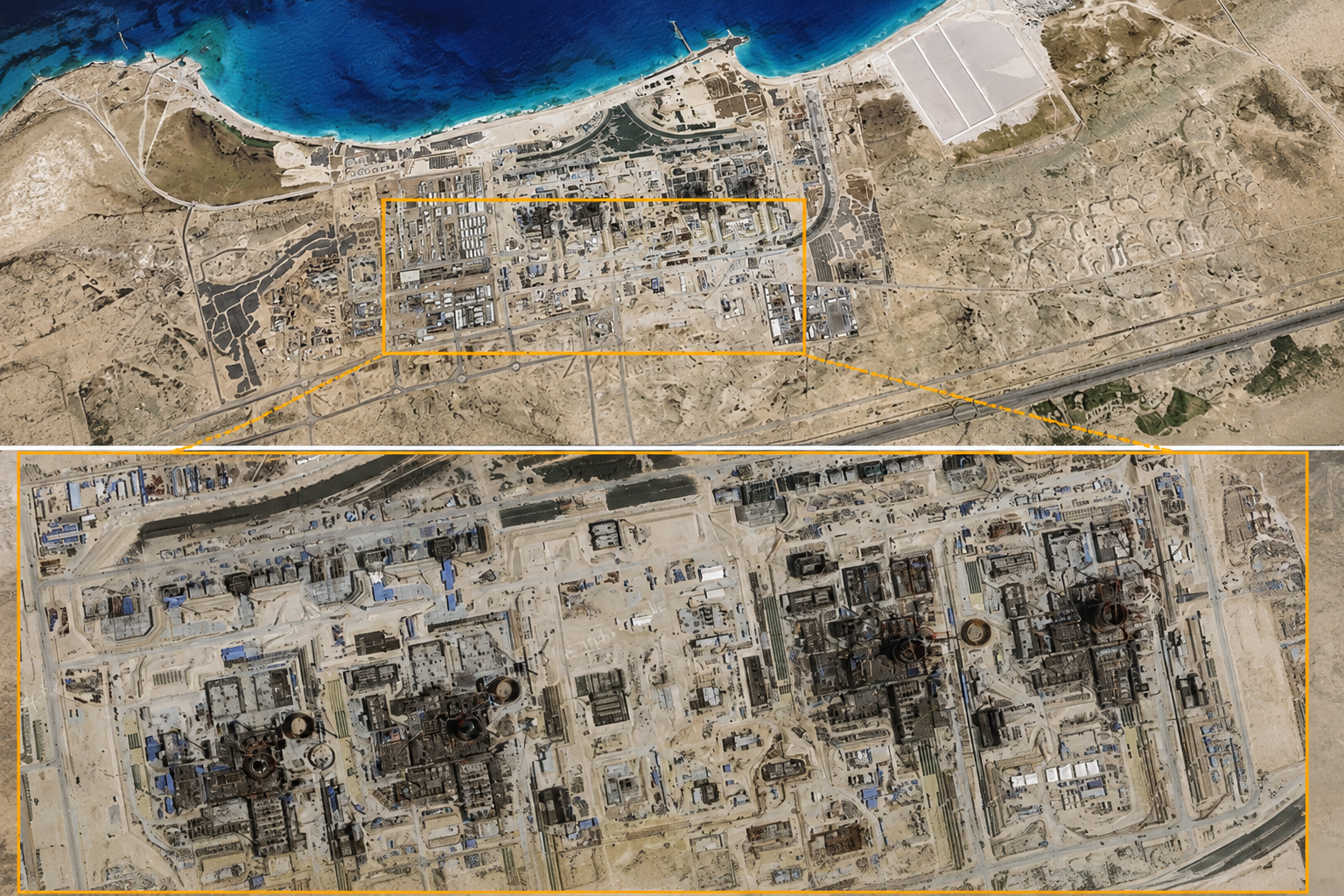
The total capital expenditure for the El-Dabaa Nuclear Power Plant project exceeds $28 billion. Under the financing agreement, the Russian Federation provides an 85% state export credit loan ($25 billion), while the Egyptian government finances the remaining 15% out of state budgetary allocations via structured installments. The facility comprises four advanced Generation III+ VVER-1200 pressurized water reactors. Each individual reactor unit holds an electrical generating capacity of 1,200 MW, bringing the total installed capacity of the complex to 4,800 MW.
The construction process has maintained rapid timelines:
-
2022: The first safety concrete is poured for Units 1 and 2 within a four-month window.
-
2023: Full-scale construction commences on Unit 3.
-
January 2024: First concrete is poured for Unit 4, bringing all four nuclear reactors under simultaneous active construction.
The construction site hosts a workforce of over 25,000 engineers, technicians, and specialized construction workers—more than **17,000 **of whom are Egyptian nationals. Major engineering partners include the Korea Hydro & Nuclear Power corporation (KHNP) alongside leading Egyptian industrial contractors such as Petrojet, Hassan Allam Construction, and The Arab Contractors. Crucially, the underlying contracts contain binding technology transfer clauses designed to thoroughly train Egyptian engineering personnel to independently manage, operate, and maintain the facility throughout its lifecycle.
10. Geographic, Environmental, and Strategic Advantages of the El-Dabaa Site
-
Meeting Regional Demand Centers: Strategically positioned along the northern coast to inject high-density electrical output directly into the industrial hubs and expanding urban centers of the Nile Delta and the North Coast corridor.
-
Arid Topography and Safety Isolation: The arid, desert topography of the Western Desert minimizes proximity to major inland agricultural zones, freshwater networks, and complex terrestrial ecosystems, thereby reducing potential environmental exposure paths in the event of an operational anomaly.
-
Demographic Buffering: The expansive 35 km² site provides a substantial geographic buffer, isolating the reactor complex from dense population centers and enhancing physical security protocols.
-
Abundant Mediterranean Cooling Water: Siting the plant directly on the Mediterranean coastline ensures an endless, thermodynamically stable supply of seawater for secondary cooling loops and steam condensation requirements.
-
Valuable Natural Gas Diversion: Replacing natural gas-fired thermal generation with nuclear base-load capacity frees up vast volumes of domestic natural gas, enabling the state to redirect these hydrocarbons toward export markets or process them internally into high-value petrochemical products.
11. Nuclear Safety Innovations: Eliminating Historical Vulnerabilities
The Generation III+ VVER-1200 reactors selected for El-Dabaa incorporate advanced passive and active safety architectures that render the structural failure modes of historical reactor accidents physically impossible:
SAFETY AND STRUCTURAL TOLERANCES
| Operational Lifespan: 60 - 100 Years (4-Year Fuel Cycle) |
|---|
| Seismic Resilience: Rated for up to Magnitude 10 (MSK) |
| Tsunami Resistance: Rated for Sea Surges up to 14 Meters |
| Impact Resilience: Withstands Direct Impact of 450-Ton |
| Commercial Aircraft Without Radiological Leakage |
The facility features a designed operational lifespan ranging from 60 to 100 years. Under the primary contracts, Rosatom guarantees the full fuel supply cycle for the lifetime of the plant, with a single nuclear fuel assembly batch capable of maintaining continuous operation within the reactor core for up to four full years before requiring replacement. Furthermore, the site includes specialized dry-storage infrastructure for spent nuclear fuel alongside automated waste handling facilities. The entire site remains under continuous international monitoring and compliance auditing by both the International Atomic Energy Agency (IAEA) and the Egyptian Nuclear and Radiological Regulatory Authority (ENRRA).
12. Engineering Milestone: Installation of the Unit 1 Reactor Pressure Vessel
The El-Dabaa project reached its most critical symbolic and engineering milestone with the successful installation of the Reactor Pressure Vessel (RPV) for Unit 1—the primary structural component that houses the active nuclear core and contains the nuclear chain reaction.
This Reactor Pressure Vessel is a massive structural engineering component forged from ultra-high-strength alloy steel, weighing approximately 330 metric tons, standing 11 meters in height, and featuring wall thicknesses of 30 centimeters.
13. Quantifiable Economic and Developmental Benefits
-
Injected Generating Capacity (4,800 MW): Injects a vast, continuous stream of zero-carbon base-load electricity directly into the national grid, providing the structural capacity required to eliminate recurring supply deficits.
-
Multi-Billion-Dollar Gas Conservation: Conserves billions of cubic meters of natural gas annually that would otherwise be combusted for power generation, shielding the broader macroeconomy from volatile global energy shocks.
-
Industrial Support: Delivers reliable, competitively priced power to heavy industries—such as steel, aluminum, and manufacturing—enabling them to maintain uninterrupted, long-term operational schedules.
-
Localized Technological Advancement: Builds a highly trained national cadre of nuclear engineers, health physicists, and specialized technicians, permanently upgrading the nation's technical workforce.
14. What El-Dabaa Can—and Cannot—Solve Within Egypt's Power Sector
While the El-Dabaa complex represents a major structural upgrade, its ultimate effectiveness depends on its integration within a broader, multi-faceted national energy strategy.
| What El-Dabaa Successfully Solves | What Requires Broader System Strategy |
|---|---|
| Continuous Base Load Power: Provides stable, zero-emission electricity 24/7, completely unaffected by weather conditions or international fuel price spikes. | Extreme Peak Demand Surges: Rapid, short-term afternoon spikes during severe heatwaves still require flexible, fast-ramping peaker generation assets. |
| Gas Consumption Offsetting: Replaces billions of cubic meters of domestic natural gas previously burned in aging thermal power stations. | Dynamic Grid Flexibility: Balancing sudden variable load changes requires a complementary mix of quick-start gas turbines, hydro storage, and utility batteries. |
| Long-Term Price Predictability: Locks in stable levelized electricity generation costs over a multi-decade operational lifespan. | Distribution Network Infrastructure: Upgrading localized medium-and-low-voltage distribution lines to prevent physical distribution bottlenecks. |
To permanently ensure national energy security, Egypt's power strategy must leverage a balanced energy portfolio:
Natural Gas for flexible peaking and operational maneuvering + Nuclear Power for clean, continuous base load + Solar and Wind for zero-carbon daytime generation + Advanced Battery Storage and Regional Grid Interconnections.
Conclusion: El-Dabaa as a Pillar of National Energy Security
Installing the reactor pressure vessel at El-Dabaa turns a vision first mapped out in the mid-1950s into physical reality. Designed to generate 4,800 MW—roughly 10% to 12% of Egypt's projected electricity needs—the plant is much more than a routine expansion. It represents a clear strategic shift: moving away from managing short-term fuel crises toward building a reliable, long-term energy baseline.
No single power plant is going to fix Egypt’s energy grid overnight—it still takes smart resource tracking, updated wiring, and a mix of different power sources to keep the lights on. But El-Dabaa gives the country something it’s lacked for years: a massive, dependable baseline of clean energy that doesn't blink when demand spikes. That’s the kind of backbone you build an industrial economy around.
Sources
International Atomic Energy Agency (IAEA) — Country Nuclear Power Profiles: Egypt — information on Egypt’s nuclear power programme and the El-Dabaa Nuclear Power Plant, including the four VVER-1200 units and total planned capacity of 4,800 MWe. Egyptian Ministry of Electricity and Renewable Energy (MOEE) — official information, statistics, energy strategy, grid development, renewable energy, and the Egyptian nuclear power programme. Al Jazeera — reports on Egypt’s electricity-saving measures, including early closure of shops and restaurants, reduced street lighting, and the economic effects on the night-time economy. Worldometer — Egypt Electricity — electricity generation, consumption, installed capacity, fossil-fuel share, and other electricity-sector indicators. Worldometer — Egypt Electricity GlobalPetrolPrices — Egypt Electricity Prices — residential and business electricity price data used for the comparison of electricity tariffs. GlobalPetrolPrices — Egypt Electricity Prices