
Introduction
The digital asset landscape of 2026 is a far cry from the speculative frenzy that defined the previous decade. We have collectively moved past the "crypto project" phase and entered an era where Bitcoin serves as foundational macroeconomic infrastructure. While thousands of alternative protocols promised superior speed or complex features, Bitcoin’s dominance has not just persisted—it has calcified.
As someone working within the ASIC mining and secure custody sectors, I witness this reality daily: institutional capital doesn't chase the "fastest" chain; it flows toward the most predictable one. This shift is rooted in three pillars: the Schelling Point, the Lindy Effect, and a unique "headless" neutrality.
The 2026 Security Moat: Why Bitcoin’s Ledger Remains Unassailable
It is a common mistake to view Bitcoin’s technical simplicity as stagnation. In truth, its "slowness" is a deliberate, sophisticated design choice that prioritizes security and decentralization over raw throughput.
1. Bitcoin as the Global Schelling Point: Understanding Market Convergence in the Digital Asset Era
In game theory, a Schelling Point is a solution people adopt naturally when they cannot communicate, simply because it feels like the universal default. In a sea of tens of thousands of tokens, Bitcoin is that default. Whether you are a central bank in the Global South or a hedge fund manager in New York, Bitcoin is the asset everyone assumes everyone else will eventually hold.
2. Applying the Lindy Effect to Bitcoin: Why Longevity is the Best Predictor of Future Financial Security
The Lindy Effect suggests that for non-perishable things like technologies, future life expectancy is proportional to current age. Every day Bitcoin operates without a catastrophic failure, its perceived "half-life" doubles. By 2026, having survived nearly 17 years of state-level bans, exchange collapses, and internal civil wars, Bitcoin’s survival has become its greatest technical achievement.
3. The Power of the Headless: Why Lack of Leadership is Bitcoin’s Greatest Asset
One of Bitcoin’s most underrated strengths is the silence of Satoshi Nakamoto. Modern protocols like Ethereum or Solana have visible leaders. If a founder takes a political stance or complies with regulatory pressure, the "neutrality" of that network is compromised. Bitcoin is acephalous—headless. With no CEO to subpoena or founder to influence, it remains a politically neutral tool, serving as the "Great Equalizer" in a fragmented global economy.
The Industrialization of Mining: Energy Arbitrage and Efficiency
By 2026, Bitcoin mining has matured into a sophisticated energy-management industry. The "hobbyist" era is largely in the rearview mirror, replaced by institutional-grade deployments that are deeply integrated into renewable energy grids.
| Metric | The Speculative Era (2016–2021) | The Infrastructure Era (2026) |
|---|---|---|
| Primary Driver | Retail FOMO & VC Speculation | Sovereign Wealth & Institutional Allocation |
| Mining Metric | Raw Hashrate (TH/s) | Energy Efficiency (J/TH) |
| Grid Role | Pure Energy Consumer | Grid Stabilizer (Demand Response) |
| Custody Profile | Centralized Exchanges (CEX) | Multi-Sig & Air-Gapped Self-Custody |
| Strategic Logic | Digital Gold (Store of Value) | Layer 0 (Global Settlement Foundation) |
| Governance | Founder Influence & Soft Forks | Acephalous Neutrality (Hardened Protocol) |
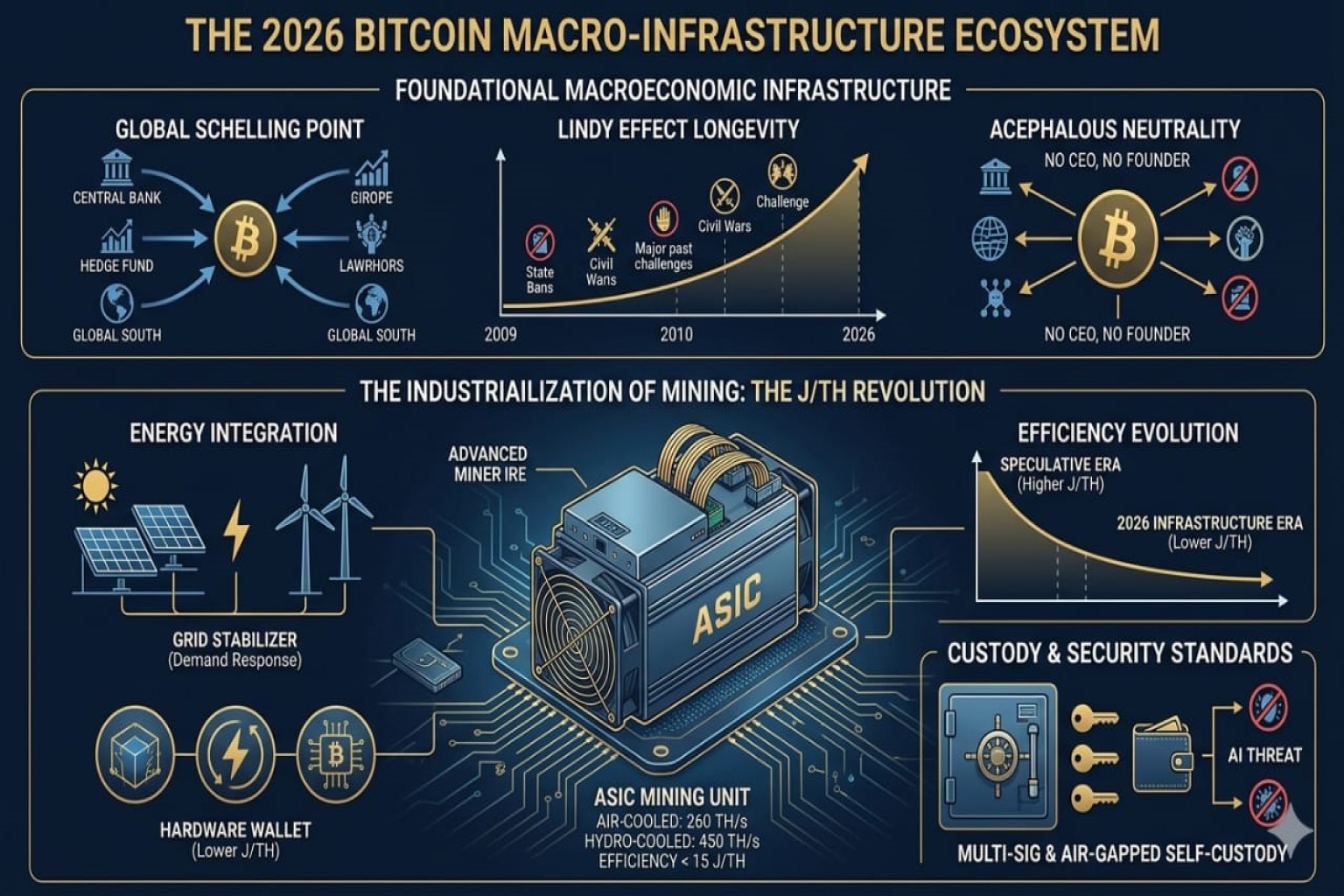
The J/TH Revolution: Why Joules per Terahash is the Only Metric That Matters in 2026 Bitcoin Mining
We have reached a plateau in raw hashing power; the battle is now fought in Joules per Terahash (J/TH).
-
Hardware Evolution: Current-gen miners, with air-cooled units hitting 260 TH/s and hydro-cooled systems exceeding 450 TH/s, are pushing efficiencies well below 15 J/TH.
-
The New Logic: Mining is no longer just about "minting coins." Modern miners act as a "first responder" for energy grids, consuming excess load from wind and solar farms that would otherwise go to waste. It is now an environmental and economic tool for grid stabilization.
A Professional’s Guide to Bitcoin Infrastructure in 2026: Hosting, Hardware, and Energy Management
For those looking to engage with Bitcoin’s physical infrastructure today, the entry requirements have changed:
-
For Institutions: Vertical integration is the goal. Owning the ASICs is insufficient; you must control the power source. The most successful plays are now "behind-the-meter" opportunities.
-
For Individuals: Direct hardware ownership requires a professional hosting partner. Attempting to run 3,000W+ machines in a residential setting is no longer viable due to heat, noise, and electrical constraints.
-
Security Standards: With the rise of AI-driven phishing, hardware wallets (like ColdCards or Trezors) paired with multi-signature setups are no longer optional for serious holders—they are the minimum viable security standard.
Reality Check: The Remaining Risks
Despite its resilience, Bitcoin faces ongoing challenges. Regulatory "on-ramps" (exchanges and banks) remain under heavy surveillance via KYC/AML frameworks. Furthermore, the geographical concentration of hashrate in energy-rich regions requires constant monitoring to ensure network health.
However, the "Gold vs. Aluminum" fallacy remains relevant: newer coins often market themselves as "Bitcoin 2.0" because they are faster. But replacing Bitcoin with a faster coin is like replacing gold with aluminum because aluminum is easier to shape. Speed is a feature; scarcity and immutability are the mission.
Bitcoin as Layer 0: Why the Most Secure Ledger is the Foundation of the 2026 Digital Economy
Bitcoin has transitioned from a cryptocurrency to a global monetary standard. In 2026, it functions as the "Layer 0" of the digital economy. While other blockchains will continue to innovate in DeFi and digital identity, they will likely settle their final value back into the most secure, neutral, and time-tested ledger in existence. Bitcoin hasn't been replaced because its primary function isn't to be a fast app—it is to be unbreakable money.
🔴 Professional Disclaimer:
As a practitioner in the ASIC mining sector, my perspectives are influenced by the operational realities and infrastructure dynamics of the mining industry. This analysis is provided strictly for educational and informational purposes and should not be considered financial, investment, or legal advice. Cryptocurrency markets remain highly volatile, and readers should conduct independent research and consult qualified professionals before making financial decisions.